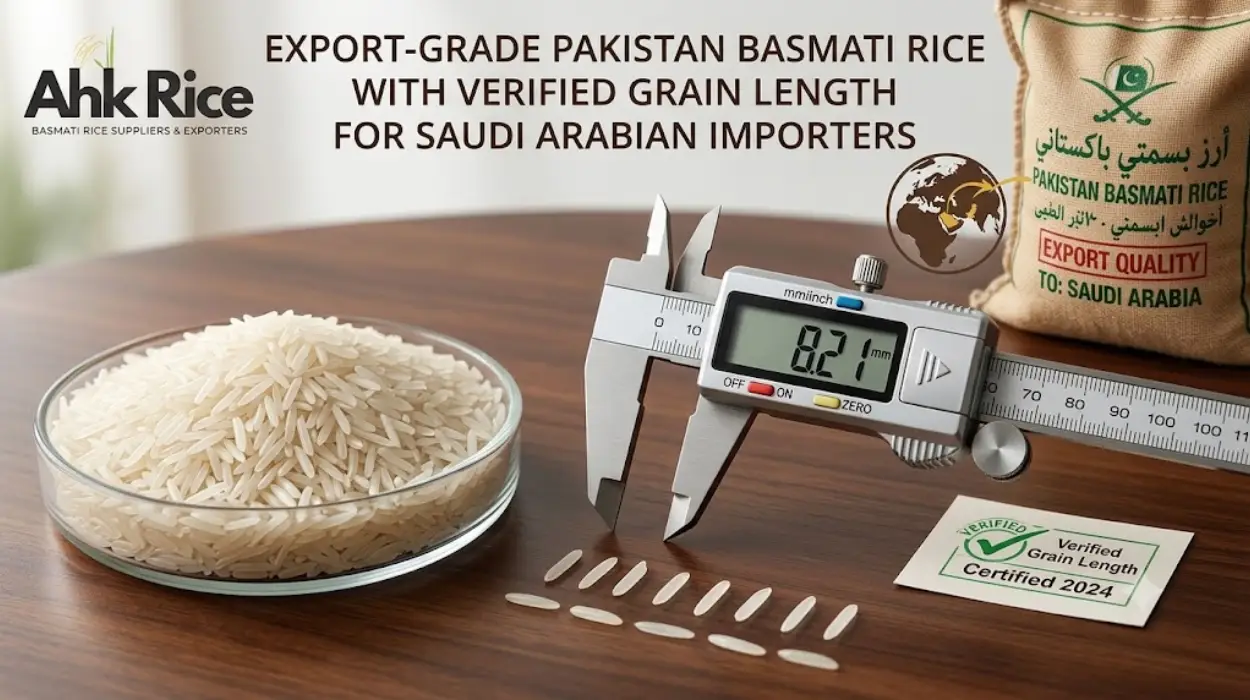
Export-Grade Pakistan Basmati Rice with Verified Grain Length for Saudi Arabian Importers
Saudi Arabian importers achieve the most consistent retail and foodservice results by sourcing export-grade Pakistan 1121 Basmati rice with verified grain length, third-party inspection, and documented quality compliance. Here is why: verified grain specifications reduce shipment disputes, improve consumer satisfaction, and ensure compliance with Saudi import requirements. Importers seeking reliable supply chains increasingly choose premium-grade exporters that provide documented grain measurements, laboratory reports, and shipment traceability.
Saudi Arabia remains one of the largest destinations for Pakistani Basmati rice exports due to strong consumer demand for long-grain aromatic rice in retail, hospitality, catering, and wholesale channels (source: REAP export data, December 2025). Buyers evaluating grain length requirements can first review our guide on grain quality expectations in Saudi markets through understanding Saudi buyer grain length requirements. For importers ready to source verified export-grade rice, AHK Rice provides specification-based procurement with documented quality verification and shipment support.
When Saudi buyers compare different export grades, our detailed explanation of Pakistan 1121 rice grade classifications helps identify the correct specification before placing an order.
What Is the Best Solution for Saudi Arabian Importers Seeking Verified Grain Length?
The best solution is sourcing Pakistan 1121 Basmati rice with verified grain length of 8.30 mm and above, third-party inspection reports, and documented export specifications.
Saudi Arabian importers often face inconsistencies between approved samples and delivered shipments. Grain length variation affects shelf presentation, cooking performance, and customer satisfaction. Export-grade verification minimizes these risks.
AHK Rice supplies export-grade Pakistan Basmati rice with documented grain length verification before loading. Every shipment undergoes inspection, grading, and specification matching before dispatch. This process helps Saudi importers receive rice that matches contractual requirements.
1121 Steam Basmati Rice
1121 Steam Basmati remains popular among premium retail distributors. The rice maintains natural color and aroma while delivering excellent cooking performance.
Specification Table
| Attribute | Specification |
|---|---|
| Average Grain Length | 8.30–8.50 mm |
| Moisture | 12–13% |
| Purity | 95–100% |
| Broken Grains | 1–5% |
| Crop Year | Current Crop |
| Shelf Life | 12–18 months |
| Origin | Pakistan |
AHK Rice verifies grain length through calibrated grading systems before shipment. Saudi retailers prefer this specification because consumers associate longer grains with premium quality.
1121 Golden Sella Basmati Rice
1121 Golden Sella Basmati serves wholesale, catering, and institutional buyers. The parboiling process improves grain strength and storage stability.
Specification Table
| Attribute | Specification |
|---|---|
| Average Grain Length | 8.35–8.50 mm |
| Moisture | 12–13% |
| Purity | 95–100% |
| Broken Grains | 1–5% |
| Shelf Life | 18–24 months |
| Color | Golden |
| Origin | Pakistan |
Golden Sella lasts longer than Steam rice. In Gulf warehouse environments, Golden Sella typically maintains quality for up to 24 months. Steam rice generally performs best within 18 months. For Saudi catering distributors storing larger inventories, Golden Sella provides greater storage flexibility.
1121 White Basmati Rice
1121 White Basmati targets premium supermarkets and branded retail packaging programs. The bright appearance attracts consumers seeking traditional Basmati quality.
AHK Rice mills, polishes, grades, and sorts White Basmati according to export specifications. Grain length verification remains part of the final inspection process before loading.
With the optimal sourcing solution established, the next question concerns expected business results after importing verified export-grade rice.
What Results Can Saudi Arabian Importers Expect?
Importers can expect lower claim rates, stronger retail positioning, consistent cooking performance, and improved customer retention when grain length remains verified throughout supply.
Verified grain length directly influences customer perception. Longer grains create a premium visual appearance before cooking and maintain attractive elongation after cooking.
AHK Rice helps importers reduce specification disputes through documented quality controls. Verified measurements create transparency between buyer expectations and shipment performance.
Quality Verification Process
AHK Rice follows nine processing and quality steps:
- Clean the paddy.
- De-husk the grain.
- Dry the rice.
- Parboil selected grades.
- Mill the kernels.
- Polish the rice.
- Grade by length.
- Sort through color sorters.
- Inspect and certify before loading.
Each stage contributes to export consistency. Saudi importers benefit from fewer quality complaints because specifications are verified before shipment.
Export Documentation Benefits
Saudi Arabian importers typically require:
- Commercial Invoice
- Packing List
- Certificate of Origin
- Phytosanitary Certificate
- Fumigation Certificate
- Quality Inspection Certificate
- Bill of Lading
AHK Rice prepares export documentation according to destination requirements. Complete documentation supports smoother customs clearance and reduces administrative delays.
Market Performance Outcomes
Premium grain length often supports stronger retail positioning. Consumers recognize extra-long Basmati as a premium product category.
Verified specifications also strengthen importer branding. Private-label distributors frequently use grain consistency as a selling point in Saudi supermarkets and wholesale markets.
According to Pakistan’s export performance data, demand for premium Basmati continues to grow across Gulf markets because consumers increasingly favor high-quality aromatic rice products (source: Pakistan Bureau of Statistics, FY2024-25).
With expected outcomes explained, importers should evaluate the factors affecting procurement costs and shipment pricing.

What Factors Affect the Cost of Export-Grade Pakistan Basmati Rice?
Pricing depends primarily on grain length, processing grade, broken percentage, packaging type, inspection requirements, and freight destination.
Saudi importers often compare offers based only on FOB pricing. Total landed cost provides a more accurate purchasing comparison.
AHK Rice helps buyers evaluate complete procurement costs rather than headline pricing alone. This approach improves budgeting accuracy and supplier comparison.
Grain Length Impact
Longer grains command higher export values. Rice measuring 8.30 mm and above generally receives premium pricing because grading yields are lower.
Extra-long kernels create stronger consumer appeal. Retail brands often prioritize premium grain length despite higher procurement costs.
Processing Grade Impact
Steam, White, and Golden Sella grades differ in production requirements.
Golden Sella typically commands a premium due to additional parboiling operations. The process improves grain strength and storage stability.
Steam rice often attracts buyers seeking natural appearance and aroma retention. White rice appeals to premium retail markets requiring bright kernel presentation.
Packaging Impact
Packaging influences shipping efficiency and retail readiness.
Common export packaging includes:
- 5 kg retail bags
- 10 kg retail bags
- 20 kg PP bags
- 25 kg PP bags
- 40 kg PP bags
- 50 kg PP bags
Retail-ready packaging increases processing costs. Bulk packaging reduces unit packaging expenses.
Freight Impact by Saudi Destination
Shipping schedules vary by destination port.
| Destination Port | Typical Transit Time |
|---|---|
| Jeddah | 15–22 days |
| Dammam | 12–18 days |
| Riyadh via Dammam | 16–24 days |
| Jazan | 18–26 days |
Transit times depend on vessel schedules, customs processing, and seasonal shipping conditions.
Inspection and Certification Costs
Third-party inspection increases confidence in shipment quality. Independent verification often proves valuable for first-time transactions.
AHK Rice supports inspection requirements before loading. Buyers receive documented reports matching agreed specifications.
With pricing factors understood, the next decision concerns evaluating samples before committing to a commercial shipment.
How Does the Sample Process Work Before a Commercial Order?
A structured sampling process allows importers to verify grain length, cooking quality, aroma, and appearance before approving a full container shipment.
Sampling reduces procurement risk. Buyers can inspect product characteristics before finalizing commercial agreements.
AHK Rice follows a transparent sample approval procedure designed for international buyers.
Sample Approval Process
- Request product specifications.
- Receive grain length data.
- Approve sample selection.
- Dispatch representative samples.
- Test cooking performance.
- Verify laboratory specifications.
- Confirm commercial order.
- Approve production.
- Load and ship cargo.
Each stage helps align expectations before container loading.
Typical Sample Costs
Sample expenses vary by destination and courier provider.
| Item | Typical Range |
|---|---|
| Product Sample | Usually free |
| Courier Charges | USD 40–120 |
| Laboratory Testing | USD 50–250 |
| Third-Party Inspection | Project dependent |
Courier costs depend on shipment weight and destination city within Saudi Arabia.
Why Sampling Matters
Sample approval confirms actual grain length performance. Visual inspection helps verify consistency.
Cooking evaluation confirms elongation, aroma, and texture. Saudi distributors often test samples through both laboratory analysis and commercial kitchen preparation.
AHK Rice provides representative samples matching production specifications. This approach minimizes variation between approved samples and delivered shipments.
With sampling complete, importers can confidently proceed toward commercial procurement.
How Can Saudi Arabian Importers Get Started with AHK Rice?
Importers can begin by sharing required grain length, target grade, packaging preference, destination port, and estimated volume requirements.
Supplier selection should focus on consistency rather than price alone. Verified specifications reduce long-term procurement risk.
AHK Rice supports Saudi importers through specification-based sourcing. The company verifies grain length, prepares export documentation, coordinates inspections, and manages shipment logistics.
What AHK Rice Provides
- Grain length verification
- Quality inspection
- Export documentation
- Flexible packaging
- Private label solutions
- Container loading support
- Shipping coordination
AHK Rice also offers seven processing grades:
- 1121 Steam Basmati
- 1121 Golden Sella Basmati
- 1121 White Basmati
- Super Kernel Basmati
- PK 386 Rice
- IRRI-6 Rice
- C9 Rice
Each grade serves different retail, wholesale, and foodservice applications.
Why Importers Choose AHK Rice
AHK Rice focuses on measurable specifications. AHK Rice verifies grain length before loading. AHK Rice supports third-party inspections. AHK Rice prepares export documentation. AHK Rice manages shipment coordination. AHK Rice supplies multiple Basmati grades. AHK Rice supports private-label programs. AHK Rice prioritizes consistency throughout the export process.
Export-grade Pakistan Basmati rice with verified grain length provides Saudi importers with stronger quality control, reduced procurement risk, and improved market positioning. Contact AHK Rice today through our quotation request page to receive a specification-based export proposal.
Frequently Asked Questions
What grain length should Saudi Arabian importers require for export-grade Pakistan Basmati rice?
Saudi Arabian importers typically prefer Pakistan 1121 Basmati rice with a grain length of 8.30 mm or longer before cooking. This specification is widely accepted in retail, wholesale, and foodservice sectors because it delivers premium appearance and excellent elongation after cooking.
How does AHK Rice verify grain length before export?
AHK Rice verifies grain length through grading, sorting, and quality inspection processes before shipment. Samples are measured and inspected to ensure they match the agreed specifications. Buyers can also request third-party inspection reports for additional verification.
Which Pakistan Basmati rice grade is most popular in Saudi Arabia?
1121 Golden Sella Basmati Rice is one of the most popular grades in Saudi Arabia due to its extra-long grain, strong cooking performance, and longer shelf life. 1121 Steam Basmati and 1121 White Basmati are also widely imported for premium retail and hospitality applications.
How long does it take to ship Pakistan Basmati rice to Saudi Arabia?
Shipping times vary by destination port and vessel schedule. Typical transit times are 12–18 days to Dammam, 15–22 days to Jeddah, and 18–26 days to Jazan. Customs clearance and seasonal shipping conditions may affect final delivery timelines.
What documents are required to import Pakistan Basmati rice into Saudi Arabia?
Saudi Arabian importers generally require a Commercial Invoice, Packing List, Certificate of Origin, Phytosanitary Certificate, Fumigation Certificate, Quality Inspection Certificate, and Bill of Lading. These documents help ensure smooth customs clearance and regulatory compliance.