Top Pakistani Rice Varieties Preferred by UAE Retail and Hospitality Buyers in 2026
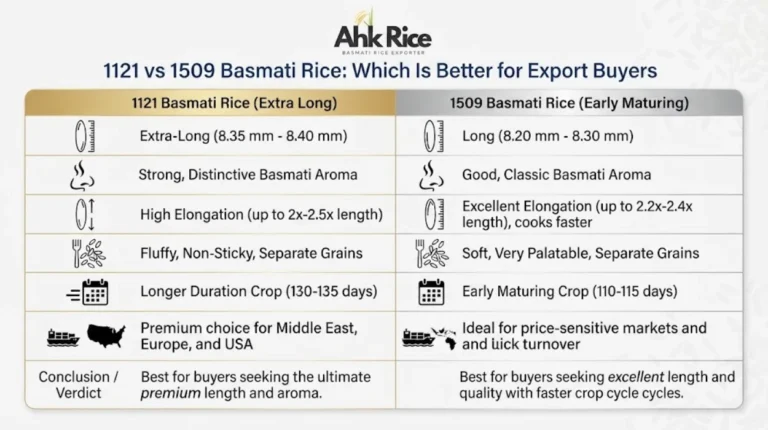
Pakistani 1121, Super Kernel, and 1509 Basmati rice serve different UAE retail and hospitality requirements. Here is why: 1121 targets premium long-grain positioning, Super Kernel offers traditional aroma, and 1509 supports cost-conscious bulk purchasing. AHK Rice supplies these varieties from Punjab, Pakistan, with export specifications, packaging options, and shipment coordination.
UAE importers need more than an attractive price per metric ton. They need consistent grain quality, suitable cooking performance, compliant documentation, reliable shipment schedules, and packaging matched to their customers. Buyers can first understand UAE rice import market growth and demand for Pakistani Basmati in 2026 before selecting a commercial specification.
What is the best solution for UAE rice importers in 2026?
Choose 1121 for premium retail, Super Kernel for aromatic traditional rice, and 1509 for value-focused distribution and bulk foodservice. The correct choice depends on your selling price, customer preferences, cooking requirements, and expected sales volume.
1121 Basmati: Premium retail and hospitality
1121 Basmati is known for its long grains and cooked-grain elongation. UAE supermarkets can position it in premium packaged-rice ranges, while hotels and restaurants can use it for biryani, pulao, and presentation-focused dishes.
Buyers can specify White, Steam, Golden Sella, Creamy Sella, or Brown processing options. Each option should be evaluated against colour, cooking behaviour, grain integrity, and the intended menu.
Super Kernel Basmati: Traditional aroma and everyday demand
Super Kernel Basmati suits retailers serving customers who value traditional Pakistani Basmati aroma and familiar cooking characteristics. Its positioning can support ethnic grocery stores, specialist distributors, and foodservice businesses.
Importers should confirm raw grain length, moisture, broken percentage, purity, and cooking performance before approving a shipment. AHK Rice can discuss commercial specifications around 7.0–7.5 mm raw grain length, subject to the selected grade and final approved specification.
1509 Basmati: Volume distribution and catering
1509 Basmati provides an option for buyers balancing long-grain presentation with purchasing costs. Retailers can consider it for mainstream packaged rice, while catering businesses can evaluate its suitability for large-volume biryani, pulao, and steamed-rice preparation.
Available processing choices can include White, Steam, and Golden Sella, subject to order specifications. Buyers should compare actual milling yield, broken percentage, cooking results, and landed cost instead of selecting solely by variety name.
For a closer grade-level evaluation, consult this comparison of popular Pakistani Basmati rice grades exported to the UAE in 2026. Once the preferred grade is established, the next step is matching the supplier’s controls to your purchasing requirements.
Why choose AHK Rice as your Pakistani rice supplier?
AHK Rice provides Pakistani 1121, Super Kernel, and 1509 Basmati with specification-led sourcing, processing, packaging, and export coordination. This approach helps UAE buyers evaluate product suitability before committing to a commercial shipment.
AHK Rice operates from Punjab, Pakistan, and supplies rice to international markets. Buyers can discuss sourcing, milling, grading, sorting, packaging, and shipment preparation through its Pakistani rice export service.
The purchasing process should establish measurable quality requirements before production begins. These requirements help the supplier and importer evaluate the same product against an agreed specification.
Key commercial controls include:
- Grain length: Define the required raw-grain measurement and tolerance.
- Broken percentage: Set the maximum permitted broken grains.
- Moisture content: Agree on the maximum acceptable moisture level.
- Grain appearance: Specify colour, milling finish, and acceptable defects.
- Packaging: Confirm bag material, printed design, net weight, and labelling.
- Inspection: Agree on sampling, inspection timing, and approval procedures.
- Documentation: Confirm certificates and records required for the destination.
UAE importers must also verify applicable food registration, labelling, customs, and inspection requirements with their importer and relevant authorities. The UAE government states that food products generally require registration through the national food-registration system before being handled in the market (source: UAE Government, National Food Accreditation and Registration System).
AHK Rice can coordinate the commercial preparation, but the importer remains responsible for confirming destination-specific requirements. These controls establish the foundation for measurable shipment results.
What results can UAE buyers expect from a specification-led order?
Buyers can expect clearer quality acceptance, more consistent purchasing decisions, and better cost comparisons when every order follows an approved specification. Actual results depend on the selected grade, processing, storage, preparation, and shipment conditions.
A supermarket importing 5 kg retail packs may prioritise clean appearance, consumer-friendly packaging, and consistent cooking performance. A hotel purchasing 25 kg or 40 kg bags may focus on kitchen yield, grain integrity, and cost per serving.
A distributor supplying several emirates may need more than one variety. For example, 1121 can serve a premium retail segment, while Super Kernel supports traditional-aroma demand and 1509 addresses selected volume-oriented accounts.
AHK Rice should provide an agreed specification and representative sample for evaluation before the buyer confirms the final purchase. The buyer should compare the approved sample against the production lot and retain the signed specification with the purchase documents.
No supplier can guarantee identical results across every kitchen or storage facility. However, defined specifications, appropriate storage, and documented inspection reduce avoidable differences between orders.
How much does Pakistani Basmati rice cost for UAE buyers?
The final price depends on variety, grade, processing, order volume, packaging, inspection, and delivery terms. Buyers should request comparable FOB and CIF quotations rather than comparing prices that include different services.
FOB pricing generally covers the seller’s responsibilities up to loading aboard the nominated vessel under the agreed contract. CIF pricing includes cost, insurance, and freight to the named destination port, subject to the applicable Incoterms and contract terms.
The main cost factors are:
| Cost factor | What buyers should confirm |
|---|---|
| Rice variety | 1121, Super Kernel, or 1509 |
| Processing grade | White, Steam, Golden Sella, or another agreed grade |
| Quality specification | Grain length, moisture, broken percentage, and purity |
| Order quantity | Trial shipment, partial load, or full container |
| Packaging | Bulk bags, retail packs, or private-label packaging |
| Freight and insurance | Route, carrier, shipment date, and Incoterm |
| Inspection and documentation | Required testing, certificates, and destination charges |
A low FOB price does not automatically produce the lowest landed cost. Freight, insurance, port charges, customs clearance, local transport, and applicable duties or taxes can change the final cost per ton.
AHK Rice should quote against the buyer’s destination, quantity, packaging, and agreed grade. Prices should be confirmed at the time of purchase because freight rates, availability, and market conditions change.
How long does shipping from Pakistan to the UAE take?
Sea transit from Karachi to Jebel Ali commonly takes approximately 3–5 days on suitable direct sailings, while the complete export-to-delivery process takes longer. Buyers should distinguish vessel transit from processing, port handling, customs clearance, and inland delivery.
Observed Karachi-to-Jebel Ali container movements had a median transit time of 3.3 days, with the middle half taking approximately 2.6–4.6 days, according to route data updated in June 2026 (source: Ports and Routes, Karachi–Jebel Ali transit data).
Use the following planning ranges as estimates, not guaranteed delivery commitments:
| UAE destination | Estimated planning allowance |
|---|---|
| Dubai and Jebel Ali | Around 3–5 days at sea, plus handling and clearance |
| Sharjah | Around 3–5 days at sea to Jebel Ali, plus onward transport |
| Abu Dhabi | Around 3–5 days at sea to Jebel Ali, plus onward transport |
| Ajman and northern emirates | Around 3–5 days at sea to Jebel Ali, plus onward transport |
These estimates assume a suitable sailing and do not represent guaranteed port-to-door transit. Vessel schedules, transshipment, congestion, documentation delays, inspections, and customs release can extend delivery.
Importers should confirm the booking, vessel departure, estimated arrival, required certificates, and destination delivery arrangements before committing to retail launch dates. AHK Rice can coordinate shipment planning against the agreed order and available carrier schedule.
What does the rice sample process cost?
A representative sample lets UAE buyers evaluate aroma, grain appearance, cooking performance, and suitability before placing a bulk order. Sample costs depend on the selected variety, quantity, courier route, packaging, and any required inspection or phytosanitary procedures.
AHK Rice can discuss sample availability for Super Kernel Basmati, including a sample offer of up to 20 kg, subject to confirmation. Under the stated offer, the buyer covers courier shipping and applicable phytosanitary charges.
How to request and approve a sample
- Select the variety: Choose 1121, Super Kernel, or 1509.
- Define the grade: Specify White, Steam, Golden Sella, or another available option.
- Confirm the sample quantity: Agree on the amount required for laboratory or kitchen evaluation.
- Confirm the charges: Obtain the courier quotation and confirm any applicable certification or phytosanitary costs.
- Provide delivery details: Share the UAE destination, recipient information, and required documentation details.
- Evaluate the sample: Check appearance, aroma, grain integrity, cooking performance, and suitability for the intended market.
- Approve the specification: Record the accepted grade, quality limits, packaging, and purchase quantity.
- Confirm the order: Approve the commercial quotation and shipment plan.
The sample should represent the intended commercial specification as closely as possible. Buyers should not assume that a sample is free of every charge or that sample approval replaces inspection of the production shipment.
Exact courier charges cannot be stated reliably without the destination, sample weight, and service level. Request a written breakdown before dispatch to avoid unexpected costs.
How can UAE buyers start a bulk rice order?
Start with the target market, required variety, measurable quality specification, packaging, quantity, and delivery terms. This information allows AHK Rice to prepare a more useful quotation and clarify the sample, inspection, and shipment process.
Prepare the following details before requesting an offer:
- Destination: Emirate, delivery location, and preferred port.
- Product: 1121, Super Kernel, or 1509 Basmati.
- Grade: White, Steam, Golden Sella, or another agreed specification.
- Quality limits: Grain length, broken percentage, moisture, and purity.
- Quantity: Trial order or planned recurring volume.
- Packaging: Bag weight, material, labelling, and private-label requirements.
- Delivery terms: FOB Karachi or CIF to the agreed destination port.
- Documentation: Importer requirements for certificates, labelling, and clearance.
AHK Rice can then confirm product availability, sample arrangements, specification approval, packing details, and a shipment schedule based on the order. Buyers should approve the final specification and commercial terms before production and dispatch.
The purchasing decision should reflect the customer segment rather than variety popularity alone. Premium retailers may favour 1121, traditional grocery channels may prioritise Super Kernel, and volume-oriented buyers may evaluate 1509 against their cooking and landed-cost requirements.
To receive a specification-based offer for your UAE market, request a rice export quotation from AHK Rice.
FAQs About Pakistani Rice Varieties for UAE Buyers
Which Pakistani rice variety is best for UAE supermarkets?
1121 suits premium retail positioning because of its long grain and presentation. Super Kernel suits traditional-aroma demand, while 1509 offers another option for mainstream distribution. The final choice depends on customer preferences, selling price, and product specification.
Which Pakistani Basmati is suitable for UAE hotels and restaurants?
1121, Super Kernel, and 1509 can all suit hospitality operations. Buyers should test the intended grade against biryani, pulao, or steamed-rice requirements. Kitchen yield, holding performance, grain integrity, and cost per serving should guide the decision.
How many days does Pakistani rice take to reach Dubai?
Karachi-to-Jebel Ali sea transit commonly takes approximately 3–5 days on suitable direct sailings. Export preparation, port handling, customs clearance, and delivery add time. Buyers should confirm the current vessel schedule and total delivery estimate before booking.
Can UAE importers request free rice samples from AHK Rice?
AHK Rice can discuss a Super Kernel Basmati sample of up to 20 kg, subject to confirmation. The stated offer requires the buyer to cover courier shipping and applicable phytosanitary charges. Confirm sample availability, quantity, and total costs before dispatch.
What documents should UAE rice importers confirm before shipment?
Importers should verify the commercial invoice, packing list, certificate of origin, and applicable food-safety or phytosanitary documents. Requirements depend on the product and current destination rules. Confirm food registration, label approval, inspection requirements, and customs documentation with the relevant UAE authorities before dispatch.