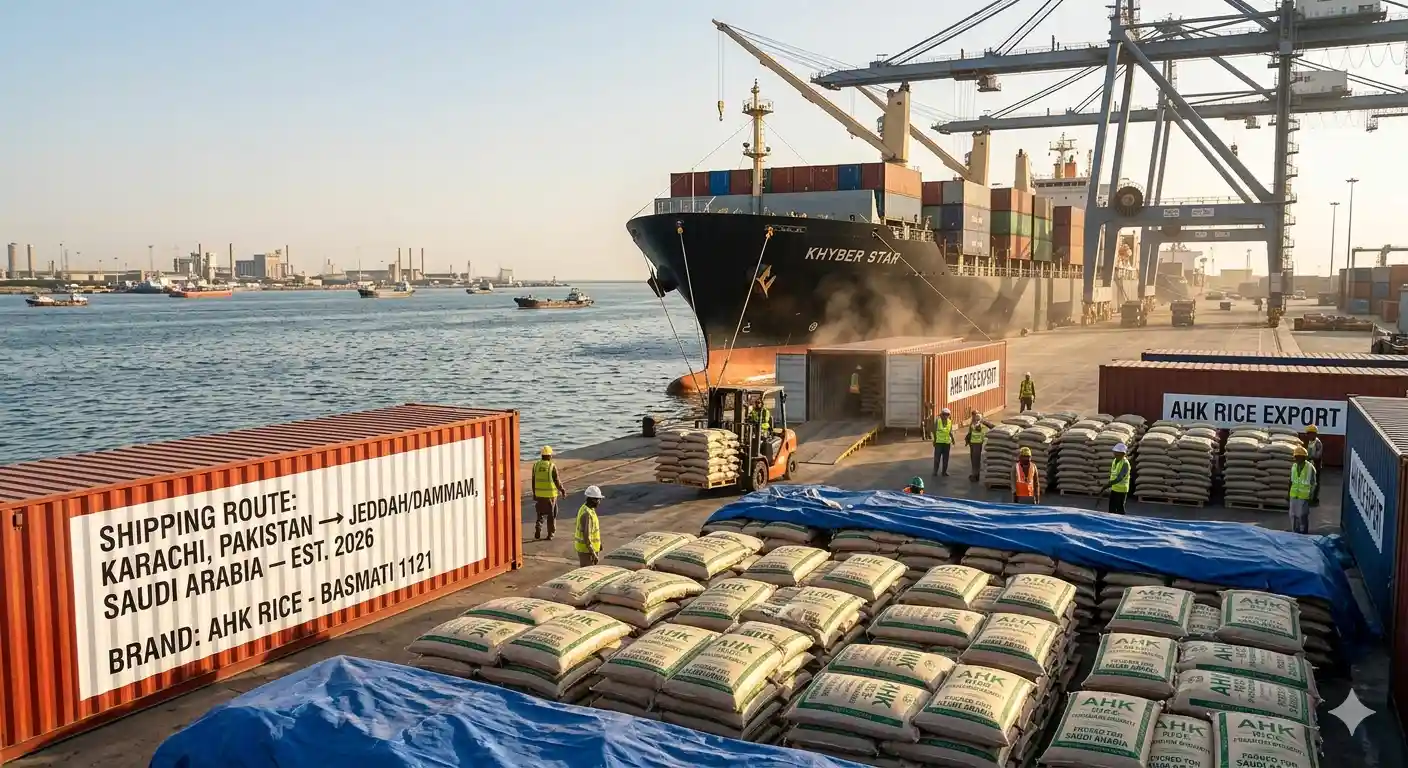
Pakistan to Saudi Arabia Rice Shipping via Jeddah and Dammam Port 2026
Rice shipping from Pakistan to Saudi Arabia in 2026 refers to the structured export process where milled and packaged Basmati rice is transported via sea freight from Karachi ports to Jeddah and Dammam ports within defined transit timelines ranging from 10 to 25 days depending on routing and handling stages.
Rice shipping is a multi-stage logistics operation. It begins at processing units in Punjab and ends at distribution hubs in Saudi Arabia. The product involved is Basmati rice, including 1121, Super Kernel, and 1509 varieties. These varieties differ in grain length, aroma intensity, and cooking behavior.
The export route starts from Karachi, Pakistan’s primary maritime hub. Shipments move through container vessels across the Arabian Sea. The destination ports are Jeddah Islamic Port on the Red Sea and King Abdulaziz Port in Dammam on the Arabian Gulf.
Shipping duration is defined by several measurable steps. These include inland transport, port clearance, vessel transit, unloading, and customs release. Each stage contributes specific time intervals, creating a predictable delivery timeline.
For example, a container of 1121 Basmati rice processed in Punjab requires 2 days for inland transport to Karachi, 3 days for port handling, 12 days for sea transit to Jeddah, and 4 days for clearance and delivery.
How does rice shipping from Pakistan to Saudi Arabia work step by step?
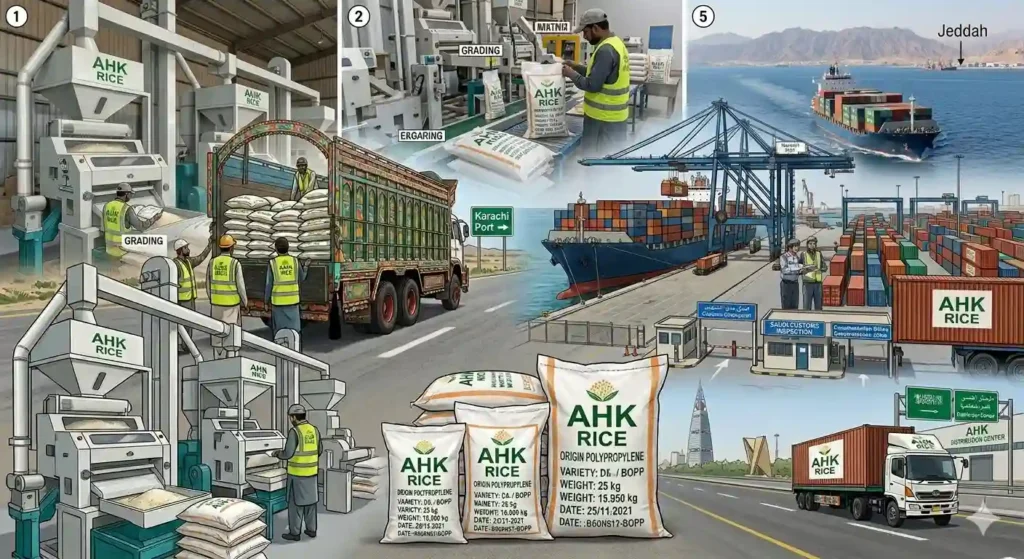
Rice shipping follows a linear sequence that includes processing, packing, inland transportation, port documentation, container loading, sea transit, destination clearance, and final delivery, with each stage assigned a defined operational duration and compliance requirement.
Processing and Milling
Rice processing begins with paddy cleaning and husk removal. The rice is then polished and graded. Sorting machines classify grains by length and thickness. Broken percentage is measured numerically, such as 2%, 5%, or 10%.
Packaging and Labeling
Rice is packed in standardized bags. Common sizes include 5 kg, 10 kg, 25 kg, and 50 kg. Packaging materials include woven polypropylene and BOPP laminated bags. Labels include origin, variety, net weight, and production date.
Inland Transport to Karachi
Finished goods are transported from Punjab to Karachi via trucks. The distance ranges from 1,000 to 1,200 kilometers. Transit time is 24 to 48 hours depending on road conditions and load size.
Port Handling and Documentation
At Karachi port, containers are booked and documentation is completed. Required documents include commercial invoice, packing list, certificate of origin, phytosanitary certificate, and bill of lading.
Customs clearance at origin takes 1 to 3 days. Containers are then loaded onto vessels.
Sea Freight Transit
Sea freight is the longest phase. Transit duration depends on route:
- Karachi to Jeddah: 10 to 14 days
- Karachi to Dammam: 18 to 25 days
The difference exists because Jeddah is directly accessible via the Red Sea, while Dammam requires passage through the Arabian Gulf.
Destination Clearance and Delivery
At Saudi ports, containers undergo customs inspection. Clearance takes 2 to 5 days. After release, goods are transported to warehouses or distributors.
For example, a shipment arriving in Jeddah can reach Riyadh within 2 additional days via road freight.
What are the key components that define shipping duration?
Shipping duration is determined by five measurable components: inland logistics time, port processing time, vessel transit duration, customs clearance period, and last-mile delivery time, each contributing a fixed number of operational days to the total timeline.
Inland Logistics Time
This includes transportation from rice mills to Karachi port. Average duration is 1 to 2 days. Delays occur due to truck availability or road congestion.
Port Processing Time
Port handling includes container stuffing, inspection, and documentation. Standard duration is 2 to 4 days. High export volumes increase waiting time.
Vessel Transit Duration
Transit time varies by route and shipping line. Direct routes reduce time. Indirect routes with transshipment increase duration by 5 to 7 days.
Customs Clearance Period
Both origin and destination customs contribute to total duration. Combined clearance time ranges from 3 to 8 days.
Last-Mile Delivery Time
Delivery from port to warehouse depends on distance. For example:
- Jeddah to Mecca: 1 day
- Dammam to Riyadh: 2 to 3 days
Each component is measurable and affects scheduling accuracy.
What are the benefits of shipping rice via Jeddah and Dammam ports?
Shipping rice through Jeddah and Dammam ports provides optimized regional access, reduced inland transport costs, structured distribution networks, and predictable delivery timelines based on port specialization and geographic positioning within Saudi Arabia.
Jeddah port serves western Saudi Arabia. It provides direct access to cities like Mecca and Medina. This reduces inland transport time for western markets.
Dammam port serves eastern and central regions. It connects directly to Riyadh and industrial zones. This improves efficiency for bulk distribution.
Using both ports creates a dual-entry strategy. Importers can split shipments. This reduces risk and ensures continuous supply.
For example, a distributor importing 200 tons of rice can send 100 tons to Jeddah and 100 tons to Dammam. This allows simultaneous distribution across regions.
Port infrastructure also influences efficiency. Jeddah handles higher container volumes. Dammam provides faster clearance for bulk shipments.
Where is Basmati rice grown and how does origin affect shipping?
Basmati rice exported to Saudi Arabia is grown in Punjab’s fertile plains, where climatic conditions and irrigation systems produce long-grain aromatic rice, and the inland distance from these farms to Karachi directly influences initial shipping timelines.
Punjab is the primary rice-producing region. Districts such as Gujranwala, Sialkot, and Sheikhupura are known for Basmati cultivation.
The crop cycle includes planting in June and harvesting in October. After harvesting, rice undergoes drying and aging. Aging improves aroma and elongation ratio.
Distance from farms to Karachi affects logistics. Longer distances increase inland transport time. Efficient supply chains reduce this delay.
For example, rice from central Punjab reaches Karachi faster than rice from northern regions due to better road connectivity.
What are the available rice grades and how do they impact shipping?
Rice grades such as 1121 Basmati, Super Kernel, and 1509 determine packaging density, container loading capacity, and handling requirements, which directly influence shipping efficiency and total transit time.
1121 Basmati
This grade has extra-long grains. Average length exceeds 8.3 mm. It has high export demand and is packed carefully to prevent breakage.
Super Kernel Basmati
This variety has strong aroma and medium-long grains. It is widely used in traditional dishes. Packaging density allows optimal container utilization.
1509 Basmati
This is an early-harvest variety. It has shorter aging time. It is shipped faster due to quicker processing cycles.
Each grade affects container loading. For example, a 20-foot container holds approximately 24 tons of rice. Packaging style and grain type influence how efficiently space is used.
Which markets in Saudi Arabia import Pakistani rice and why?
Major Saudi markets including Jeddah, Riyadh, Dammam, and Medina import Pakistani rice due to consistent grain quality, competitive pricing, and established trade routes that ensure reliable delivery within defined shipping durations.
Jeddah imports rice for western distribution. It serves religious tourism demand in Mecca and Medina.
Riyadh is the largest consumption hub. It receives shipments primarily from Dammam due to proximity.
Dammam serves industrial and residential markets in the eastern region.
Pakistani rice is preferred for its aroma and elongation after cooking. These characteristics meet consumer expectations in Saudi cuisine.
For example, 1121 Basmati is commonly used in Kabsa, a traditional Saudi dish.
What certifications apply to rice shipping from Pakistan to Saudi Arabia?
Rice exports require certifications including phytosanitary certificates, certificates of origin, quality inspection reports, and compliance with Saudi Food and Drug Authority standards, each ensuring product safety, traceability, and regulatory approval.
Phytosanitary certificates confirm that rice is free from pests and diseases. These are issued by plant protection authorities.
Certificates of origin verify that the rice is produced in Pakistan. These are required for customs clearance.
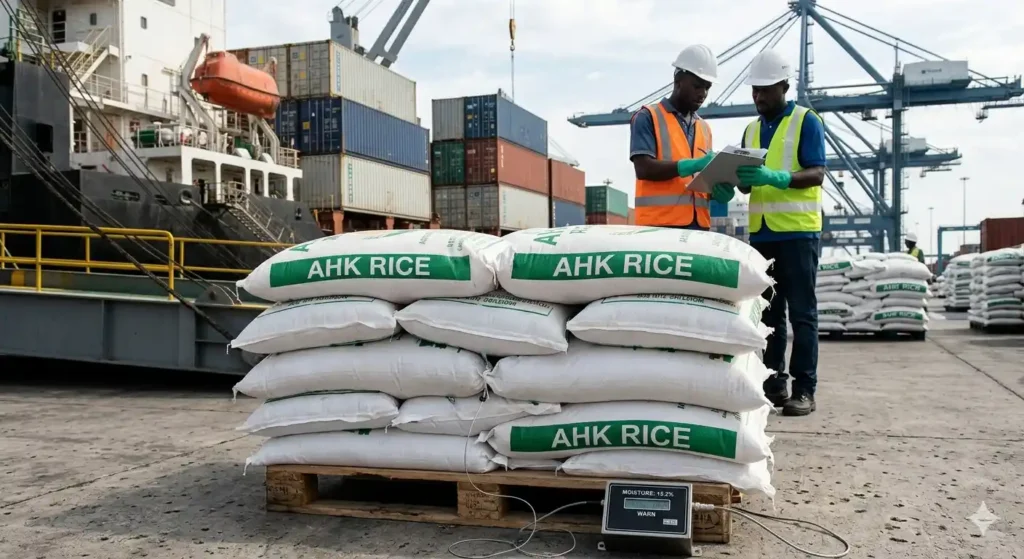
Quality inspection reports provide details on grain length, moisture content, and broken percentage.
Saudi regulations require labeling compliance. Labels must include production date, expiry date, and batch number.
For example, moisture content must remain below 14% to ensure shelf stability during transit.
What are the common problems and misconceptions in rice shipping?
Common issues include inaccurate transit expectations, misunderstanding of port delays, improper documentation, and the belief that all routes have identical shipping times, while in reality each factor introduces measurable variation in total delivery duration.
One misconception is that shipping time is fixed. In reality, delays occur due to port congestion or weather conditions.
Another issue is incomplete documentation. Missing certificates delay customs clearance.
Improper packaging leads to damage during transit. This affects product quality upon arrival.
Some exporters assume Jeddah and Dammam have identical timelines. In practice, Jeddah shipments are faster due to direct Red Sea access.
For example, choosing an indirect route with transshipment increases shipping time by up to 7 days.
What are the practical use cases of rice shipping timelines?
Shipping timelines are used for inventory planning, contract scheduling, retail distribution, and price forecasting, enabling importers and distributors to align supply chain operations with predictable delivery windows.
Importers use timelines to maintain stock levels. A 15-day shipping duration requires advance ordering.
Retailers plan promotions based on arrival schedules. Timely delivery ensures product availability.
Distributors allocate warehouse space based on incoming shipments.
For example, a distributor expecting 500 tons of rice schedules warehouse capacity 3 days before vessel arrival.
Accurate timelines reduce storage costs and prevent stock shortages.