Saudi Arabia Basmati Rice Market: Pakistan’s Top Export Destination Explained
Saudi Arabia imports over 1.3 million metric tons of rice annually, and Pakistan supplies a dominant share of premium basmati due to consistent grain length, aroma stability, and price competitiveness (source: REAP export data, December 2025). Here is why: Saudi consumers demand long-grain aromatic rice for traditional dishes, and Pakistan cultivates and processes basmati varieties that match these exact consumption patterns.
What is the Saudi Arabia basmati rice market and why is Pakistan the top destination supplier?
The Saudi Arabia basmati rice market is a structured import-driven supply chain where Pakistan provides over 40% of premium basmati rice due to grain length of 7.5–8.5 mm, stable aroma, and scalable milling capacity (source: Pakistan Bureau of Statistics, FY2024-25).
Saudi Arabia basmati rice market refers to a demand system where local production remains negligible and imports fulfill national consumption. Saudi Arabia consumes rice as a staple in dishes such as Kabsa, Mandi, and Biryani. These dishes require long-grain rice with elongation after cooking.
Pakistan rice Saudi market dominates because Pakistan cultivates basmati in Punjab’s irrigated plains. Punjab provides controlled irrigation through canal systems. This irrigation ensures uniform grain development. Uniform grain length directly impacts cooking quality.
Pakistan exports three primary basmati categories to Saudi Arabia:
Each category fulfills a different price and use segment. 1121 serves premium retail. Super Kernel serves mid-range consumers. 1509 serves budget-conscious buyers.
Saudi basmati demand remains consistent because population growth exceeds 2% annually (source: Saudi General Authority for Statistics, 2025). Increased urbanization raises demand for packaged rice. Packaged rice requires consistent milling and grading standards.
With the market defined, the next question explains how this import system functions operationally.
How does the KSA rice import system work from Pakistan to Saudi Arabia?
The KSA rice import system works through a 9-step export process including harvesting, milling, grading, certification, container loading, and sea shipment, ensuring quality compliance and timely delivery within 25–35 days.
Export process from Pakistan to Saudi Arabia
- Harvest the paddy during October–November
- Dry the paddy to 12–14% moisture
- Clean impurities using pre-cleaners
- De-husk the paddy into brown rice
- Polish the grain to remove bran layers
- Grade by length using length graders
- Sort by color using optical sorters
- Pack into 5 kg, 10 kg, 20 kg, or 40 kg bags
- Load containers and ship via Karachi Port
Each step ensures quality consistency. Moisture control prevents fungal growth. Length grading ensures uniform cooking. Color sorting removes defective grains.
Shipping routes operate from Karachi to Jeddah Islamic Port and Dammam Port. Transit time averages 25 days. Bulk buyers procure rice in 20-foot or 40-foot containers.
Required export documents
- Commercial invoice
- Packing list
- Phytosanitary certificate
- Certificate of origin
- Fumigation certificate
- Bill of lading
Inspection authorities verify each shipment before dispatch. Certification ensures compliance with Saudi Food and Drug Authority standards.
This process explains movement efficiency, which leads to understanding the structural components behind the market.
What are the key components of the Saudi basmati demand ecosystem?
The Saudi basmati demand ecosystem includes importers, distributors, retailers, catering buyers, and regulatory authorities, each controlling quality, pricing, and distribution channels across urban and rural markets.
Saudi basmati demand operates through multiple structured layers. Each layer defines a specific function in the supply chain.
Core components of the market
- Importers handle procurement and customs clearance
- Distributors manage regional supply networks
- Retailers sell packaged rice to households
- Catering buyers procure bulk rice for restaurants and hotels
- Regulatory bodies inspect and certify imported goods
Importers negotiate contracts with Pakistani exporters. Contracts define grade, moisture level, broken percentage, and packaging type.
Distributors break bulk shipments into regional deliveries. Retailers sell branded rice in supermarkets such as Panda and Carrefour Saudi Arabia. Catering buyers focus on bulk packaging in 20 kg and 40 kg bags.
Saudi basmati demand splits into two segments:
- Retail segment: 5 kg to 10 kg packaging
- Catering segment: 20 kg to 40 kg packaging
Each segment requires different grain specifications. Retail buyers prefer polished white rice. Catering buyers prefer parboiled rice due to durability.
This ecosystem shows how demand is structured, leading to the benefits driving Pakistan’s dominance.
What benefits make Pakistan rice Saudi market dominant?
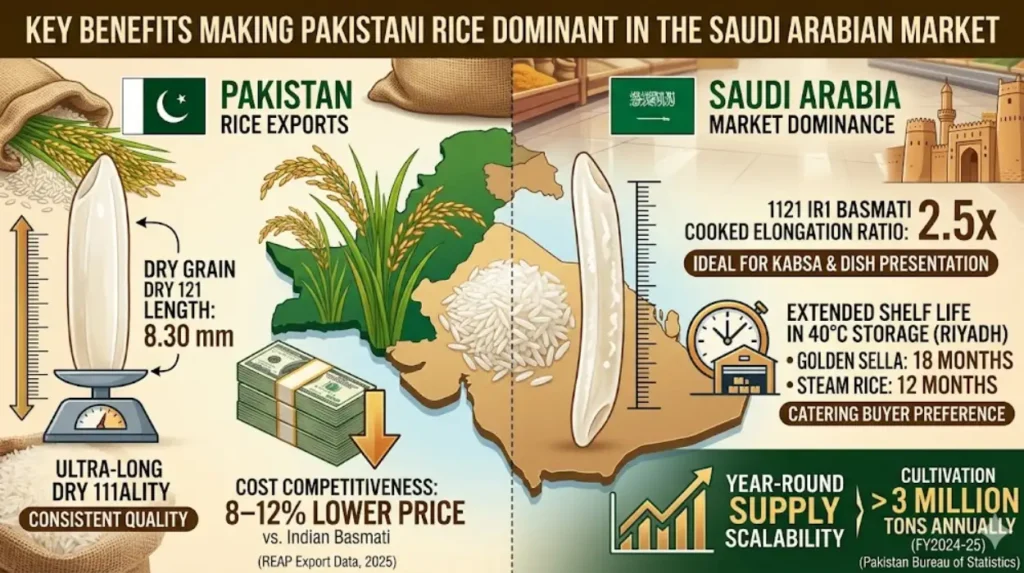
Pakistan rice Saudi market dominates due to longer grain length of 8.30 mm, higher elongation ratio of 2.5x after cooking, and lower cost per metric ton compared to Indian basmati by 8–12% (source: REAP export data, 2025).
Pakistan basmati provides measurable advantages. These advantages align directly with Saudi consumption patterns.
Key benefits of Pakistani basmati
- Grain length consistency
- Aroma retention after storage
- Cooking elongation ratio
- Price competitiveness
- Supply scalability
1121 Basmati elongates up to 2.5 times after cooking. This elongation improves dish presentation. Kabsa requires long, separate grains. Pakistani basmati delivers this result consistently.
Golden Sella processing increases shelf life. In 40°C storage conditions in Riyadh, Golden Sella maintains quality for 18 months. Steam rice maintains quality for 12 months. Catering buyers prefer Golden Sella due to longer storage cycles.
Cost efficiency improves procurement decisions. Pakistan offers lower milling and labor costs. These savings reduce export pricing.
Pakistan also maintains year-round supply through large-scale cultivation exceeding 3 million tons annually (source: Pakistan Bureau of Statistics, FY2024-25).
With benefits clarified, the next section explains where and how this rice is used in Saudi Arabia.
What are the main use cases of basmati rice in Saudi Arabia?
Basmati rice in Saudi Arabia is used in household cooking, restaurant catering, religious events, and bulk food services, with 60% consumed in traditional dishes like Kabsa and Mandi (source: Saudi Food Consumption Report, 2025).
Saudi basmati demand directly connects to cultural and culinary practices. Each use case requires specific rice characteristics.
Primary use cases
- Household cooking uses premium white basmati
- Restaurant catering uses Golden Sella basmati
- Religious gatherings use bulk parboiled rice
- Institutional catering uses cost-effective 1509 basmati
Household cooking focuses on aroma and taste. Retail buyers prefer extra-long grain rice. Restaurants prioritize consistency and durability. Golden Sella rice resists breakage during large-scale cooking.
Religious events such as Hajj and Ramadan increase rice consumption. Bulk procurement rises by 25% during these periods (source: Saudi Ministry of Commerce, 2025).
Institutional catering includes labor camps and large kitchens. These buyers prefer 1509 basmati due to cost efficiency.
This segmentation highlights the importance of selecting the right grade, which connects to the next detailed section.
What are the available basmati rice grades exported to Saudi Arabia?
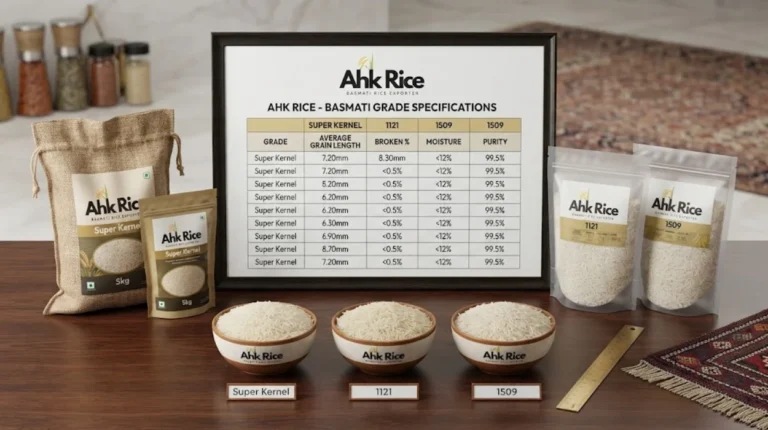
Pakistan exports 3 major basmati grades to Saudi Arabia: 1121 Basmati with 8.30 mm grain length, Super Kernel with 7.80 mm, and 1509 with 7.40 mm, each serving different price and quality segments.
1121 Basmati Rice
1121 Basmati defines the premium segment. Grain length ranges between 8.05 mm and 8.30 mm. This grade delivers maximum elongation after cooking.
Specifications
- Grain length: 8.05–8.30 mm
- Broken: 2–5%
- Moisture: 12–14%
1121 serves retail supermarkets and premium restaurants. Its aroma remains stable after 12 months of storage.
Super Kernel Basmati Rice
Super Kernel Basmati serves the mid-range market. Grain length remains slightly shorter than 1121.
Specifications
- Grain length: 7.60–7.90 mm
- Broken: 5–10%
- Moisture: 12–14%
Super Kernel suits daily consumption households. It balances cost and quality.
1509 Basmati Rice
1509 Basmati serves budget markets. It matures faster during cultivation.
Specifications
- Grain length: 7.20–7.50 mm
- Broken: 10–15%
- Moisture: 12–14%
1509 suits institutional catering. It offers cost efficiency at scale.
These grades show structured segmentation. This segmentation leads to understanding regulatory and certification requirements.
What certifications apply to rice exported to Saudi Arabia?
Rice exported to Saudi Arabia requires phytosanitary certification, ISO quality standards, and fumigation compliance to meet Saudi Food and Drug Authority import regulations.
Certifications ensure food safety and compliance. Each certification addresses a specific risk factor.
Required certifications
- Phytosanitary certification confirms pest-free status
- ISO 22000 ensures food safety management
- HACCP certification verifies hazard control
- Fumigation certificate eliminates insects
- Certificate of origin verifies country of production
Inspection authorities test rice for pesticide residue. Maximum residue limits must remain within Saudi standards.
Quality testing includes:
- Moisture analysis
- Broken percentage verification
- Grain length measurement
Certification ensures consistency across shipments. This consistency reduces rejection risk at Saudi ports.
With compliance clarified, the next section addresses common problems and misconceptions in the market.
What are common problems and misconceptions in the Saudi basmati market?
The most common problems include mixing of rice grades, misunderstanding of parboiled vs steam rice, and incorrect storage practices that reduce shelf life and cooking quality.
Buyers often confuse rice types. This confusion leads to incorrect purchasing decisions.
Common problems
- Mixing different basmati grades in one shipment
- Mislabeling steam rice as Golden Sella
- Storing rice in high humidity environments
- Ignoring broken percentage specifications
Mixed grades reduce cooking consistency. Grain size variation leads to uneven cooking results.
Steam vs Golden Sella confusion affects durability. Steam rice cooks faster but spoils sooner. Golden Sella lasts longer in high temperatures.
Storage issues impact quality. Rice stored above 14% moisture develops fungal contamination. Proper storage requires dry and ventilated warehouses.
Understanding these problems improves procurement accuracy. This understanding naturally leads to deeper evaluation of grade selection.
To explore grade selection for retail and catering in more detail, refer to a dedicated breakdown of Pakistani basmati suitability for Saudi buyers
This completes the full overview of the Saudi Arabia basmati rice market and prepares the reader to evaluate specific product-grade decisions.
Frequently Asked Questions
What makes Saudi Arabia a top destination for Pakistani basmati rice?
Saudi Arabia imports over 1.3 million metric tons of rice annually, and Pakistan supplies a large share due to consistent grain quality, competitive pricing, and strong logistics routes. Saudi consumers prefer long-grain aromatic rice for traditional dishes, which aligns with Pakistan’s basmati varieties.
Which basmati rice grade is most popular in Saudi Arabia?
1121 Basmati rice is the most popular grade in Saudi Arabia because it offers extra-long grain length of 8.30 mm and high elongation after cooking. It is widely used in premium retail and restaurants serving Kabsa and Mandi.
How long does basmati rice from Pakistan last in Saudi climate?
Golden Sella basmati rice lasts up to 18 months in Saudi Arabia’s high temperatures around 40°C when stored properly. Steam rice lasts around 12 months under the same conditions due to lower durability.
What is the difference between Golden Sella and Steam basmati rice?
Golden Sella basmati rice undergoes parboiling, which increases durability and shelf life. Steam rice is processed without parboiling, which results in softer texture but shorter storage life and faster cooking time.
What certifications are required for exporting rice to Saudi Arabia?
Rice exported to Saudi Arabia must include phytosanitary certification, fumigation certificate, certificate of origin, and ISO or HACCP compliance. These documents ensure food safety and compliance with Saudi import regulations.