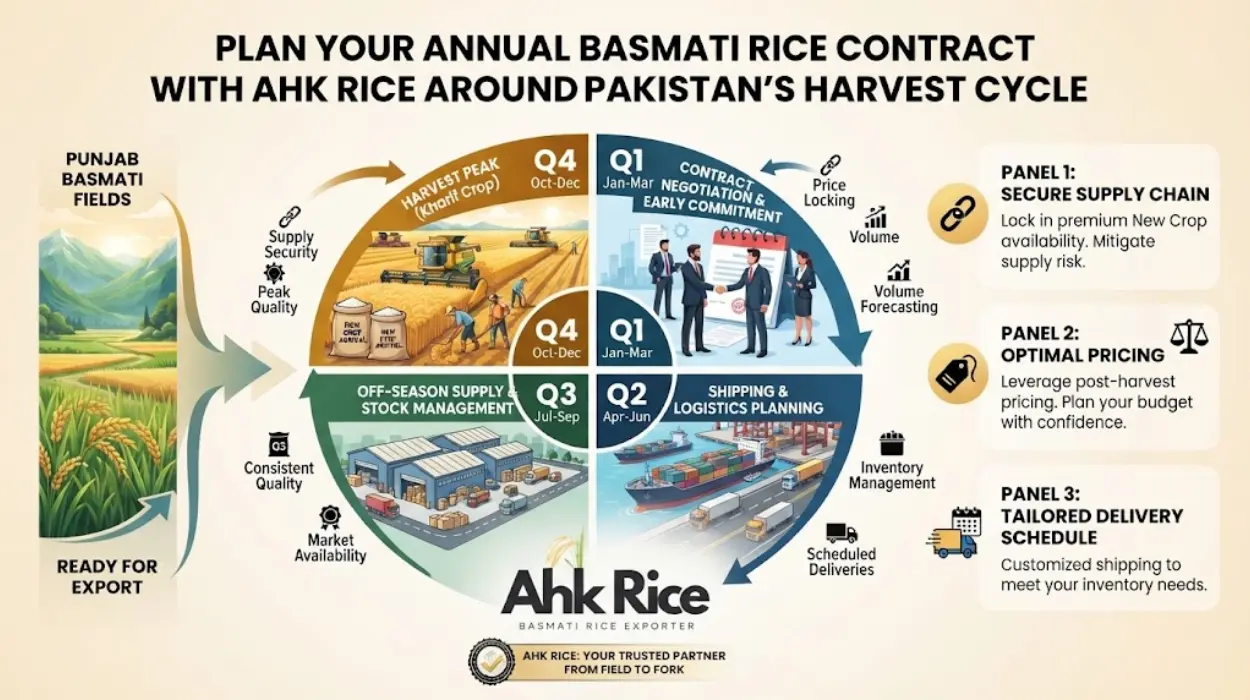
Plan Your Annual Basmati Rice Contract with AHK Rice Around Pakistan’s Harvest Cycle
Plan annual Basmati procurement around Pakistan’s October–December harvest, then secure specifications, samples, pricing, and shipment schedules before lean-season pressure increases. Here is why: Pakistan’s rice crop is planted during the Kharif season and harvested mainly from October to December. Basmati harvesting in northeastern Punjab generally starts in early November and finishes by early December.
Annual contracting gives importers more control over supply continuity, grade selection, packaging, and delivery timing. Pakistan exported 808,643 MT of Basmati rice worth US$830.57 million in FY2024–25, showing the scale of the export market. (source: Rice Exporters Association of Pakistan)
Buyers can also review when Basmati rice is planted and harvested in Pakistan before finalizing their procurement calendar. AHK Rice can then align sourcing, milling, grading, packaging, inspection, and export coordination with the buyer’s annual requirement.
What is the best solution for planning an annual Basmati rice contract?
The best solution is a harvest-linked annual contract covering grade, specifications, volume, packaging, shipment windows, inspection, and price review terms. Here is why: a written procurement plan connects crop availability with the buyer’s monthly inventory requirements.
Build the contract around the harvest cycle
Pakistan’s Basmati harvest generally reaches the market from November into December. Fresh paddy then moves through milling, grading, sorting, testing, and export preparation.
AHK Rice uses this cycle to structure procurement discussions around the buyer’s annual requirement. The buyer can define 1121, Super Kernel, or 1509 requirements before shipment dates become urgent.
A practical annual contract can divide volume into several shipment windows. For example, a buyer requiring 600 MT annually can schedule 100 MT every two months instead of purchasing the complete volume immediately.
This approach reduces inventory concentration. It also creates clearer production and loading requirements for the exporter.
Match the grade to the market
1121 Basmati suits premium retail and foodservice programs requiring long grain presentation and aroma. Super Kernel suits buyers seeking traditional Pakistani Basmati characteristics with strong aroma. 1509 suits buyers prioritizing grain length, yield efficiency, and competitive positioning.
AHK Rice can align each grade with white, Steam, Golden Sella, or other agreed processing specifications. The contract should state grain length, broken percentage, moisture, purity, processing type, packing, and inspection requirements.
With the annual sourcing structure established, the next decision is why the supplier should manage the complete export cycle.
Why choose AHK Rice for an annual Basmati contract?
AHK Rice connects Pakistani Basmati sourcing with milling, grading, packaging, inspection, and export coordination from Punjab to the buyer’s destination. Here is why: annual contracts require consistent specifications across multiple shipments, not only an attractive first quotation.
AHK Rice supplies 1121, Super Kernel, and 1509 Basmati rice varieties to international markets. The sourcing process begins with suitable paddy and continues through controlled milling and grading.
The AHK Rice Basmati export service gives buyers a direct route to specify product requirements before commercial production begins.
Use a specification-based approval process
AHK Rice can structure the contract around an approved reference sample. The sample establishes the commercial benchmark for grain appearance, processing type, aroma, broken percentage, moisture, and packaging presentation.
The buyer should approve the sample before the first commercial shipment. The approved specification then becomes the reference for subsequent production and inspection.
A professional annual contract should also define inspection responsibility. Third-party inspection can verify agreed quality parameters before loading.
Coordinate packaging with annual demand
Packaging affects both product protection and commercial positioning. A retail buyer may require branded 5 kg or 10 kg bags. A wholesaler may prefer 25 kg or 50 kg commercial bags.
AHK Rice can coordinate packaging requirements with the shipment plan. Private-label artwork, bag material, marking, net weight, origin details, and destination requirements should be confirmed before production.
This converts an annual purchasing plan into a repeatable shipment specification.
What results can be expected from harvest-linked contracting?
Harvest-linked contracting can improve supply continuity, reduce emergency purchasing, and give buyers clearer control over specifications, inventory, and shipment timing. Here is why: procurement decisions become scheduled actions rather than repeated spot-market purchases.
Expect clearer annual volume planning
An importer can divide annual demand into monthly or quarterly shipment quantities. This structure helps distributors maintain stock without holding the entire annual requirement in one warehouse.
For example, a UAE distributor can schedule heavier arrivals before Ramadan stock-building periods. A UK importer can use smaller recurring shipments for retail replenishment.
The comparison of Pakistan’s Basmati harvest calendar with UAE supply, pricing, and Ramadan planning is useful when setting destination-specific shipment windows.
Expect destination-based logistics planning
Shipping time depends on port congestion, vessel schedules, documentation, transshipment, and destination clearance. Use the following as planning ranges rather than guaranteed delivery commitments:
| Market | Indicative sea transit planning | Contract planning focus |
|---|---|---|
| UAE | 4–12 days | Ramadan and retail replenishment |
| Saudi Arabia | 4–12 days | Wholesale and foodservice stock |
| Iraq | 10–12 days | Sella and bulk distribution |
| UK | 18–24 days | Retail and wholesale inventory |
| USA | 25–30 days | Longer replenishment cycles |
These windows are indicative commercial planning ranges. Actual transit depends on the selected vessel, port, routing, and clearance conditions. Pakistan-origin Basmati commonly serves Gulf, European, North American, and Iraqi markets.
Expect stronger stock visibility
A scheduled contract lets buyers calculate expected stock before placing the next shipment. The procurement team can connect warehouse inventory with production and vessel schedules.
This becomes particularly important during pre-harvest months. Supply availability can tighten as old-crop inventory declines before new-crop rice becomes export-ready.
With the expected commercial results established, the next step is calculating the annual contract cost.
What affects the price of an annual Basmati rice contract?
Annual Basmati pricing depends on variety, processing, grade, broken percentage, moisture, packaging, quantity, freight, inspection, and Incoterm. Here is why: these variables change the exporter’s production and delivery cost.
| Cost factor | Buyer decision |
|---|---|
| Variety | 1121, Super Kernel, or 1509 |
| Processing | White, Steam, or Golden Sella |
| Grain specification | Required length and appearance |
| Broken percentage | Maximum permitted level |
| Moisture | Contract specification |
| Packing | Retail, commercial, or private label |
| Quantity | Annual and shipment volume |
| Incoterm | FOB, CFR/CNF, or CIF |
| Inspection | Supplier or third-party inspection |
| Destination | Freight and clearance exposure |
Pakistan’s Basmati export average was US$1,027.11 per MT in FY2024–25, although this is an export-sector average rather than a quotation for a specific grade. (source: Rice Exporters Association of Pakistan)
Buyers should therefore avoid using a single market-average number as an annual contract price. A confirmed quotation should reflect the exact grade, processing, packing, quantity, shipment period, and destination.
Plan for seasonal price movement
Fresh-crop procurement can create a different pricing environment from late-season purchasing. Industry buying calendars commonly identify November through February as an important fresh-crop procurement window.
AHK Rice can structure discussions around the expected crop and shipment schedule rather than quoting an isolated number without specifications.
For an annual contract, buyers can also negotiate fixed pricing, scheduled price reviews, or shipment-specific pricing. The correct structure depends on market volatility and the buyer’s risk tolerance.
With cost drivers defined, the remaining decision is how to approve the product and start the contract.
How do buyers get started with an annual AHK Rice contract?
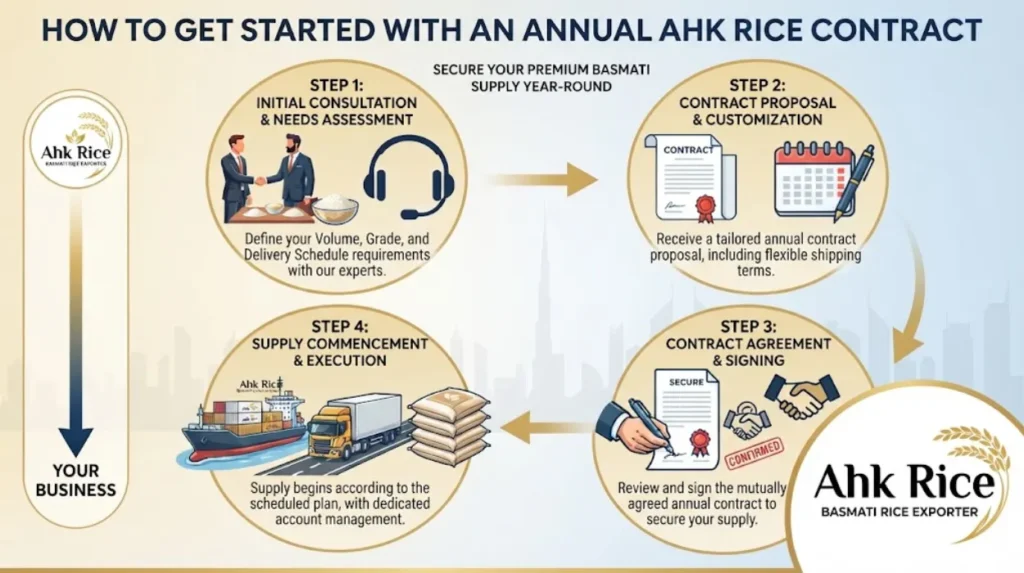
Start with the required grade, annual quantity, destination, packing, specifications, sample approval, and preferred shipment schedule. Here is why: these details allow the exporter to calculate production and logistics requirements accurately.
Complete the sample process
- Define the grade — Select 1121, Super Kernel, or 1509 and state the required processing type.
- Define the specification — Confirm grain length, broken percentage, moisture, purity, packaging, and other quality parameters.
- Request the sample — AHK Rice can provide up to 20 kg of Super Kernel Basmati for sampling, with courier shipping and applicable phytosanitary charges paid by the buyer.
- Inspect the sample — Test cooking performance, aroma, grain appearance, elongation, texture, and packaging presentation.
- Approve the reference — Record the accepted specifications and use the approved sample as the commercial benchmark.
- Confirm the contract — Agree annual volume, shipment schedule, price basis, Incoterm, packaging, inspection, documentation, and payment terms.
- Schedule production — Coordinate paddy sourcing, milling, grading, sorting, packing, inspection, and container loading.
- Dispatch the shipment — Load the approved rice, complete export documentation, and ship according to the agreed schedule.
AHK Rice should receive the buyer’s destination port, annual volume, preferred grade, packing format, and target delivery months before preparing the commercial offer.
Choose the contract structure
A buyer requiring predictable annual supply can use scheduled shipments with defined quantities. A buyer exposed to market price changes can use periodic price reviews.
A distributor with seasonal demand can concentrate shipments around major consumption periods. A retail buyer can spread arrivals across the year to control warehouse inventory.
AHK Rice can also help buyers compare FOB and destination-based commercial structures. The final choice should reflect freight exposure, destination clearance, and the buyer’s internal logistics capability.
What should buyers decide before signing?
Approve the rice specification first, then agree annual volume, shipment timing, price structure, packaging, inspection, and destination delivery terms. Here is why: the contract becomes enforceable only when the commercial specification is precise.
Use this decision framework:
| Decision | Recommended contract action |
|---|---|
| Grade | Approve one defined Basmati variety |
| Quality | Record measurable specifications |
| Volume | Divide annual demand into shipment lots |
| Pricing | Define fixed or review-based pricing |
| Logistics | Confirm shipment months and destination |
| Packaging | Approve bag format and artwork |
| Inspection | Define pre-shipment verification |
| Documentation | Confirm destination requirements |
AHK Rice provides a practical route for buyers seeking repeat Pakistani Basmati supply around the agricultural calendar. The commercial advantage comes from planning before urgent replenishment begins.
The strongest annual contract is therefore not simply a yearly purchase order. It is a coordinated procurement plan connecting harvest, processing, quality approval, packaging, logistics, and destination demand.
For buyers ready to convert the annual requirement into a detailed commercial specification, submit the requirements through the AHK Rice request-a-quote process.
Frequently Asked Questions
When should buyers plan an annual Basmati rice contract?
Pakistan’s main Basmati harvest occurs around November and December.
Buyers should finalize specifications before the harvest procurement period.
Early planning gives more time for samples and quality approval.
Annual demand can then be divided into scheduled shipments.
This reduces dependence on urgent spot purchases.
Which Basmati varieties can AHK Rice supply?
AHK Rice supplies 1121, Super Kernel, and 1509 Basmati varieties.
1121 targets premium retail and foodservice requirements.
Super Kernel provides traditional Pakistani Basmati characteristics and aroma.
1509 supports cost-conscious volume procurement.
Processing can be specified according to the buyer’s market.
Does AHK Rice provide Basmati samples?
AHK Rice can provide up to 20 kg of Super Kernel Basmati for sampling.
The buyer pays courier shipping charges.
Applicable phytosanitary charges are also paid by the buyer.
The buyer tests cooking quality and commercial specifications.
The approved sample becomes the reference for commercial supply.
What affects annual Basmati rice contract pricing?
Variety and processing type directly affect the rice specification.
Grain length, broken percentage, moisture, and purity also affect pricing.
Packaging and annual quantity influence production costs.
Freight, inspection, destination, and Incoterm affect delivered cost.
A final quotation requires the complete commercial specification.
How long does Pakistani Basmati take to reach major markets?
Gulf shipments commonly use short sea-transit planning windows.
Iraq generally requires a longer regional logistics window.
UK shipments require more time for ocean transport and clearance.
USA shipments require the longest planning window among these markets.
Actual delivery depends on vessel schedules, ports, and customs clearance.