AHK Rice Supplies Label-Ready Basmati Rice for England Retail Markets
AHK Rice is a practical sourcing solution for England retailers that need specification-controlled Basmati rice, export documentation, retail packaging, and coordinated shipment planning. Here is why: retail buyers reduce specification risk when rice, packaging, labelling information, samples, and logistics are agreed before commercial production.
England retail buyers should treat labelling as part of the procurement specification, not as a final packaging task. Product variety, net quantity, origin information, lot identification, storage guidance, and responsible food-business details must align with the intended retail format.
For a deeper explanation of the compliance issue, see why food labelling is important for England rice retail businesses before approving a commercial specification.
What is the best solution for England retail rice sourcing?
The best solution is a label-ready Basmati specification covering grade, quality, packaging, documentation, sample approval, and shipment planning before production starts.
England retailers commonly require consistent product presentation across multiple purchase cycles. A specification should therefore identify the Basmati variety, processing grade, broken percentage, moisture target, packaging format, net weight, crop year, and required export documents.
AHK Rice supplies Pakistani Basmati varieties including 1121, Super Kernel, and 1509. Available processing options include White, Steam, Golden Sella, Creamy Sella, and Brown grades, depending on the selected variety.
Retail buyers can also use private-label packaging requirements as part of the quotation. Packaging specifications should define bag material, retail weight, artwork requirements, barcode placement, printing details, carton configuration, and pallet requirements.
A label-ready approach reduces late artwork changes. It also helps the importer compare suppliers using the same commercial specification rather than comparing generic descriptions such as “premium Basmati.”
Why choose AHK Rice for label-ready Basmati?
AHK Rice combines rice processing, grading, sorting, packaging, export documentation, and shipment coordination into one procurement workflow for international buyers.
AHK Rice export service gives buyers a direct route for discussing product grade, quantity, packaging, destination, and commercial terms.
AHK Rice processes and grades the selected rice before packaging. Quality teams can inspect grain length, broken percentage, moisture, purity, foreign matter, and other agreed specifications before dispatch.
The procurement benefit is specification continuity. The same approved product specification can guide sampling, production, packaging, inspection, documentation, and container loading.
England buyers should also compare documentation capability before selecting a supplier. Typical export documentation can include a commercial invoice, packing list, certificate of origin, phytosanitary certificate, fumigation documentation, bill of lading, and applicable inspection records.
Retail buyers evaluating UK compliance can also review how imported rice products meet UK labelling expectations before finalising artwork and packaging requirements.
What Basmati specification should an England retailer approve?
A retail specification should define variety, processing grade, broken percentage, moisture, packaging, crop information, quality checks, and the exact retail presentation required.
| Specification | Retail buying consideration |
|---|---|
| Variety | 1121, Super Kernel, or 1509 |
| Processing | White, Steam, Golden Sella, Creamy Sella, or Brown |
| Broken percentage | Agree the commercial tolerance before production |
| Moisture | Set the contractual target and testing method |
| Packaging | Define retail weight, material, artwork, and barcode |
| Traceability | Maintain batch and crop-year identification |
| Documentation | Confirm required export and inspection records |
Premium England retail channels generally benefit from low-broken specifications because uniform grains improve shelf presentation and consumer perception. Previous AHK Rice material identifies 1–5% broken as a common premium retail range, while higher percentages serve commercial and manufacturing applications.
The correct grade still depends on the retailer’s positioning. A premium private-label product may select 1121 with low broken content, while a value-focused range may choose a different grade to control purchase cost.
How does the sample process work and what does it cost?
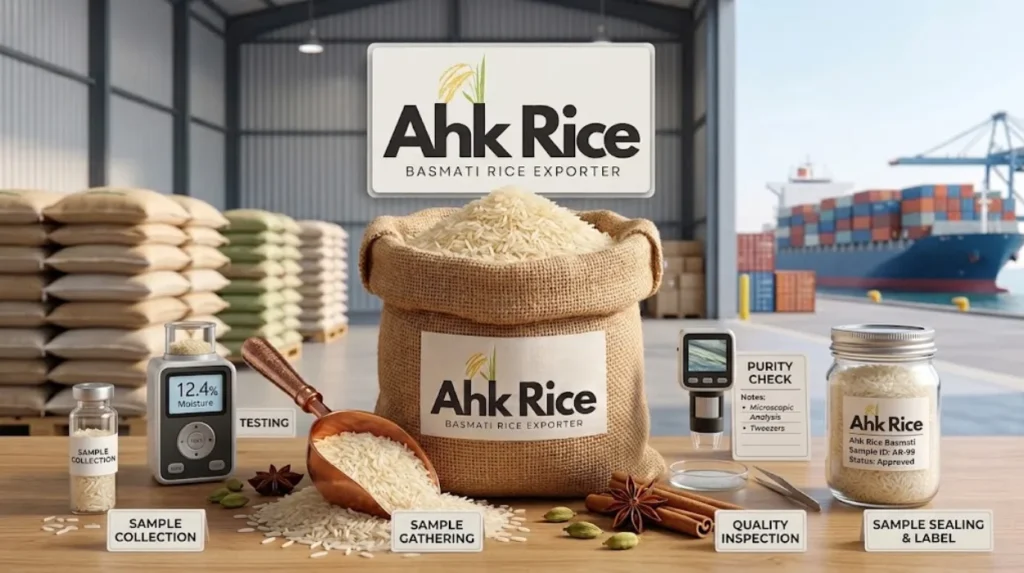
The sample process should test the exact commercial specification, with buyers budgeting separately for rice, courier, laboratory testing, documentation, and any certification requirements.
AHK Rice states that samples of up to 20 kg can be provided, while the client covers sample shipping. Buyers can also use their own courier account.
The process should follow a controlled sequence:
- Submit the target variety, grade, quantity, packaging, destination, and required specification.
- Prepare the representative rice sample against the requested specification.
- Inspect dry grain length, uniformity, colour, broken grains, foreign matter, and appearance.
- Cook the sample using a consistent method and evaluate elongation, separation, aroma, and texture.
- Test moisture, purity, broken percentage, or other laboratory parameters requested by the buyer.
- Approve the specification before commercial production and packaging.
- Confirm the quotation, Incoterm, shipment schedule, and documentation requirements.
Sample costs should not be presented as one fixed international fee. Courier charges depend on weight, dimensions, destination, service level, and carrier rates. Laboratory testing also varies according to the requested parameters.
The important commercial rule is simple: approve the same specification that will appear on the container order. A different moisture range, broken percentage, packaging format, or grade can make an approved sample commercially misleading.
How many shipping days should England and UK regional buyers plan?
England buyers should plan around 28–33 port-to-port days to Felixstowe, while Northern Ireland and inland UK routes require additional planning.
Current lane data places Karachi-to-Felixstowe FCL transit at approximately 28–33 days.
| UK market | Practical planning range | Main routing consideration |
|---|---|---|
| England | 28–33 days port-to-port | Felixstowe or London Gateway |
| Scotland | 35–45+ days | UK port plus inland movement |
| Wales | 32–42+ days | UK port plus inland delivery |
| Northern Ireland | 45–50+ days | Transshipment or UK feeder routing |
Northern Ireland requires more conservative planning. Current route data shows approximately 46 days 11 hours for the quickest Karachi-to-Belfast container route, with transshipment involved.
Liverpool routes can also take longer than Felixstowe. Current routing estimates show around 42 days for one Karachi-to-Liverpool sea route.
These figures represent transport planning rather than guaranteed delivery dates. Production, inspection, documentation, vessel availability, port congestion, customs clearance, and inland transport can extend the final timeline.
Retailers should therefore reorder before warehouse inventory reaches its critical minimum. This approach protects shelf availability during longer shipping cycles.
What results can be expected from the right supplier?
A controlled supplier should deliver repeatable rice quality, clearer packaging coordination, fewer specification disputes, stronger traceability, and more predictable replenishment planning.
The first result is product consistency. A defined grain specification helps retailers maintain similar appearance and cooking performance across successive shipments.
The second result is packaging consistency. Approved artwork, bag specifications, weights, and packing instructions reduce avoidable changes during production.
The third result is procurement control. AHK Rice can coordinate processing, grading, colour sorting, packaging, documentation, container loading, and export logistics as connected stages.
The fourth result is stronger traceability. Crop-year records, batch identification, inspection results, and export documentation give importers a clearer evidence trail.
The commercial outcome is fewer surprises between sample approval and retail delivery. That matters more than simply selecting the lowest initial rice quotation.
What factors affect the final Basmati rice price?
Final pricing depends on rice grade, quality requirements, order volume, packaging, processing, inspection, freight, destination, Incoterm, and requested documentation.
Rice grade creates the first major price difference. Premium 1121 specifications with low broken percentages require tighter grading and sorting.
Packaging creates another variable. Standard export bags usually cost less than customised private-label packaging with printed artwork and retail-specific requirements.
Processing requirements also affect the quotation. Additional sorting, polishing, blending, testing, or inspection can change the production cost.
Freight depends on container availability, carrier rates, route, destination port, and booking date. A current Karachi-to-Felixstowe 40-foot FCL benchmark was approximately US$5,210–US$5,636 in late July 2026.
This figure is only a freight benchmark. It does not represent the final landed price of Basmati rice. Buyers should request pricing against their exact quantity, packaging, destination, and commercial terms.
How can an England retailer get started with AHK Rice?
Start with the retail specification, approve a representative sample, confirm packaging and documentation, then contract production against the required shipment window.
- Define the variety, grade, broken percentage, moisture, quantity, and packaging.
- Submit the destination, preferred port, Incoterm, and required delivery window.
- Review the representative sample and quality documentation.
- Approve the final retail packaging and product specification.
- Confirm the commercial quotation and payment terms.
- Schedule production, inspection, container loading, and dispatch.
- Track shipment progress through the agreed export documentation.
AHK Rice is most suitable for buyers who want one specification to control the product from processing through export. The decision should therefore be based on repeatability, documentation, packaging capability, quality control, and landed cost.
For an England retail buyer, the strongest purchase is not simply the cheapest Basmati container. It is the shipment that matches the approved product, label, documentation, quality, and delivery specification from the first sample through repeat orders.
Contact AHK Rice today and submit your requirements through the quotation request form to receive a tailored export proposal.
Frequently Asked Questions
Is AHK Rice suitable for England retail Basmati sourcing?
Yes, AHK Rice supplies Pakistani Basmati for international markets.
Available varieties include 1121, Super Kernel, and 1509.
Retail packaging can be discussed against buyer requirements.
Quality and export documents can form part of the specification.
The final grade should match the retailer’s target market.
How long does Basmati take from Karachi to England?
Karachi-to-Felixstowe FCL transit is currently around 28–33 days.
London Gateway can also provide a comparable UK entry route.
Inland delivery adds time after port arrival.
Production and documentation require additional lead time.
Buyers should therefore plan inventory before stock becomes critical.
How much does a rice sample cost?
AHK Rice states that samples up to 20 kg can be provided.
The buyer covers sample shipping costs.
Courier pricing depends on destination and shipment weight.
Laboratory testing can create additional charges.
Confirm the complete sample cost before dispatch.
Can AHK Rice provide private-label retail packaging?
AHK Rice can support buyer-specific packaging requirements for export orders.
Retailers should provide artwork and packaging specifications early.
Weight, material, barcode, printing, and carton details should be confirmed.
The approved packaging should match the commercial production order.
This reduces packaging changes before container loading.
What should England retailers compare before ordering?
Retailers should compare grade, broken percentage, moisture, packaging, documentation, and landed cost. They should also review sample cooking performance. Shipment timing should match planned inventory requirements.