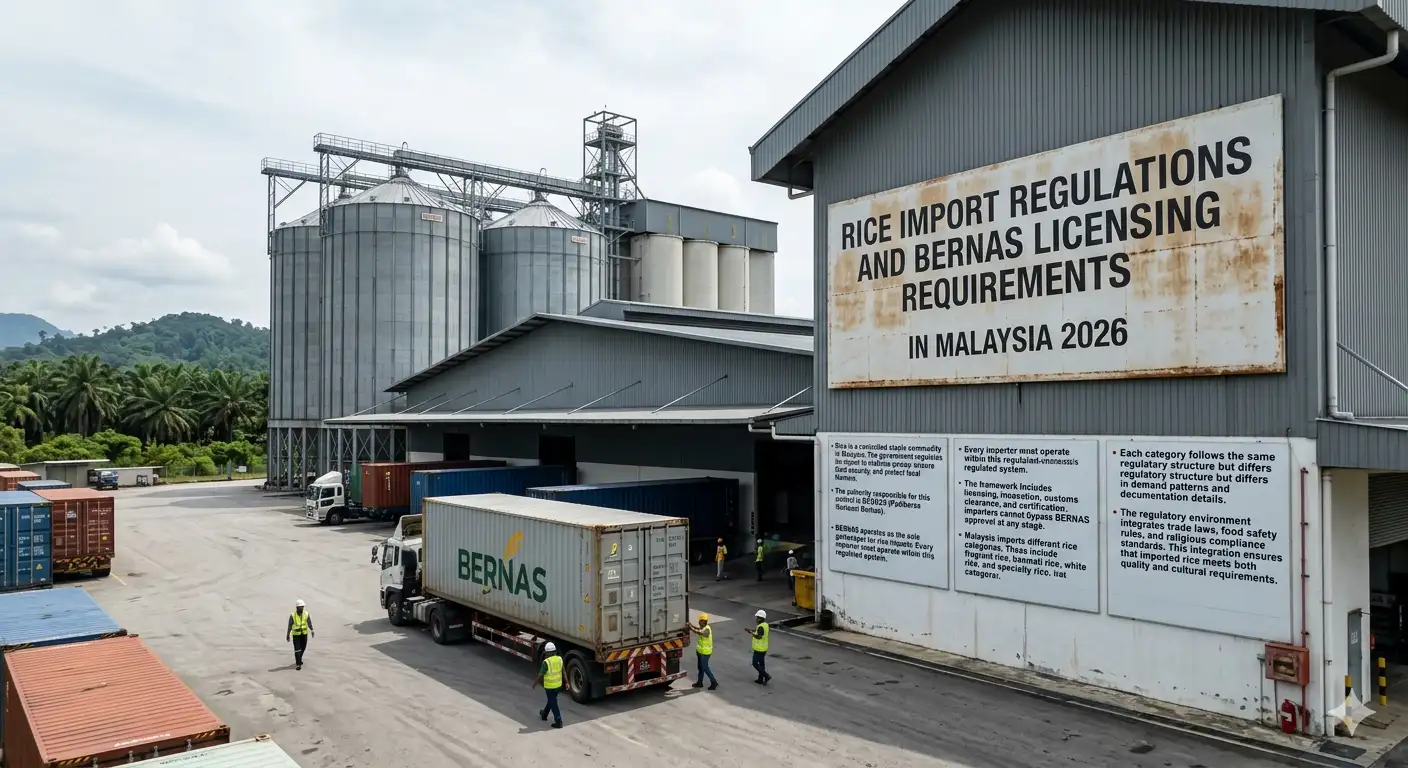
Rice Import Regulations and BERNAS Licensing Requirements in Malaysia 2026
Rice import regulations in Malaysia in 2026 refer to a structured legal framework controlled by BERNAS, where importers must obtain licenses, meet customs and halal standards, and comply with national food security policies governing rice supply, pricing, and distribution.
Rice is a controlled staple commodity in Malaysia. The government regulates its import to stabilize prices, ensure food security, and protect local farmers. The authority responsible for this control is BERNAS (Padiberas Nasional Berhad). BERNAS operates as the sole gatekeeper for rice imports.
Every importer must operate within this regulated system. The framework includes licensing, inspection, customs clearance, and certification. Importers cannot bypass BERNAS approval at any stage.
Malaysia imports different rice categories. These include fragrant rice, basmati rice, white rice, and specialty rice. Each category follows the same regulatory structure but differs in demand patterns and documentation details.
The regulatory environment integrates trade laws, food safety rules, and religious compliance standards. This integration ensures that imported rice meets both quality and cultural requirements.
How does the BERNAS licensing system work for rice imports?
The BERNAS licensing system works by granting import permits exclusively to approved companies, requiring documentation verification, supply allocation approval, and strict monitoring of imported rice volumes, quality standards, and distribution channels within Malaysia.
BERNAS issues import licenses to selected companies. These companies act as authorized importers. The licensing process includes eligibility checks, financial verification, and operational capability assessment.
The system functions through controlled allocation. BERNAS determines how much rice can be imported annually. It distributes quotas among licensed importers.
Each shipment requires a separate permit. Importers must submit documentation before shipment. These documents include invoice, packing list, certificate of origin, and quality certification.
After approval, the shipment moves to Malaysian ports. Customs authorities verify documents. BERNAS ensures that imported rice matches declared specifications.
Distribution also falls under monitoring. Imported rice must enter approved supply chains. This prevents market imbalance and price manipulation.

What are the key components of Malaysia rice import regulations?
Key components include BERNAS import licensing, customs clearance procedures, halal certification compliance, quality inspection standards, tariff classifications, and documentation requirements that collectively ensure regulated rice entry into Malaysia’s domestic market.
Licensing Requirements
Importers must obtain a valid BERNAS license. This license defines the importer’s quota and scope. Without this license, import activity is illegal.
Customs Procedures
Malaysia customs requires accurate declaration. Importers must submit HS codes, product descriptions, and shipment values. Errors lead to shipment delays or penalties.
Halal Certification
Rice imported into Malaysia must comply with halal standards when required. Certification ensures that processing, storage, and handling follow Islamic guidelines.
Quality Standards
Rice must meet Malaysian food safety standards. These include moisture levels, grain length, and impurity limits. For example, 1121 basmati requires specific grain elongation ratios.
Documentation
Each shipment requires multiple documents. These include:
- Certificate of origin (proves production country)
- Phytosanitary certificate (confirms pest-free status)
- Commercial invoice (details transaction value)
All documents must match shipment details exactly.
Why are rice import regulations important for Malaysia?
Rice import regulations are important because they ensure national food security, stabilize market prices, protect local farmers, maintain quality standards, and enforce halal compliance across all imported rice products entering Malaysia.
Malaysia depends on both local production and imports. Regulations balance this dependency. Without regulation, imports could flood the market and harm domestic farmers.
Price stability is another objective. Controlled imports prevent sudden price drops or spikes. This benefits both consumers and producers.
Food safety remains a priority. Regulations ensure that only safe, high-quality rice enters the country. This protects public health.
Halal compliance reflects cultural and religious needs. Malaysia has a large Muslim population. Ensuring halal integrity builds consumer trust.
Regulations also support traceability. Authorities can track rice from origin to retail. This improves accountability in the supply chain.
How does Malaysia customs handle rice imports?
Malaysia customs handles rice imports through document verification, tariff classification, physical inspection, and coordination with BERNAS to ensure compliance with import permits, food safety standards, and national regulatory requirements.
Customs acts as the enforcement authority at entry points. When rice arrives at ports, customs officers review all submitted documents.
They verify HS codes. Rice typically falls under specific tariff classifications depending on type. For example:
- Basmati rice uses a different code than white broken rice
- Specialty rice has unique classification identifiers
Customs inspects shipments physically when required. They check packaging, labeling, and product condition.
Coordination with BERNAS ensures that the shipment aligns with approved quotas. If discrepancies appear, customs holds the shipment.
Import duties apply based on classification. Some rice types benefit from reduced tariffs under trade agreements.
Clearance is granted only after all conditions are met. This structured process ensures compliance at every step.
What certifications are required for rice imports into Malaysia?
Rice imports into Malaysia require certifications such as halal certification, phytosanitary certificates, certificate of origin, and quality assurance documentation to confirm compliance with health, safety, and religious standards.
Halal Certification
Halal certification verifies that rice processing follows Islamic guidelines. This includes:
- No contamination with non-halal substances
- Clean processing environments
- Proper storage and handling
Phytosanitary Certificate
This certificate confirms that rice is free from pests and diseases. It is issued by the exporting country’s agricultural authority.
Certificate of Origin
This document identifies the country where the rice was produced. It supports trade agreements and tariff calculations.
Quality Certification
Quality reports confirm grain specifications. These include:
- Moisture percentage
- Broken grain ratio
- Grain length and aroma
All certifications must be valid and consistent with shipment details.
What types of rice are imported into Malaysia?
Malaysia imports various rice types including basmati rice, white long-grain rice, fragrant rice, and broken rice, each serving different consumer segments such as retail households, restaurants, and food processing industries.
Malaysia’s rice market is diverse. Different consumer groups demand different rice types.
Basmati rice serves premium consumers. It is popular in urban areas and restaurants.
White long-grain rice serves daily consumption. It is widely used in households.
Fragrant rice offers aroma and taste. It targets mid-range consumers.
Broken rice supports industrial use. It is used in food processing and animal feed.
Each type follows the same regulatory framework but differs in demand and pricing structure.
What are the common problems in rice import regulations in Malaysia?
Common problems include misunderstanding BERNAS licensing rules, incomplete documentation, delays in customs clearance, incorrect tariff classification, and lack of awareness about halal certification requirements among new importers.
Licensing Misunderstanding
New importers often assume open access. Malaysia operates a controlled system. Without BERNAS approval, imports are not permitted.
Documentation Errors
Missing or inconsistent documents cause delays. For example, mismatch between invoice and packing list leads to shipment holds.
Customs Delays
Improper classification or incomplete declarations slow down clearance. This increases storage costs at ports.
Halal Compliance Gaps
Some exporters overlook halal requirements. This creates issues during inspection and approval.
Quality Disputes
If rice does not meet declared standards, authorities reject or reclassify the shipment.
Understanding these challenges reduces operational risks.
How do businesses use Malaysia rice import regulations effectively?
Businesses use Malaysia rice import regulations effectively by aligning with BERNAS licensing requirements, preparing accurate documentation, maintaining quality standards, and building structured supply chains that comply with customs and halal certification rules.
Importers build structured processes. They align procurement, documentation, and logistics with regulatory requirements.
They work with certified exporters. This ensures that rice meets Malaysian standards before shipment.
Documentation systems are digitized. This reduces errors and speeds up submission.
Supply chains are optimized. Importers coordinate with logistics providers to ensure timely delivery and compliance.
Businesses also track regulatory updates. Malaysia updates policies based on market conditions. Staying informed ensures continuous compliance.
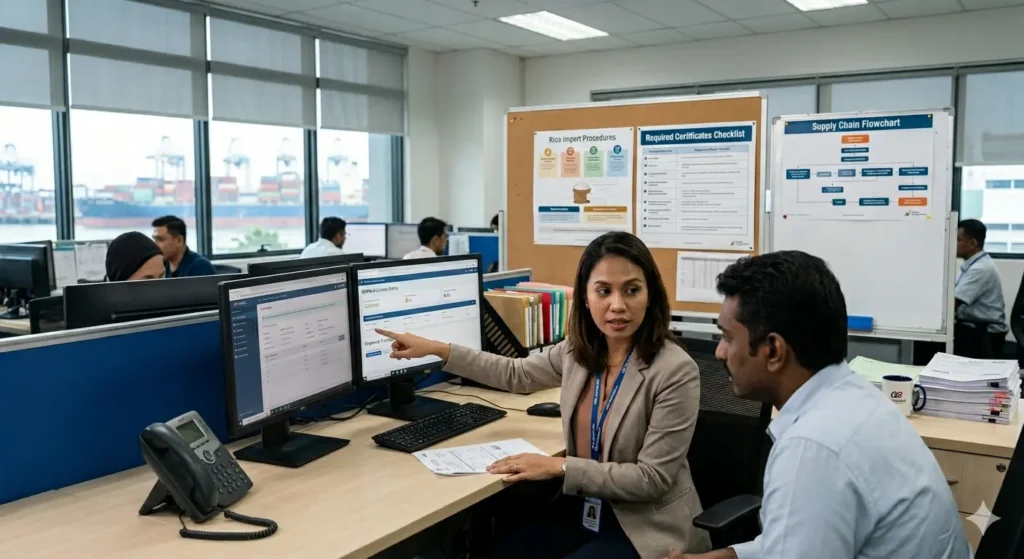
How does the rice import process work step by step in Malaysia?
The rice import process in Malaysia follows a step-by-step system involving BERNAS license approval, shipment documentation preparation, export certification, customs declaration, inspection, and final clearance for distribution within regulated supply chains.
Step 1: License Approval
Importer obtains BERNAS license and quota allocation.
Step 2: Supplier Selection
Importer selects exporter meeting quality and certification standards.
Step 3: Documentation Preparation
Exporter prepares:
- Invoice
- Packing list
- Certificate of origin
- Phytosanitary certificate
Step 4: Shipment Dispatch
Rice is shipped to Malaysian port.
Step 5: Customs Declaration
Importer submits documents to customs.
Step 6: Inspection
Authorities inspect shipment for compliance.
Step 7: Clearance
Customs releases shipment after verification.
Step 8: Distribution
Rice enters approved supply chain.
Each step must align with regulatory requirements.