Rice Packaging Standards and Bag Sizes for the Indonesian Market 2026
Rice packaging Indonesia 2026 defines the standardized methods, materials, labeling rules, and bag sizes used to pack rice for wholesale and retail distribution in Indonesia under national regulations such as SNI, ensuring safety, traceability, and consumer clarity.
Rice packaging in Indonesia refers to a regulated system that controls how rice is packed, labeled, transported, and sold. The system aligns with national standards known as SNI (Standar Nasional Indonesia), which define quality, safety, and packaging compliance.
The term includes multiple elements such as packaging material, bag sizes, labeling language, weight accuracy, and storage compatibility. These rules apply to both imported rice and domestically produced rice.
In 2026, packaging standards focus on traceability and consumer transparency. Every rice bag must clearly communicate origin, variety, grade, and net weight. For example, a 5 kg retail pack must display product name, importer details, and Bahasa Indonesia labeling.
Rice packaging is not limited to physical containment. It acts as a compliance tool, logistics unit, and marketing identifier within Indonesia’s rice distribution ecosystem.
How does rice packaging work in the Indonesian market?
Rice packaging works by integrating processing, grading, weighing, sealing, labeling, and compliance verification into a structured system that ensures rice moves safely from exporters to Indonesian consumers with consistent quality and regulatory adherence.
The process begins at the milling stage. Paddy is cleaned, husked, polished, and graded into specific categories such as long grain or broken rice. Each grade is assigned a packaging format.
Weighing follows strict calibration rules. Exporters use digital scales to ensure precise quantities such as 5 kg, 10 kg, 25 kg, or 50 kg. Any deviation beyond tolerance limits results in rejection during inspection.
Packaging material selection depends on use case. Polypropylene (PP) woven bags are used for bulk shipments. Laminated plastic or vacuum-sealed packs are used for retail.
Sealing methods include stitching for large sacks and heat sealing for retail packs. Each method ensures protection against moisture, contamination, and tampering.
Labeling is applied after sealing. All retail rice Indonesia packaging must include Bahasa label rice requirements. This includes product name, net weight, production date, expiry date, importer details, and country of origin.
Final inspection ensures compliance with SNI rice packaging Indonesia standards before shipment clearance.
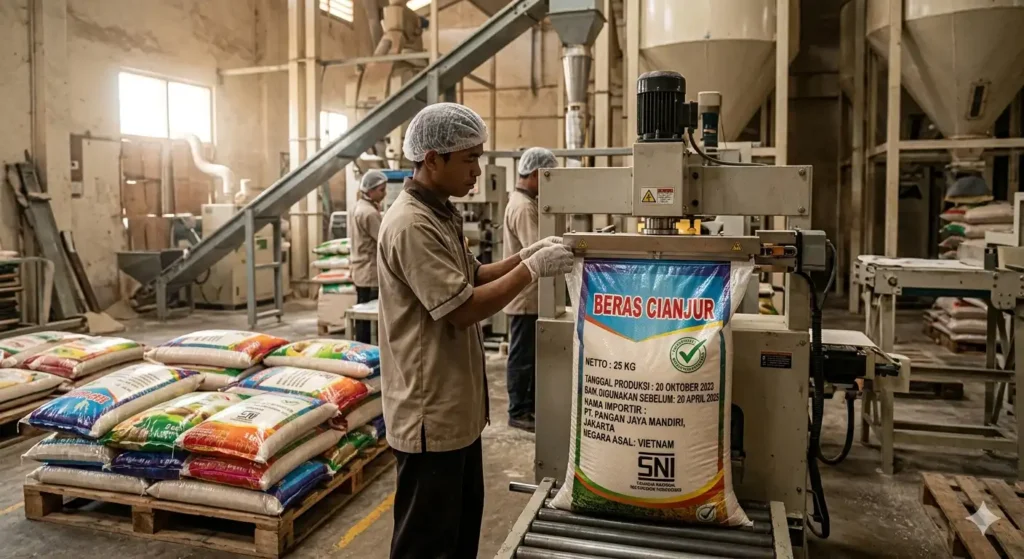
What are the key components of rice packaging standards?
Key components of rice packaging standards include packaging material, bag size classification, labeling requirements, sealing methods, weight accuracy, and certification compliance, all of which ensure safety, quality preservation, and regulatory approval in Indonesia.
Packaging Material
Packaging material determines durability and protection. Common materials include woven polypropylene bags, polyethylene liners, and vacuum packs.
Bulk rice uses woven sacks with inner liners to prevent moisture entry. Retail rice uses laminated plastic packs for better shelf presentation.
Bag Size Classification
Rice bag sizes Indonesia are categorized into retail and wholesale formats. Retail sizes include 1 kg, 2 kg, 5 kg, and 10 kg. Wholesale sizes include 25 kg and 50 kg.
Each size serves a specific distribution channel. For example, supermarkets use 5 kg packs while food service businesses use 25 kg bags.
Labeling Requirements
Bahasa label rice rules require all labels to be written in Bahasa Indonesia. The label must include:
- Product name (e.g., Basmati Rice)
- Net weight (e.g., 5 kg)
- Origin (e.g., Product of Pakistan)
- Importer name and address
- Production and expiry dates
Incorrect labeling leads to customs rejection.
Sealing Methods
Sealing ensures product safety. Bulk bags are stitched using industrial sewing machines. Retail packs are heat-sealed or vacuum-sealed.
Vacuum sealing extends shelf life by reducing oxygen exposure.
Weight Accuracy
Weight accuracy ensures consumer trust and regulatory compliance. Tolerance levels are strictly monitored. For example, a 5 kg pack must not fall below declared weight.
Certification Compliance
SNI certification confirms that packaging meets Indonesian national standards. Without SNI compliance, rice cannot legally enter the Indonesian retail market.
What are the standard rice bag sizes in Indonesia?
Standard rice bag sizes in Indonesia include 1 kg, 2 kg, 5 kg, and 10 kg for retail distribution, and 25 kg and 50 kg for wholesale and food service sectors, each designed for specific consumer and supply chain needs.
Rice bag sizes are standardized to align with purchasing behavior and logistics efficiency.
Retail sizes include smaller packs such as 1 kg and 2 kg, which target daily consumption households. Mid-range sizes such as 5 kg and 10 kg are used by families and supermarkets.
Wholesale sizes such as 25 kg and 50 kg are used in bulk distribution. These are common in traditional markets, restaurants, and catering services.
Each size influences packaging design. For example, a 5 kg retail pack requires attractive printing and clear labeling, while a 50 kg sack focuses on durability and stackability.
Examples of usage include:
- 1 kg packs for convenience stores
- 5 kg packs for supermarkets
- 25 kg sacks for restaurants
- 50 kg sacks for wholesalers
These standardized sizes simplify inventory management and transportation.
What are the benefits of standardized rice packaging?
Standardized rice packaging ensures product safety, improves logistics efficiency, enhances consumer trust, supports regulatory compliance, and enables consistent quality control across the Indonesian rice supply chain.
Standardization reduces confusion in the supply chain. Every stakeholder understands packaging formats, weight units, and labeling structure.
Safety improves because packaging materials are tested for durability and contamination resistance. Moisture-proof liners protect rice from spoilage during long-distance shipping.
Logistics efficiency increases because uniform bag sizes allow better stacking, container loading, and warehouse storage. For example, 50 kg bags are optimized for pallet stacking.
Consumer trust grows when packaging provides clear and accurate information. Buyers rely on labels to understand rice type, origin, and quality.
Regulatory compliance ensures uninterrupted trade. Packaging that meets SNI standards passes customs inspection without delays.
Quality control becomes consistent. Each batch follows the same packaging process, reducing variation in product presentation.
What are the main use cases of rice packaging in Indonesia?
Main use cases of rice packaging in Indonesia include retail distribution, wholesale trading, food service supply, and institutional procurement, each requiring specific bag sizes, materials, and labeling formats.
Retail distribution focuses on consumer-ready packaging. Supermarkets and convenience stores sell rice in 1 kg to 10 kg packs with branded designs and clear labeling.
Wholesale trading uses larger sacks such as 25 kg and 50 kg. These are transported in bulk and sold in traditional markets.
Food service supply involves restaurants, hotels, and catering businesses. These buyers prefer 25 kg bags for operational efficiency.
Institutional procurement includes government programs and large organizations. These require standardized packaging for large-scale distribution.
Each use case demands a different packaging approach. For example, retail packaging prioritizes visual appeal, while wholesale packaging prioritizes durability.
What are common problems in rice packaging for Indonesia?
Common problems in rice packaging for Indonesia include incorrect labeling, non-compliant bag sizes, poor material quality, inaccurate weight, and lack of SNI certification, all of which lead to shipment rejection and market access issues.
Incorrect labeling is the most frequent issue. Labels not written in Bahasa Indonesia fail regulatory checks. Missing details such as importer information also cause rejection.
Non-compliant bag sizes create distribution challenges. Using uncommon sizes disrupts retail shelf planning and logistics systems.
Poor material quality leads to damage during transportation. Weak bags tear easily, causing product loss and contamination.
Inaccurate weight results in legal penalties. Underweight packs violate consumer protection laws.
Lack of SNI certification blocks market entry. Without certification, rice cannot be sold legally in Indonesia.
Examples of problems include:
- Retail packs without expiry dates
- Bulk bags without inner liners
- Labels printed only in English
Each problem directly impacts trade efficiency and compliance.
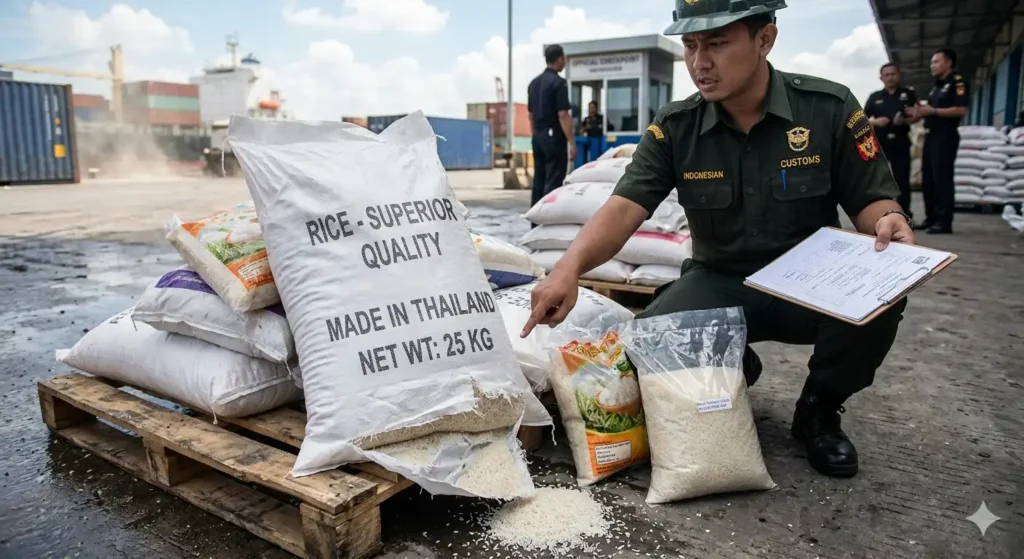
What misconceptions exist about rice packaging standards?
Misconceptions about rice packaging standards include the belief that packaging is only for protection, that labeling is optional, and that all markets accept the same bag sizes, which leads to non-compliance in Indonesia.
One misconception is that packaging only protects rice. In reality, packaging also communicates product information and ensures regulatory compliance.
Another misconception is that labeling is flexible. Indonesian regulations require strict adherence to Bahasa label rice rules.
Some exporters assume that global bag sizes are acceptable everywhere. Indonesia follows specific rice bag sizes Indonesia standards, which differ from other markets.
There is also a belief that certification is optional. SNI certification is mandatory for retail distribution.
These misconceptions create operational risks. Exporters must align packaging with Indonesian standards to ensure smooth market entry.