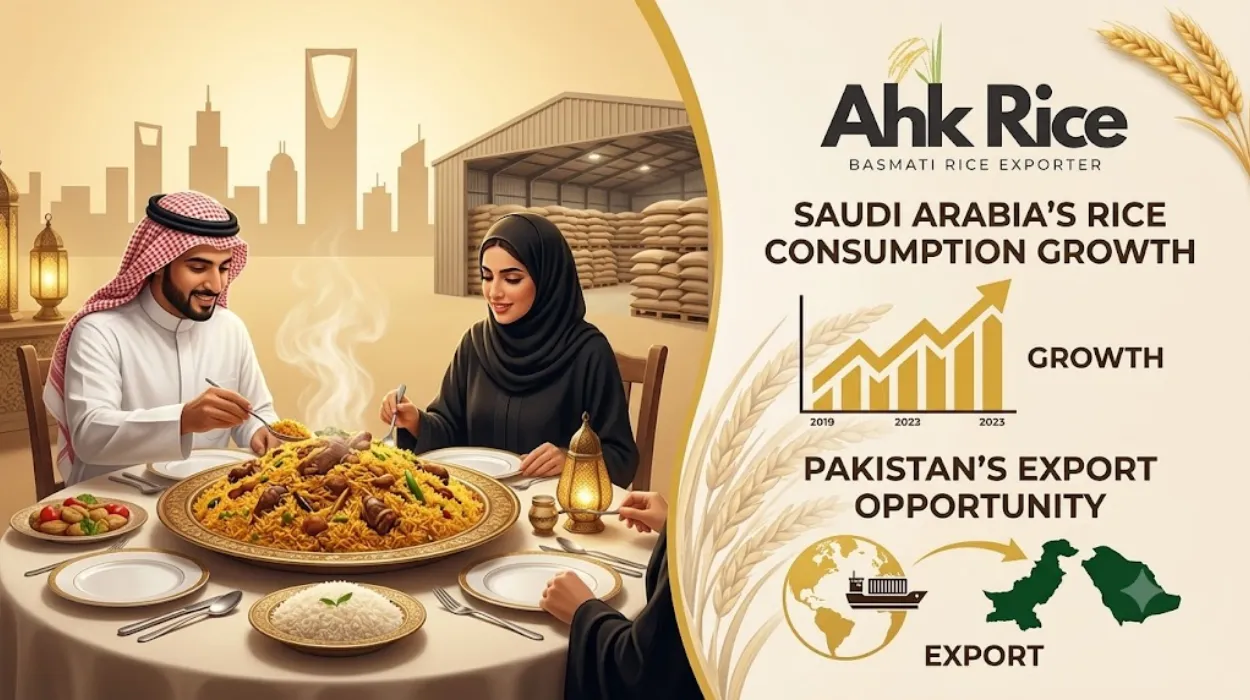
Saudi Arabia’s Rice Consumption Growth and Pakistan’s Export Opportunity
Saudi Arabia’s rice consumption continues to increase because population growth, tourism, food service expansion, and changing consumer preferences have raised annual demand for premium and value-added rice. Here is why: the Kingdom imports most of its rice requirements, creating long-term opportunities for major exporting countries such as Pakistan, India, Thailand, and Vietnam. Pakistan benefits through its globally recognized Basmati varieties, established export infrastructure, and competitive processing capabilities.
Rice remains one of the most consumed staple foods in Saudi Arabia. Families, restaurants, catering companies, hotels, and institutional buyers purchase rice every day for traditional dishes such as Kabsa, Mandi, Biryani, and Maqluba. This consistent demand keeps imports active throughout the year instead of limiting purchases to seasonal periods.
Pakistan plays an important role in supplying premium aromatic rice to Saudi Arabia. Pakistani Basmati, particularly 1121, Super Kernel, and 1509 varieties, satisfies consumer demand for long grains, strong aroma, and excellent cooking performance. Understanding how Saudi Arabia’s consumption grows explains why Pakistan continues expanding its export potential.
Readers interested in the preferred premium varieties imported by Saudi buyers can continue with our detailed guide explaining which Pakistani Basmati grades dominate the Saudi retail and wholesale market.
What is driving Saudi Arabia’s rice consumption growth?
Saudi Arabia imports most of its rice because domestic cultivation remains extremely limited. Population growth, urbanization, tourism expansion, higher disposable income, and food service development continue increasing annual consumption across retail, hospitality, catering, and industrial food sectors.
Rice consumption grows because Saudi Arabia has limited freshwater resources and very little commercial rice cultivation. Importing rice remains the country’s practical solution for maintaining food security.
According to international agricultural trade data, Saudi Arabia imports well over one million metric tons of rice annually, making it one of the Middle East’s largest rice importers (Source: USDA Foreign Agricultural Service).
Population growth directly increases household demand. Every additional household purchases rice regularly as part of everyday meals.
Tourism also contributes significantly. Millions of religious pilgrims visiting Makkah and Madinah consume rice through hotels, restaurants, and catering providers throughout the year.
Food delivery platforms, institutional catering, and restaurant chains continue expanding. These sectors purchase rice in bulk and require consistent quality specifications.
The growing demand explains why understanding the import system becomes the next logical step.
How does Saudi Arabia import rice from exporting countries?
Saudi Arabia imports rice through international suppliers that cultivate, process, inspect, certify, load, ship, clear customs, and distribute products through wholesalers, retailers, supermarkets, food service companies, and institutional buyers across the Kingdom.
How does the export process work?
Rice exports follow a structured supply chain.
- Cultivate paddy in suitable agricultural regions.
- Harvest mature rice crops.
- Dry harvested paddy.
- Mill the rice.
- Polish or parboil according to specifications.
- Grade by grain size and quality.
- Sort using optical colour sorters.
- Inspect physical and chemical quality.
- Package according to buyer requirements.
- Load containers.
- Dispatch shipments.
- Clear customs and deliver cargo.
Every stage influences the final quality received by Saudi buyers.
Professional exporters maintain moisture control, broken percentage, purity, and grain length throughout processing.
The export process naturally leads to understanding why Pakistan performs well in this market.
Why does Pakistan have a strong export opportunity?
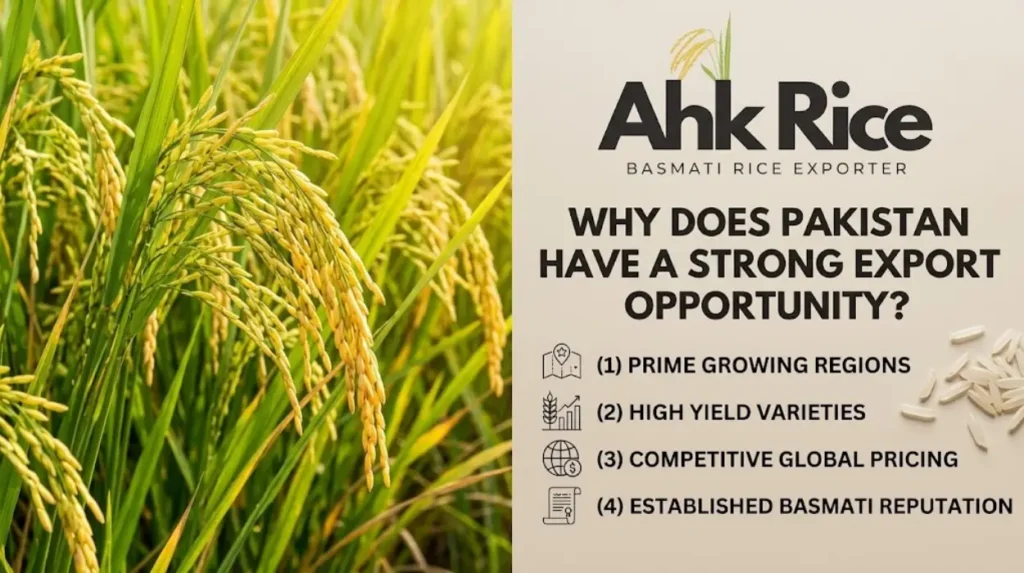
Pakistan combines ideal Basmati-growing conditions, modern rice mills, competitive pricing, internationally accepted certifications, experienced exporters, and strong shipping access through Karachi ports, making the country an important supplier for Saudi Arabian buyers.
Punjab produces most Pakistani Basmati rice. Fertile soil, irrigation systems, and suitable climatic conditions create long, aromatic grains with excellent cooking characteristics.
Pakistan exports multiple rice categories instead of depending on one product.
Major exported Basmati varieties
- 1121 Basmati
- Super Kernel Basmati
- 1509 Basmati
Each variety serves different customer requirements.
1121 Basmati offers exceptional grain length after cooking.
Super Kernel Basmati provides traditional aroma preferred by many Middle Eastern consumers.
1509 Basmati delivers faster crop maturity while maintaining premium appearance.
Pakistan also exports non-Basmati varieties for buyers seeking economical alternatives.
Strong product diversity strengthens export competitiveness.
Understanding the products explains the specifications Saudi buyers evaluate before purchasing.
What are the key components Saudi buyers evaluate?
Saudi importers compare grain length, aroma, purity, moisture, broken percentage, processing method, packaging, shelf life, certifications, and shipping reliability before selecting suppliers for wholesale, retail, catering, and hospitality sectors.
Grain Length
Long grains improve presentation after cooking.
Example varieties include 1121 and Super Kernel.
Aroma
Natural fragrance remains one of the strongest purchasing factors for premium Basmati.
Moisture Content
Proper moisture extends storage stability.
Excess moisture increases quality risks during shipping.
Broken Percentage
Lower broken percentages produce more uniform cooked rice.
Purity
High purity means fewer foreign materials, stones, or damaged grains.
Packaging
Export packaging protects rice throughout transportation.
Common packaging examples include:
- 1 kg retail bags
- 5 kg family packs
- 10 kg consumer packs
- 25 kg PP bags
- 40 kg woven sacks
- 50 kg export bags
These specifications directly influence purchasing decisions across Saudi markets.
The next section explains how rice reaches these quality standards.
How is Pakistani rice processed before export?
Rice processing follows standardized industrial operations including cleaning, dehusking, milling, polishing, grading, colour sorting, moisture testing, packaging, inspection, and container loading before international shipment.
Cleaning
Cleaning removes dust, straw, stones, and field impurities.
Dehusking
Dehusking separates the outer husk from the grain.
Milling
Milling removes bran layers according to buyer specifications.
Polishing
Polishing improves grain appearance and market presentation.
Grading
Grading separates rice according to size and quality.
Colour Sorting
Optical machines remove defective grains.
Moisture Testing
Laboratories verify export moisture levels.
Packaging
Packaging protects rice during transportation.
Inspection
Inspection confirms buyer specifications before shipment.
Container Loading
Containers receive fumigation when required before dispatch.
Consistent processing increases buyer confidence and export performance.
The processing system also supports compliance with international certification standards.
What certifications apply to rice exports?
International buyers require documented quality systems including food safety certifications, phytosanitary compliance, laboratory testing, fumigation documentation, and export inspection before shipment approval.
Common certifications include:
- ISO 22000
- HACCP
- Halal Certification
- Phytosanitary Certificate
- Certificate of Origin
- Fumigation Certificate
- Health Certificate
- Quality Inspection Reports
Government authorities and accredited organizations inspect export documentation before shipment.
These certifications improve traceability and food safety throughout international supply chains.
Certification standards support the long-term growth of Pakistan’s exports.
The next section explains the broader economic benefits.
What benefits does Saudi Arabia gain from importing Pakistani rice?
Reliable imports provide food security, product diversity, stable supply chains, premium quality choices, competitive pricing, and year-round availability for consumers, retailers, wholesalers, and hospitality businesses.
Consumers receive multiple rice options across different price segments.
Retailers maintain consistent inventory.
Hotels secure dependable supplies for daily operations.
Restaurants prepare traditional meals using long-grain aromatic rice.
Importers diversify sourcing strategies to reduce supply chain risks.
These combined benefits strengthen bilateral agricultural trade.
The discussion naturally extends to practical applications across industries.
Frequently Asked Questions
Why is Saudi Arabia one of the world’s largest rice importers?
Saudi Arabia imports most of its rice because its arid climate and limited freshwater resources restrict large-scale rice cultivation. The country relies on imports to meet year-round consumer and commercial demand.
Which countries export the most rice to Saudi Arabia?
Saudi Arabia primarily imports rice from Pakistan, India, Thailand, Vietnam, and the United States. Pakistan is widely recognized for exporting premium Basmati rice, while other suppliers offer both aromatic and non-aromatic varieties.
Which Pakistani rice varieties are most popular in Saudi Arabia?
The most popular Pakistani rice varieties include 1121 Basmati, Super Kernel Basmati, and 1509 Basmati. These varieties are valued for their long grain, natural aroma, soft texture, and excellent cooking performance.
Why is Pakistani Basmati rice preferred in the Saudi market?
Pakistani Basmati rice is preferred because it offers extra-long grains, a distinctive aroma, good grain elongation after cooking, and suitability for traditional Saudi dishes such as Kabsa, Mandi, and Biryani.
What factors influence Saudi Arabia’s rice consumption?
Population growth, urbanization, tourism, religious pilgrimages, rising disposable income, and the expansion of restaurants, hotels, and catering services all contribute to increasing rice consumption in Saudi Arabia.