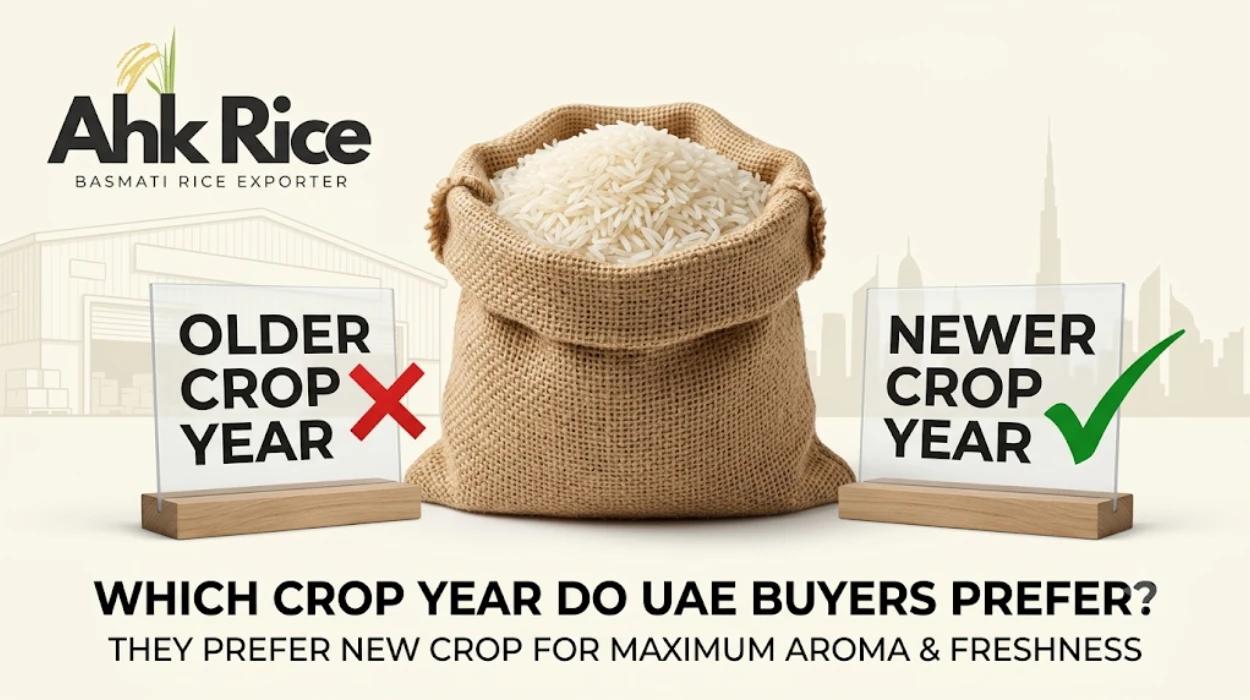
Which Crop Year of Pakistan 1121 Rice Do UAE Buyers Prefer?
For most UAE importers, properly aged Pakistan 1121 Basmati rice consistently delivers better commercial value than freshly harvested rice because it provides a stronger aroma, more stable cooking performance, lower moisture content, and fewer quality-related complaints across retail, foodservice, and private-label supply chains.
Pakistan 1121 Basmati rice remains one of the world’s most traded premium aromatic rice varieties. Importers across the UAE evaluate suppliers based on consistency rather than price alone. The crop year directly influences grain maturity, moisture level, cooking expansion, storage stability, and customer satisfaction. Buyers who understand crop-year differences reduce commercial risk and achieve more predictable product performance.
Before comparing crop years, it helps to understand how harvest timing affects grain quality throughout processing and export. Our guide on understanding Pakistan 1121 rice quality from harvest to shipment explains how moisture, milling, grading, and storage influence final export quality before crop-year comparisons become relevant.
Pakistan produces one primary Basmati harvest every year between October and November. After harvesting, paddy undergoes drying, milling, polishing, grading, sorting, packaging, and storage. During storage, natural aging changes the grain’s internal structure. These changes improve cooking performance and enhance aroma, making aged rice the preferred choice for many commercial buyers.
AHK Rice sources premium Pakistan 1121 Basmati rice from Punjab, where fertile soil, glacier-fed irrigation, and favorable climate support consistent grain quality. Through modern processing facilities, crop segregation, quality inspections, custom packaging, and complete export documentation, AHK Rice supplies international buyers with traceable rice suited for multiple commercial applications.
What crop-year options are available for Pakistan 1121 rice?
Pakistan 1121 rice is generally available as freshly harvested rice and naturally aged rice. Each option serves different commercial objectives depending on budget, customer expectations, cooking requirements, storage duration, and export destination. Understanding these categories allows UAE buyers to choose the most suitable procurement strategy.
Crop year refers to the agricultural season during which the rice was harvested. Although every shipment may appear visually similar, crop year significantly affects physical and cooking characteristics.
Fresh crop rice usually enters export channels shortly after processing. Moisture levels remain relatively higher, the aroma is lighter, and grains require additional storage before reaching optimal cooking performance.
Naturally aged rice remains under controlled warehouse conditions for approximately twelve to twenty-four months. During this period, moisture gradually decreases while the grain stabilizes internally. This maturation process strengthens aroma, improves elongation after cooking, reduces stickiness, and produces more consistent cooking results.
Commercial exporters generally classify Pakistan 1121 rice into three practical categories:
- Fresh Crop (0–6 months)
- Semi-Aged Crop (6–12 months)
- Fully Aged Crop (12–24 months)
Although longer aging increases storage costs, many importers accept the premium because customer satisfaction improves substantially.
Pakistan 1121 Rice Crop Comparison
| Specification | Fresh Crop | Semi-Aged | Fully Aged |
|---|---|---|---|
| Harvest Age | 0–6 months | 6–12 months | 12–24 months |
| Moisture Level | Higher | Moderate | Lower |
| Aroma | Mild | Stronger | Premium |
| Cooking Expansion | Good | Better | Excellent |
| Grain Stability | Moderate | High | Very High |
| Shelf Stability | Good | Better | Excellent |
| Typical Commercial Use | Budget retail | Mixed retail & foodservice | Premium retail, hotels & restaurants |
The comparison demonstrates that crop year affects far more than aroma. Moisture stability influences shipping performance, warehouse storage, cooking consistency, and consumer perception after purchase.
How do different crop years compare for UAE buyers?
UAE buyers compare crop years by evaluating cooking consistency, aroma development, shelf stability, moisture control, grain appearance, and customer expectations rather than focusing solely on purchase price. Long-term profitability usually depends on selecting the crop year that matches the intended market segment and sales strategy.
The UAE imports Pakistan 1121 Basmati rice for supermarkets, wholesalers, restaurants, hotels, catering companies, and private-label brands. Each customer group values different product characteristics.
Premium supermarkets emphasize consistent grain appearance, attractive packaging, and excellent cooking quality. Hotels and restaurants prioritize elongation, aroma, and repeatability across large-volume cooking operations. Catering companies focus on minimizing cooking variation while maintaining acceptable cost per serving.
These commercial objectives explain why aged rice often commands higher market demand despite its higher purchase price.
Approximate export pricing illustrates the relationship between crop year and value.
| Crop Type | Approximate Export Price (USD/MT) | Commercial Position |
|---|---|---|
| Fresh Crop | 950–1,050 | Budget |
| Semi-Aged | 1,050–1,180 | Mid-range |
| Fully Aged | 1,180–1,350 | Premium |
Prices fluctuate according to harvest volume, freight rates, currency exchange, milling quality, and international demand. However, aged rice consistently maintains a pricing premium because buyers recognize its improved commercial performance.
Beyond pricing, shelf life also becomes an important procurement consideration.
| Crop Type | Typical Shelf Life |
|---|---|
| Fresh Crop | 18–24 months |
| Semi-Aged | 24 months |
| Fully Aged | Up to 24 months with greater storage stability |
For UAE distributors operating in hot climates, storage stability reduces inventory risk while maintaining product quality throughout warehouse operations.
AHK Rice maintains crop segregation throughout procurement, processing, grading, storage, and export preparation. Buyers seeking verified harvest information and documented quality assurance often evaluate suppliers that provide crop-year traceability and export documentation for Pakistan 1121 Basmati rice destined for UAE importers.
Which crop year works best for different importers?
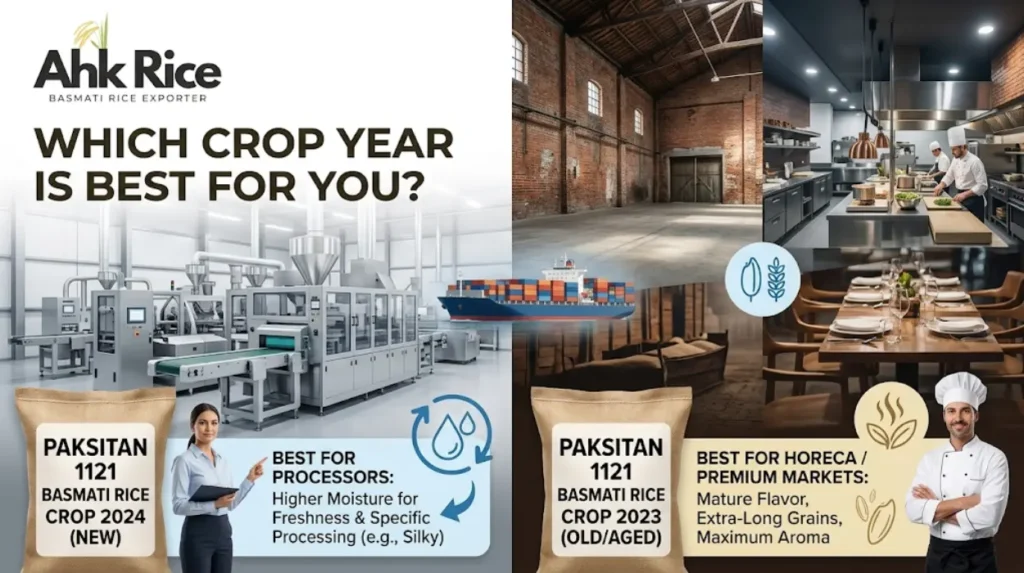
The best crop year depends on the buyer’s business model rather than the lowest purchase price. Retail brands, hotels, restaurants, and premium distributors usually benefit from fully aged Pakistan 1121 rice, while price-sensitive wholesalers and high-volume traders may prefer fresh or semi-aged stock to optimize procurement costs.
Selecting the appropriate crop year begins with understanding the expectations of the end customer. Every segment of the UAE market measures quality differently. A supermarket chain selling premium private-label rice values aroma, grain appearance, and cooking consistency because consumers compare products directly on the shelf. Restaurants and hotels prioritize long grain elongation, uniform cooking, and minimal breakage to maintain presentation and portion consistency. In contrast, wholesale traders supplying budget markets often focus on competitive pricing and faster inventory turnover.
Fresh crop Pakistan 1121 rice is suitable for buyers targeting value-conscious consumers. It offers a lower purchase price and immediate availability after harvest, making it attractive when budgets are tight or rapid market entry is required. However, fresh rice may produce slightly less aroma and greater variation during cooking, especially when compared with naturally aged stock.
Semi-aged rice represents a balanced solution. After six to twelve months of controlled storage, moisture stabilizes, cooking performance improves, and aroma becomes more pronounced. Many importers choose this category because it delivers better quality without the premium price associated with fully aged rice.
Fully aged Pakistan 1121 rice remains the preferred option for premium market segments. The extended aging period allows the grain to mature naturally, resulting in excellent elongation, stronger fragrance, firmer cooked texture, and greater consistency across production batches. These characteristics reduce customer complaints and strengthen brand reputation over time.
UAE and European Market Preferences
Although Pakistan exports 1121 Basmati rice worldwide, buyer expectations differ between regions.
| Market | Preferred Grade | Main Buying Priority | Common Buyers |
|---|---|---|---|
| UAE | Fully Aged 1121 Basmati | Aroma, elongation, consistency | Supermarkets, hotels, restaurants, distributors |
| Europe | Semi-Aged or Fully Aged Premium Grades | Food safety, traceability, consistent specifications | Retail chains, importers, private-label brands |
UAE buyers generally emphasize sensory qualities because premium Basmati rice is closely associated with authentic Middle Eastern and South Asian cuisine. European buyers also value aroma and cooking quality, but procurement decisions place additional emphasis on documentation, traceability, laboratory testing, and compliance with food safety standards.
This difference explains why exporters increasingly provide detailed crop-year records, batch identification, and quality certificates alongside traditional export documentation.
What are the advantages and disadvantages of each crop year?
Each crop year offers measurable commercial benefits and trade-offs. Fresh crop rice provides cost advantages, while aged rice delivers superior cooking quality and stronger customer satisfaction. Importers achieve the best results by matching crop-year characteristics with their target market instead of choosing based only on price.
Fresh Crop Rice
Advantages
- Lower procurement cost.
- Greater availability immediately after harvest.
- Suitable for budget-focused markets.
- Faster purchasing cycles during peak export season.
Disadvantages
- Higher moisture content.
- Less developed aroma.
- Slightly lower cooking expansion.
- Greater variability between batches during the first months after harvest.
Example
A wholesaler supplying price-sensitive independent grocery stores may prioritize lower acquisition costs over premium cooking performance. Fresh crop rice supports this commercial objective while maintaining acceptable quality standards.
Semi-Aged Rice
Advantages
- Balanced price and quality.
- Improved cooking consistency.
- Better grain stability.
- Stronger aroma than fresh crop.
Disadvantages
- Moderately higher cost than fresh rice.
- Availability depends on warehouse inventory.
Example
A regional food distributor serving both restaurants and supermarkets often benefits from semi-aged rice because it satisfies diverse customer expectations without significantly increasing procurement costs.
Fully Aged Rice
Advantages
- Premium aroma.
- Excellent grain elongation.
- Stable moisture.
- Consistent cooking performance.
- Lower risk of customer complaints.
- Stronger brand positioning.
Disadvantages
- Higher purchase price.
- Limited availability during periods of strong international demand.
Example
A supermarket chain selling premium private-label Basmati rice gains long-term value from fully aged rice because consistent product quality encourages repeat purchases and enhances consumer trust.
What decision factors should UAE buyers evaluate before selecting a crop year?
Successful procurement depends on evaluating technical specifications, commercial objectives, storage capability, customer expectations, and supplier transparency together rather than focusing on a single quality indicator. Buyers who compare these factors systematically reduce procurement risks and improve long-term profitability.
Every procurement decision should balance quality, operational requirements, and financial objectives. Rather than assuming that the oldest rice is always the best choice, importers should evaluate how the product aligns with their business strategy.
Decision Framework
| Decision Factor | Fresh Crop | Semi-Aged | Fully Aged |
|---|---|---|---|
| Lowest Purchase Cost | ✓ Excellent | ✓ Good | Moderate |
| Premium Retail Quality | Moderate | Good | ✓ Excellent |
| Restaurant Performance | Good | ✓ Very Good | ✓ Excellent |
| Long-Term Brand Reputation | Moderate | Good | ✓ Excellent |
| Customer Satisfaction | Good | Very Good | ✓ Excellent |
This framework demonstrates that no single crop year is ideal for every importer. The best decision depends on customer expectations, sales channel, inventory planning, and pricing strategy. Businesses that align crop-year selection with market demand consistently achieve better commercial outcomes than those purchasing solely on cost.
Pakistan 1121 Basmati rice is recognized worldwide for its long grains, distinctive aroma, and exceptional cooking performance. However, the crop year significantly influences how these qualities develop. Fresh crop rice offers an economical option for buyers serving price-sensitive markets, while semi-aged rice provides a practical balance between cost and performance. Fully aged rice delivers the highest level of aroma, grain elongation, moisture stability, and cooking consistency, making it the preferred choice for premium retail, hospitality, and foodservice sectors in the UAE.
Rather than selecting rice solely based on the lowest quotation, experienced importers evaluate crop year alongside milling quality, grading accuracy, moisture content, storage conditions, packaging options, and supplier traceability. These factors directly affect shipment stability, shelf performance, customer satisfaction, and repeat business.
AHK Rice supports international buyers by maintaining crop-year segregation throughout procurement, processing, grading, storage, packaging, and export documentation. This approach enables importers to verify harvest information and source rice that aligns with their specific market requirements. By choosing the appropriate crop year for the intended customer segment, UAE importers can improve product consistency, strengthen brand reputation, and achieve better long-term commercial value.
Frequently Asked Questions
Which crop year of Pakistan 1121 rice is most popular in the UAE?
Most premium UAE importers prefer 12–24 month naturally aged Pakistan 1121 Basmati rice because it provides stronger aroma, better grain elongation, lower moisture content, and more consistent cooking performance than freshly harvested rice.
Does aged Pakistan 1121 rice cost more than fresh crop rice?
Yes. Naturally aged rice generally commands a higher export price because of storage costs and improved quality characteristics. However, many buyers consider the premium worthwhile due to fewer customer complaints, better cooking consistency, and stronger consumer satisfaction.
How can buyers verify the crop year of exported rice?
Importers should request crop-year documentation, batch records, quality inspection reports, milling dates, and supplier traceability records. Working with exporters that maintain crop segregation throughout processing improves confidence in harvest-year verification.
Is fresh crop Pakistan 1121 rice suitable for commercial import?
Yes. Fresh crop rice is appropriate for budget retail markets and wholesalers where competitive pricing is the primary purchasing factor. Buyers should understand that aroma and cooking performance continue to improve as the rice naturally ages.
Which crop year is best for hotels and restaurants?
Hotels, restaurants, and catering companies generally prefer fully aged Pakistan 1121 Basmati rice because it consistently produces long grain elongation, excellent texture, premium aroma, and reliable cooking performance across large-volume food preparation.