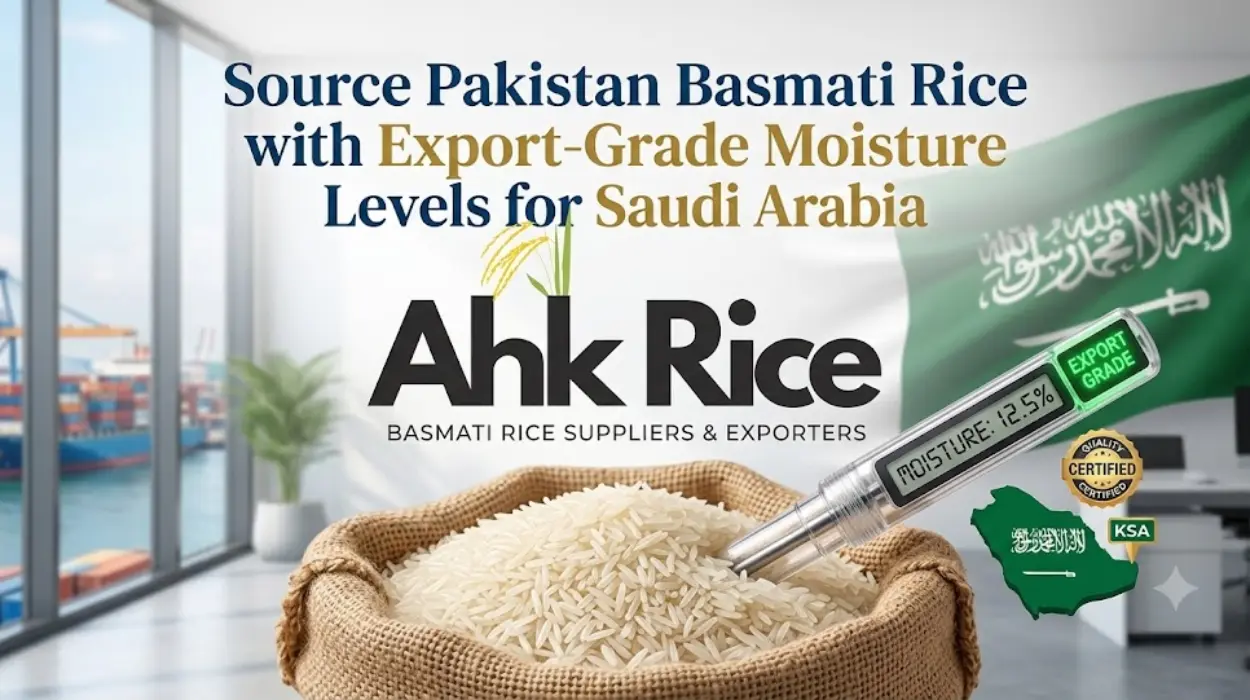
Source Pakistan Basmati Rice with Export-Grade Moisture Levels for Saudi Arabia
Saudi Arabian rice buyers expect consistent grain quality, reliable documentation, and moisture levels that protect the product throughout the export journey. If you are comparing suppliers, understanding moisture specifications is one of the most important purchasing decisions. Before selecting a supplier, it helps to understand:
Why Does Moisture Content Matter When Exporting Pakistan Basmati Rice to Saudi Arabia?.
Saudi Arabia continues to be one of the largest destinations for premium Pakistani Basmati rice. Importers, wholesalers, retail chains, hospitality groups, and food service distributors increasingly require export-grade moisture levels supported by laboratory testing and shipment documentation. AHK Rice supplies export-quality Pakistani Basmati rice prepared according to buyer specifications while maintaining quality throughout processing, storage, container loading, and international shipping.
What is the best solution for sourcing Pakistan Basmati rice with export-grade moisture levels for Saudi Arabia?
The best solution is choosing an exporter that controls moisture throughout milling, grading, storage, quality inspection, container loading, and shipment documentation. Consistent moisture management reduces transit risks, preserves grain quality, extends shelf life, and helps Saudi importers receive rice that meets agreed commercial specifications without unnecessary claims or losses.
Moisture content influences nearly every quality characteristic of exported Basmati rice. Excess moisture increases the likelihood of mould development, discolouration, odour, and grain deterioration during long-distance transportation. Moisture that is too low may increase grain breakage during handling and packaging.
AHK Rice follows controlled processing procedures from paddy selection through final container loading. Moisture is measured during multiple production stages rather than only before shipment. This creates greater consistency across every export lot.
For Saudi Arabian buyers, the target moisture level commonly requested for export-grade Pakistani Basmati rice generally falls within commercial specifications of approximately 12% to 13%, depending on the buyer’s contract, packaging format, and destination requirements. Individual tenders may specify slightly different acceptable ranges.
If you are comparing moisture specifications between rice grades and buyer expectations, our article discussing:
Saudi importer moisture preferences provides additional technical guidance before placing an order.
The Saudi Arabia service page explains how AHK Rice manages export documentation, quality assurance, packaging options, and shipment planning specifically for Saudi buyers.
Why should Saudi Arabian importers choose AHK Rice?
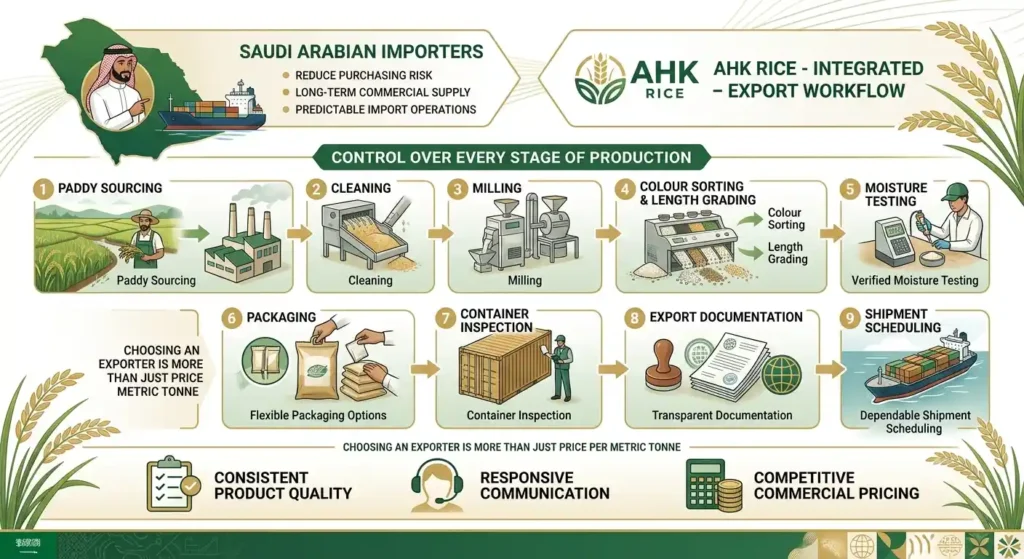
Saudi importers should select exporters that combine consistent product quality, verified moisture testing, transparent documentation, responsive communication, flexible packaging options, competitive commercial pricing, and dependable shipment scheduling. These capabilities reduce purchasing risk while supporting long-term commercial supply relationships and predictable import operations.
Choosing an exporter involves much more than comparing price per metric tonne.
A reliable supplier should demonstrate control over every stage of production, including:
- Paddy sourcing
- Cleaning
- Milling
- Colour sorting
- Length grading
- Moisture testing
- Packaging
- Container inspection
- Export documentation
AHK Rice integrates these processes into a controlled export workflow designed for international buyers.
Export-grade quality control
Each production batch undergoes inspection before shipment.
Typical quality checks include:
- Moisture analysis
- Broken percentage verification
- Foreign matter inspection
- Grain length consistency
- Colour uniformity
- Packaging inspection
- Weight verification
These inspections help ensure every shipment aligns with contractual specifications.
Documentation support
Saudi importers generally request documentation such as:
- Commercial Invoice
- Packing List
- Certificate of Origin
- Phytosanitary Certificate
- Fumigation Certificate (when required)
- Quality Certificate
- Bill of Lading
AHK Rice prepares shipment documentation according to buyer requirements and destination regulations.
Flexible packaging
Saudi buyers purchase rice in multiple retail and wholesale formats, including:
- 1 kg
- 2 kg
- 5 kg
- 10 kg
- 20 kg
- 25 kg
- 35 kg
- 40 kg
- 50 kg PP bags
- Custom private-label packaging
Private branding options are also available for distributors and supermarket suppliers.
What results can buyers expect when working with AHK Rice?
Buyers can expect consistent moisture specifications, improved product stability during transport, reliable documentation, timely communication, flexible order planning, and professional export coordination that supports smoother customs clearance, lower quality risks, and stronger long-term commercial partnerships with dependable supply continuity.
When moisture remains within the agreed export specification, several commercial advantages become more predictable.
Better shelf life
Proper moisture control helps maintain grain condition during:
- Ocean freight
- Port storage
- Warehouse storage
- Retail distribution
This contributes to longer commercial shelf life under suitable storage conditions.
Reduced shipment claims
Consistent quality reduces the likelihood of disputes relating to:
- Damp rice
- Condensation
- Mould
- Odours
- Excessive breakage
Although no exporter can eliminate every logistics-related risk, controlled production significantly lowers avoidable quality issues.
Improved customer satisfaction
Retailers and wholesalers benefit from:
- Better grain appearance
- Consistent cooking performance
- Uniform aroma
- Cleaner packaging presentation
These characteristics support repeat purchasing.
Reliable commercial planning
Many Saudi importers purchase throughout the year.
Working with AHK Rice enables buyers to discuss:
- Scheduled production
- Multiple container orders
- Seasonal procurement
- Annual contracts
- Repeat shipment planning
How much does export-grade Pakistan Basmati rice for Saudi Arabia cost?
Pricing depends on rice variety, crop season, grain specifications, moisture requirements, packaging type, branding, shipment volume, freight conditions, certification requirements, and international market movements. Comparing quotations should include quality specifications rather than focusing only on the lowest offered price per metric tonne.
There is no universal export price because several commercial variables influence quotations.
Key pricing factors include:
Rice variety
Examples include:
- Super Kernel Basmati
- 1121 Steam
- 1121 Sella
- 1121 White
- PK 386
- IRRI varieties
Each variety has different market demand.
Moisture specification
Special contractual moisture requirements may require additional processing and testing.
Packaging
Private-label retail packaging generally costs more than standard export bags due to:
- Printing
- Design
- Smaller packing sizes
- Additional handling
Quantity ordered
Large-volume container orders generally achieve better pricing efficiencies than smaller shipments.
Freight market
Ocean freight rates continue to fluctuate depending on:
- Shipping line capacity
- Fuel costs
- Port congestion
- Seasonal demand
Freight should always be quoted separately unless purchasing under delivered terms.
What is the sample process before placing a commercial order?
Professional exporters provide structured sampling procedures that allow buyers to evaluate grain quality, moisture specifications, cooking characteristics, aroma, packaging, and documentation before confirming larger commercial contracts. Sampling reduces purchasing uncertainty while building confidence between exporter and importer before container production begins.
Sampling is an essential part of international rice procurement.
AHK Rice typically follows a structured process.
Step 1 — Requirement discussion
The buyer confirms:
- Rice variety
- Grain length
- Moisture specification
- Packaging
- Quantity
- Destination port
Step 2 — Sample preparation
Representative samples are selected from export-quality production.
Step 3 — Laboratory verification
Where requested, laboratory testing may include:
- Moisture
- Broken percentage
- Purity
- Foreign matter
Step 4 — Sample dispatch
Samples are shipped using international courier services.
Step 5 — Buyer evaluation
The buyer reviews:
- Appearance
- Aroma
- Cooking performance
- Moisture
- Packaging
Step 6 — Commercial quotation
Following sample approval, the commercial quotation is prepared.
Typical sample costs
Sample costs vary depending on destination, courier provider, sample weight, and laboratory testing requirements.
Typical commercial practice includes:
| Item | Typical Cost (USD) |
|---|---|
| Rice sample | Often complimentary or charged at product value |
| Courier charges | Approximately $40–$120 depending on destination and weight |
| Laboratory testing (if requested) | Approximately $25–$80 per analysis |
| Special customised packaging sample | Additional cost may apply |
Many exporters deduct approved sample costs from confirmed commercial orders, although this depends on agreed sales terms.
How many shipping days are required from Pakistan to Saudi Arabia?
Shipping time depends on the Saudi destination port, vessel schedules, customs procedures, and selected shipping line. Production planning should consider both manufacturing lead time and ocean transit to maintain reliable inventory availability throughout the import supply chain.
Estimated sea freight transit times are typically:
| Saudi Destination | Estimated Ocean Transit |
|---|---|
| Jeddah Islamic Port | 10–15 days |
| Dammam | 12–18 days |
| Riyadh (via Dammam) | 15–22 days including inland movement |
| King Abdullah Port | 10–16 days |
| Jubail | 13–19 days |
Production before shipment generally requires approximately 10–20 days, depending on:
- Packaging requirements
- Order size
- Seasonal demand
- Private labelling
- Inspection scheduling
Buyers should confirm current vessel schedules before issuing purchase orders.
How can Saudi importers get started?
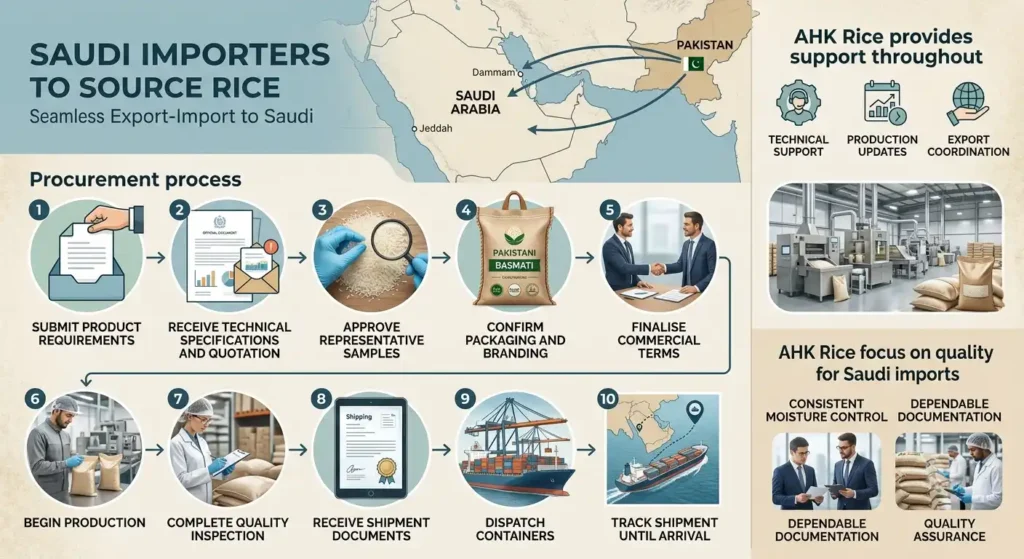
The purchasing process becomes straightforward when buyers define technical specifications, review samples, compare documentation, confirm commercial terms, approve production, and coordinate shipment schedules with an experienced exporter capable of maintaining quality throughout the complete export supply chain.
A typical procurement process includes:
- Submit product requirements.
- Receive technical specifications and quotation.
- Approve representative samples.
- Confirm packaging and branding.
- Finalise commercial terms.
- Begin production.
- Complete quality inspection.
- Receive shipment documents.
- Dispatch containers.
- Track shipment until arrival.
Throughout this process, AHK Rice provides technical support, production updates, and export coordination to help Saudi buyers source Pakistan Basmati rice with confidence. Whether purchasing for wholesale distribution, retail brands, food service, or long-term contracts, AHK Rice focuses on consistent moisture control, dependable documentation, and quality assurance that supports successful imports into Saudi Arabia. Buyers seeking export-grade Pakistani Basmati rice can review educational guidance, compare technical specifications, and work directly with AHK Rice to develop supply arrangements suited to their commercial requirements. When you are ready to discuss your specifications and receive a tailored quotation from AHK Rice,
Frequently Asked Questions
What moisture level is considered export grade for Pakistan Basmati rice shipped to Saudi Arabia?
Most Saudi Arabian buyers prefer Pakistan Basmati rice with moisture levels around 12%–13%, depending on contractual specifications and the rice variety. Proper moisture helps preserve grain quality during storage and sea freight.
Why is moisture content important when importing Basmati rice into Saudi Arabia?
Correct moisture levels reduce the risk of mould, discoloration, unpleasant odours, and excessive grain breakage during transportation. It also helps maintain the rice’s aroma, texture, and shelf life.
How does AHK Rice verify moisture levels before export?
AHK Rice conducts moisture testing at multiple stages of processing, including milling, grading, and final pre-shipment inspection. Quality reports can be provided based on buyer requirements.
Can I request a rice sample before placing a bulk order?
Yes. AHK Rice offers export-quality rice samples so buyers can evaluate grain length, aroma, cooking performance, moisture content, and overall quality before confirming a commercial order.
How long does it take to ship Pakistan Basmati rice to Saudi Arabia?
Sea freight from Pakistan to Saudi Arabia generally takes 10 to 18 days, depending on the destination port, shipping line, and vessel schedule. Production time is additional and depends on the order specifications.
What packaging options are available for Saudi Arabian importers?
AHK Rice supplies Basmati rice in 1 kg, 2 kg, 5 kg, 10 kg, 20 kg, 25 kg, 35 kg, 40 kg, and 50 kg bags, along with customised private-label packaging for wholesalers and retailers.
What documents are included with an export shipment?
Typical export documents include the Commercial Invoice, Packing List, Certificate of Origin, Phytosanitary Certificate, Bill of Lading, and other certificates required by Saudi Arabian import regulations.
What factors affect the price of Pakistan Basmati rice exports?
Pricing depends on the rice variety, moisture specification, grain grade, packaging type, order volume, certifications, shipping terms, and current international market conditions.
Which Pakistan Basmati rice varieties are popular in Saudi Arabia?
Saudi Arabian buyers commonly import 1121 Basmati White, 1121 Steam, 1121 Sella, Super Kernel Basmati, and other premium Pakistani rice varieties based on market demand.
How can I place an export order with AHK Rice?
Simply share your required rice variety, quantity, packaging, destination port, and quality specifications. AHK Rice will prepare a quotation, arrange samples if needed, and guide you through the complete export process.