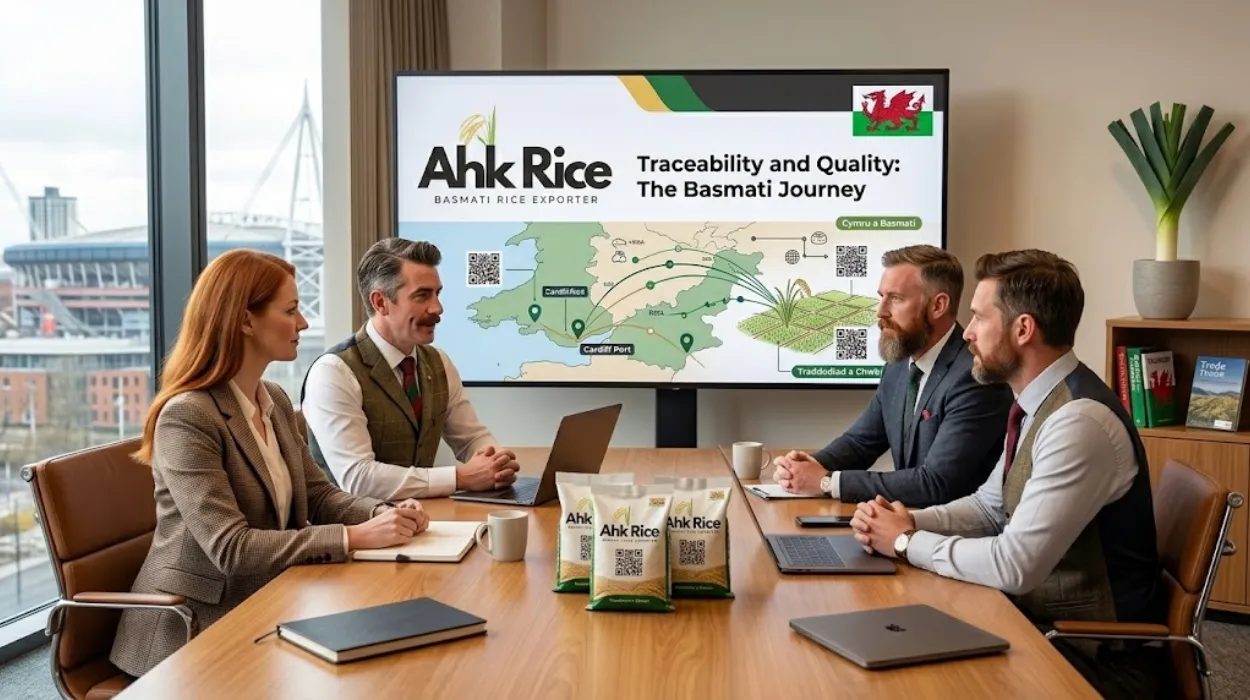
Why Should Welsh Businesses Understand the Basmati Rice Import Journey?
Welsh businesses should understand the Basmati rice import journey because product selection, processing, documentation, customs classification, food safety, and delivery determine how rice reaches the Welsh market. Here is why: each stage connects agricultural production in Pakistan with UK import controls and commercial distribution.
Basmati rice is a long-grain, aromatic, slender, non-glutinous rice variety. UK customs classifies rice using factors such as grain length and length-to-width ratio. Long-grain rice exceeds 6.0 mm, while Basmati includes approved Pakistani varieties such as Kernel Basmati.
What Is the Basmati Rice Import Journey?
The Basmati rice import journey covers cultivation, harvesting, milling, grading, testing, packaging, export documentation, shipping, UK customs clearance, food controls, warehousing, and final distribution.
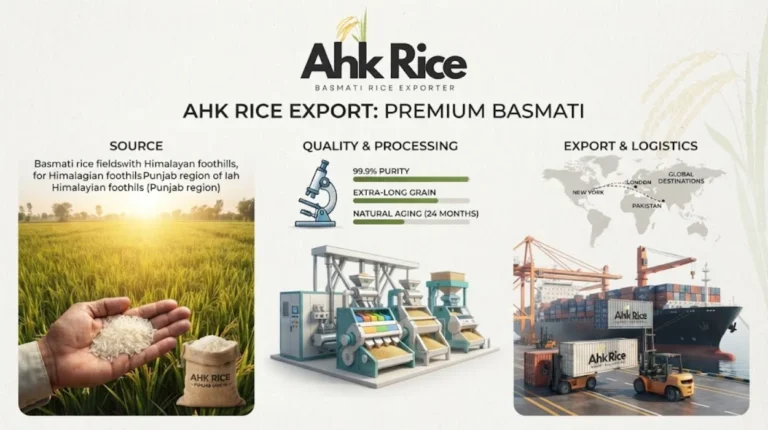
Basmati begins as paddy rice cultivated in agricultural regions of Pakistan. Punjab is a major production area for Pakistani Basmati. Farmers irrigate fields, harvest mature paddy, and transport the crop to rice mills.
The commercial product differs from harvested paddy. Paddy retains its protective husk. Milling removes the husk and produces brown rice. Further polishing produces white rice. Grading separates grains according to length, broken percentage, appearance, and other specifications.
The main Pakistani Basmati varieties relevant to this supply chain include 1121, Super Kernel, and 1509. Each variety serves different commercial specifications. Processing forms include white, Steam, Sella, and Golden Sella rice.
UK customs also distinguishes rice according to processing condition. Categories include paddy rice, husked rice, semi-milled rice, wholly milled rice, and broken rice.
With the product defined, the next question is how Pakistani Basmati moves from cultivation into an exportable specification.
Where Is Basmati Rice Grown and Produced?
Pakistani Basmati rice is cultivated mainly across Punjab, where farmers produce aromatic long-grain varieties for domestic consumption and international food markets.
Punjab provides the agricultural environment associated with Pakistan’s traditional Basmati production. Farmers cultivate rice during the appropriate growing season and harvest mature paddy before transferring it to processing facilities.
AHK Rice operates within this Pakistani supply context and supplies 1121, Super Kernel, and 1509 varieties. These varieties enter commercial supply chains after milling, grading, sorting, quality testing, and packaging.
Agricultural production establishes the raw material specification. Milling then determines the physical condition of the finished rice. This distinction matters because importers purchase a defined product rather than unprocessed paddy.
Welsh businesses therefore need to identify the variety and processing form before discussing price, packaging, or shipment. A 1121 White specification differs from 1121 Golden Sella because the processing method changes the finished product.
Understanding origin establishes the first link in the chain; processing determines the specification that importers actually receive.
How Is Basmati Rice Processed Step by Step?
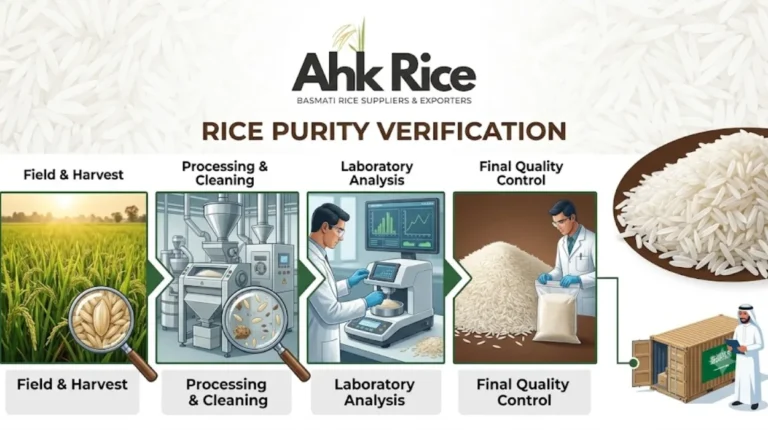
Basmati rice processing converts harvested paddy into export-grade rice through cleaning, dehusking, milling, grading, sorting, testing, and packaging.
Which Processing Steps Create Export-Grade Rice?
Nine core processing stages are cleaning, dehusking, milling, polishing, grading, sorting, processing, testing, and packaging for the defined export specification.
- Clean the paddy to remove stones, dust, straw, and other foreign material.
- De-husk the grain to remove the outer husk and produce brown rice.
- Mill the grain to remove bran layers and produce white rice.
- Polish the grain to achieve the required surface appearance.
- Grade the grain according to length, broken percentage, and physical quality.
- Sort the grain using mechanical and optical systems to remove defective grains.
- Process the rice through Steam, Sella, or Golden Sella treatment where specified.
- Test the rice against agreed quality and food-safety parameters.
- Pack the rice into the selected retail, food-service, or bulk packaging format.
Processing directly affects cooking behaviour, appearance, moisture stability, and commercial value. Sella and Golden Sella rice undergo parboiling and drying before milling. Steam rice follows a different treatment route.
A Welsh importer therefore needs the exact product description before comparing suppliers. The specification should state variety, processing type, grain requirement, broken percentage, moisture requirement, packaging, and destination.
The processing chain establishes product identity, while grading determines the commercial quality within that identity.
What Grades and Varieties Should Welsh Businesses Understand?
Welsh businesses should understand 1121, Super Kernel, and 1509 varieties alongside White, Steam, Sella, and Golden Sella processing forms.
What Is 1121 Basmati?
1121 Basmati is a premium long-grain Pakistani Basmati variety recognised for its slender grain profile and strong elongation during cooking.
1121 is widely used in retail, food service, restaurants, catering, and rice-based prepared foods. Its long grain makes it suitable for dishes where cooked appearance matters.
What Is Super Kernel Basmati?
Super Kernel Basmati is a Pakistani Basmati variety valued for its aromatic profile, long grain structure, and suitability for retail and food-service applications.
Super Kernel serves buyers seeking a recognisable Pakistani Basmati specification. Importers normally define the required processing form and physical grade within the purchase specification.
What Is 1509 Basmati?
1509 Basmati is a Pakistani long-grain variety used across export markets where buyers require aromatic rice with defined grain and processing specifications.
1509 enters different commercial channels according to processing, packaging, price position, and intended use. The same variety therefore supports multiple market requirements.
These varieties become commercially meaningful only after the importer defines processing and quality requirements.
Which Markets Import Basmati Rice?
Basmati rice enters retail, food-service, catering, wholesale, and ethnic-food markets across the UK, Europe, Middle East, Africa, and other international destinations.
The UK represents an established market for Pakistani Basmati. Commercial demand includes retail packs, wholesale formats, restaurant supply, catering, and food manufacturing.
For Welsh businesses, the UK customs system governs imports entering Great Britain. Businesses importing goods into Wales require a GB EORI number and must identify the correct commodity code. The commodity code determines applicable customs treatment and can affect import licensing requirements.
UK rice trade also operates with specific tariff quota arrangements. A 2026 UK government rice notice identifies Pakistan under a quota arrangement for semi-milled or wholly milled rice under CN code 1006 30. The relevant quota process requires supporting documentation and origin information.
The market destination determines commercial demand, while UK import rules determine how the shipment enters Great Britain.
Which Certifications and Documents Apply to Basmati Rice?
Key import documentation includes the commercial invoice, packing details, transport document, origin evidence, commodity classification, and certificates required by the specific shipment.
Which Documents Support UK Import Clearance?
A UK rice shipment requires accurate customs information, product classification, origin evidence, and supporting food-safety documentation required by the applicable import route.
A commercial invoice identifies the seller, buyer, product, quantity, value, and trade terms. A packing list records package quantities and shipment configuration. The bill of lading records maritime transport information.
A certificate of origin establishes where the rice originates. UK rice quota arrangements can require proof of origin for eligible consignments.
Food businesses must also maintain appropriate food-safety controls. Welsh food businesses operate within food hygiene requirements and HACCP-based food safety management principles.
Imported cereals must meet UK food hygiene standards equivalent to those applying to food produced domestically. UK guidance also covers labelling, packaging, pesticides, and food safety considerations for imported cereals.
Certification requirements depend on the product, origin, processing, and import control applicable to the shipment. Businesses should verify current requirements before dispatch.
Documentation connects the physical shipment with its legal identity, and customs classification determines the next stage.
How Does Basmati Rice Move Through UK Trade Channels?
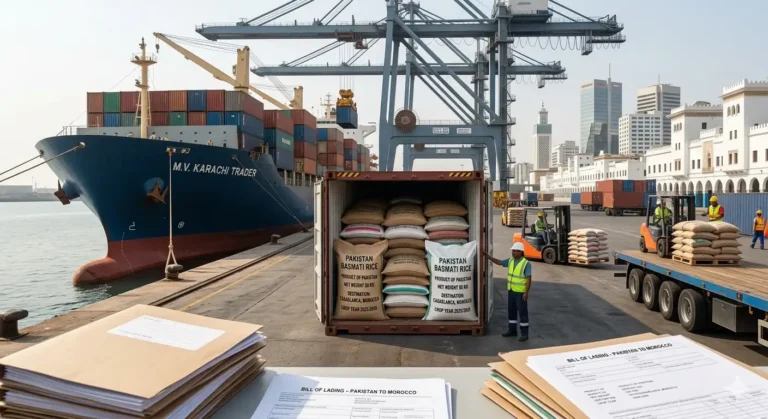
The shipment moves from Pakistani processing facilities to export loading, international transport, UK customs clearance, warehousing, and distribution to Welsh commercial buyers.
The exporter first completes the agreed product specification and prepares the rice for dispatch. Containers are loaded with the approved packaging and documented against the commercial shipment.
The shipping stage moves the container from Pakistan to the UK. The importer or customs agent then handles the relevant customs declaration, commodity code, valuation, origin information, and applicable licensing requirements.
UK government guidance states that importers can manage customs declarations themselves or appoint a customs agent or transporter. Most businesses use specialist customs or transport providers.
Once cleared, the rice moves into UK warehousing or directly toward distribution. Welsh wholesalers, retailers, restaurants, caterers, and food businesses can then receive the product.
Businesses wanting a deeper explanation of this stage should connect this article with the planned guide on [how international rice shipping moves through UK trade channels]([Insert Link to MOFU Article]).
The import journey therefore continues beyond the port because clearance, storage, and distribution determine commercial availability.
What Benefits Does Understanding the Import Journey Provide?
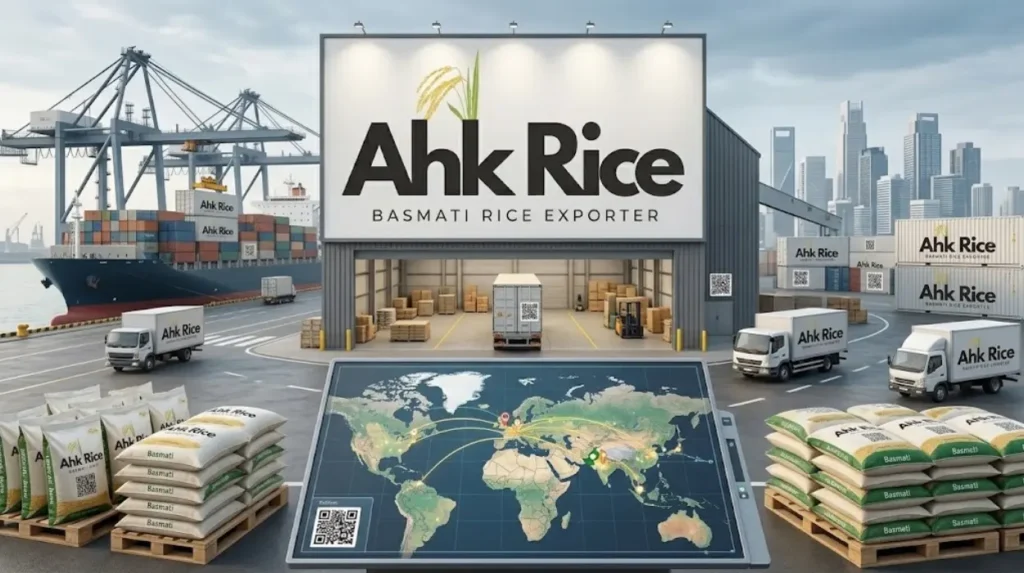
Understanding the journey improves product specification, purchasing accuracy, documentation control, cost planning, food-safety management, and communication with exporters and customs agents.
Specification knowledge prevents buyers from treating every Basmati product as identical. A 1121 White specification differs from a Golden Sella specification because processing changes the product characteristics.
Documentation knowledge reduces avoidable clearance problems. Correct commodity classification and accurate shipment information support customs processing. UK guidance confirms that commodity codes influence duty and import licence requirements.
Food-safety knowledge also supports responsible procurement. Welsh food businesses need food safety management procedures based on HACCP principles.
Supply-chain knowledge improves planning. Buyers can coordinate purchasing, shipping, customs clearance, warehousing, and distribution as connected stages rather than separate activities.
The result is a clearer procurement process based on measurable product and trade requirements.
Where Is Imported Basmati Rice Used in Wales?
Imported Basmati rice serves supermarkets, independent retailers, wholesalers, restaurants, caterers, food manufacturers, hospitality businesses, and specialist food distributors.
Retailers purchase branded or private-label packs for consumers. Wholesalers purchase larger quantities for redistribution. Restaurants and caterers use Basmati for rice dishes, meal preparation, and high-volume service.
Food manufacturers also purchase rice as an ingredient. Processing grade, broken percentage, grain length, packaging, and price become important commercial variables.
Welsh businesses can therefore require different specifications despite purchasing the same broad rice variety. A restaurant can prioritise cooking performance, while a retailer can prioritise appearance, packaging, shelf presentation, and consumer labelling.
The intended use should therefore determine the purchase specification before the shipment is booked.
What Common Problems and Misconceptions Affect Basmati Imports?
Common problems include treating varieties as identical, confusing processing grades, using incorrect commodity codes, overlooking documentation, and assuming every rice shipment follows identical controls.
One misconception is that Basmati means one uniform product. UK classification recognises Basmati as a variety, while commercial suppliers differentiate varieties and processing forms.
Another misconception is that milling alone defines quality. Export quality also depends on grain dimensions, broken percentage, foreign matter, moisture, sorting, packaging, and testing.
A third misconception is that every rice shipment requires the same certification. Import controls depend on the product, origin, and applicable UK rules. UK guidance specifically distinguishes different food and agricultural import requirements.
A fourth misconception is that customs clearance begins at the port. Import preparation starts earlier with EORI registration, commodity classification, valuation, documentation, and shipment planning.
Understanding these distinctions gives Welsh businesses a practical framework for evaluating imported Basmati rice.
Frequently Asked Questions About the Basmati Rice Import Journey
What is Basmati rice?
Basmati is an aromatic, slender, long-grain, non-glutinous rice variety. Pakistani Basmati includes varieties such as Kernel Basmati recognised within UK classification guidance.
Which Pakistani Basmati varieties are commonly supplied?
The principal varieties covered here are 1121, Super Kernel, and 1509. Each variety can be supplied in different processing forms.
What are the main Basmati processing grades?
Common commercial processing forms include White, Steam, Sella, and Golden Sella. Processing changes the physical and cooking characteristics of the finished rice.
Do Welsh businesses need a GB EORI number?
Yes. Businesses importing goods into Wales from outside the UK require a GB EORI number for Great Britain imports.
Does rice require an import licence?
Import licensing depends on the commodity, origin, tariff arrangement, and applicable UK rules. Certain rice imports operate under tariff quota arrangements.
What documents accompany a Basmati rice shipment?
Typical documents include the commercial invoice, packing list, bill of lading, origin evidence, customs information, and applicable quality or food-safety certificates.
What businesses use imported Basmati rice?
Retailers, wholesalers, restaurants, caterers, food manufacturers, hospitality businesses, and specialist food distributors use imported Basmati rice.