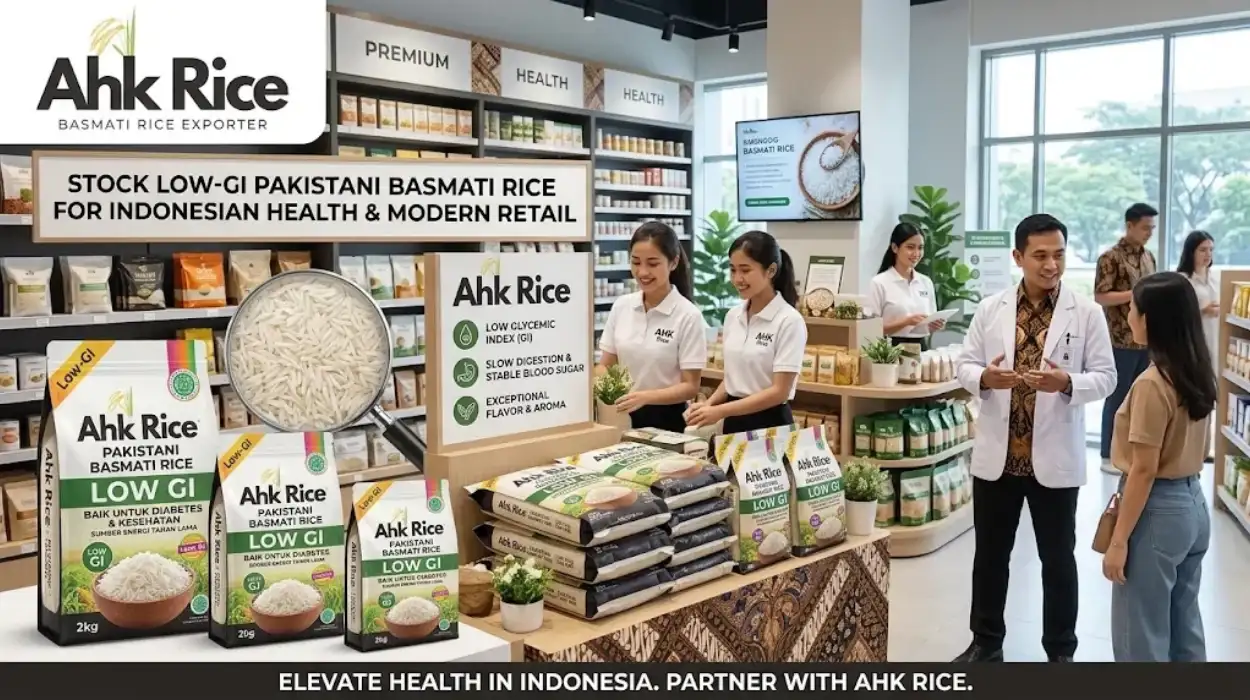
Stock Low-GI Pakistani Basmati Rice for Indonesian Health and Modern Retail
Indonesian health-focused retailers need more than a long-grain rice product. They need a rice specification that supports consumer demand for better-controlled carbohydrate choices, consistent cooking performance, attractive packaging, and dependable replenishment. For importers comparing Basmati with conventional white rice, the decision should start with the evidence covered in Is Basmati Rice a Better Choice for Diabetic Consumers in Indonesia? and then move to commercial product selection.
For buyers already evaluating the nutrition and glycemic-index positioning of different rice categories, the Glycemic Index of Basmati vs White Rice: Nutrition Facts for Indonesian Health Buyers provides the comparison framework. The commercial decision is different: select the Pakistani Basmati grade, approve the specification, validate the sample, and establish a repeatable container supply plan.
What is the best solution for Indonesian retailers seeking lower-GI rice options?
The best solution is specification-controlled Pakistani Basmati supplied in the correct grade, processing format, packaging, and shipment quantity, with cooking performance approved before bulk production. Basmati should be positioned as a suitable dietary option, not marketed as a treatment for diabetes.
For modern Indonesian retail, 1121 Basmati is a strong starting point because its extra-long grain, aroma, and premium presentation support higher-value shelf positioning. Super Kernel provides a more traditional Pakistani Basmati profile, while 1509 offers another long-grain option for buyers balancing product positioning and procurement economics.
The product should be selected according to the target customer. A premium supermarket may require 5 kg or 10 kg retail bags with a clean nutritional and origin presentation. A health-focused distributor may prefer private-label packaging. A foodservice wholesaler can require 25 kg or 50 kg formats.
AHK Rice supplies 1121, Super Kernel, and 1509 Pakistani Basmati from Punjab and can coordinate sourcing, processing, grading, packaging, documentation, and shipment preparation. Its export service is built around specification-based procurement rather than a generic rice quotation.
The important commercial point is that a low-GI positioning does not automatically make every Basmati shipment identical. Cooking method, variety, processing, portion size, and consumer diet all influence the nutritional outcome. Retailers should therefore avoid unsupported medical claims and instead communicate verified product characteristics.
Why choose AHK Rice for Indonesian health and modern retail supply?
AHK Rice provides an end-to-end export process that connects Pakistani Basmati sourcing with product specifications, sample approval, processing, custom packaging, export documentation, and shipment coordination for Indonesian buyers.
The first advantage is product choice. AHK Rice can supply 1121, Super Kernel, and 1509, allowing importers to match the rice to a specific retail or foodservice segment. 1121 is suited to premium long-grain positioning. Super Kernel fits buyers seeking characteristic Pakistani Basmati aroma. 1509 provides another commercial option where grain appearance and procurement value are important.
The second advantage is specification control. Buyers can define grain length, moisture, broken percentage, processing type, packaging, and inspection requirements before production. This creates a measurable purchasing specification that can be checked against the commercial sample and final shipment.
The third advantage is packaging flexibility. Indonesian buyers can discuss bulk bags, retail packs, and private-label requirements. Custom packaging is particularly useful for modern retailers building a differentiated health-oriented rice range.
The fourth advantage is export coordination. AHK Rice can prepare commercial export documentation and coordinate container loading and shipment planning from Pakistan. Buyers remain responsible for confirming their applicable Indonesian import approvals and destination-side requirements.
This approach reduces a common procurement problem: comparing suppliers only by price per metric ton. A lower FOB price does not necessarily produce the lowest landed or operational cost if the grade, packaging, freight, inspection, or documentation differs.
What results can Indonesian buyers expect?
A properly specified Pakistani Basmati order gives retailers a repeatable product reference, predictable packaging requirements, clearer procurement costs, and a practical basis for replenishing health-focused and premium rice shelves.
The first result is product consistency. Once the importer approves the variety and specification, future purchasing can follow the same reference instead of relying on informal descriptions.
The second result is better retail positioning. Long-grain Pakistani Basmati can occupy a premium shelf segment where aroma, grain appearance, origin, and cooking characteristics support differentiation from standard white rice.
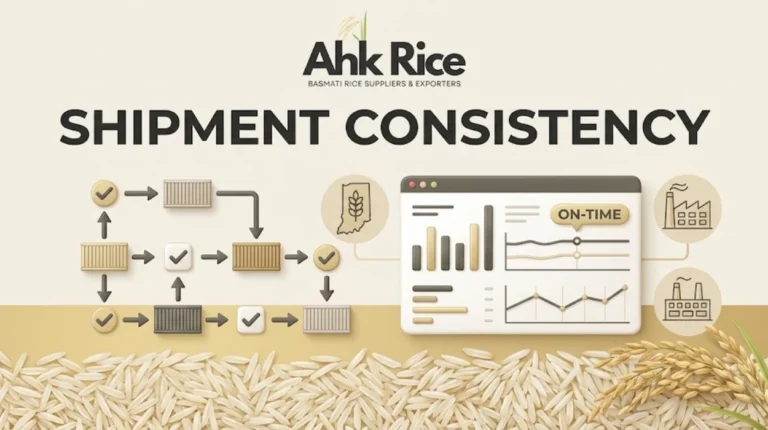
The third result is improved stock planning. AHK Rice states that Indonesian shipments can be planned around major ports including Jakarta and Surabaya, with indicative sea-transit windows generally around 14–21 days, while the complete procurement cycle can extend to approximately four to six weeks because production, documentation, port handling, and vessel scheduling occur before or around ocean transit.
For Jakarta, importers should use Tanjung Priok as a major destination planning point. Surabaya buyers can plan through Tanjung Perak. Northern Indonesian distribution can require routing through Belawan or another appropriate port.
These are planning windows, not guaranteed delivery dates. Vessel availability, transshipment, port congestion, customs clearance, inspection, and inland transportation affect the final delivery schedule.
A practical retail scenario is a supermarket distributor launching a premium Basmati SKU before a promotional period. The buyer can approve the cooking sample, confirm the bag artwork, place the production order, and schedule the container early enough to account for ocean transit and Indonesian clearance.
How much does Pakistani Basmati rice cost for Indonesia?
There is no single fixed Indonesia price because the final quotation depends on variety, processing, specification, quantity, packaging, inspection, freight, insurance, destination port, and the selected FOB or CIF basis.
FOB Karachi is useful for importers with their own freight arrangements. CIF is more practical when the buyer wants the exporter to quote the rice together with agreed ocean freight and insurance to the named Indonesian port.
Current AHK Rice references indicate that 1121 pricing can start around US$1,100 per MT on an FOB Karachi basis, but this is a reference rather than a guaranteed current quotation for every grade or shipment.
For a health-focused retail program, buyers should request the price against a complete specification:
- Variety: 1121, Super Kernel, or 1509
- Processing: White, Steam, Golden Sella, or other approved format
- Grain length and appearance
- Moisture and broken percentage
- Quantity per shipment
- Retail or bulk packaging
- Printed or private-label bags
- Destination port
- FOB or CIF terms
- Inspection requirements
- Required export documents
Packaging can materially affect the commercial offer. A plain export bag and a professionally printed private-label retail bag are different procurement projects.
The same principle applies to inspection. An importer requiring third-party verification should specify this before the quotation is finalised. AHK Rice indicates that third-party inspection can be arranged, with the buyer covering the inspection cost.
How does the sample process work before a commercial order?
The sample process starts with the buyer’s specification, moves through sample dispatch and cooking evaluation, and ends with written approval before commercial production. International courier and applicable phytosanitary costs are normally paid by the buyer.
First, the Indonesian buyer identifies the required variety and application. For example, a premium retailer may request 1121 White or Steam Basmati, while an aromatic specialty distributor may request Super Kernel.
Second, AHK Rice confirms the sample quantity and dispatch requirements. Eligible sampling arrangements can provide up to 20 kg of rice, while the buyer covers international courier transportation and applicable phytosanitary charges.
Third, the buyer evaluates the sample. The assessment should include raw grain appearance, aroma, cooking expansion, texture, separation, and suitability for the intended retail or foodservice use.
Fourth, the importer approves the commercial specification. The approved reference should identify the variety, processing method, grain characteristics, moisture, broken percentage, packaging, and other agreed quality parameters.
Fifth, the exporter prepares the commercial order. Production, packing, documentation, inspection, and container loading proceed according to the approved requirements.
This process matters because a sample should not be treated as an isolated promotional item. It should become the quality reference for the commercial shipment.
How can Indonesian buyers get started with AHK Rice?
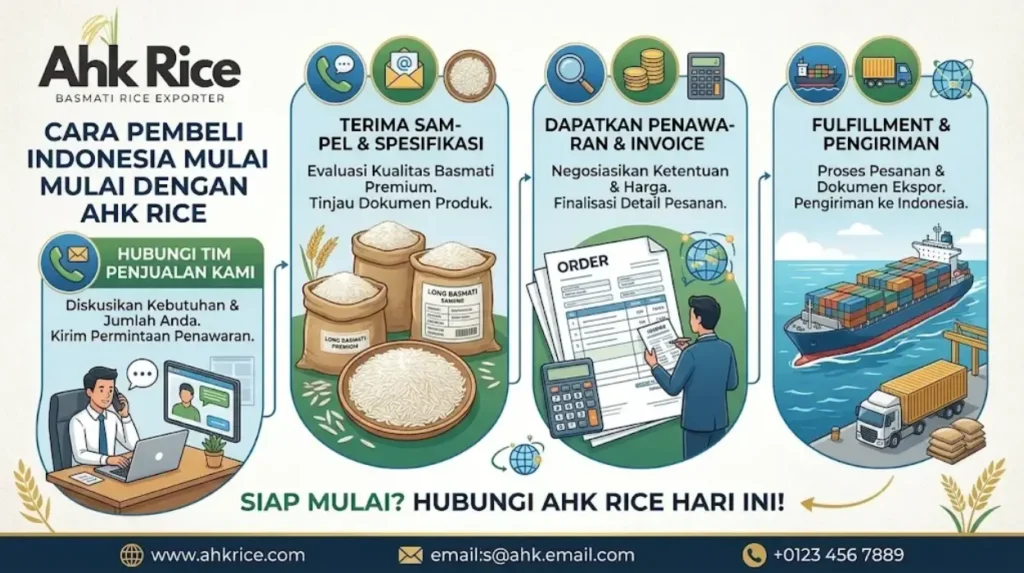
Start by sending the required Basmati variety, processing type, quantity, packaging format, destination port, and target market to AHK Rice, then request a specification-based quotation and representative sample before committing to regular stock.
The first step is product selection. Decide whether the target is premium retail, health-oriented grocery, foodservice, or wholesale distribution.
The second step is specification approval. Define the grain characteristics, processing, moisture, broken percentage, packaging, and inspection requirements.
The third step is sampling. Request the appropriate product sample and conduct a cooking test using the preparation method relevant to Indonesian consumers.
The fourth step is commercial quotation. Compare FOB Karachi and CIF Indonesia when both bases are useful for landed-cost planning.
The fifth step is import readiness. The Indonesian importer must confirm the current applicable import permissions, product classification, food requirements, labelling rules, and customs documentation before dispatch. Indonesian import controls can change, so the importer should verify the requirements applicable to the specific shipment.
The sixth step is production and shipment. AHK Rice can coordinate processing, packaging, documentation, container loading, and export dispatch according to the approved order.
For a modern Indonesian retailer, the strongest purchasing decision is therefore not simply “buy low-GI rice.” It is to establish a documented Basmati product specification, validate the cooking result, calculate the complete landed cost, and secure a repeatable supply schedule.
AHK Rice gives buyers a practical route from Pakistani origin to Indonesian retail supply, while the importer retains control over the final market specification and regulatory approval process.
Frequently Asked Questions
Is Pakistani Basmati suitable for Indonesian health-focused retail?
Pakistani Basmati can support premium and health-oriented rice categories.
1121 provides strong long-grain retail presentation.
Super Kernel provides traditional Pakistani Basmati aroma.
1509 offers another commercial long-grain option.
Retailers should avoid unsupported medical claims and verify their nutrition messaging.
How long does Pakistani Basmati take to reach Indonesia?
Jakarta and Surabaya planning can use approximately 14–21 days of sea transit.
Other Indonesian destinations require route-specific confirmation.
Production and export preparation add time before vessel departure.
The overall procurement cycle can reach approximately four to six weeks.
Customs clearance and inland delivery require additional planning.
Can Indonesian buyers receive Pakistani Basmati samples?
Yes, AHK Rice can arrange representative samples for Indonesian buyers.
Eligible sampling arrangements can provide up to 20 kg of rice.
The buyer normally pays international courier transportation.
Applicable phytosanitary costs can also be charged to the buyer.
Commercial production follows the approved product specification.
What packaging is available for modern Indonesian retailers?
AHK Rice can discuss retail and bulk packaging requirements.
Common commercial formats include 5 kg, 10 kg, 25 kg, and 50 kg bags.
Private-label packaging can be developed around approved artwork.
Packaging must follow the importer’s Indonesian market requirements.
The final packaging specification should be confirmed before production.
How should Indonesian buyers request a quotation?
Send the required variety, processing type, quantity, and destination port.
Include preferred packaging and private-label requirements if applicable.
Ask for both FOB Karachi and CIF Indonesia when useful.
Confirm inspection, documentation, and sample requirements before comparing prices.
Then approve the sample and commercial specification before placing the bulk order.