Is Basmati Rice a Better Choice for Diabetic Consumers in Indonesia?
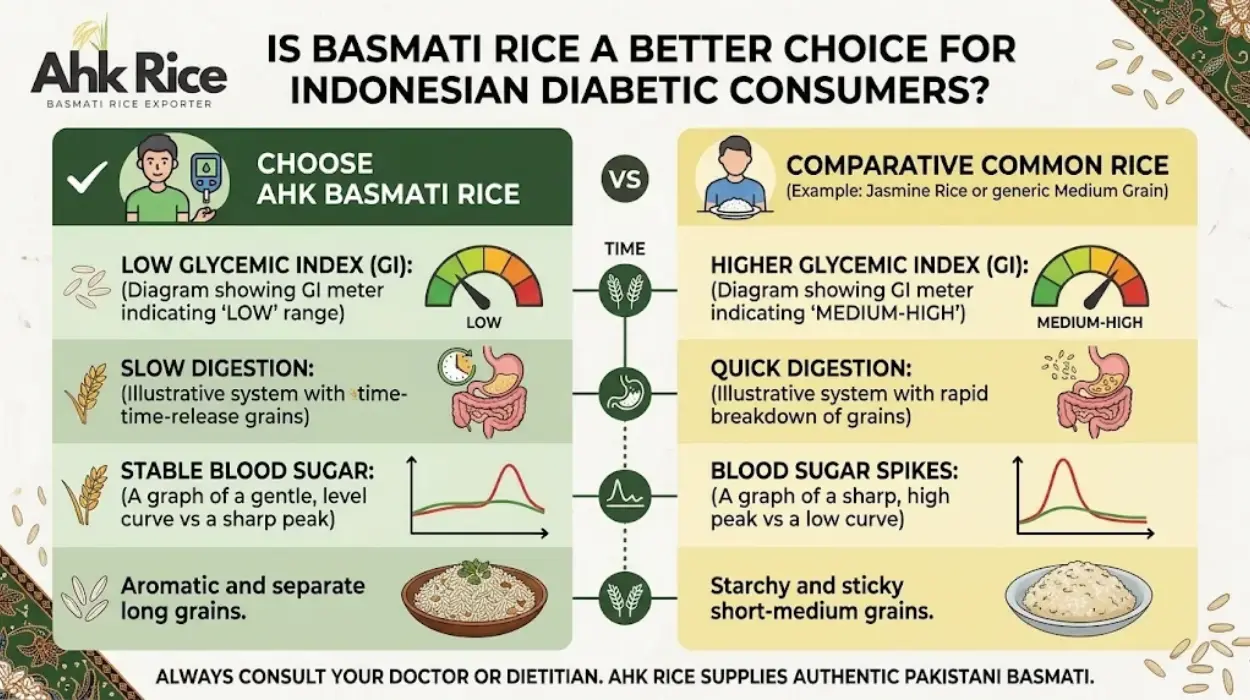
For diabetic consumers in Indonesia, Basmati rice is a better choice than many ordinary white-rice options when the priority is controlling the post-meal glucose response, but portion size, preparation method, total carbohydrate intake, and the specific rice variety remain more important than the Basmati label alone.
Rice is a major carbohydrate source in Indonesia, so choosing between imported Basmati and local Beras requires more than comparing grain length or aroma. Understanding the differences between Pakistani Basmati rice and Indonesian Beras helps buyers evaluate grain structure, starch behaviour, cooking texture, and the type of rice used in everyday meals.
The key point is that Basmati is not automatically a “diabetic rice.” Its advantage comes from its generally lower glycemic response compared with many high-GI white rice varieties, especially when consumed in controlled portions. For Indonesian health-focused buyers, the strongest strategy is to select an appropriate Basmati grade and combine it with balanced meals.
What are the available rice solutions for diabetic consumers in Indonesia?
The main solutions are Pakistani Basmati, lower-GI rice alternatives, and controlled portions of conventional Indonesian white rice. Basmati provides a practical option because its starch characteristics and cooking behaviour can produce a lower post-meal glucose response than many ordinary white rice varieties.
Indonesian consumers have several rice choices. Conventional white rice remains the dominant staple because it is familiar, widely available, soft after cooking, and economical. However, many white rice varieties produce a relatively rapid rise in blood glucose.
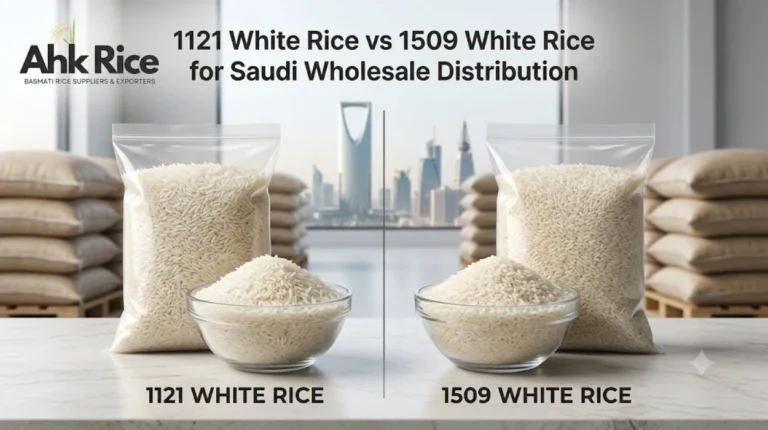
Pakistani Basmati provides another option. It is an aromatic long-grain rice grown primarily in Punjab. Commercial varieties include 1121, Super Kernel, and 1509. These varieties differ in grain length, aroma, processing, cooking texture, and commercial positioning.
Brown rice provides a third approach. It retains more of the bran layers and provides more dietary fibre than polished white rice. It also has a different texture and cooking requirement.
Parboiled or Sella rice provides another strategy. Parboiling changes the physical and starch characteristics of rice and produces firmer, more separate cooked grains.
For diabetic consumers, however, the rice variety is only one part of the dietary decision. A large serving of Basmati still supplies substantial carbohydrate. Portion control remains essential.
How do Basmati and Indonesian white rice compare for blood-glucose management?
Basmati generally offers a more favourable glycemic profile than many conventional white rice varieties, particularly when properly portioned. The difference comes from starch structure, amylose content, processing, cooking conditions, and the amount of rice consumed in one meal.
The glycemic index (GI) ranks carbohydrate-containing foods according to how quickly they raise blood glucose compared with a reference food. A lower GI means a slower increase, while a higher GI indicates a faster glucose response.
Rice GI varies substantially. The same rice variety can produce different results depending on milling, processing, cooking time, cooling, reheating, and meal composition.
Basmati is commonly associated with a lower GI than many standard white rice varieties. This makes it attractive for consumers who need better control over post-meal glucose levels.
However, GI should not be treated as a fixed number printed on every bag. Laboratory testing conditions differ, and actual glucose response varies according to preparation and individual metabolism.
For an Indonesian consumer, the practical comparison is therefore not simply “Basmati versus white rice.” The better question is:
Which rice, serving size, cooking method, and meal combination provides the desired carbohydrate load?
7-attribute specification comparison
| Attribute | Pakistani Basmati | Indonesian White Rice |
|---|---|---|
| Grain structure | Long and slender | Varies by local variety |
| Aroma | Distinctive natural Basmati aroma | Usually mild to moderate |
| Cooked texture | Fluffy and separate | Often softer and more cohesive |
| Typical GI positioning | Often lower than many white rice types | Often moderate to high |
| Portion requirement | Still requires carbohydrate control | Requires strict portion control |
| Premium health positioning | Strong | Mainly everyday staple |
| Best application | Controlled portions, premium meals, aromatic dishes | Everyday Indonesian meals |
This comparison does not mean every Basmati product has a low GI. Processing and cooking remain important.
How do different Basmati approaches compare for Indonesian health buyers?
1121, Super Kernel, 1509, Steam, White, and Sella each serve different commercial and cooking purposes. For health-focused consumers, the best selection depends less on grain length and more on processing, portion control, cooking texture, and the complete meal.
1121 Basmati
1121 is an extra-long Pakistani Basmati variety. It is particularly suitable for premium retail, restaurants, hotels, and foodservice applications where long cooked grains and visual presentation matter.
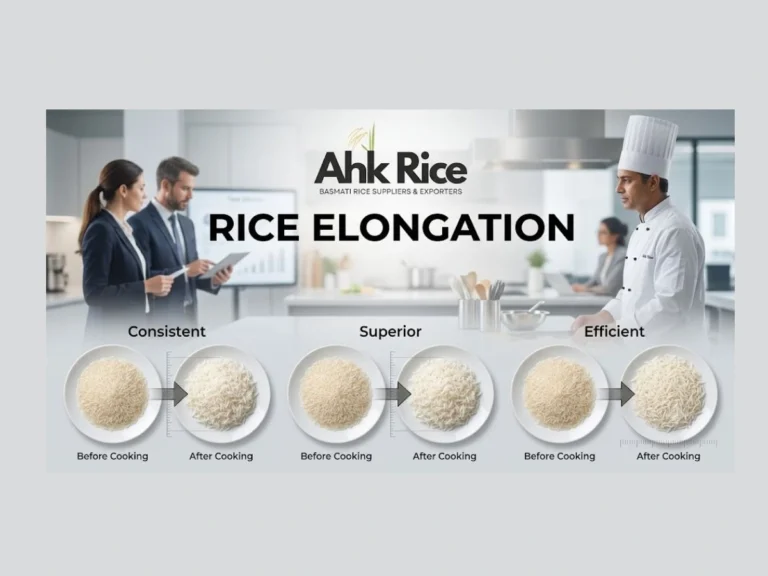
Its strong grain elongation makes it attractive for biryani, pulao, and other rice dishes where separate grains are desirable.
For health-focused retail, 1121 provides a premium Basmati identity, but its nutritional advantage still depends on portion size and preparation.
Super Kernel Basmati
Super Kernel provides strong traditional Pakistani Basmati aroma and a slightly different grain profile from 1121.
It fits consumers who value fragrance and separate cooked grains. It also suits South Asian specialty stores and Indonesian distributors targeting premium or imported-rice consumers.
1509 Basmati
1509 provides an extra-long grain profile with a competitive premium-value position.
For Indonesian buyers, it can serve a segment seeking Basmati characteristics without selecting the highest-priced premium grade.
The health comparison remains similar. 1509 should not be classified as a diabetic-specific rice simply because it is Basmati.
White, Steam, and Sella
Processing changes the eating experience.
White Basmati provides a clean appearance and traditional cooked texture. Steam processing creates firmer grains. Sella is parboiled and generally produces firmer, separate grains.
For foodservice buyers, Steam and Sella can provide better grain integrity during preparation and holding.
For diabetic consumers, the relevant question is whether the selected processing method, serving size, and cooking process produce a suitable carbohydrate response.
Which Basmati method works best for different Indonesian market regions?
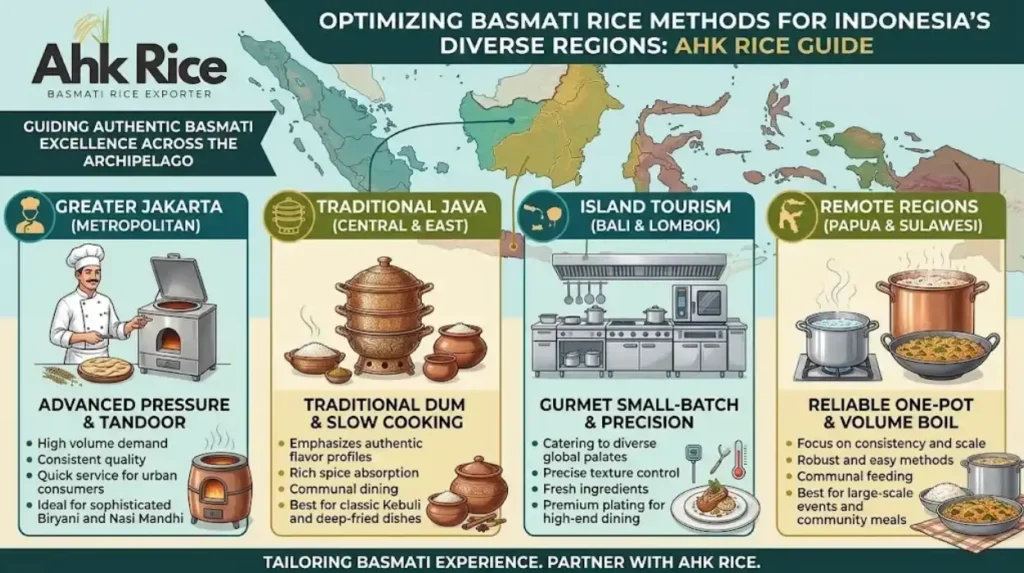
Jakarta and Java favour premium retail and specialty foodservice applications, while Bali and eastern Indonesian markets provide stronger opportunities through hotels, resorts, restaurants, and tourism-driven foodservice. Grade selection should follow the customer segment rather than treating Indonesia as one uniform market.
Region 1: Java and Greater Jakarta
Jakarta and the wider Java market provide a strong environment for premium supermarkets, specialty grocery stores, hotels, restaurants, and distributors.
1121 White fits premium retail where long grain appearance and aroma support a higher-value position.
Super Kernel White suits consumers who prioritise traditional Basmati fragrance.
1509 Steam provides a premium-value option for foodservice operators seeking long grains and firmer cooking performance.
For health-focused retail, packaging can communicate portion guidance, cooking information, and appropriate nutritional information according to Indonesian labelling requirements.
Region 2: Bali and eastern Indonesia
Bali provides a strong tourism and hospitality market. Hotels, resorts, international restaurants, catering companies, and premium foodservice businesses require rice varieties for specialised menus.
1121 Steam suits premium restaurant presentation.
1121 Golden Sella suits catering and bulk preparation where grain firmness is important.
Super Kernel Sella suits aromatic rice programs requiring firm, separate grains.
1509 Steam provides a competitive foodservice alternative.
Eastern Indonesian markets require additional attention to domestic transportation and distribution costs. Imported rice with a higher landed cost needs a clear premium positioning to maintain commercial viability.
How does the price and shelf life compare?
Indonesian domestic rice generally provides a lower entry cost, while Pakistani Basmati carries a premium linked to variety, processing, grain specifications, packaging, freight, and import costs. Properly stored milled rice commonly has a planning shelf life of about 12–24 months.
Price comparison requires careful interpretation.
Indonesian domestic rice prices are normally quoted within the domestic market and regulatory framework. Pakistani Basmati is imported and therefore includes additional logistics, freight, customs, distribution, and commercial costs.
A previous Indonesia comparison using 2025 benchmarks showed Indonesian premium-rice price ceilings around Rp14.9 million per MT in Java and Rp15.8 million per MT in Maluku and Papua. These figures are domestic benchmarks rather than Basmati import quotations.
AHK Rice has published an illustrative Super Kernel FOB Karachi benchmark of US$1,165–US$1,205 per MT. This is not a live Indonesian landed price. The final Basmati quotation depends on grade, quality, quantity, packaging, destination, freight, and Incoterm.
| Factor | Indonesian domestic rice | Pakistani Basmati |
|---|---|---|
| Purchase position | Everyday staple | Premium/imported |
| Main cost driver | Domestic supply | Grade + freight + import costs |
| Price per MT | Lower domestic benchmark | Higher specification-based cost |
| Shelf-life planning | Commonly 12–24 months | Commonly 12–24 months |
| Storage requirement | Cool, dry, protected | Cool, dry, protected |
| Health positioning | Depends on variety | Stronger lower-GI positioning |
Shelf life is not determined by Basmati identity alone. Moisture, milling quality, packaging, temperature, humidity, pest control, and storage conditions all affect product stability.
What are the pros and cons for diabetic consumers?
Basmati offers a useful lower-GI alternative to many conventional white rice products, but it remains a carbohydrate-rich food. Its main advantage is the potential for a slower glucose response, while its main limitation is that excessive portions still increase total carbohydrate intake.
Advantages
Lower glycemic positioning: Basmati generally produces a lower glycemic response than many standard white rice varieties.
Longer grain structure: Separate grains make it easier to visually control serving size.
Strong meal compatibility: Basmati works well with vegetables, legumes, lean proteins, fish, and other balanced foods.
Premium variety selection: Indonesian buyers can select between 1121, Super Kernel, and 1509 according to market requirements.
Multiple processing choices: White, Steam, and Sella provide different cooking characteristics.
Limitations
Basmati is still carbohydrate-rich: Lower GI does not mean low carbohydrate.
Serving size remains critical: A large bowl can deliver a substantial carbohydrate load even when the rice has a lower GI.
Cooking affects response: Overcooking can change texture and starch availability.
Price is higher: Imported Basmati includes freight and import-related costs.
Individual response differs: Consumers with diabetes should follow their clinician or dietitian’s dietary plan and monitor their own glucose response where appropriate.
What five factors should Indonesian health buyers use when choosing rice?
Indonesian buyers should evaluate GI positioning, carbohydrate portion, rice variety, processing method, and complete meal composition. Price and aroma matter for commercial purchasing, but health-focused decisions require attention to nutrition, serving size, preparation, and consumer needs.
| Decision factor | What to check | Best approach |
|---|---|---|
| Glycemic response | Rice type and preparation | Choose Basmati over higher-GI white rice where appropriate |
| Portion size | Carbohydrate per serving | Control cooked-rice quantity |
| Variety | 1121, Super Kernel, 1509 | Match grade to consumer segment |
| Processing | White, Steam, Sella | Select according to cooking and meal requirements |
| Meal composition | Protein, vegetables, fibre | Build a balanced meal rather than eating rice alone |
The most practical strategy is therefore not to remove rice completely. It is to improve the rice choice, control the serving, and improve the overall meal composition.
Is Basmati a better choice than Indonesian white rice for diabetic consumers?
Basmati is often the stronger rice choice for diabetic consumers when compared with higher-GI white rice, but it does not replace portion control or a balanced diet. The strongest option combines an appropriate Basmati variety with controlled servings and nutrient-rich foods.
Indonesian health buyers should avoid treating “Basmati” as a medical claim. It is a rice category, not a diabetes treatment.
The commercial opportunity lies in providing a better-informed rice choice. Retailers can offer premium Basmati alongside nutritional guidance and clear serving information.
For Indonesian consumers, 1121, Super Kernel, and 1509 provide different grain and aroma profiles. Steam and Sella provide additional cooking options.
The final choice should therefore combine rice variety + processing + portion + meal composition + consumer preference.
For buyers evaluating the nutritional side in greater detail, the next-stage comparison should focus specifically on the glycemic index and nutrition facts of Basmati versus ordinary white rice.
Frequently Asked Questions
Is Basmati rice good for diabetic consumers?
Basmati can be a suitable rice choice for people with diabetes because it generally has a lower glycemic response than many conventional white rice varieties. Portion size and total carbohydrate intake remain important.
Is Basmati rice low in sugar?
Rice is not normally classified according to sugar content. Basmati is primarily a carbohydrate food containing starch. Its relevance for diabetes relates mainly to carbohydrate quantity and glycemic response.
Which Basmati rice is best for diabetic consumers?
There is no single Basmati variety that is medically established as the best choice. 1121, Super Kernel, and 1509 can all fit a controlled diet when portions and preparation are appropriate.
Is Pakistani Basmati better than Indonesian white rice?
For consumers prioritising a lower glycemic response, Pakistani Basmati can be a better option than many conventional white rice varieties. Indonesian rice remains useful for consumers who prefer local varieties, familiar texture, and lower cost.
Does cooking Basmati rice affect its glycemic response?
Yes. Cooking changes starch structure and texture. Preparation method, cooking time, cooling, reheating, and the composition of the meal can influence the glucose response.
Can diabetic consumers eat Basmati every day?
Basmati can be included in a balanced eating pattern, but daily consumption should follow individual carbohydrate requirements. Portion control is more important than simply choosing Basmati.
Is brown rice better than Basmati for diabetes?
Brown rice retains more bran and generally provides more fibre than polished white Basmati. However, the better choice depends on the individual’s dietary needs, tolerance, preparation, and total carbohydrate intake.
Does Sella Basmati have a lower GI?
Sella is parboiled rice, and parboiling changes starch characteristics. However, a specific Sella product should not be assigned a fixed GI without appropriate testing.
Which Indonesian market is best for premium Basmati?
Greater Jakarta and Java are strong markets for premium retail and specialty foodservice. Bali and other tourism-heavy regions provide opportunities through hotels, resorts, restaurants, and catering.
What should buyers check before importing Pakistani Basmati into Indonesia?
Buyers should verify the applicable import approval, food requirements, labelling, halal requirements, rice standards, phytosanitary documentation, product specifications, and destination clearance procedures before shipment.