Super Kernel Basmati for Private Label: How to Create Your Own Rice Brand
Super Kernel Basmati private label builds a branded rice product using long-grain Pakistani basmati processed, packaged, and labeled under a buyer’s identity. Here is why: Super Kernel offers consistent 7.00–7.40 mm grain length, strong aroma, and global demand stability, which supports repeat retail sales.
What is Super Kernel Basmati private label and how does it define your own rice brand?
Super Kernel Basmati private label means sourcing 7.00–7.40 mm aromatic long-grain rice, packaging it with custom branding, logos, and specifications, and selling it as your own product in retail or wholesale markets.
Super Kernel Basmati refers to a traditional basmati variety cultivated in Punjab, Pakistan. Farmers grow this variety using canal irrigation systems and controlled harvesting cycles. The grain develops a distinct aroma during post-harvest aging, which increases export value.
Private labeling transforms this agricultural product into a branded commodity. A buyer defines packaging size, design, and grade specifications. Exporters mill and pack the rice accordingly. The final product carries the buyer’s brand identity instead of the miller’s name.
Rice brand Pakistan represents a supply ecosystem. It includes farmers, millers, exporters, and logistics providers. Each participant contributes to transforming raw paddy into a retail-ready product.
Private labeling creates differentiation. Retailers control pricing, positioning, and target markets. Examples include supermarket brands, catering supply labels, and ethnic food store brands.
With the definition established, the next question is how the private label process works step by step.
How does the Super Kernel Basmati private label process work from farm to shelf?
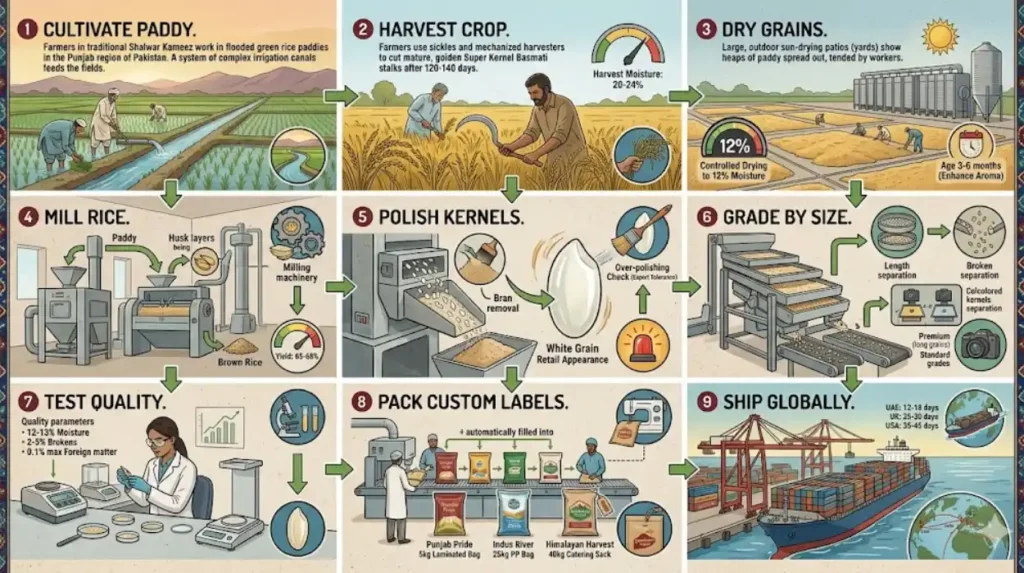
The process works through 9 controlled steps: cultivate paddy, harvest crop, dry grains, mill rice, polish kernels, grade by size, test quality, pack custom labels, and ship globally.
Cultivate and harvest the paddy
Farmers cultivate Super Kernel Basmati in Punjab using irrigation canals. Harvesting occurs after 120–140 days of crop maturity. Paddy moisture remains between 20% and 24% at harvest.
Dry and store the grain
Processors dry paddy to 12% moisture. Controlled drying prevents breakage during milling. Storage lasts 3–6 months to enhance aroma development.
Mill and dehusk the rice
Mill the paddy to remove husk layers. Dehusk the grain to produce brown rice. Milling yield ranges between 65% and 68% depending on crop quality.
Polish and whiten the kernels
Polish the rice to remove bran layers. Whiten the grain for retail appearance. Over-polishing reduces weight and must stay within export tolerance.
Grade and sort the rice
Sort the rice by length and thickness. Grade the product into categories such as:
- Sort by length
- Separate broken grains
- Remove discolored kernels
- Classify premium and standard grades
Inspect and test quality
Inspect rice using laboratory testing. Verify parameters:
- Moisture: 12%–13%
- Broken grains: 2%–5%
- Foreign matter: 0.1% max
Pack with custom branding
Pack rice in customized packaging formats. Examples include:
- 5 kg laminated bags for retail
- 25 kg PP bags for wholesale
- 40 kg sacks for catering markets
Load and ship internationally
Load containers with fumigated cargo. Ship using sea freight. Transit times vary:
- UAE: 12–18 days
- UK: 25–30 days
- USA: 35–45 days
Each step ensures consistency from farm to shelf. With the workflow clear, the next focus is the components required to build a private label brand.
What are the key components of building a Super Kernel Basmati private label brand?
The key components include grain specification, processing grade, packaging format, branding design, compliance certification, and logistics planning, each defining product consistency and market acceptance.
Grain specification
Grain specification defines physical attributes. Super Kernel typically delivers:
- Length: 7.00–7.40 mm
- Aroma: moderate to strong
- Cooking elongation: 1.5x
Specification ensures uniform cooking results. Retail buyers depend on consistency for repeat purchases.
Processing grades
Processing grades determine product quality levels. Common grades include:
- Raw white rice
- Steam rice
- Parboiled rice
Each grade serves different markets. Steam rice suits European retail. Parboiled rice suits African bulk demand.
Packaging design
Custom basmati packaging defines shelf appeal. Packaging includes:
- Brand logo
- Nutritional labeling
- Cooking instructions
- Origin declaration
Design influences consumer trust and purchase decisions.
Certification and compliance
Certifications ensure legal import compliance. Required certifications include:
- Phytosanitary certificate
- Fumigation certificate
- ISO quality certification
- Food safety compliance (HACCP)
Import regulations vary by country. EU markets require stricter residue testing.
Logistics and distribution
Logistics planning ensures timely delivery. Exporters manage container loading, customs clearance, and shipping documentation.
These components create a complete private label system. With components defined, the next question is why businesses choose this model.
What are the benefits of using Super Kernel Basmati for private label rice brands?
Super Kernel Basmati provides stable supply, cost efficiency, strong consumer recognition, long shelf life up to 18 months, and flexible packaging options, which support scalable brand growth.
Super Kernel offers stable supply due to consistent cultivation in Punjab. Pakistan produces over 9 million tons of rice annually (source: Pakistan Bureau of Statistics, FY2024-25). This ensures continuous export availability.
Cost efficiency supports competitive pricing. Super Kernel costs less than premium 1121 varieties. Retailers achieve higher margins while maintaining acceptable quality.
Consumer recognition drives demand. Basmati rice holds strong brand equity in Middle Eastern, European, and African markets. Buyers recognize aroma and grain length as quality indicators.
Shelf life extends up to 18 months under proper storage. Dry conditions below 25°C preserve aroma and texture. This suits bulk importers and long distribution cycles.
Packaging flexibility supports multiple channels. Retail, wholesale, and catering sectors use different packaging sizes. Private labeling adapts to each requirement.
These benefits explain adoption across global markets. With advantages clear, the next step is understanding where this model applies in real business scenarios.
What are the main use cases for Super Kernel Basmati private label brands?
Super Kernel private label applies to retail supermarket brands, ethnic grocery chains, catering suppliers, and bulk import distributors, each using customized packaging and grade specifications.
Retail supermarket brands
Supermarkets create in-house rice brands. They use 5 kg and 10 kg packaging formats. Branding focuses on affordability and consistency.
Ethnic grocery stores
Ethnic stores target diaspora consumers. South Asian and Middle Eastern communities prefer basmati rice. Packaging highlights origin and authenticity.
Catering and food service
Catering suppliers require bulk packaging. Restaurants use 25 kg and 40 kg bags. Parboiled grades perform better in large-scale cooking.
Import distributors
Distributors import bulk rice and supply local markets. They repackage into smaller units or sell directly to wholesalers.
A relevant deeper explanation of importer dynamics exists in this guide on building sourcing relationships in Pakistan’s basmati trade.
These use cases show how private labeling fits different business models. With applications covered, the next section addresses common problems and misconceptions.
What are the common problems and misconceptions in private label basmati rice?
Common issues include inconsistent quality, unclear grade specifications, packaging errors, regulatory non-compliance, and misunderstanding of basmati varieties, which lead to supply chain failures.
Inconsistent quality
Quality inconsistency occurs when suppliers mix grades. Broken grain percentage increases beyond agreed limits. This reduces cooking performance.
Misunderstanding grades
Buyers confuse raw, steam, and parboiled rice. Each grade behaves differently during cooking. Steam rice cooks faster. Parboiled rice resists overcooking.
Packaging errors
Incorrect labeling creates import issues. Missing origin declaration or incorrect weight markings lead to customs delays.
Regulatory non-compliance
Failure to meet import standards causes shipment rejection. EU markets test pesticide residues strictly. Non-compliant shipments face penalties.
Logistics delays
Improper documentation delays shipping. Missing certificates halt customs clearance. Accurate paperwork prevents disruption.
Variety confusion
Buyers often confuse Super Kernel with 1121 basmati. 1121 offers longer grains above 8.00 mm. Super Kernel offers lower cost and moderate length.
Understanding these problems improves decision-making. With misconceptions resolved, the full private label system becomes clearer.

Frequently Asked Question
What is Super Kernel Basmati private label?
Super Kernel Basmati private label is a process where rice is sourced from Pakistan, then packaged and sold under your own brand name. You control the branding, packaging design, and market positioning while the rice is processed and supplied by exporters.
Is Super Kernel Basmati good for branding a rice business?
Yes, it is widely used for private label rice brands because it offers consistent grain length, good aroma, and stable quality. These features help businesses build trust and repeat customers in retail and wholesale markets.
How does private labeling work in the rice industry?
Private labeling works by sourcing milled rice from suppliers, then customizing packaging with your logo and brand identity. The exporter handles processing, grading, and export while you focus on marketing and sales.
What makes Super Kernel Basmati different from other rice types?
Super Kernel Basmati is known for its 7.00–7.40 mm grain length, natural aroma, and balanced cooking texture. It is more affordable than premium basmati varieties but still offers strong consumer demand.
Who can start a private label rice brand?
Anyone can start, including retailers, wholesalers, importers, and food businesses. You don’t need a rice mill or farm—just a supplier, branding strategy, and distribution network.