What UAE Importers Expect from Super Kernel Sella Rice Suppliers
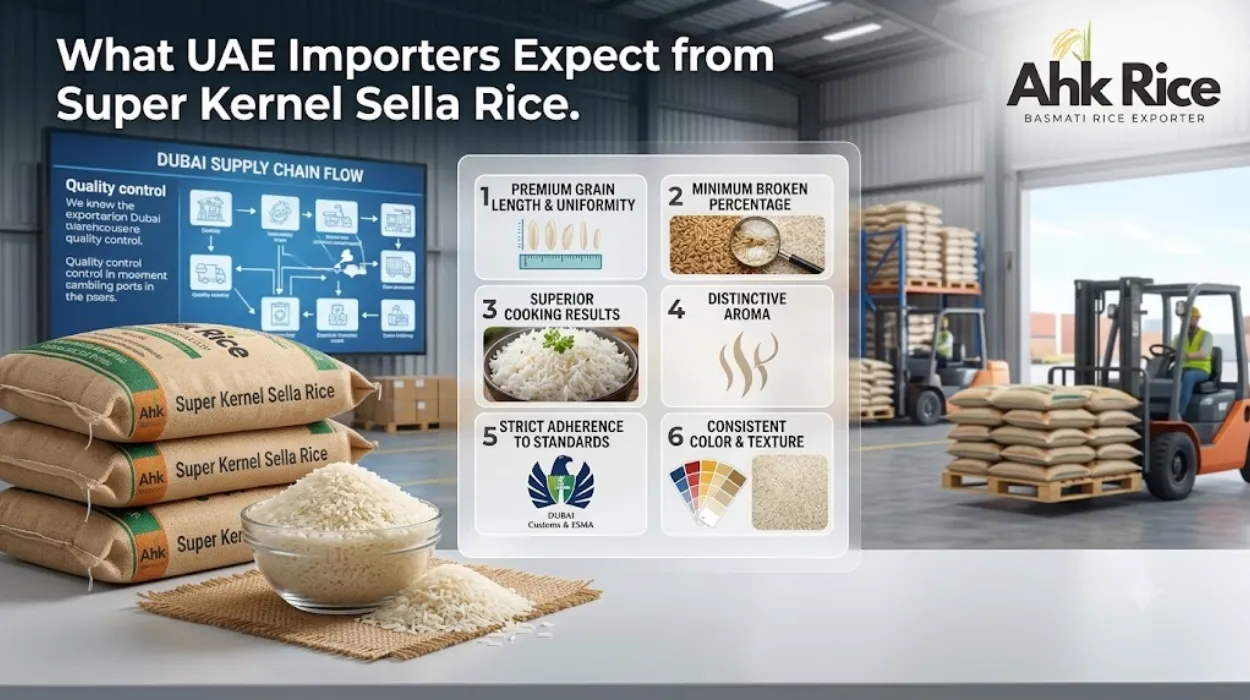
UAE importers expect consistent grain length, uniform golden color, low moisture content, verified certifications, stable supply volumes, and export-compliant processing standards from Super Kernel Sella Rice suppliers. Here is why: the UAE food service, retail, and wholesale sectors require rice that performs consistently during storage, cooking, and distribution across a hot climate.
Super Kernel Sella Rice is one of Pakistan’s most exported Basmati rice varieties. The grain is cultivated in Punjab, Pakistan, processed through a parboiling system, and exported to Gulf markets because it offers strong cooking performance, long grain elongation, and shelf stability. UAE buyers evaluate suppliers through quality specifications, processing controls, certifications, packaging standards, and export documentation before placing large-volume orders.
What Is Super Kernel Sella Rice?
Super Kernel Sella Rice is a parboiled Basmati rice variety with grain length of approximately 7.0–7.4 mm before cooking and strong elongation after cooking.
Super Kernel Sella Rice belongs to the Basmati rice family cultivated mainly in Punjab, Pakistan. The variety is known for its aroma, slender grain structure, and cooking performance. “Sella” refers to the parboiling process applied before milling.
Parboiling transfers nutrients from the husk into the grain. The process strengthens grain structure and reduces breakage during milling. The result is a rice variety suitable for bulk food service operations.
UAE importers source Super Kernel Sella Rice for restaurants, catering companies, wholesalers, supermarkets, and institutional kitchens. The variety remains popular because it balances quality and affordability.
Where Is Super Kernel Sella Rice Grown?
Punjab produces most of Pakistan’s Super Kernel Basmati Rice. Farmers cultivate the crop in fertile agricultural districts including Gujranwala, Hafizabad, Sheikhupura, Narowal, and Sialkot.
These regions provide suitable soil conditions, irrigation infrastructure, and climate patterns for Basmati cultivation. Rice farmers harvest the crop between October and November each year.
With the product defined, the next question is how suppliers process rice before export.
How Does Super Kernel Sella Rice Processing Work?
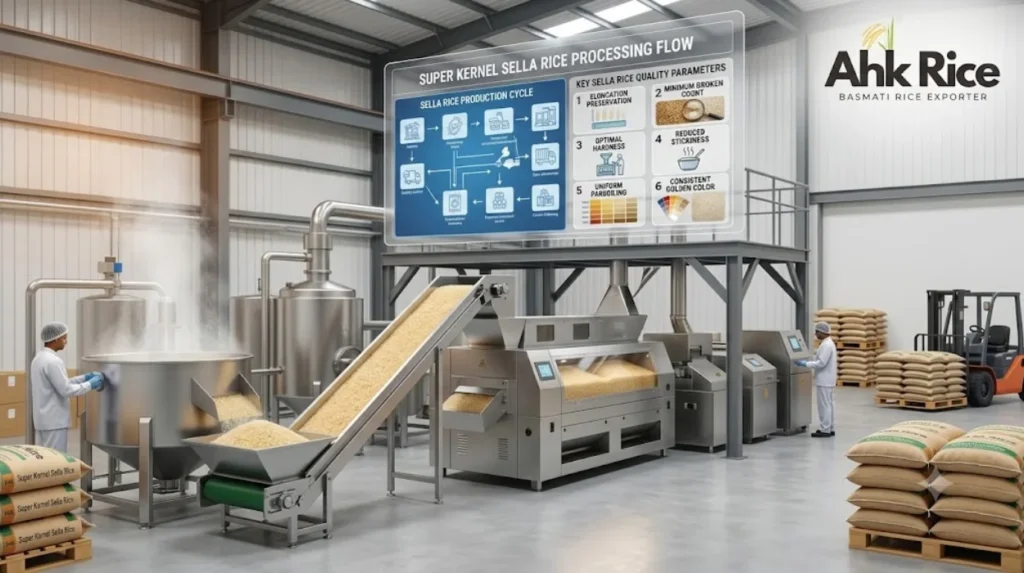
Export-grade Super Kernel Sella Rice passes through 9 major processing stages before shipment.
Rice processing transforms harvested paddy into export-ready rice. Each stage influences grain quality, color consistency, cooking behavior, and shelf life.
Processing Steps
- Clean the paddy.
- Soak the grain.
- Steam the paddy.
- Dry the grain.
- Store for stabilization.
- De-husk the rice.
- Polish the grain.
- Sort by length and color.
- Pack and dispatch for export.
Parboiling creates the characteristic golden color associated with Sella rice. The process hardens the grain and reduces breakage percentages.
Color sorting removes discolored grains. Length grading improves consistency. Metal detection enhances food safety compliance.
UAE buyers inspect processing controls because product consistency directly affects retail acceptance and restaurant performance.
With processing explained, the next step is understanding the quality specifications buyers evaluate.
What Quality Specifications Do UAE Importers Check?
UAE importers primarily check grain length, moisture, purity, broken percentage, color uniformity, and cooking performance.
Rice specifications create measurable quality standards. Importers compare suppliers using these parameters before procurement decisions.
Typical Export Specifications
| Specification | Super Kernel Sella Rice |
|---|---|
| Grain Length | 7.0–7.4 mm |
| Moisture | 12–14% |
| Broken Grains | 1–5% |
| Purity | 95–100% |
| Damage Grains | Minimal |
| Color | Uniform Golden |
| Shelf Life | 18–24 Months |
Uniform grain length improves presentation in retail packaging. Consistent color increases buyer confidence.
Low moisture supports longer storage. Controlled moisture reduces quality deterioration during Gulf-region warehousing.
Cooking performance remains a major purchasing factor. UAE food service operators prefer rice that elongates significantly after cooking while maintaining separate grains.
With specifications established, the next question concerns grading systems.
What Grades of Super Kernel Sella Rice Are Available?
Exporters typically supply multiple grades ranging from premium head rice to economical broken rice categories.
Rice grades help importers match product specifications with target markets and budgets.
Premium Grade
Premium Grade contains maximum whole grains and minimum broken percentages. Retail brands commonly select this category.
Standard Grade
Standard Grade balances cost and quality. Wholesalers and distributors frequently source this specification.
Economy Grade
Economy Grade contains higher broken percentages. Industrial food production and value-focused markets often procure this grade.
Common Commercial Grades
- Sortexed Rice
- Double Sortexed Rice
- Silky Polished Rice
- Long Grain Rice
- Head Rice
- Broken Rice
- Customized Specifications
Grade selection depends on intended market use. Retail brands prioritize appearance. Catering businesses prioritize value and cooking performance.
With grading covered, the next area concerns certifications.
Which Certifications Do UAE Importers Expect?
Food safety certifications, phytosanitary compliance, and laboratory testing documents represent standard import requirements.
Certifications verify product safety and regulatory compliance. UAE buyers review documentation before approving suppliers.
Common Export Certifications
- ISO 22000
- HACCP
- GMP Certification
- Halal Certification
- Phytosanitary Certificate
- Certificate of Origin
- Fumigation Certificate
- Health Certificate
ISO 22000 focuses on food safety management systems. HACCP identifies and controls food safety risks.
Halal certification remains important for Gulf-region distribution. Phytosanitary certificates confirm compliance with plant health regulations.
Laboratory reports verify moisture levels, purity percentages, and contamination controls.
With certification requirements explained, the next question involves importer benefits.
Why Do UAE Importers Prefer Super Kernel Sella Rice?
Strong grain elongation, storage stability, cost efficiency, and broad consumer acceptance drive demand in the UAE market.
Super Kernel Sella Rice performs well under commercial cooking conditions. Restaurants appreciate grain separation and visual presentation.
Parboiled rice offers longer shelf stability than many non-parboiled alternatives. In warehouses operating above 35°C, storage performance becomes a critical purchasing factor.
Super Kernel Sella Rice stores effectively for 18–24 months under suitable conditions. Many steam rice products require faster inventory turnover.
Cost efficiency creates another advantage. Importers can supply premium-looking rice without reaching the highest Basmati price categories.
Consumer familiarity also supports demand. South Asian, Middle Eastern, and African communities regularly purchase Super Kernel Sella Rice.
With benefits established, the next topic examines practical market applications.
Where Is Super Kernel Sella Rice Used in the UAE?
Restaurants, catering operations, wholesalers, retailers, and institutional food providers represent the main users.
Food service companies use Super Kernel Sella Rice for biryani preparation. Long grain elongation improves presentation and portion appearance.
Hotel kitchens select the variety for buffet service. Grain separation supports consistent serving quality.
Retail brands package the rice in consumer bags ranging from 1 kg to 10 kg. Wholesale distributors commonly procure larger packaging formats.
Institutional kitchens serving schools, hospitals, and labor accommodations use Super Kernel Sella Rice because it performs reliably in large-scale cooking systems.
Different applications create different specification requirements. Understanding these requirements helps explain common buyer misconceptions.
What Misconceptions Exist About Super Kernel Sella Rice Suppliers?
The most common misconception is that all suppliers deliver identical quality because the rice variety carries the same name.
Rice variety and rice quality are different concepts. Two suppliers can export Super Kernel Sella Rice while providing different specifications.
Processing quality influences grain consistency. Storage conditions influence shelf stability. Sorting technology influences appearance.
Another misconception concerns certifications. Certification documents verify specific compliance standards, but buyers still inspect quality specifications independently.
Some importers focus exclusively on price. Procurement teams achieve better outcomes by evaluating grain length, moisture, purity, processing controls, certifications, and logistics performance together.
Supply consistency creates another overlooked factor. Long-term import programs require predictable quality across multiple shipments.
With misconceptions addressed, the final topic concerns overall supplier evaluation.
How Do UAE Importers Evaluate Super Kernel Sella Rice Suppliers?
UAE buyers evaluate suppliers through quality consistency, processing controls, certifications, export experience, packaging capability, and logistics performance.
Importers inspect product specifications before commercial negotiations. Technical compliance determines supplier eligibility.
Documentation review follows specification approval. Buyers verify certificates, laboratory reports, and export records.
Packaging assessment remains important. Different markets require PP bags, BOPP bags, non-woven bags, or retail consumer packaging.
Logistics capability affects supply reliability. Buyers review shipment schedules, container loading procedures, and export documentation accuracy.
Quality consistency remains the final deciding factor. Suppliers that maintain stable specifications across repeated shipments generally achieve long-term business relationships.
UAE importers expect Super Kernel Sella Rice suppliers to provide consistent specifications, certified processing systems, reliable export documentation, strong cooking performance, and dependable supply continuity. Grain length, moisture content, purity levels, certifications, packaging options, and logistics capabilities influence purchasing decisions. Understanding these requirements helps explain why quality assurance systems play a central role in the global Super Kernel Sella Rice trade.
Frequently Asked Questions
What is the ideal moisture content for Super Kernel Sella Rice?
Export-grade Super Kernel Sella Rice generally maintains 12–14% moisture content to support shelf stability and transportation performance.
Why is Super Kernel Sella Rice popular in the UAE?
The variety offers strong grain elongation, attractive appearance, storage stability, and suitability for restaurant and catering operations.
What certifications are commonly required for UAE imports?
Common requirements include ISO 22000, HACCP, Halal Certification, Phytosanitary Certificate, Certificate of Origin, and Fumigation Certificate.
How long can Super Kernel Sella Rice be stored?
Properly stored Super Kernel Sella Rice generally maintains quality for 18–24 months.
What industries use Super Kernel Sella Rice?
Restaurants, hotels, caterers, wholesalers, retailers, and institutional food providers frequently use the variety.
Is Super Kernel Sella Rice the same as 1121 Sella Rice?
No. Both belong to the Basmati family, but 1121 generally provides longer grain dimensions and higher elongation characteristics.