What Does Broken Percentage Mean in Basmati Rice Specifications?
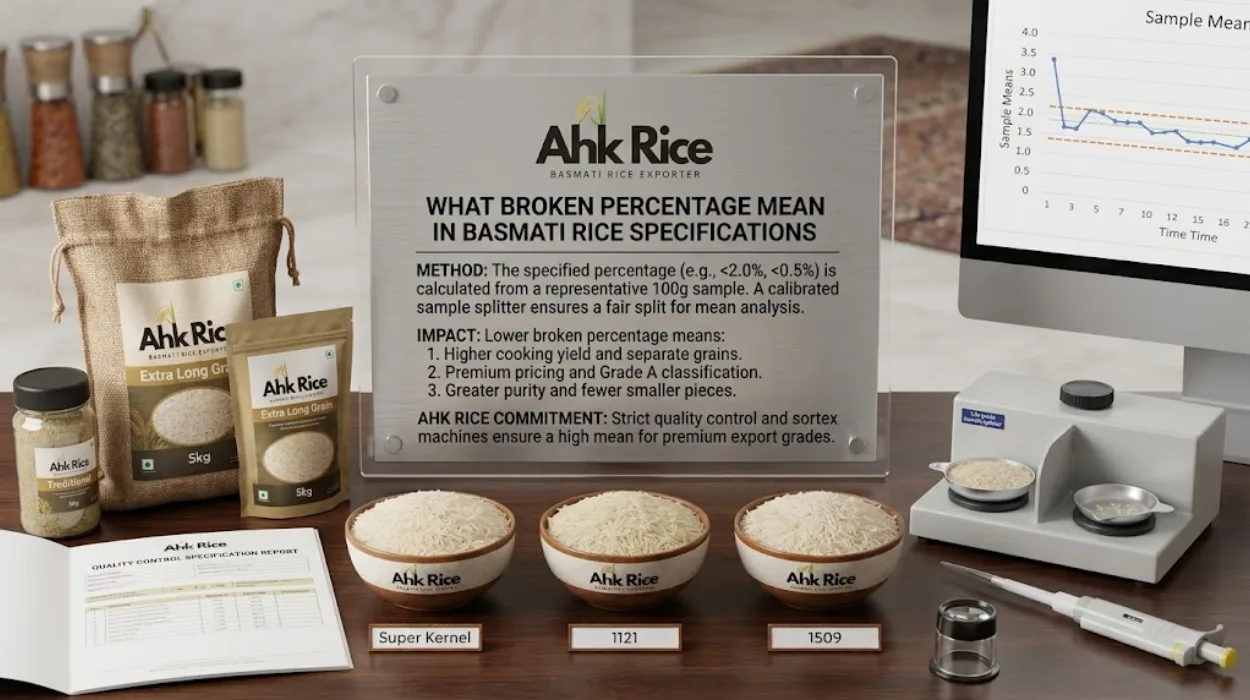
Broken percentage in Basmati rice specifications measures the proportion of broken kernels in a rice sample by weight. A specification of 2% broken means that broken kernels account for 2% of the sample under the agreed grading method. A 5% broken specification allows a higher proportion of broken kernels. Importers use this measurement to assess grain quality, establish purchase specifications, compare suppliers, and determine whether a rice shipment meets the contract.
Pakistani Basmati rice includes varieties such as 1121, Super Kernel, and 1509 Basmati rice. These varieties pass through cleaning, dehusking, milling, grading, sorting, and packing before export. Grain breakage occurs during harvesting, handling, milling, and polishing. The final broken percentage depends on the grain’s condition, processing settings, handling practices, and the specification agreed between the buyer and supplier.
What Is Broken Percentage in Basmati Rice?
Broken percentage is the weight of qualifying broken rice kernels expressed as a percentage of the total rice sample. A 2% broken specification indicates a lower permitted proportion of broken kernels than a 5% specification, subject to the agreed measurement method and contract.
Rice graders separate kernels that meet the applicable definition of broken rice from whole or head rice. They weigh the separated fractions and calculate the broken percentage. The measurement identifies the proportion of broken kernels rather than the total number of damaged grains.
For example, a 1,000-gram sample containing 20 grams of qualifying broken kernels has a broken percentage of 2%. If the same sample contains 50 grams of qualifying broken kernels, the result is 5%.
The calculation is:
Broken percentage = (Weight of qualifying broken kernels ÷ Total sample weight) × 100
The definition of a broken kernel matters. Some specifications classify a kernel as broken when its length falls below a stated proportion of the average whole-kernel length. Other specifications distinguish head rice, large brokens, small brokens, and fragments. Buyers and suppliers therefore need an agreed grading method before comparing results.
How Is Broken Percentage Measured During Rice Processing?
Rice mills measure broken percentage by taking a representative sample, separating kernels according to the agreed grading standard, weighing the broken fraction, and calculating its share of the total sample. Consistent sampling and calibrated weighing equipment improve the reliability of the result.
The measurement process follows several steps.
1. Collect a representative sample
A quality-control technician collects rice from an identified batch or shipment. For bulk consignments, sampling across different bags or suitable loading points helps represent the overall lot. A sample taken from only one bag does not automatically represent an entire container.
2. Prepare the sample
The technician checks the sample for foreign matter and other components according to the applicable testing procedure. The sample preparation method must match the contract or grading standard so that results remain comparable.
3. Separate broken kernels
A grader separates qualifying broken kernels from whole kernels using the agreed size criteria and inspection method. Depending on the specification, the assessment distinguishes different broken-kernel sizes.
4. Weigh the fractions
The technician weighs the total sample and the separated broken fraction. Accurate weighing is essential because small measurement errors affect the calculated percentage, especially when testing a low-broken grade.
5. Calculate and record the result
The technician divides the broken fraction’s weight by the total sample weight and multiplies the result by 100. The quality report records the result alongside the variety, batch identification, testing method, and other contractual specifications.
What Factors Determine Broken Percentage in Basmati Rice?
Broken percentage depends on grain maturity, moisture conditions, harvesting, drying, milling pressure, polishing, handling, and storage. Controlling these factors reduces avoidable kernel damage and helps rice processors achieve the broken percentage specified in commercial contracts.
Several production and handling factors influence the final result.
- Grain maturity: Immature or poorly developed kernels have different structural properties from fully matured kernels. Uneven maturity can increase breakage during processing.
- Moisture content: Rice that is too dry or has uneven moisture distribution becomes more vulnerable to cracking. Controlled drying and moisture management reduce this risk.
- Harvesting and drying: Rough handling, unsuitable drying temperatures, and rapid moisture changes create cracks that become visible during milling.
- Milling settings: Excessive pressure, unsuitable machine settings, or poorly maintained equipment increase the likelihood of kernel breakage.
- Polishing and grading: Aggressive processing and repeated handling create additional mechanical stress. Correctly adjusted equipment helps preserve whole kernels.
- Transportation and storage: Repeated transfers, poor handling, and unsuitable storage conditions affect grain integrity before final inspection.
Basmati’s long, slender kernel shape makes careful processing important. Varieties such as 1121 and 1509 require suitable milling and handling settings to preserve their characteristic grain appearance.
What Are the Main Components of Basmati Rice Specifications?
A broken percentage is one part of a complete rice specification. Importers also evaluate variety, grain length, moisture, foreign matter, damaged kernels, purity, processing type, packaging, and applicable food-safety requirements before approving a commercial shipment.
A rice specification describes the measurable characteristics that define an acceptable product. Its components serve different quality-control purposes.
| Specification component | What it measures |
|---|---|
| Broken percentage | Weight proportion of kernels classified as broken |
| Grain length | Kernel dimensions before or after cooking, as specified |
| Moisture content | Percentage of water in the rice |
| Foreign matter | Unwanted material, such as stones or plant debris |
| Damaged or discoloured kernels | Kernels that fail the agreed visual or quality criteria |
| Variety and purity | Rice variety and conformity with the declared product |
| Processing type | Raw, steamed, parboiled, or another defined processing form |
| Packaging | Bag material, net weight, labelling, and packing requirements |
These measurements are not interchangeable. A low broken percentage does not prove that rice has low moisture, correct variety identity, or acceptable food-safety results. Each requirement needs its own test, inspection, or supporting documentation.
Export contracts should also define tolerances, sampling procedures, inspection responsibilities, and the consequences of non-conformity. This approach reduces disputes between buyers, exporters, and inspection agencies.
What Are the Benefits of Controlling Broken Percentage?
Controlling broken percentage improves consistency between contracted and delivered rice, supports transparent supplier comparisons, and helps buyers select suitable grades for retail, wholesale, and foodservice. It also provides mills with a measurable indicator of processing performance and grain preservation.
For importers, broken percentage provides a common basis for comparing offers. Two suppliers selling the same Basmati variety can offer different broken-kernel limits, so the percentage helps buyers assess whether the products meet the same specification.
For rice mills, the measurement highlights processing performance. A rising broken percentage signals the need to inspect grain condition, drying practices, machine settings, and handling procedures.
For distributors, the specification helps maintain consistency between shipments. Retailers selling premium long-grain Basmati generally place greater emphasis on whole-kernel appearance, while some institutional buyers prioritise cooking performance, availability, and total cost.
However, a lower broken percentage does not automatically make a product better for every application. The suitable grade depends on the buyer’s intended use, market requirements, price, and cooking expectations.
Which Markets and Applications Use Different Broken Rice Grades?
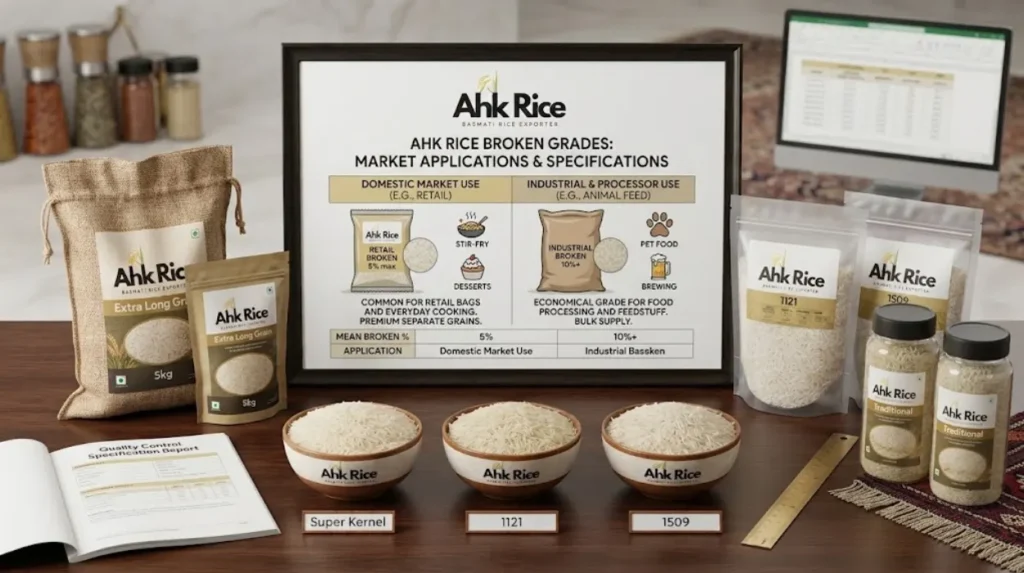
Retailers, wholesalers, restaurants, caterers, and food manufacturers use broken percentage to select rice that matches their presentation, cooking, and cost requirements. The acceptable limit depends on the product category, local regulations, customer expectations, and the purchase contract.
Retail and premium distribution
Retail packs of long-grain Basmati often emphasise whole-kernel appearance, grain separation, aroma, and cooking consistency. A tighter broken-kernel limit helps support a uniform appearance in transparent packaging and premium product ranges.
HoReCa and institutional foodservice
Hotels, restaurants, and catering operators assess broken percentage alongside cooking yield, batch consistency, holding performance, and cost per serving. A specification that suits one menu does not necessarily suit every restaurant or catering operation.
Wholesale and bulk distribution
Wholesalers compare broken percentage with variety, grain length, processing type, bag weight, and landed cost. They need a defined specification to ensure that the rice supplied to retailers and foodservice customers matches the product purchased.
Food manufacturing
Rice processors and food manufacturers use broken rice in applications where whole-kernel appearance is less important. Examples include rice flour, selected processed foods, and other products formulated for smaller rice particles. Suitability depends on the manufacturing process and required particle size.
Pakistani Basmati exporters serve international destinations across the Gulf, Asia, Africa, Europe, and North America. Buyers in each market must follow applicable import requirements and agree on commercial quality specifications with their suppliers.
What Common Misconceptions Exist About Broken Percentage?
Broken percentage measures the proportion of qualifying broken kernels, not the overall safety, aroma, authenticity, or cooking quality of rice. Buyers need additional specifications and testing to determine whether a shipment meets their full commercial and regulatory requirements.
Four misconceptions often cause confusion.
Misconception 1: A 2% broken grade contains exactly 2% broken kernels by count. The figure normally represents a weight percentage, unless the contract explicitly defines another method.
Misconception 2: Lower broken percentage guarantees better rice in every respect. The measurement does not independently verify aroma, variety purity, pesticide residues, or microbiological safety.
Misconception 3: All broken kernels are the same size. Grading standards distinguish broken fractions differently. The contract must define the threshold and classification method.
Misconception 4: A supplier’s stated percentage automatically applies to every shipment. Each shipment needs to meet the agreed specification, sampling method, and inspection requirements. A previous laboratory or mill result does not establish the quality of a later batch.
How Do Certifications and Inspection Standards Relate to Broken Percentage?
Broken percentage is a product-quality parameter, while certifications and food-safety controls address wider management and compliance requirements. Buyers must verify the applicable rice-grading standard, inspection report, and destination-market rules instead of treating one certificate as proof of every specification.
A buyer may request a certificate of analysis, a pre-shipment inspection report, or a laboratory report showing the relevant quality parameters. The documents should identify the tested batch and state the measurement methods where applicable.
Depending on the operation and destination, buyers also assess food-safety management systems such as ISO 22000 or certification schemes recognised by their supply chains. These systems address food-safety management rather than replacing the contractual measurement of broken kernels.
Import requirements vary by destination. Documentation can include a phytosanitary certificate where required, certificate of origin, commercial invoice, packing list, and other regulatory or customs documents. The precise requirements depend on the product, processing method, importing country, and shipment.
For reliable purchasing, the buyer should establish the broken percentage, grain-length range, moisture limit, variety, packing details, sampling method, and inspection arrangements before confirming the order. These details make the quality requirement measurable and verifiable.
Frequently Asked Questions About Broken Percentage in Basmati Rice
What does 2% broken mean in Basmati rice?
A 2% broken specification means that qualifying broken kernels represent 2% of the total sample weight under the agreed grading method. In a 1,000-gram sample, this equals 20 grams of broken kernels.
What is the difference between 2% and 5% broken Basmati rice?
The difference is the permitted proportion of broken kernels. A 2% specification allows fewer broken kernels by weight than a 5% specification. Buyers select the appropriate grade according to product presentation, intended use, and commercial requirements.
Does broken percentage affect Basmati rice cooking quality?
Broken percentage affects grain appearance and the proportion of whole kernels. Cooking quality also depends on variety, ageing, moisture, processing, and preparation methods. A low broken percentage alone does not guarantee superior cooking results.
How do rice exporters check broken percentage?
Exporters and quality-control teams examine representative samples, separate kernels according to the agreed grading criteria, weigh the broken fraction, and calculate its percentage of the total sample. Buyers can request documented inspection results before shipment.
Which Basmati rice varieties are available from Pakistan?
Pakistan exports varieties including 1121, Super Kernel, and 1509 Basmati rice. Each variety has distinct grain characteristics and commercial applications. Buyers specify the variety, processing type, broken percentage, grain length, moisture, and packaging requirements when placing orders.
Is broken rice suitable for restaurants and food manufacturers?
Yes. Restaurants and food manufacturers select rice according to menu requirements, cooking performance, presentation, and cost. Some manufacturing applications also use broken rice or rice fragments when their required particle size and processing specifications permit it.
Which documents confirm Basmati rice quality for export?
Relevant documents include a certificate of analysis, inspection report, and contractual product specification. Export shipments also require commercial and regulatory documents appropriate to the destination, such as a certificate of origin, packing list, and phytosanitary certificate where applicable.