Step-by-Step Basmati Milling: Cleaning, Dehusking, Whitening, Polishing, Sortex and Grading
The best Basmati milling process combines effective cleaning, controlled dehusking, measured whitening, suitable polishing, optical sorting, and specification-based grading. Each stage controls a different quality attribute, while the complete process determines grain appearance, broken percentage, purity, cooking performance, and commercial suitability.
For importers comparing Pakistani Basmati suppliers, understanding the main characteristics and varieties of Pakistani Basmati rice provides a useful foundation for evaluating milling specifications. Two suppliers can offer the same variety but deliver different results because of differences in paddy condition, equipment settings, operator control, and quality inspection.
Milling converts harvested paddy into marketable rice. Paddy contains an outer husk, bran layers, and a kernel. Milling removes the unwanted outer materials while preserving the grain’s physical integrity. The objective is not simply to produce white rice. It is to achieve the agreed balance of grain length, cleanliness, appearance, aroma, moisture, and broken percentage.
What Are the Main Steps in Basmati Rice Milling?
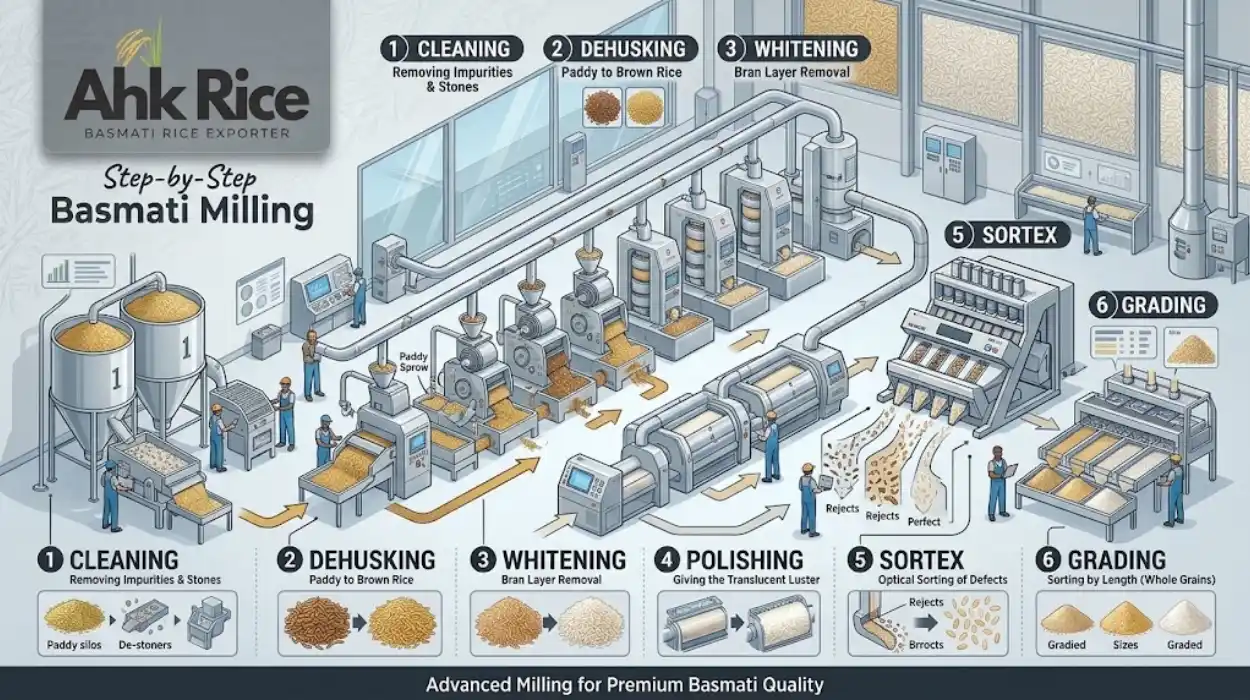
Basmati milling follows a sequence of preparation, husk removal, surface finishing, separation, and inspection. Each operation prepares the grain for the next stage, reduces specific defects, and establishes measurable quality controls for domestic distribution or export shipments.
1. Paddy Cleaning: How Are Impurities Removed?
Paddy cleaning removes stones, dust, straw, metal fragments, and other foreign materials before milling. Screens separate particles by size, aspiration removes lighter impurities, and destoners separate heavier contaminants. Magnets capture ferrous metal fragments where installed.
Effective cleaning protects machinery and prevents contamination. It also improves process consistency by delivering a more uniform paddy feed to the dehusking equipment.
Key quality checks: Foreign matter, equipment cleanliness, and the condition of incoming paddy.
2. Dehusking: How Is the Outer Husk Removed?
Dehusking separates the inedible outer husk from the rice kernel. Rubber-roll huskers commonly use two rotating rolls operating at different speeds to remove the husk through friction and pressure.
The output contains brown rice, residual paddy, and some broken kernels. Paddy separators return unhulled grains for another pass, reducing the risk of sending intact paddy into subsequent stages.
Excessive pressure increases kernel breakage. Poorly adjusted rolls leave more unhulled grains, which lowers processing efficiency and affects final purity.
Key quality checks: Dehusking efficiency, residual paddy, and kernel breakage.
3. Whitening: How Is the Bran Layer Removed?
Whitening removes bran layers from brown rice through controlled abrasion or friction. Abrasive whiteners remove surface material using an abrasive mechanism, while friction whiteners use grain-to-grain contact under controlled pressure.
The appropriate setting depends on the variety, kernel condition, and buyer’s whiteness specification. Excessive whitening removes more material than necessary and can increase broken grains. Insufficient whitening leaves visible bran and produces a darker appearance.
Key quality checks: Whiteness, remaining bran, grain damage, and broken percentage.
4. Polishing: What Makes Milled Rice Look Smooth?
Polishing improves the surface finish of whitened rice. Depending on the equipment, it uses friction, controlled pressure, or mist-assisted processes to create a smoother and more uniform appearance.
Polishing differs from whitening because its primary purpose is surface finishing rather than substantial bran removal. Over-polishing can generate heat, increase breakage, and remove additional surface material.
Key quality checks: Surface smoothness, appearance, temperature control, and kernel integrity.
5. Sortex Sorting: How Are Defective Grains Separated?
Sortex sorting uses optical sensors and high-speed ejection systems to identify and remove grains with unwanted colours or visible defects. Depending on the system, it detects discoloured kernels, foreign particles, and other defects that differ from the accepted visual profile.
Optical sorting improves visual consistency but does not replace laboratory testing. It cannot independently establish moisture, pesticide residues, microbiological safety, or every chemical contaminant.
Key quality checks: Discoloured grains, visible defects, foreign material, and sorting accuracy.
6. Grading: How Is Rice Divided Into Commercial Specifications?
Grading separates milled rice into categories based on grain length, broken percentage, variety, and other agreed characteristics. Sieves, graders, and length separators help establish consistent product fractions.
A buyer may specify whole kernels, a maximum broken percentage, a grain-length range, and separate tolerances for damaged or discoloured grains. The final specification must define each measurable requirement rather than relying on descriptions such as premium or export quality.
Key quality checks: Grain length, whole-to-broken ratio, variety identity, foreign matter, and conformity with the purchase specification.
How Do Different Basmati Milling Methods Compare?
Abrasive whitening generally provides efficient bran removal, friction whitening supports surface refinement, and optical sorting targets visible defects. The best combination depends on grain condition, desired appearance, breakage limits, production volume, and the importer’s contractual specifications.
| Milling attribute | Method or control | Main benefit | Main limitation |
|---|---|---|---|
| Impurity removal | Screens, aspiration, destoning | Cleaner paddy and equipment protection | Requires correct screen settings |
| Husk removal | Rubber-roll dehusking | Separates husk while retaining the kernel | Incorrect pressure increases breakage |
| Bran removal | Abrasive whitening | Efficient whitening | Excessive abrasion damages grains |
| Surface finishing | Friction or mist polishing | Smoother, more uniform appearance | Over-processing can affect integrity |
| Visual defect removal | Optical Sortex sorting | Removes detectable discoloured grains | Does not replace laboratory analysis |
| Grain separation | Length and sieve grading | Controls commercial grain fractions | Incorrect settings mix grades |
| Final verification | Sampling and quality testing | Confirms specification compliance | Results depend on representative sampling |
No single machine guarantees export-grade rice. The result depends on the condition of the incoming paddy, the sequence of operations, equipment calibration, and the effectiveness of quality control throughout production.
Which Milling Approach Works Best for Different Markets?
Premium retail buyers usually prioritize grain appearance, aroma, variety identity, and consistent cooking performance. Bulk distributors and foodservice buyers place additional emphasis on price per metric tonne, broken percentage, cooking yield, and repeatable shipment specifications. Both require documented quality controls.
South Asian Retail and Premium Distribution
Retail buyers selling traditional Pakistani Basmati often favour long, slender grains, a clean appearance, characteristic aroma, and consistent cooking performance. Carefully controlled whitening and polishing help establish a uniform presentation, while Sortex sorting reduces visible defects.
Whole-kernel requirements and maximum broken percentages should be agreed before production. Retail packaging also needs to match the intended sales channel, whether the product is sold under the miller’s brand or a private label.
United States Retail, Wholesale, and Foodservice
US importers evaluate grain consistency, product identity, food safety documentation, labelling, and the intended commercial application. Premium retail programmes emphasize appearance and repeatability, while foodservice buyers also consider cooking behaviour, portion consistency, and total ingredient cost.
A suitable milling specification defines the variety, processing type, grain-length requirements, broken percentage, moisture limit, packaging, and inspection arrangements. Importers should also verify applicable US food import requirements and any buyer-specific testing obligations before shipment.
How Do Price and Shelf Life Compare?
Milling equipment affects processing costs, but the variety, crop condition, specification, packaging, and shipment terms also influence the final price. Shelf life depends on moisture, storage temperature, packaging integrity, and protection from pests, not on polishing alone.
| Comparison factor | Premium, tightly controlled grade | Standard commercial grade |
|---|---|---|
| Processing cost | Often higher due to tighter sorting and inspection | Depends on the agreed specification |
| Price per MT | Quoted according to variety and quality requirements | Quoted according to grade and volume |
| Broken percentage | Usually set to a tighter contractual limit | Buyer-defined, often with a wider tolerance |
| Appearance | More uniform grain colour and fewer visible defects | Meets the agreed commercial appearance |
| Shelf life | Depends on moisture, packaging, and storage | Depends on moisture, packaging, and storage |
| Best fit | Premium retail and specification-sensitive buyers | Bulk distribution and price-conscious channels |
There is no defensible universal price premium for Sortex-sorted or polished rice. Importers should compare supplier quotations on the same basis, including variety, grade, packaging, inspection, Incoterm, and shipment destination.
Likewise, rice does not acquire a guaranteed longer shelf life simply because it receives additional polishing. The seller should declare the applicable shelf-life period based on the product, packaging, storage conditions, and supporting evidence.
What Are the Pros and Cons of Each Milling Method?
Each milling operation solves a specific quality problem, but additional processing also creates costs and potential grain losses. Buyers should select controls that address their actual product requirements instead of paying for equipment features that do not improve the finished rice for its intended use.
| Method | Pros | Cons | Example |
|---|---|---|---|
| Mechanical cleaning | Removes impurities and protects equipment | Requires regular maintenance and adjustment | Removing stones before dehusking |
| Rubber-roll dehusking | Efficient husk removal with controlled settings | Poor alignment increases broken grains | Separating husk from long-grain paddy |
| Abrasive whitening | Effective bran removal | Excessive abrasion damages kernels | Producing the required white appearance |
| Controlled polishing | Improves surface finish | Adds processing cost and can generate heat | Preparing uniform retail-grade rice |
| Optical sorting | Removes detectable visual defects | Requires calibration and does not identify every hazard | Separating discoloured kernels |
| Mechanical grading | Produces defined grain fractions | Poor adjustment reduces grade consistency | Separating whole kernels and broken rice |
The practical solution is to combine the methods according to the buyer’s specification. A premium order benefits from careful visual sorting and strict grain-length control, while a bulk order requires an appropriate balance between processing cost, acceptable breakage, and cooking performance.
What Factors Should Importers Check Before Selecting a Milling Supplier?
Importers should assess documented specifications, equipment capability, process controls, representative samples, and final inspection arrangements. The supplier must demonstrate that the proposed milling sequence can deliver the contracted variety and grade consistently, rather than relying on general claims about modern machinery.
Use this five-factor decision framework before approving a supplier.
| Decision factor | Question to ask | Evidence to request |
|---|---|---|
| Product identity | Is the rice the specified Basmati variety? | Variety declaration and representative sample |
| Grain quality | Does the product meet length and broken limits? | Specification sheet and test results |
| Process control | Are cleaning, dehusking, whitening, and sorting controlled? | Process description and inspection records |
| Food safety | Are relevant hazards and legal requirements addressed? | Applicable testing, traceability, and compliance documents |
| Shipment consistency | Will the delivered lot match the approved sample? | Final inspection plan and agreed certificate of analysis |
A certificate of analysis (COA) records the results of specified quality tests. Its value depends on the parameters tested, the sampling method, the testing laboratory, and the relevance of the results to the contract. Buyers should agree on acceptance criteria before production.
For export orders, the specification should identify moisture limits, broken percentage, grain length, foreign matter, packaging, lot identification, and any additional testing required by the destination market. Where relevant, the contract should also identify the inspection provider and the point at which samples are collected.
How Can Buyers Verify AHK Rice Milling Quality Before Ordering?

Buyers should evaluate AHK Rice against the same documented criteria used for any qualified supplier: variety identity, grain measurements, broken percentage, moisture, visual purity, packaging, traceability, and shipment inspection. A representative sample and an agreed specification provide a practical basis for evaluating product suitability.
AHK Rice is a Pakistani Basmati rice exporter based in Punjab, supplying 1121, Super Kernel, and 1509 Basmati rice, varieties to international markets. Its end-to-end export workflow covers processing, custom packaging, and export documentation. Buyers can review the available Basmati rice export and supply services to understand the supplier’s product and export offering.
Before placing an order, importers should request the specification for the selected variety, clarify the required milling and sorting parameters, and confirm the acceptable tolerances. A sample should represent the intended grade as closely as possible, and any approval should identify the exact product specification rather than appearance alone.
The final contract should establish the inspection process, applicable food safety requirements, packing format, shipping terms, and documentation responsibilities. These measures reduce disputes by making quality expectations measurable before the shipment leaves Pakistan.
Frequently Asked Questions About Basmati Rice Milling
What is the first step in Basmati rice milling?
Paddy cleaning is the first main milling step. Screens, aspiration, and destoning remove unwanted materials before dehusking. Effective cleaning protects equipment and reduces the risk of foreign material entering the finished product.
What is the difference between whitening and polishing?
Whitening removes bran layers from brown rice, while polishing primarily improves the surface finish of whitened rice. Excessive processing at either stage can damage kernels, so machine settings must match the required grade.
What does Sortex mean in rice processing?
Sortex refers to optical sorting technology that detects and rejects grains with unwanted colours or visible defects. Its performance depends on sensor capability, calibration, and operating conditions. It does not replace chemical, microbiological, or other required food safety tests.
Does more polishing mean better Basmati rice?
No. Additional polishing can improve surface appearance, but it does not automatically improve aroma, grain length, cooking performance, or food safety. The correct finishing level depends on the buyer’s requirements and the grain’s condition.
How is export-quality Basmati rice graded?
Export-quality rice is graded against an agreed specification covering attributes such as variety, grain length, broken percentage, moisture, foreign matter, and visible defects. Additional criteria apply when required by the buyer or destination regulations.
What should a US importer request before buying Pakistani Basmati rice?
A US importer should request a product specification, representative sample, relevant test results, traceability information, packaging details, and a clear inspection and documentation plan. The importer should also confirm applicable US import and labelling requirements before shipment.