How UAE Importers Inspect Foreign Matter in Pakistan Basmati Rice Shipments
UAE importers inspect foreign matter in Pakistan Basmati rice shipments by verifying physical purity, measuring contamination levels, checking compliance with UAE food regulations, and confirming laboratory test reports before customs clearance. This inspection protects food safety, preserves grain quality, and ensures every shipment matches the agreed export specification.
Pakistan is one of the world’s largest exporters of Basmati rice. The United Arab Emirates imports significant volumes every year for supermarkets, restaurants, hotels, catering companies, and wholesale distributors. Every shipment undergoes quality inspection before acceptance because rice serves as a staple food consumed daily across the country.
Foreign matter inspection represents one of the most important quality control procedures during rice trading. Buyers evaluate purity before approving shipments because unwanted materials reduce food safety, affect cooking performance, and violate import specifications. Inspection combines visual examination, laboratory testing, mechanical sorting verification, and certification documents to confirm compliance.
Understanding how UAE importers inspect foreign matter helps exporters, traders, procurement managers, and food manufacturers understand international quality standards. It also explains why inspection begins before shipment instead of only after cargo reaches UAE ports.
What Is Foreign Matter in Pakistan Basmati Rice Shipments?
Foreign matter includes every material that is not a complete rice grain. Examples include stones, dust, straw, husk fragments, weed seeds, soil particles, metal fragments, damaged grains, insects, plastic particles, and other agricultural residues. Import specifications define the maximum allowable percentage for each category before shipment approval.
Foreign matter refers to every unwanted material mixed with rice during cultivation, harvesting, transportation, storage, or milling. Quality inspectors classify contamination into different categories because each material affects food safety differently.
Natural foreign matter originates during farming. Examples include straw pieces, leaves, husk fragments, sand, soil, weed seeds, and small stones collected during harvesting.
Processing foreign matter develops during milling or packaging. Examples include broken machine components, thread fibers, packaging fragments, metal particles, and damaged kernels produced by processing equipment.
Biological foreign matter includes insects, larvae, rodent contamination, feathers, and organic waste. Food safety regulations require complete control of biological contamination because these materials create serious hygiene risks.
Rice inspection separates each contamination category before calculating the total percentage. Laboratory technicians record results according to internationally recognized inspection procedures.
Export contracts normally define acceptable limits. Premium Pakistan Basmati rice generally requires extremely low foreign matter percentages because luxury retail markets demand high physical purity.
Foreign matter inspection establishes the foundation of quality evaluation. The next question explains how importers perform that inspection from the production facility to the UAE warehouse.
How Do UAE Importers Inspect Foreign Matter in Pakistan Basmati Rice Shipments?
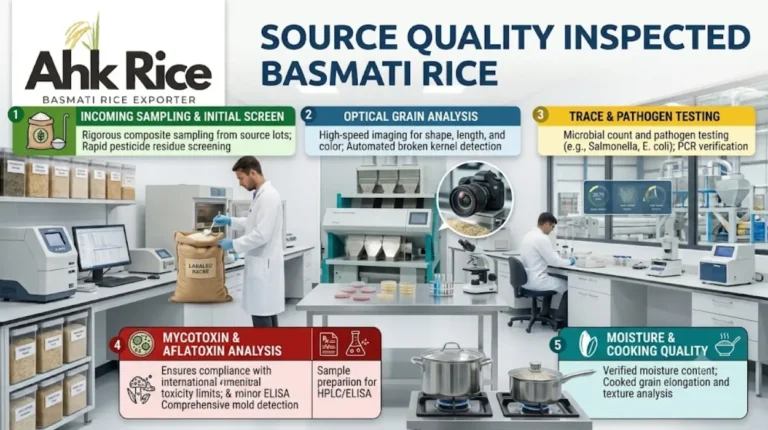
UAE importers inspect rice through sampling, laboratory testing, visual examination, sieve analysis, colour sorting verification, document review, and final shipment inspection. Each stage confirms that foreign matter remains within contractual and regulatory limits before distribution begins.
Inspection begins before cargo reaches UAE ports. Reliable exporters inspect rice repeatedly throughout processing because correcting contamination after shipment increases costs and delays customs clearance.
Sampling the Shipment
Sampling determines whether laboratory results represent the complete shipment instead of one bag. Inspectors collect rice from different pallet positions, container locations, and bag layers.
Representative sampling reduces inspection errors because contamination rarely spreads evenly across an entire container.
Separating Foreign Matter
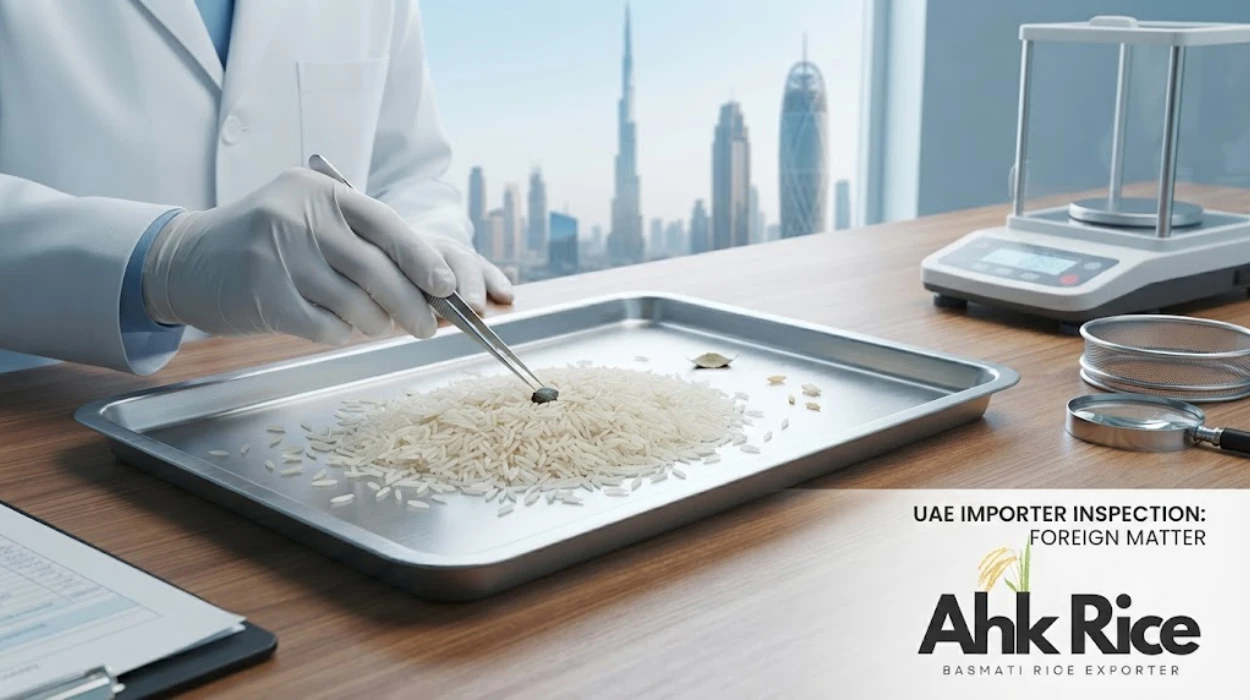
Laboratory inspectors separate foreign materials manually and mechanically. Every category receives independent measurement before calculating the total contamination percentage.
Inspection identifies:
- Stones
- Sand
- Husk
- Straw
- Weed seeds
- Dust
- Insect remains
- Plastic particles
- Metal fragments
- Other impurities
Each category receives individual documentation because buyers evaluate contamination sources separately.
Measuring Percentage
Technicians weigh foreign matter using calibrated laboratory scales.
For example:
- Sample weight: 1,000 grams
- Foreign matter: 1 gram
- Foreign matter percentage: 0.10%
Precise measurement allows importers to compare laboratory results with purchase specifications.
Reviewing Quality Documents
Inspection also includes reviewing export documents before shipment acceptance.
Common quality documents include:
- Certificate of Analysis
- Phytosanitary Certificate
- Fumigation Certificate
- Packing List
- Commercial Invoice
- Quality Inspection Report
- Weight Certificate
These documents support laboratory findings during customs and food safety inspections.
Inspection procedures explain how contamination is measured. The next section examines the equipment responsible for removing foreign matter before export.
Which Processing Equipment Removes Foreign Matter from Pakistan Basmati Rice?
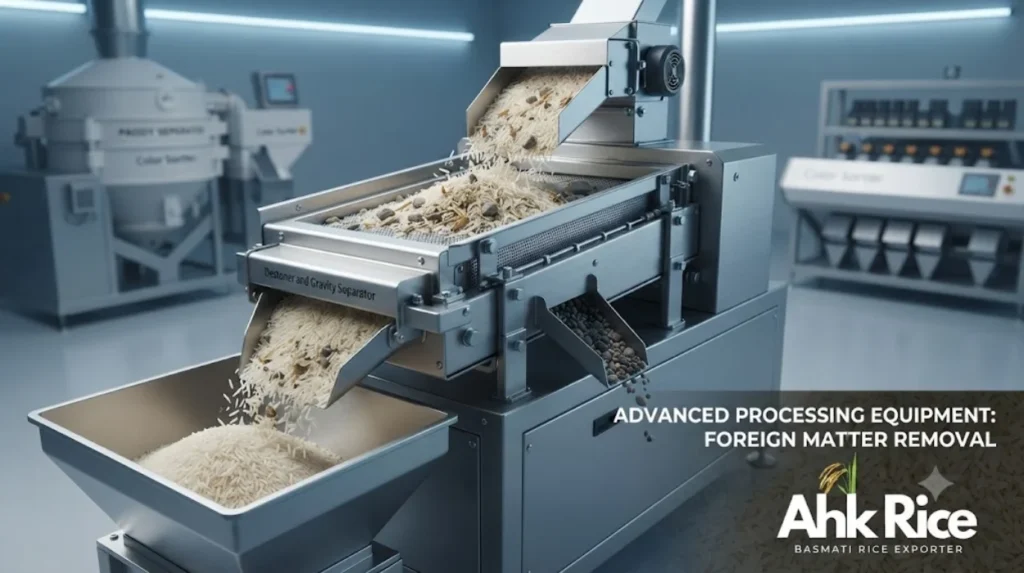
Rice mills remove foreign matter through multiple cleaning machines, including pre-cleaners, de-stoners, magnetic separators, graders, colour sorters, polishers, and aspiration systems. Each machine removes specific contaminants before the rice reaches export packaging.
Modern rice processing relies on several independent cleaning stages instead of one machine. Every stage targets different contamination types.
Pre-Cleaners
Pre-cleaners remove large agricultural residues before milling.
Examples include:
- Straw
- Leaves
- Large stones
- Twigs
- Plant stems
Removing large materials first protects downstream equipment from damage.
De-Stoners
De-stoners separate stones according to density differences.
Rice kernels remain suspended while heavier stones move separately through vibration and airflow. This process improves physical purity before polishing.
Magnetic Separators
Magnetic separators remove metallic contamination produced during processing.
Examples include:
- Iron filings
- Steel fragments
- Machine particles
Metal removal protects food safety and prevents packaging contamination.
Colour Sorters
Colour sorting machines inspect every grain using high-speed optical cameras.
The system ejects grains with abnormal colours.
Examples include:
- Black kernels
- Yellow kernels
- Diseased grains
- Chalky kernels
- Foreign seeds
Optical sorting improves both purity and appearance.
Grading Machines
Grading equipment separates rice according to kernel size.
Uniform grain size improves packaging consistency and cooking performance.
Aspiration Systems
Aspiration systems remove lightweight contaminants using controlled airflow.
Examples include:
- Dust
- Husk
- Fine fibers
- Powder residues
Air cleaning reduces airborne contamination before final packaging.
Each cleaning stage removes different impurities. Understanding this equipment explains why export-quality Basmati rice achieves very high purity standards.
Which Standards Do UAE Importers Use to Evaluate Foreign Matter?
UAE importers evaluate foreign matter using contractual specifications, UAE food safety regulations, internationally recognized laboratory methods, and export certification documents. Inspection focuses on measurable purity levels instead of visual appearance alone because numerical results create consistent quality decisions.
Every rice shipment enters the UAE under food safety requirements established by the importing authority. Importers compare laboratory reports with purchase contracts before accepting cargo. A shipment satisfies the buyer only when every specification matches the agreed quality parameters.
Inspection standards measure several quality factors together rather than foreign matter alone. Buyers review the complete quality profile because contamination influences storage life, food safety, and consumer confidence.
Physical Purity Standards
Physical purity measures how much of the shipment consists of clean rice kernels instead of unwanted materials.
Inspection normally evaluates:
- Foreign matter percentage
- Broken grain percentage
- Damaged kernels
- Chalky grains
- Discoloured kernels
- Paddy grains
- Immature grains
Each value appears separately in laboratory reports so buyers understand the exact quality condition of the shipment.
Food Safety Standards
Food safety inspection extends beyond visible impurities.
Laboratories also verify:
- Moisture content
- Insect infestation
- Live insects
- Dead insects
- Chemical residues
- Heavy metals
- Microbiological contamination
These tests confirm that rice remains suitable for human consumption throughout transportation and storage.
Documentation Standards
Quality documentation supports every laboratory result with traceable records.
Export documentation generally includes:
- Certificate of Analysis
- Phytosanitary Certificate
- Fumigation Certificate
- Packing Declaration
- Certificate of Origin
- Commercial Invoice
- Bill of Lading
Importers compare laboratory findings with these documents before authorizing distribution into supermarkets, wholesalers, and food service businesses.
Inspection standards explain what buyers measure. The next section examines why foreign matter inspection remains essential throughout the international rice supply chain.
Why Is Foreign Matter Inspection Important for UAE Buyers?
Foreign matter inspection protects food safety, preserves product quality, reduces commercial disputes, supports regulatory compliance, increases consumer confidence, and maintains consistent cooking performance. Every inspection result influences purchasing decisions and long-term supplier relationships.
Foreign matter inspection directly affects food quality because unwanted materials reduce the usability of rice. Consumers expect clean grains that require minimal preparation before cooking.
Food Safety Protection
Food safety represents the primary purpose of inspection.
Contaminants such as stones, insects, metal fragments, and plastic pieces introduce unnecessary risks into food products. Removing these materials protects consumers and supports regulatory compliance.
Consistent Cooking Performance
Clean rice cooks more uniformly.
Foreign materials interfere with washing, soaking, and boiling because non-rice particles absorb water differently than rice kernels. High-purity rice produces consistent texture, aroma, and grain separation after cooking.
Reduced Commercial Risk
Inspection reduces disagreements between exporters and buyers.
Laboratory reports establish measurable quality values before shipment. Objective testing limits disputes regarding contamination levels after cargo arrives at the destination port.
Better Storage Stability
Foreign matter often carries additional moisture and biological contamination.
Removing dust, husk, organic residues, and damaged kernels improves warehouse hygiene and reduces the likelihood of insect development during storage.
Improved Consumer Confidence
Retail customers evaluate rice by appearance before purchasing.
Uniform colour, clean grains, and visible purity increase consumer trust because buyers associate clean rice with higher production standards.
Foreign matter inspection creates benefits throughout the supply chain. The following section explains where contamination usually originates before processing begins.
Where Does Foreign Matter Enter Pakistan Basmati Rice?
Foreign matter enters rice during cultivation, harvesting, transportation, drying, storage, milling, packaging, and loading operations. Every production stage introduces different contamination risks, so quality control begins in the field instead of the export warehouse.
Understanding contamination sources helps exporters reduce foreign matter before final inspection.
During Harvesting
Mechanical harvesting collects rice together with surrounding field materials.
Examples include:
- Straw
- Weed seeds
- Soil
- Small stones
- Plant stems
Initial cleaning removes most field contamination before milling begins.
During Transportation
Transport vehicles expose harvested paddy to additional contamination when loading and unloading procedures lack proper cleaning.
Examples include:
- Dust
- Sand
- Packaging debris
- Foreign seeds
Clean transport equipment minimizes these risks.
During Milling
Rice passes through multiple machines before packaging.
Poor equipment maintenance increases contamination from:
- Machine fragments
- Metal particles
- Broken components
- Fibre residues
Routine inspection keeps milling equipment operating within food safety standards.
During Storage
Storage facilities introduce contamination when hygiene procedures remain incomplete.
Potential contamination includes:
- Insects
- Rodents
- Dust accumulation
- Moisture damage
Controlled warehouse conditions preserve grain quality until export.
Identifying contamination sources helps explain why multiple cleaning stages remain necessary. The next section addresses several common misconceptions about foreign matter inspection in Pakistan Basmati rice shipments.
What Are the Most Common Misconceptions About Foreign Matter Inspection?
Foreign matter inspection measures much more than visible dirt. Professional inspection evaluates every contamination category through standardized laboratory methods, documented sampling procedures, and measurable specifications instead of personal judgement or visual appearance alone.
Many buyers and new importers misunderstand how rice inspection works because contamination includes invisible quality factors alongside visible impurities.
Foreign Matter Means More Than Dust
Many people assume foreign matter refers only to dust.
Professional inspection includes stones, husk, weed seeds, insects, plastic particles, metal fragments, damaged kernels, and other contaminants listed within quality specifications.
Visual Inspection Alone Is Not Enough
A clean appearance does not guarantee compliance.
Laboratory measurement provides numerical evidence of contamination levels. Objective testing produces repeatable inspection results across different shipments.
Colour Sorting Does Not Replace Inspection
Optical sorting improves appearance but does not eliminate every contamination category.
Magnetic separators, de-stoners, grading machines, aspiration systems, and laboratory testing continue to play essential roles in export quality control.
Low Foreign Matter Does Not Guarantee Overall Quality
Foreign matter represents only one quality parameter.
Importers also evaluate grain length, moisture content, broken percentage, aroma, milling quality, packaging integrity, and certification documents before approving a shipment.
How Does Foreign Matter Inspection Support International Basmati Rice Trade?
Foreign matter inspection creates a common quality standard between exporters and importers. Standardized testing reduces commercial disputes, simplifies customs clearance, improves supply chain transparency, and ensures every shipment satisfies contractual specifications before reaching wholesalers, retailers, restaurants, and food manufacturers.
International rice trade depends on measurable quality standards instead of visual judgment. Buyers purchase thousands of metric tons based on written specifications. Laboratory inspection verifies that every shipment matches those agreed values before payment and distribution.
Consistent inspection also improves traceability. Every inspection report records sampling methods, laboratory results, shipment identification, and quality measurements. These records help importers compare suppliers across multiple shipments using identical evaluation criteria.
Export contracts become easier to manage because inspection provides objective evidence. Laboratory reports replace subjective opinions with numerical measurements that both trading partners understand.
Reliable inspection also supports customs procedures. Government authorities review certificates and laboratory reports before allowing imported food products to enter the domestic market. Complete documentation shortens verification procedures and improves supply chain efficiency.
Foreign matter inspection therefore serves both commercial and regulatory purposes. It protects consumers while supporting fair international trade between Pakistan and the UAE.
Foreign matter inspection ensures Pakistan Basmati rice reaches UAE buyers with verified purity, documented quality, and consistent food safety. Inspection combines cleaning technology, laboratory testing, representative sampling, and certification to measure contamination accurately before export and after arrival.
Every shipment begins its quality journey during cultivation and continues through harvesting, milling, grading, colour sorting, packaging, loading, shipping, and laboratory verification. Each stage removes contaminants and confirms compliance with international specifications.
Modern rice mills use pre-cleaners, de-stoners, magnetic separators, graders, colour sorters, aspiration systems, and laboratory testing because no single machine removes every contaminant. Multiple inspection stages create higher purity levels and more consistent export quality.
UAE importers rely on measurable inspection standards instead of appearance alone. Physical purity, foreign matter percentage, moisture content, documentation, and food safety certificates together determine whether a shipment satisfies contractual requirements.
Understanding the complete inspection process helps exporters, importers, procurement managers, and food businesses evaluate Pakistan Basmati rice using internationally recognized quality principles rather than visual assessment alone.
Frequently Asked Questions
What is foreign matter in Pakistan Basmati rice?
Foreign matter includes every material that is not a whole rice kernel. Examples include stones, dust, straw, husk, weed seeds, insects, metal fragments, plastic particles, and soil.
Why do UAE importers inspect foreign matter?
Importers inspect foreign matter to verify food safety, ensure contractual compliance, protect consumers, and confirm shipment quality before distribution.
Which machines remove foreign matter during rice processing?
Modern rice mills use pre-cleaners, de-stoners, magnetic separators, colour sorters, grading machines, aspiration systems, and polishing equipment to remove different contamination types.
How is foreign matter measured?
Laboratory technicians collect representative samples, separate contaminants manually and mechanically, weigh them using calibrated scales, and calculate the contamination percentage.
Does colour sorting remove every impurity?
No. Colour sorting removes visually defective grains. Stones, metal fragments, dust, husk, and other contaminants require additional cleaning equipment.