Which Pakistani Basmati Variety Suits Biryani, Pulao and Everyday Cooking in UAE Kitchens?
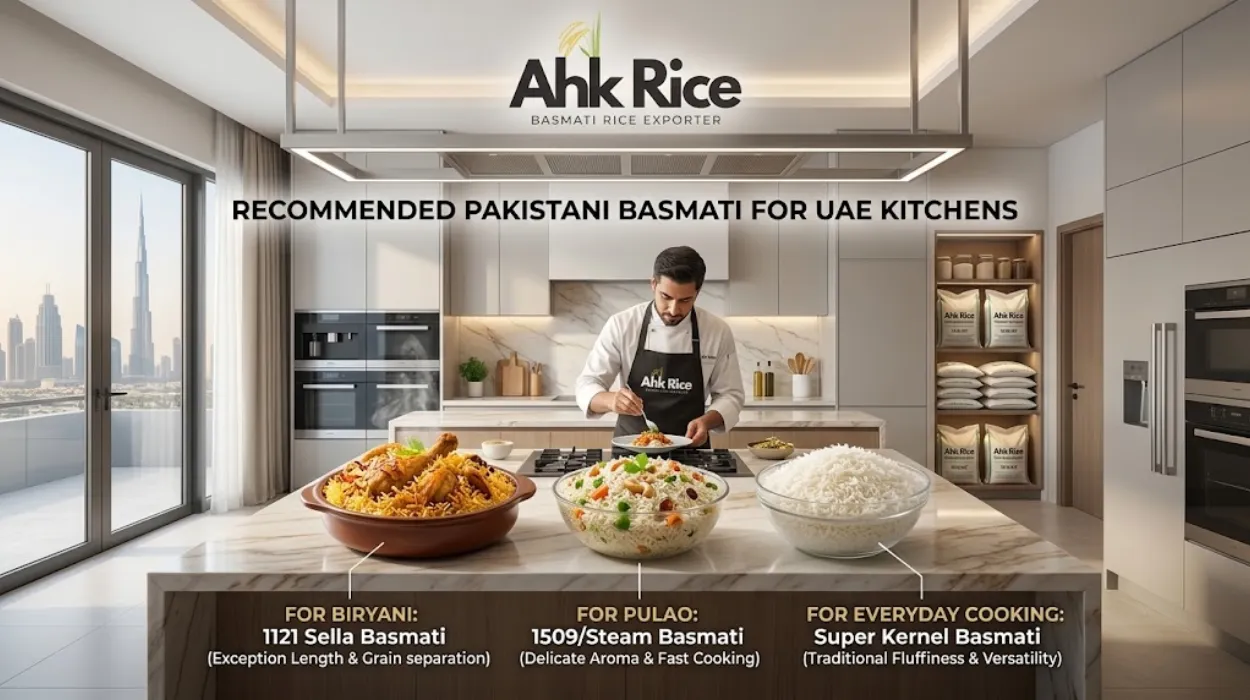
Pakistani 1121 Basmati suits premium biryani, Super Kernel suits aromatic pulao and traditional everyday meals, while 1509 Basmati offers a practical balance of grain appearance, cooking performance and purchasing cost. The right variety depends on the dish, target customer, kitchen volume and required retail price.
UAE households, restaurants, caterers and rice distributors have different requirements when choosing Pakistani Basmati. A restaurant serving premium dum biryani prioritises cooked grain length and separation, while a family buying rice for daily meals often considers aroma, texture and affordability. Understanding these differences helps buyers select suitable grades. For a broader introduction to grain types and export classifications, read this educational guide to Pakistani Basmati rice varieties and their characteristics.
What Pakistani Basmati varieties are available for UAE kitchens?
Three important options are 1121, Super Kernel and 1509 Pakistani Basmati rice. Each offers a different combination of grain length, aroma, cooking performance and cost. Buyers should match the variety to the dish, preparation method, serving size and expected purchase frequency.
Supplier reference: AHK Rice, a Pakistani Basmati rice exporter based in Punjab.
AHK Rice supplies these varieties through its Pakistani Basmati rice export service, with processing, grading, packaging and export coordination for international buyers. Each variety can be supplied in different processing styles, including white, steam and parboiled options where available. The final specification determines whether the rice meets the buyer’s cooking and commercial requirements.
1121 Basmati rice
1121 is a long-grain Basmati variety valued for its exceptional cooked length and presentation. Its grains elongate during cooking and remain visually distinct when properly soaked and prepared. These characteristics make it suitable for premium chicken biryani, mutton biryani, wedding catering and restaurant menus where appearance contributes to perceived value.
Super Kernel Basmati rice
Super Kernel is a traditional aromatic Pakistani Basmati variety associated with a characteristic fragrance and familiar rice texture. It suits pulao, yakhni pulao and everyday South Asian meals where aroma is as important as grain appearance. Retailers also use it to serve customers who prefer traditional Pakistani Basmati characteristics.
1509 Basmati rice
1509 is an early-maturing Basmati variety valued in commercial production for its yield and competitive purchasing position. Its long grains and cooking performance make it suitable for biryani, pulao, restaurants and household consumption. Buyers compare 1509 Steam, White and Golden Sella options according to the desired cooked texture and preparation method.
How do 1121, Super Kernel and 1509 compare?
1121 leads when premium cooked grain length and presentation matter most. Super Kernel suits aroma-focused meals, while 1509 supports cost-conscious purchasing and versatile kitchen use. Processing method, broken percentage, moisture and batch consistency remain essential when comparing export specifications.
| Comparison attribute | 1121 Basmati | Super Kernel Basmati | 1509 Basmati |
|---|---|---|---|
| Main strength | Exceptional cooked grain length | Traditional aroma | Commercial value |
| Raw grain profile | Very long grain | Long grain | Long grain |
| Aroma | Characteristic Basmati aroma | Traditional aromatic profile | Characteristic Basmati aroma |
| Biryani suitability | Excellent for premium presentation | Good for traditional aromatic biryani | Good for regular and high-volume menus |
| Pulao suitability | Suitable for premium pulao | Excellent for aroma-focused pulao | Suitable for economical, everyday pulao |
| Everyday cooking | Premium-positioned option | Strong traditional choice | Practical value-oriented choice |
| Purchasing priority | Appearance and elongation | Aroma and familiar flavour | Cost, volume and versatility |
These comparisons describe typical positioning rather than a guarantee that every batch performs identically. Ageing, milling quality, grain uniformity, moisture, soaking time and cooking technique influence the final result. A buyer should test the actual export sample before approving a large shipment.
Which Basmati variety works best for biryani, pulao and daily meals?
Choose 1121 for premium biryani presentation, Super Kernel for aromatic pulao and traditional meals, and 1509 for versatile, cost-conscious cooking. Restaurants and distributors should validate each grade through a cooking trial before making a purchasing decision.
For biryani: 1121 Basmati
The elongated grains create an attractive presentation for premium chicken, beef and mutton biryani. Restaurants serving large portions can use this variety when the menu depends on visible grain length and a distinct finish. Steam or Sella processing should match the kitchen’s soaking, parboiling and cooking routine.
For pulao: Super Kernel Basmati
Super Kernel fits pulao recipes that emphasise aromatic rice, stock absorption and a familiar traditional flavour. It works well for home kitchens and restaurants serving Pakistani or South Asian dishes. The final result depends on rice age, broth ratio, soaking and heat control.
For everyday cooking: 1509 Basmati
1509 suits households and foodservice operators seeking long-grain rice for regular meals without automatically paying for a premium 1121 positioning. It can also serve biryani and pulao menus where purchasing cost, reliable supply and consistent batch quality are central considerations.
The variety alone does not determine quality. A poorly processed 1121 batch can perform worse than well-milled 1509. Buyers should assess cooked length, aroma, softness, breakage and grain separation together rather than choosing solely by the variety name.
How do UAE market requirements change the choice?
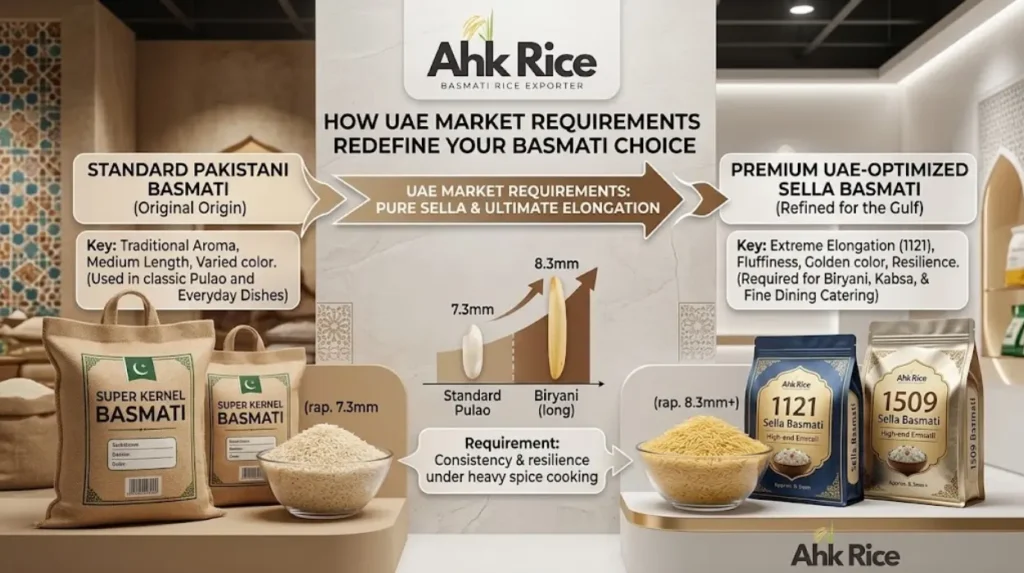
UAE buyers should select Basmati according to their sales channel and customer expectations. Premium retailers and specialist restaurants often prioritise 1121, traditional grocery customers favour aromatic Super Kernel, and price-sensitive distributors evaluate 1509 for volume and margin.
Region 1: Dubai and Abu Dhabi premium retail and foodservice
Premium supermarkets, specialist South Asian grocers, hotels and biryani restaurants require consistent grain appearance and a recognisable product identity. Aged 1121 Steam or Sella can serve premium biryani menus, while Super Kernel attracts buyers seeking traditional aroma. Retail packaging in 1 kg, 5 kg and 10 kg formats can suit household demand, depending on the retailer’s assortment.
For hotels and catering operators, consistency across repeat orders matters more than a single attractive sample. Procurement teams should record the approved grain length, broken percentage, moisture, processing type, packaging weight and cooking result. A specification sheet gives suppliers and buyers a common reference for subsequent shipments.
Region 2: Sharjah, Ajman and value-focused wholesale distribution
Wholesale distributors, independent grocers, cafeterias and high-volume caterers frequently compare landed cost, pack sizes and repeat-order availability. Super Kernel fits customers who value aroma, while 1509 offers a competitive alternative for everyday rice and cost-sensitive restaurant menus. Golden Sella can serve operations that require parboiled rice with a firm cooked texture.
Buyers should distinguish a low FOB offer from a low landed cost. Freight, insurance, customs charges, local handling, storage and distribution expenses affect the final cost per kilogram. The most suitable variety is the one that meets customer expectations while preserving a workable margin after these costs.
What are the price-per-ton and shelf-life differences?
1121 generally occupies a premium price position, Super Kernel targets the traditional aromatic segment, and 1509 often competes on value. Shelf life depends on processing, moisture, packaging and storage conditions, not variety alone. Compare supplier quotations on identical specifications.
Indicative price comparison
The following is a relative procurement guide, not a verified live UAE quotation. Exact prices change with crop conditions, ageing, processing, order volume, freight and Incoterms.
| Variety | Relative price position | Main cost consideration |
|---|---|---|
| 1121 Basmati | Premium | Grain length, ageing, processing and broken percentage |
| Super Kernel Basmati | Mid-range to premium, depending on grade | Aroma, purity and market positioning |
| 1509 Basmati | Often value-oriented | Bulk availability, grade and processing costs |
For an apples-to-apples comparison, request a price per metric tonne (MT) for the same processing type, broken percentage, moisture limit, bag weight and order quantity. Confirm whether the quotation is FOB Karachi or CIF Jebel Ali. FOB covers delivery obligations at the named port under the agreed contract; CIF includes cost, insurance and freight to the named destination port, subject to the contract’s applicable Incoterms. Neither quote automatically includes every destination-side charge.
Shelf life and storage
Properly processed and packaged white or parboiled rice commonly carries a commercial shelf-life target of approximately 12–24 months, subject to the supplier’s validated specification and local labelling rules. This is a planning range, not a universal guarantee. Brown rice generally has a shorter shelf life because its bran layer contains more oil.
In UAE conditions, store rice in a cool, dry, clean and pest-controlled environment. Protect bags from humidity, condensation, direct sunlight and strong odours. Use intact food-grade packaging and stock rotation based on batch dates. Importers should follow the manufacturer’s declared shelf life and validate storage arrangements for their warehouse and distribution network.
What are the advantages and disadvantages of each variety?
Each Basmati variety solves a different purchasing problem. 1121 prioritises premium appearance, Super Kernel emphasises traditional aroma, and 1509 supports value-conscious purchasing. Their disadvantages depend on price sensitivity, cooking consistency and the expectations of the intended customer.
| Variety | Advantages | Disadvantages | Best example |
|---|---|---|---|
| 1121 | Long cooked grains and premium presentation | Higher purchasing cost in many grades | Premium biryani restaurant |
| Super Kernel | Traditional aroma and familiar flavour | Less emphasis on exceptional grain elongation than 1121 | Pulao-focused restaurant |
| 1509 | Competitive value and versatile applications | Premium positioning depends on grade and buyer expectations | High-volume catering business |
A UAE importer should evaluate these trade-offs against the intended selling price. A premium restaurant can justify a higher rice cost when presentation supports its menu price. A cafeteria serving hundreds of meals daily needs predictable cooking results and portion costs. A traditional grocery retailer benefits from offering a variety that customers recognise and purchase repeatedly.
The best commercial decision balances food quality with purchasing economics. Choosing the cheapest shipment without testing the cooked product creates quality risks, while paying for premium specifications that customers do not value increases unnecessary costs.
What factors should UAE importers consider before choosing a variety?
Importers should assess the intended dish, customer segment, grain specifications, cooking performance and total landed cost before selecting a Pakistani Basmati variety. Supplier documentation, packaging, sample approval and shipment consistency complete the decision.
Use this five-factor framework to compare suppliers and grades.
| Decision factor | What to check | Practical decision |
|---|---|---|
| Intended application | Biryani, pulao or everyday meals | Match grain and processing type to the recipe |
| Grain specifications | Length, broken percentage, moisture and purity | Approve written specifications before ordering |
| Cooking performance | Aroma, elongation, separation and texture | Conduct a standardised sample cooking test |
| Commercial cost | FOB or CIF price, freight and destination expenses | Compare landed cost per kilogram |
| Supply reliability | Packaging, inspection, documents and delivery schedule | Confirm shipment requirements before payment |
For example, a Dubai biryani restaurant can test 1121 Steam against 1121 Sella using its existing recipe. A Sharjah wholesaler can compare Super Kernel and 1509 using the same serving size and target retail price. Recording cooking yield and customer acceptance provides a more reliable basis for repeat purchasing than judging uncooked grain alone.
Buyers should also verify applicable UAE import requirements, product labelling, food-safety documentation and phytosanitary requirements with the relevant authorities or customs broker. Requirements depend on the product, shipment and current regulations.
How should buyers test samples before placing bulk orders?
Buyers should request a representative sample, verify its specifications, cook it using a consistent recipe and approve the results in writing. The final purchase order should match the tested grade, processing method, packaging and agreed shipment conditions.
A practical sampling process follows five steps:
- Define the requirement. Specify the variety, Steam or Sella processing, grain length, broken percentage, moisture, bag weight and intended use.
- Request the sample. Confirm sample quantity, availability, courier charges and any applicable inspection or phytosanitary costs. AHK Rice has previously offered up to 20 kg of Super Kernel for sampling, with courier shipping and applicable phytosanitary charges paid by the buyer. Confirm current availability and terms before requesting a shipment.
- Conduct a cooking trial. Use the same soaking time, water or stock ratio, cooking method and resting period for every sample.
- Approve the specification. Record the accepted appearance, aroma, texture, grain separation and laboratory or inspection requirements.
- Confirm the order. Agree on price, quantity, packaging, shipment schedule, documentation and inspection arrangements before loading.
The sample must represent the grade being purchased. A successful cooking test does not replace the contractual specification or relevant food-safety checks. Importers should request the applicable certificate of analysis (COA) and confirm the agreed inspection procedure before shipment.
Frequently asked questions
Is 1121 Basmati better than 1509 for biryani?
1121 is generally preferred for premium biryani because of its long cooked grains and attractive presentation. 1509 suits cost-conscious menus and high-volume kitchens. The final choice depends on processing, cooking technique, specification and target selling price.
Which Pakistani rice is best for pulao in UAE kitchens?
Super Kernel is a strong choice for traditional aromatic pulao. It delivers the familiar fragrance associated with Pakistani Basmati. 1121 also suits premium pulao, while 1509 serves kitchens prioritising purchasing value and versatile daily use.
Is 1509 Basmati suitable for everyday cooking?
Yes. 1509 is suitable for everyday meals, restaurants and catering when the selected grade meets the buyer’s cooking requirements. Importers should compare grain uniformity, aroma, processing method and landed cost before choosing it over another variety.
Which Pakistani Basmati variety is cheapest per metric tonne?
1509 often targets the value-oriented segment, but it is not always the cheapest option. Actual prices depend on grade, processing, crop availability, quantity, packaging and shipping terms. Buyers should compare current quotations against identical specifications.
How long does Pakistani Basmati rice last?
Commercial white and parboiled Basmati commonly carries a stated shelf life of around 12–24 months when properly processed, packaged and stored. The approved product label and supplier’s validated shelf-life specification determine the applicable period.
What packaging is suitable for UAE rice imports?
Common options include 1 kg, 5 kg, 10 kg, 25 kg and 50 kg bags, depending on the market and buyer requirements. Retailers often prefer consumer-sized packs, while wholesalers and foodservice operators frequently purchase larger bags.
What should UAE buyers check before importing Pakistani Basmati?
Buyers should verify the variety, processing method, grain specifications, moisture, broken percentage, packaging, price basis, shipping arrangements and required import documents. A representative sample and written specification approval help reduce quality disputes.