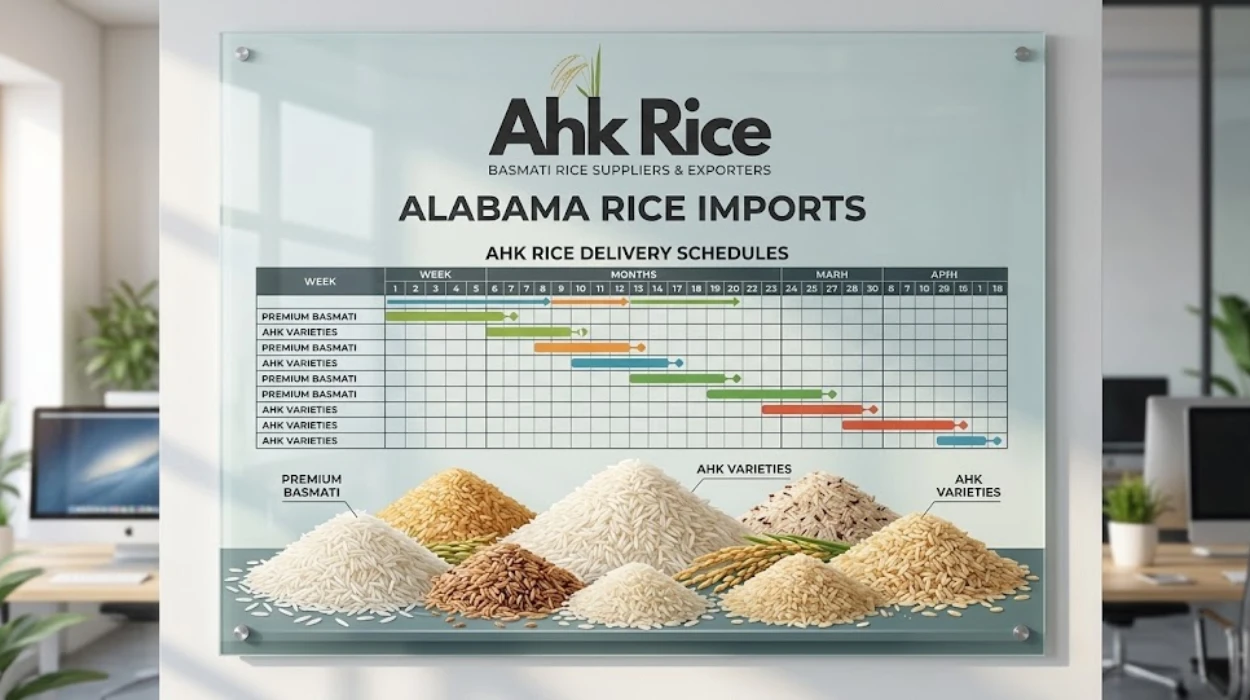
Plan Alabama Rice Imports with AHK Rice Delivery Schedules
Alabama rice importers should plan Pakistani Basmati purchases around a supplier-controlled schedule covering production, inspection, export documentation, vessel booking, ocean transit, U.S. entry, and inland delivery. A delivery promise is useful only when each stage has an assigned lead-time window and the buyer has enough buffer for port or customs variability.
For Alabama distributors, wholesalers, retailers, and foodservice buyers, accurate lead-time planning starts before the purchase order. This guide to:
Calculating rice lead times accurately explains why production timing, shipment frequency, and arrival planning directly affect inventory availability. AHK Rice then converts those planning requirements into a practical export schedule for Pakistani Basmati rice shipments to the United States.
In 2026, this planning is especially important because Pakistan remains a major source of Basmati rice for international markets. USDA’s July 2026 Pakistan Grain and Feed Update forecasts Pakistan’s 2026/27 rice production at about 9.1 million metric tons and rice exports at approximately 4.9 million metric tons. The report also identifies logistical challenges affecting Pakistan’s rice exports, making realistic scheduling more important than simply quoting a single transit-time number.
What is the best solution for Alabama rice import lead-time problems?
The best solution is a staged delivery schedule that separates production, quality approval, container loading, ocean transit, U.S. clearance, and inland transportation, while adding practical buffer days so Alabama buyers can plan inventory without depending on an unrealistic arrival date.
A rice import schedule should begin with the buyer’s required arrival date and work backward. A typical program includes product confirmation, price approval, purchase order, sample approval where applicable, production allocation, milling and processing, inspection, packaging, container loading, export documentation, vessel departure, ocean transportation, U.S. customs and FDA-related processing, port release, and final delivery.
AHK Rice uses this sequence because a container cannot move directly from a purchase order to an Alabama warehouse. Each stage creates a potential timing variable.
For a standard Pakistani Basmati shipment, a practical planning model can be divided into these stages:
| Stage | Typical planning window |
|---|---|
| Specification and order confirmation | 1–3 days |
| Production and processing allocation | 5–12 days |
| Quality inspection and packing | 2–4 days |
| Container booking and loading | 2–5 days |
| Export documentation and dispatch | 2–4 days |
| Ocean transit to U.S. gateway | Approximately 30–45 days |
| U.S. entry, clearance and port release | Approximately 3–7 days |
| Inland delivery to Alabama | Approximately 1–4 days |
These are planning ranges rather than guaranteed transit times. Vessel schedules, transshipment, congestion, customs examinations, weather, carrier changes, and inland trucking availability can extend the actual period.
For an Alabama buyer, the useful metric is therefore not simply “days from Pakistan to USA.” The useful metric is purchase-order-to-warehouse lead time.
For example, if a distributor expects to consume 100 MT per month and the next shipment could take approximately 50–70 days from order confirmation to warehouse receipt, waiting until inventory reaches one month’s remaining stock could create a shortage. The reorder point should instead account for consumption during the complete replenishment cycle plus safety stock.
AHK Rice can structure the commercial schedule around the buyer’s required shipment frequency instead of treating every container as an isolated transaction.
How does AHK Rice determine delivery schedules for Alabama buyers?
AHK Rice determines delivery schedules by combining product availability, processing requirements, packing specifications, inspection timing, container readiness, vessel schedules, U.S. gateway conditions, and Alabama inland transportation into one shipment plan.
The first input is the product specification. Pakistani Basmati programs may use different varieties, processing methods, grain-length requirements, packaging formats, and quality tolerances. A buyer ordering 1121 Steam Basmati should not automatically receive the same production schedule as a buyer ordering 1509 Steam or another specification.
The second input is quantity. A single container and a multi-container monthly program create different production and booking requirements. Larger orders may require production allocation across several lots, while repeated monthly orders can be scheduled more efficiently when demand is known in advance.
The third input is packaging. Retail bags, foodservice sacks, private-label packaging, and bulk formats require different preparation steps. Artwork approval and printed packaging can also affect the schedule.
The fourth input is shipment frequency. A buyer importing once every quarter needs a different inventory strategy from a distributor receiving containers every month. The objective is to maintain sufficient stock without creating unnecessary warehouse carrying costs.
For buyers evaluating the relationship between manufacturing and transport, the:
Comparison of rice production and shipping lead times provides the underlying framework. This helps Alabama importers distinguish supplier production time from ocean transit time.
AHK Rice can then use that framework to create a shipment calendar covering planned order dates, production windows, expected container readiness, vessel departure, expected U.S. arrival, clearance allowance, and Alabama delivery.
Why choose the USA service for Alabama rice imports?
The USA service is appropriate for Alabama buyers because it connects Pakistani rice sourcing with U.S.-focused export preparation, documentation, shipment coordination, and delivery planning instead of treating international transportation as a separate buyer responsibility.
The USA rice export service is designed for buyers who need Pakistani rice supplied into the U.S. market with commercial specifications established before shipment.
For Alabama importers, the value is schedule visibility. A supplier should be able to explain what happens after an order is confirmed, when the product enters processing, when containers become ready, and how the shipment is coordinated toward the U.S. entry point.
The U.S. regulatory side also matters. FDA states that imported food must meet applicable U.S. requirements and that food facilities involved in production, storage, or handling must be registered where required. Importers must also follow U.S. import procedures and Prior Notice requirements.
FDA’s current framework also places Foreign Supplier Verification Program responsibilities on covered U.S. food importers. The importer generally must verify that the foreign supplier is producing food in a manner that provides the required level of public-health protection and that the food is not adulterated or misbranded.
Prior Notice is another scheduling consideration. For food arriving by water, FDA guidance states that Prior Notice must be received and confirmed at least eight hours before arrival, subject to the applicable filing route and requirements.
AHK Rice therefore treats documentation as part of shipment planning rather than an administrative task that begins after the container is already moving.
How many shipping days should Alabama buyers plan for?
Alabama buyers should generally budget about 30–45 days for ocean transportation from a Pakistani loading point to a U.S. gateway, then add approximately 3–7 days for U.S. entry and port processing and another 1–4 days for inland delivery.
The exact number depends on the U.S. gateway used for the shipment. Alabama buyers may receive cargo through a suitable Gulf or East/Gulf Coast routing depending on carrier availability, destination requirements, freight economics, and the final delivery location.
A practical planning framework is:
| Alabama delivery stage | Planning allowance |
| Pakistan production and preparation | 7–16 days |
| Container loading and export dispatch | 2–5 days |
| Ocean movement | 30–45 days |
| U.S. port and customs allowance | 3–7 days |
| Inland movement to Alabama | 1–4 days |
| Recommended overall planning window | About 43–77 days |
These figures should not be interpreted as a fixed carrier timetable. They are procurement-planning ranges.
The Alabama buyer should also distinguish port arrival from warehouse arrival. A container arriving at a U.S. port is not necessarily available for immediate delivery. Customs entry, FDA processes where applicable, document review, terminal availability, release status, and trucking can affect the final delivery date.
For that reason, AHK Rice recommends that buyers establish a target warehouse-arrival date rather than selecting a purchase order date based only on advertised sailing duration.
What does the full rice sample process cost before a commercial order?
A commercial rice sample process normally involves specification selection, sample preparation, courier transportation, buyer testing, approval, commercial quotation, and production confirmation; the exact cost depends on sample quantity, courier destination, testing requirements, and packaging.
A typical sample process can be structured as follows.
First, the buyer provides the required variety, processing type, grain specification, packaging preference, quantity, destination, and intended application. This prevents a sample from being evaluated against an incomplete commercial specification.
Second, AHK Rice prepares a representative sample from the proposed specification. For a serious commercial evaluation, the sample should reflect the product that would ultimately be supplied rather than being treated as a generic marketing sample.
Third, the sample is packed for international courier shipment. A small sample may involve approximately $30–$100 in courier charges, depending on destination, service level, shipment weight, and courier conditions. These figures are indicative rather than a fixed AHK Rice fee.
Fourth, the buyer evaluates physical appearance, grain length, broken percentage, aroma, cooking performance, moisture, purity, packaging suitability, and any other agreed parameters. Laboratory testing can add cost depending on the number and type of tests required.
Fifth, once the specification is approved, the buyer and supplier confirm the commercial quotation, quantity, Incoterm, packaging, shipment schedule, and documentation requirements.
The important point is that a sample should be connected to the eventual commercial specification. Approving a sample without documenting its measurable characteristics can create disputes when the bulk shipment is produced.
For larger Alabama programs, buyers should also consider whether pre-shipment inspection or laboratory verification should be incorporated into the purchase process.
What factors determine the final price of Pakistani rice delivered to Alabama?
The final Alabama import cost depends on rice variety and grade, processing method, crop and market conditions, packaging, order volume, freight, insurance where applicable, port charges, customs-related costs, inland transportation, testing, and other buyer-specific requirements.
The rice price itself is only one component.
Pakistan’s Federal Board of Revenue issued a 2026 customs valuation ruling concerning rice, demonstrating that customs valuation remains an active consideration in the country’s rice export environment. The January 2026 ruling was subsequently cancelled and withdrawn, which also illustrates why buyers should avoid treating an old reference valuation as a permanent commercial price.
For an Alabama buyer, the commercial quotation should therefore identify what is included and excluded.
Important cost variables include:
- Rice variety and processing type.
- Grade, broken percentage, and quality tolerance.
- Quantity per shipment.
- Retail, foodservice, or bulk packaging.
- Custom printing and private-label requirements.
- Sample and laboratory testing.
- Pre-shipment inspection.
- Ocean freight and carrier selection.
- Insurance terms.
- U.S. port and terminal charges.
- Customs brokerage and entry-related expenses.
- Inland transportation to the Alabama warehouse.
- Storage or demurrage if delays occur.
- Currency movements between quotation and payment.
A buyer comparing two quotations should calculate landed cost per metric ton, not simply compare the FOB or product price.
For example, a lower rice quotation can become less competitive if it requires higher freight, additional packaging charges, slower production, or greater inland transportation costs. Conversely, a slightly higher product price may be commercially stronger when the supplier provides consistent specifications and a more reliable replenishment schedule.
What results can Alabama importers expect from a scheduled supply program?
A properly scheduled supply program can improve stock availability, reduce emergency purchasing, support predictable warehouse planning, simplify customer commitments, and make recurring Pakistani Basmati rice imports easier to manage across monthly or quarterly demand cycles.
The first result is better inventory visibility. If an Alabama distributor knows the expected production period, vessel departure range, U.S. arrival window, and inland delivery allowance, its purchasing team can establish a more realistic reorder point.
The second result is reduced stockout exposure. Instead of waiting until current inventory is nearly exhausted, the importer can initiate the next purchase while sufficient stock remains available.
The third result is better working-capital planning. Predictable shipment quantities and intervals help buyers forecast inventory purchases, warehouse requirements, and customer sales commitments.
The fourth result is improved supplier accountability. A written schedule gives both parties measurable milestones. The buyer can ask whether production has started, whether the container has been loaded, whether export documents are complete, and whether the vessel has departed.
Consider an Alabama wholesaler consuming 80 MT each month. If its expected replenishment cycle is approximately 60 days, it may consume about 160 MT while waiting for the next shipment. The buyer therefore needs sufficient opening stock and safety inventory before depending on that replenishment cycle.
AHK Rice can help structure repeated shipment schedules around this type of demand model, subject to confirmed production, logistics, and commercial terms.
How should Alabama buyers decide whether AHK Rice is the right supplier?
Alabama buyers should evaluate AHK Rice against measurable criteria: specification consistency, production scheduling, documentation readiness, shipment visibility, sample-to-bulk consistency, communication, packaging capability, and the supplier’s ability to support recurring U.S. import requirements.
A decision should not be based only on the lowest quoted price.
| Decision factor | What Alabama buyers should verify |
| Product specification | Grade, variety, processing, broken percentage and quality limits |
| Production | Confirmed processing and packing window |
| Shipment | Container readiness and expected vessel schedule |
| Documentation | Commercial and export documents prepared correctly |
| U.S. compliance | Importer-side FDA and applicable FSVP responsibilities understood |
| Quality control | Sample and bulk specification alignment |
| Packaging | Approved bag size, artwork and labeling requirements |
| Replenishment | Ability to plan recurring shipments |
| Communication | Clear milestone updates before and during shipment |
| Commercial value | Landed cost rather than product price alone |
This framework gives Alabama buyers a more defensible basis for supplier selection.
AHK Rice should be considered when the buyer values a controlled export process rather than a transaction based solely on a one-time quotation. The objective is to establish a repeatable supply relationship in which specifications, quantities, packaging, production, documentation, and shipping schedules are agreed before the container moves.
How can an Alabama importer get started with AHK Rice?
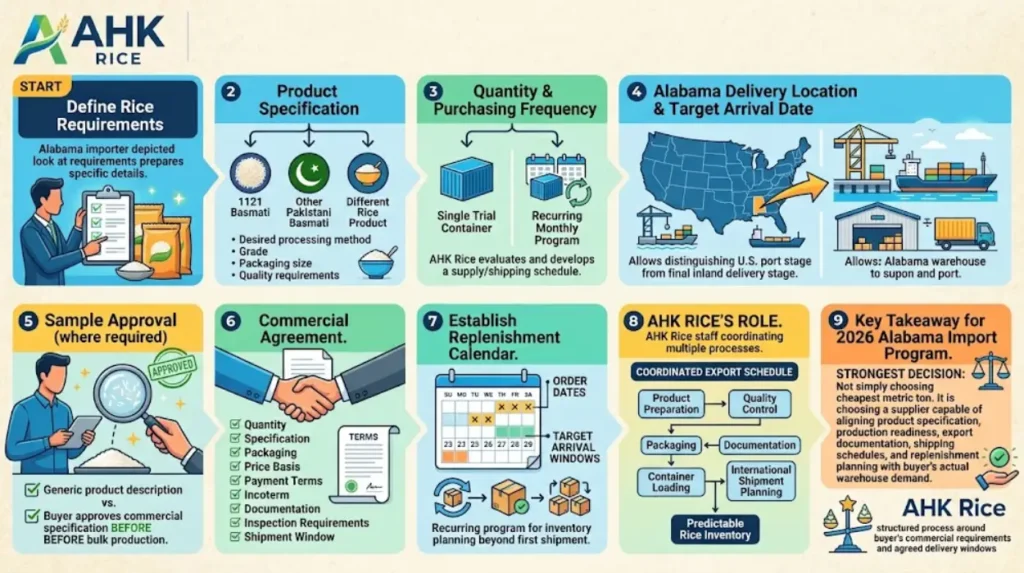
Alabama importers can begin by providing their rice specification, required quantity, packaging format, target arrival date, delivery location, and purchasing frequency so AHK Rice can evaluate the requirement and develop a commercially realistic supply and shipping schedule.
Start with the product specification. Identify whether the requirement is 1121 Basmati, another Pakistani Basmati specification, or a different rice product. State the desired processing method, grade, packaging size, and quality requirements.
Next, provide the quantity and purchasing frequency. A single trial container should be planned differently from a recurring monthly program.
Then provide the Alabama delivery location and target arrival date. This allows the logistics plan to distinguish the U.S. port stage from the final inland delivery stage.
The next step is sample approval where required. Buyers should approve the commercial specification before bulk production rather than relying on a generic product description.
After approval, the commercial agreement should define quantity, specification, packaging, price basis, payment terms, Incoterm, documentation, inspection requirements, and shipment window.
Finally, establish a replenishment calendar. A recurring program should identify expected order dates and target arrival windows so inventory planning can continue beyond the first shipment.
AHK Rice’s role is to turn those requirements into a coordinated export schedule covering product preparation, quality control, packaging, documentation, container loading, and international shipment planning. For Alabama importers, this approach provides a clearer path from supplier selection to predictable rice inventory.
For a 2026 Alabama import program, the strongest decision is not simply choosing the cheapest metric ton. It is choosing a supplier capable of aligning product specification, production readiness, export documentation, shipping schedules, and replenishment planning with the buyer’s actual warehouse demand. AHK Rice can structure that process around the buyer’s commercial requirements and agreed delivery windows.
To begin a shipment discussion and request a commercial supply plan, use the rice import quotation request.
Frequently Asked Questions
How long does Pakistani Basmati rice take to reach Alabama?
A typical Pakistan-to-Alabama rice import can require approximately 43–77 days from production planning through inland warehouse delivery. Ocean transit commonly takes around 30–45 days, followed by U.S. clearance, port handling, and inland transportation.
What shipping days should Alabama rice importers plan for?
Alabama importers should generally budget 30–45 days for ocean transportation, plus approximately 3–7 days for U.S. port and clearance processes and 1–4 days for inland delivery. Actual schedules depend on vessel routing and logistics conditions.
What information does AHK Rice need to prepare an Alabama rice delivery schedule?
AHK Rice needs the rice variety, grade, processing type, quantity, packaging format, Alabama delivery location, required arrival date, and purchasing frequency. These details allow the production and shipping schedule to be planned accurately.
How much does a rice sample from Pakistan to Alabama cost?
International courier delivery for a small rice sample may cost approximately $30–$100, depending on sample weight, destination, courier, and service level. Laboratory testing or additional inspection can create separate costs.
What affects the landed cost of Pakistani rice in Alabama?
Landed cost depends on the rice variety, grade, processing, quantity, packaging, ocean freight, insurance where applicable, port charges, customs-related expenses, testing, brokerage, and inland transportation to Alabama.
Does AHK Rice provide Pakistani Basmati rice for U.S. buyers?
Yes. AHK Rice supplies Pakistani Basmati rice for U.S. import programs, with product specifications, packaging, quality requirements, documentation, and shipment planning established according to the buyer’s commercial requirements.