What Is the UAE Basmati Rice Market?
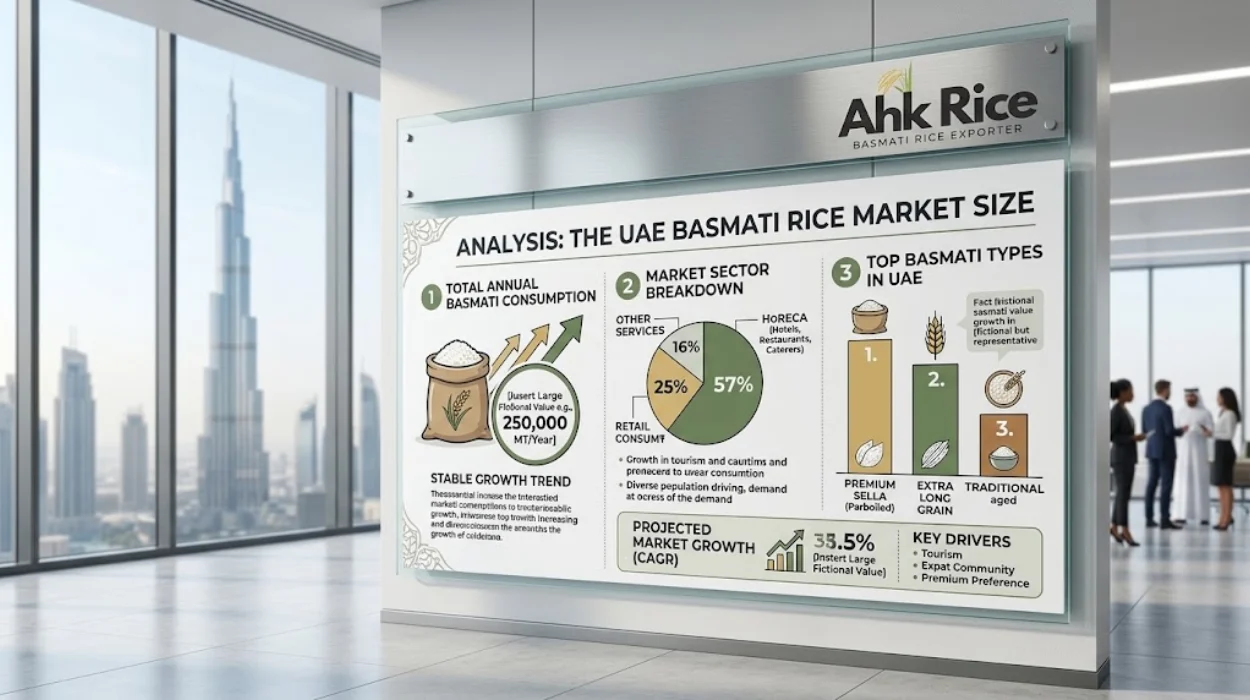
The UAE Basmati rice market comprises imported aromatic rice sold through distributors, supermarkets, wholesalers, restaurants and foodservice businesses. Its size depends on import volumes, consumer demand, retail sales, wholesale distribution and the UAE’s role as a regional food trading hub.
Basmati rice is a long-grain aromatic rice traditionally associated with the Punjab regions of Pakistan and India. Its characteristic fragrance, elongated cooked grains and relatively fluffy texture distinguish it from many non-Basmati varieties. Pakistani Basmati supplies form an important part of the UAE’s imported rice selection.
The United Arab Emirates relies on international suppliers to meet much of its food demand. Limited agricultural land, arid conditions and water constraints make large-scale domestic rice production impractical. Importers therefore source rice from established producing countries and distribute it through local and regional supply chains.
The market includes several commercial segments. Retail consumers purchase branded packs for household cooking. Restaurants and hotels buy larger quantities for biryani, pulao and other rice-based meals. Wholesalers supply grocery stores, catering companies and independent retailers. Re-export traders also purchase rice for distribution to other markets.
Market size requires a clear measurement. Import volume measures the quantity of rice entering the country, while import value measures its declared monetary value. Retail market value includes downstream selling prices, which differ from import prices because of freight, insurance, duties where applicable, warehousing, packaging, distribution and retail margins.
A reliable estimate of the UAE Basmati rice market therefore requires Basmati-specific data rather than total rice imports alone. Rice trade statistics often separate Basmati from non-Basmati rice imperfectly, so researchers must identify the product classification and reporting period before comparing figures.
How Large Is the UAE Basmati Rice Market in Trade Volume?
Pakistan’s December 2025 rice exports to the UAE reached 74,897 tonnes, including 16,850 tonnes of Basmati rice. These figures demonstrate substantial bilateral trade, but they represent one month of Pakistani shipments rather than the UAE’s entire annual Basmati market.
The December 2025 figures provide a useful benchmark for understanding the scale of Pakistani rice demand. Basmati accounted for approximately 22.5% of Pakistan’s reported rice shipments to the UAE that month. The remaining 58,047 tonnes comprised other rice categories.
This distinction matters because the UAE imports rice from multiple countries. Pakistan’s export statistics measure shipments from Pakistan, while UAE import statistics measure arrivals reported by the importing country. Timing, transit, re-exports and differences in product classification affect comparisons.
A complete market estimate needs four measurements:
- Annual import volume: The tonnes of Basmati rice imported into the UAE during a defined calendar or financial year.
- Annual import value: The declared customs value of those shipments.
- Country-of-origin share: Pakistan’s contribution compared with India and other suppliers.
- Domestic and re-export demand: The share consumed within the UAE compared with rice distributed to other countries.
Trade databases also require careful interpretation. Broad rice classifications include non-Basmati varieties, while shipment databases count recorded transactions rather than necessarily measuring total consumption. Researchers should verify the reporting period, commodity description, unit of measurement and source methodology.
Consequently, the December 2025 data establish a concrete measure of Pakistani rice trade, not a definitive annual valuation of the UAE Basmati rice market.
What Drives Demand for Basmati Rice in the UAE?
UAE Basmati rice demand is supported by household consumption, South Asian food traditions, restaurant and catering purchases, premium retail products and regional distribution. These channels create demand for different grain lengths, processing grades, pack sizes and price points across the market.
The UAE’s diverse population supports several rice consumption patterns. Pakistani, Indian, Bangladeshi and other South Asian communities purchase Basmati for everyday meals and traditional dishes. Hotels, restaurants and catering companies also use it in biryani, pulao, buffet meals and large-scale food preparation.
Tourism and hospitality add another commercial channel. Hotels and event caterers require consistent cooking performance across repeated batches. A rice variety that produces elongated, separate grains and maintains its texture after cooking suits many premium foodservice applications.
Retail demand operates differently. Supermarkets sell branded products in consumer-friendly packs, often emphasizing grain length, aroma, origin and cooking results. Wholesale distributors serve smaller grocery shops and bulk purchasers that prioritize price, availability and repeatable specifications.
Dubai also functions as a major trading and logistics centre. Its ports, warehousing infrastructure and established distribution networks support the movement of imported food products. Some rice entering the UAE supplies local consumers, while other consignments enter re-export channels subject to applicable regulations.
Seasonal purchasing patterns influence ordering schedules. Ramadan, Eid celebrations, wedding seasons and periods of high tourism increase demand for particular retail and catering formats. Importers typically plan inventory before anticipated demand peaks because international procurement, customs clearance and domestic distribution require time.
These demand drivers do not affect every grade equally. Premium restaurants prioritize grain appearance and cooking quality, while high-volume caterers balance performance against cost per serving. Retail buyers often consider packaging, brand recognition and price alongside rice quality.
Which Pakistani Basmati Rice Varieties Sell in the UAE?
Pakistani Basmati rice sold in the UAE includes 1121, Super Kernel, and 1509 Basmati rice. Buyers select among white, steam, parboiled Sella and brown processing options according to grain appearance, aroma, cooking performance, target customers and the intended retail or foodservice application.
1121 Basmati rice
1121 is recognized for its extra-long raw grain and pronounced elongation after cooking. White, Steam, Golden Sella, Creamy Sella, Brown and broken grades serve different commercial requirements. Premium retailers, restaurants and catering operators use it when grain length and presentation are important.
Super Kernel Basmati rice
Super Kernel is a traditional Pakistani Basmati variety associated with Punjab. It combines a characteristic aroma with long grains and suits household consumption, specialist grocery retail and foodservice. Buyers assess grain uniformity, broken percentage, moisture and cooking results before selecting a specification.
1509 Basmati rice
1509 is an early-maturing Basmati variety associated with comparatively high agricultural yield. It provides a commercial option for buyers balancing grain length and price. White, Steam and Sella processing formats address different retail, bulk distribution and institutional catering requirements.
What Are the Main Basmati Processing Grades?
The variety identifies the rice type, while the processing grade describes how the harvested grain is treated and presented.
| Grade | Processing characteristics | Common application |
|---|---|---|
| White Basmati | Milled grain with bran and husk removed | Household retail and restaurants |
| Steam Basmati | Paddy or rice receives controlled steaming during processing | Retail, biryani and foodservice |
| Golden Sella | Parboiled rice with a characteristic golden colour | Catering, biryani and bulk kitchens |
| Creamy Sella | Parboiled rice with a lighter creamy appearance | Wholesale and institutional foodservice |
| Brown Basmati | Outer bran layer largely retained | Whole-grain retail and specialist diets |
| Broken Basmati | Grain fragments separated during milling and grading | Selected food manufacturing and price-sensitive uses |
Steam and Sella are not interchangeable terms. Steam rice receives a steaming treatment, while Sella rice undergoes parboiling, which involves soaking, heat treatment and drying before milling. Exact processing parameters vary by mill and product specification.
Broken rice also requires a defined percentage or size specification. It is not automatically equivalent to low-quality rice; its commercial suitability depends on the buyer’s intended use and agreed grade.
How Is Pakistani Basmati Rice Grown and Processed for Export?
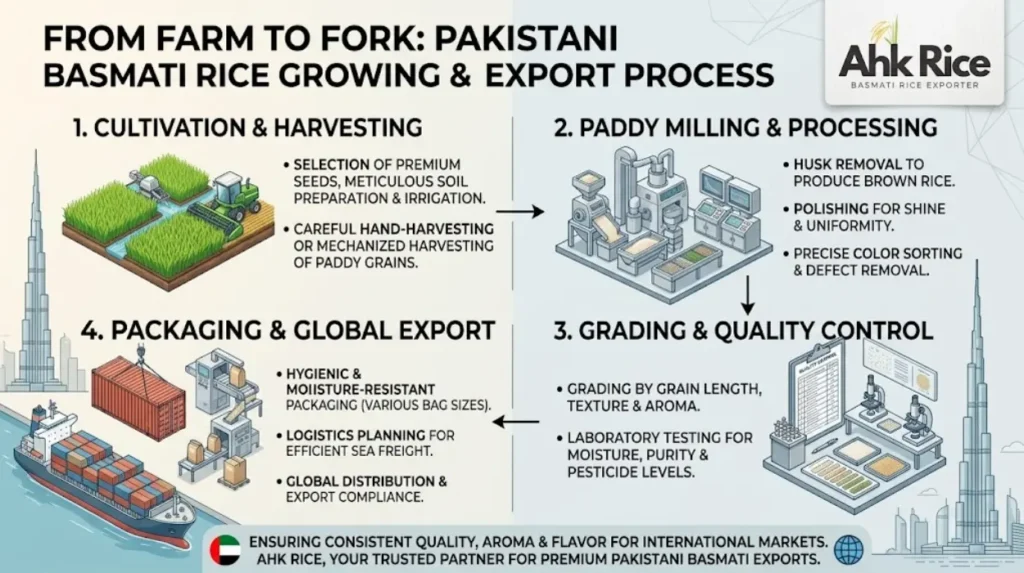
Pakistani Basmati rice begins as paddy cultivated mainly in Punjab’s rice-growing districts. After harvesting, mills clean, dry, husk, mill, grade and sort the grain. Quality checks and export packaging prepare the finished rice for international distribution and storage.
Where Is Pakistani Basmati Rice Grown?
Pakistan’s traditional Basmati-growing region lies mainly in Punjab, including areas around Gujranwala, Hafizabad, Sheikhupura, Narowal and Sialkot. The region’s agricultural conditions and established cultivation practices support aromatic Basmati production.
Farmers grow rice in seasonal agricultural cycles. Paddy, the harvested rice grain with its outer husk intact, moves from farms to procurement centres and processing mills. Variety selection, crop condition, moisture and grain maturity affect the quality of the final product.
What Are the Main Rice Processing Steps?
1. Paddy procurement and inspection
Mills inspect incoming paddy for moisture, impurities, grain condition and variety identity. Procurement controls help establish the starting quality of each processing lot.
2. Cleaning and drying
Screens, aspirators and separators remove dust, straw, stones and other foreign materials. Controlled drying brings paddy to a suitable moisture level for safe processing and storage.

3. Husking
Husking machines remove the outer husk while retaining the bran layer. The resulting brown rice moves to subsequent milling stages.
4. Milling and polishing
Whitening machines remove bran to achieve the specified finish. Polishing creates the required surface appearance when the product specification calls for it.
5. Grading and colour sorting
Length graders separate whole kernels from broken grains. Optical sorters remove discoloured or defective kernels, improving visual uniformity.
6. Quality testing and packing
Processors check the agreed specifications, pack rice into approved bag formats and prepare shipment records. Export consignments proceed through the applicable inspection, documentation and customs procedures.
Sella processing adds a distinct treatment before final milling. Paddy or rice undergoes soaking, heat treatment and drying in a controlled sequence. This process changes the grain’s physical characteristics and produces parboiled rice.
Quality assurance covers more than appearance. Buyers establish limits for moisture, broken percentage, grain length, foreign matter and other relevant parameters. Laboratories also test food-safety indicators when required by the destination market or purchase contract.
What Benefits Does Basmati Rice Offer UAE Buyers?
Basmati rice offers UAE consumers aromatic flavour, elongated cooked grains and several processing options. Importers benefit from a broad product range serving household retail, premium restaurants, catering, wholesale distribution and private-label packaging, with specifications matched to customer expectations.
For consumers, aroma and texture distinguish Basmati from many standard long-grain rice products. Grain elongation after cooking contributes to its presentation in biryani and other traditional dishes. Cooking performance depends on variety, processing, ageing, storage and preparation method.
For retailers, several grades allow product segmentation. Premium long-grain varieties serve customers who prioritize appearance and cooking results. More price-sensitive products address shoppers seeking Basmati within a defined budget. Brown rice serves consumers who prefer whole-grain options.
For restaurants and caterers, consistent specifications support portion planning and repeatable recipes. Broken percentage, moisture and cooking tests help purchasing teams compare batches before approving larger orders.
For wholesalers, multiple bag sizes and processing grades provide flexibility across customer categories. Smaller consumer packs suit supermarkets, while 25 kg and 50 kg bags often serve bulk buyers, subject to the requirements of each business.
The commercial benefit depends on product suitability, not simply the variety name. A buyer should compare samples, specifications, landed cost, storage requirements and expected customer demand before choosing a grade.
How Do UAE Importers Purchase and Distribute Basmati Rice?
UAE importers source Basmati from overseas suppliers, confirm product specifications, arrange shipping and complete applicable food-import procedures. After customs and food-control clearance, rice moves to warehouses, supermarkets, wholesalers, restaurants, catering businesses or authorised re-export channels.
The procurement process starts with a product requirement. A buyer defines the variety, processing grade, grain length, broken percentage, moisture limit, quantity and packaging. These specifications create a measurable basis for comparing suppliers.
Importers then evaluate samples and commercial quotations. A cooking test checks aroma, elongation, texture and grain separation. The purchase agreement records price, Incoterm, shipment schedule, payment conditions, inspection arrangements and the procedure for resolving specification disputes.
The logistics stage includes booking freight, preparing shipping documents and arranging cargo insurance where applicable. Documents commonly associated with international rice shipments include a commercial invoice, packing list, certificate of origin and bill of lading. Phytosanitary, health or inspection certificates apply according to the product and destination requirements.
The importer must also confirm local food-registration and clearance procedures. The UAE’s national ZAD system supports food-product registration, while Dubai Municipality provides services for food-item assessment and imported-consignment release. Requirements depend on the emirate, shipment and product category.
zad.gov.ae
+1
After release, the importer distributes rice through its chosen channels. Retail stock moves to shelves and e-commerce fulfilment centres. Foodservice stock moves to restaurant kitchens, hotel stores and catering operations. Re-export shipments require the relevant approvals and documentation.
The full commercial cost includes more than the supplier’s quoted price. Freight, insurance, inspection, customs-related charges where applicable, port handling, storage, inland transport and distributor margins contribute to the final landed cost.
What Certifications and Import Requirements Apply to Basmati Rice in the UAE?
Basmati rice imports must meet applicable UAE food-safety, product-registration, labelling and customs requirements. Importers verify the required certificates and documents for each shipment, while exporters provide accurate product information, traceability records and test results supporting the agreed specifications.
The main compliance areas include:
- Food registration: Imported food products must meet applicable registration requirements before market distribution. ZAD provides a federal platform for food-business and product registration.
- Labelling: Retail packaging must meet applicable requirements for product identification, origin, net weight, dates and other mandatory information. Arabic-language labelling requirements apply in the relevant UAE regulatory framework.
- Food safety: Importers verify relevant contaminant limits, pesticide-residue requirements and supporting laboratory documentation.
- Origin and shipment documents: Commercial invoices, packing lists, origin documentation and transport records support customs clearance.
- Quality management: HACCP and ISO 22000 provide recognised food-safety management frameworks. They are not substitutes for mandatory UAE product and import approvals.
- Additional certificates: Phytosanitary, health, inspection or other certificates depend on applicable rules and shipment circumstances. Halal certification is not automatically a requirement for plain rice simply because it is imported.
Dubai Municipality provides services for food-item registration, imported-consignment release and food re-export approvals. Importers should confirm the current requirements with the relevant authority before dispatch rather than assume that one certificate satisfies every requirement.
What Common Problems Affect the UAE Basmati Rice Market?
Common market challenges include inconsistent grain specifications, moisture-related deterioration, inaccurate labels, incomplete documentation, price volatility and poor shipment planning. Importers reduce these risks through written specifications, representative samples, suitable storage, verified documents and clearly agreed inspection procedures.
One frequent misconception is that all Basmati rice has identical grain length and cooking characteristics. Varieties differ, and processing affects appearance, texture and performance. Buyers should compare like-for-like grades rather than select products by name alone.
Another problem is confusing Pakistani rice exports to the UAE with the entire UAE Basmati market. National export figures measure trade from a particular origin. They do not measure imports from every supplier or the volume consumed locally.
Moisture control is another priority. Excessive moisture and unsuitable storage conditions increase deterioration risks. Importers should review moisture specifications, warehouse ventilation, packaging integrity and stock rotation.
Pricing also creates confusion. An FOB quotation covers a different set of costs from a CIF quotation. Neither price automatically represents the final warehouse cost or retail selling price. Buyers should compare the same grade, quantity, delivery basis and shipment period.
Finally, an exporter’s general certification claims do not prove that every shipment complies with every destination requirement. Buyers should verify relevant certificates, batch test reports, product registration responsibilities and contractual quality terms before approving a consignment.
How Can Businesses Research UAE Basmati Rice Market Trends?
Businesses can analyse the UAE Basmati rice market by combining customs data, Pakistani export statistics, retail prices, buyer demand and seasonal purchasing patterns. Consistent reporting periods and product definitions help distinguish genuine market changes from differences in shipment timing or classification.
A practical market study tracks annual import tonnes, declared import value, supplier-country shares and changes in average unit value. Researchers should separate Basmati from non-Basmati rice wherever the available trade classifications permit.
Retail price monitoring provides another perspective. The UAE Ministry of Economy and Tourism publishes an essential-goods price platform that includes Basmati rice products and retail pack prices. These prices help researchers compare consumer-facing products, but they do not establish wholesale import values.
Seasonal research should examine monthly imports alongside Ramadan, Eid, wedding periods and tourism-related foodservice demand. A single month cannot establish a recurring seasonal pattern. Several years of comparable data provide a stronger basis for identifying peaks.
For a deeper analysis of Pakistani shipment volumes, purchasing drivers and seasonal changes, read the related guide on Pakistani Basmati rice export trends to the UAE. This research connects the broader market picture with the trade data used to understand sourcing and distribution.
What Are the Frequently Asked Questions About the UAE Basmati Rice Market?
The UAE Basmati rice market includes imported premium and value-oriented grades supplied to retail, wholesale and foodservice channels. Its exact annual size requires Basmati-specific import volume and value data, while demand patterns reflect consumer preferences, hospitality activity and regional trade.
How much Basmati rice does the UAE import annually?
The exact annual quantity requires UAE import statistics that isolate Basmati rice from other rice categories. Pakistan exported 16,850 tonnes of Basmati to the UAE in December 2025, a monthly figure rather than an annual market total.
Which Pakistani Basmati varieties are popular in the UAE?
1121, Super Kernel and 1509 are important Pakistani commercial varieties. Buyers select among them according to grain length, aroma, processing grade, cooking performance and price.
Why does the UAE import Basmati rice?
Domestic agricultural conditions limit large-scale rice cultivation. Imports supply household consumers, supermarkets, restaurants, hotels, catering businesses and regional distribution networks.
What documents do UAE rice importers need?
Common shipment documents include a commercial invoice, packing list, certificate of origin and bill of lading. Additional health, phytosanitary or inspection documents depend on applicable product and destination requirements.
Does every Basmati rice shipment require Halal certification?
Plain rice does not automatically require Halal certification solely because it is imported. Importers should confirm the specific product, claim and regulatory requirements that apply to their shipment.
Which factors influence Basmati rice prices in the UAE?
Prices reflect variety, processing grade, grain specifications, broken percentage, crop availability, order quantity, freight, insurance, packaging, storage and distribution costs.