AHK Rice Supports High-Volume Basmati Rice Imports into New York, USA
New York buyers sourcing high-volume Basmati rice should prioritize production capacity, specification consistency, documentation, and shipment planning rather than choosing an exporter on FOB price alone. A supplier that can repeatedly process, inspect, pack, and dispatch container quantities is better positioned for long-term distribution contracts.
Before committing to a supplier, buyers should understand:
Why New York buyers evaluate rice production capacity. Production capacity directly affects whether an exporter can maintain agreed grades when order volumes increase, especially when a buyer moves from a trial container to scheduled monthly or quarterly shipments.
For New York importers, the commercial requirement is straightforward: the rice must arrive with the agreed variety, grain specification, packaging, documentation, and quantity while the exporter maintains production continuity. AHK Rice supports this model through integrated sourcing, processing, grading, inspection, packaging, and export coordination from Punjab, Pakistan. AHK Rice currently supplies markets including the USA and operates an end-to-end processing and export system.
What is the best solution for high-volume Basmati rice imports into New York?
The best solution is a specification-based supply program combining verified production capacity, pre-shipment inspection, scheduled container loading, compliant documentation, and repeatable quality controls. This structure gives New York importers greater supply continuity and reduces the risk of inconsistent commercial shipments.
High-volume importing should begin with a defined product specification rather than a general request for “premium Basmati rice.” The buyer should identify the variety, processing grade, grain length, broken percentage, moisture target, packaging format, quantity per container, destination port, and Incoterm.
For New York, common commercial choices include 1121 Basmati, 1121 Sella, Super Kernel, and 1509 Basmati. The appropriate grade depends on the sales channel. Premium ethnic supermarkets may prioritize extra-long 1121 grain, while restaurants and wholesalers may select a specification that balances cooking performance with landed cost.
AHK Rice processes Pakistani Basmati through stages including paddy procurement, cleaning, de-husking, whitening or polishing, grading, length sorting, color sorting, inspection, packing, and container loading. Managing these stages through an integrated operation helps reduce variation between production lots.
The commercial advantage becomes more important as order volume increases. A supplier may satisfy a 20-metric-ton trial order but struggle to reproduce the same specification across several containers. New York buyers therefore need to assess whether the exporter can align production schedules with contractual demand.
This is where production capacity becomes a procurement issue rather than simply a factory statistic. A buyer planning 10 containers per quarter needs confidence that the exporter can allocate the required paddy, milling capacity, grading resources, packaging materials, inspection time, and loading windows without compromising specifications.
Why choose USA supply services from AHK Rice?
AHK Rice is suitable for USA importers seeking specification-based Pakistani Basmati supply because it combines Punjab-based sourcing and processing with grading, inspection, packaging, export documentation, and container logistics for international buyers. The structure supports repeat orders instead of isolated spot transactions.
AHK Rice has a dedicated USA export service covering Pakistani Basmati supply to American importers, wholesalers, retailers, and foodservice businesses. The USA service identifies 1121 Sella, Super Kernel, and white Basmati among the products available for American buyers.
The first product decision should be made against the buyer’s commercial application. For example, 1121 Basmati can suit premium retail positioning where extra-long cooked grains create visual differentiation. Super Kernel can suit traditional South Asian grocery channels where aroma and familiar cooking characteristics influence repeat purchases.
AHK Rice can coordinate product processing, quality verification, packing, and export documentation through one supply relationship. Its published USA information also states that buyers can begin with a 20-foot container and that quotations depend on variety, quantity, and current market conditions.
The supplier’s quality infrastructure is also relevant. AHK Rice states that its rice products are supported by ISO 22000:2018, HACCP, ISO 9001:2015, GMP, and Halal certifications, while pre-shipment inspections can be conducted through recognized inspection organizations such as SGS and Bureau Veritas.
For a New York importer, these controls matter because a large shipment magnifies the cost of specification errors. If a container does not match the approved sample, the buyer may face rework, customer complaints, inventory disruption, or additional inspection and handling expenses.
AHK Rice therefore positions the service around controlled export execution rather than simply supplying a commodity. This is particularly relevant when a distributor needs the same specification across multiple purchase cycles.
How does production capacity affect long-term New York rice supply contracts?
Production capacity determines whether an exporter can turn a negotiated annual volume into consistent shipments. Buyers should compare available production resources, grade consistency, inspection procedures, packaging capability, and shipment scheduling before signing a long-term supply contract.
A long-term contract should translate the buyer’s annual requirement into manageable production and shipping schedules. Instead of agreeing only on total metric tons, the contract can define shipment frequency, minimum lot size, specifications, packaging, inspection requirements, and permitted tolerances.
For example, a New York distributor requiring 120 metric tons annually could structure the requirement as six 20-metric-ton shipments. The exporter must then plan production and packing around each dispatch rather than treating the entire annual volume as one theoretical commitment.
The comparison should also consider how production capacity affects contract reliability. Buyers evaluating:
Production capacity and long-term supply contracts should examine whether the supplier can maintain the same variety and grade during different production periods.
AHK Rice’s integrated facility allows production activities to be coordinated from paddy procurement through final loading. The company states that it manages procurement, processing, grading, sorting, packaging, and export documentation as part of its supply process.
This structure can be valuable for New York buyers because the supplier relationship remains centralized. The buyer does not need separate commercial coordination for milling, grading, packing, and export documentation.
A practical contract should establish measurable specifications. These can include grain length, broken percentage, moisture, purity, processing type, packaging material, net weight, and acceptable tolerances. The approved pre-shipment sample should serve as the commercial reference wherever appropriate.
What shipping days should New York buyers expect from Pakistan?
New York shipments normally require substantially more transit time than Pakistan-to-West-Coast routes. Buyers should plan roughly 35–50 days for an East Coast shipment from Pakistan when inland movement, export clearance, ocean transit, and U.S. clearance are considered. Actual schedules vary by vessel and port conditions.
New York importers should distinguish between production lead time and ocean transit time. A supplier may complete rice processing before the vessel is available, so the commercial delivery schedule must include production, inspection, documentation, port handling, vessel departure, ocean transit, and U.S. clearance.
Current AHK Rice shipping guidance places East Coast shipments to the Port of New York and New Jersey or similar destinations at approximately 35–50 days in total. Its breakdown includes around two days for inland movement, two days for export clearance, approximately 28–35 days for sea freight, and four to seven days for U.S. clearance.
These figures are planning ranges rather than guaranteed delivery dates. Vessel schedules, transshipment, port congestion, customs processing, weather, documentation issues, and carrier changes can extend the timeline.
A New York distributor should therefore maintain sufficient safety stock. If the business sells 20 metric tons per month, it should not schedule replenishment only when its warehouse reaches zero inventory. A longer lead-time corridor requires earlier purchasing decisions.
AHK Rice can coordinate container loading and export documentation as part of the shipment process. Its USA service information also states that shipment tracking is available and that buyers can arrange their own freight forwarder when preferred.
For recurring contracts, the most practical approach is to establish a shipment calendar several weeks ahead of the desired arrival window. This allows the buyer and exporter to align production with vessel availability.
What is the full Basmati rice sample process and what does it cost?
The sample process should confirm product identity, cooking performance, physical specifications, packaging suitability, and commercial expectations before bulk production. AHK Rice states that samples up to 20 kg can be supplied without a rice charge, while the buyer pays applicable courier and phytosanitary costs.
The first step is specification collection. The New York buyer provides the required variety, processing grade, grain length, broken percentage, moisture requirement, packaging preference, intended quantity, and destination.
The second step is sample selection. AHK Rice identifies the appropriate commercial grade and prepares the requested quantity. Its USA service states that up to 20 kg of Basmati rice can be provided as a sample without a rice charge.
The third step is sample dispatch. The buyer can provide its courier account, or shipping can be arranged according to the agreed process. The buyer is responsible for sample shipping costs. The exact courier charge depends on destination, weight, dimensions, service level, and carrier.
The fourth step is documentation. Where a phytosanitary certificate is required for the sample shipment, the buyer covers the applicable certificate cost. AHK Rice’s USA product information specifically identifies the client as responsible for the phytosanitary certificate for samples.
The fifth step is buyer evaluation. A professional importer should test the sample for appearance, aroma, grain elongation, cooking expansion, texture, broken percentage, moisture, and overall suitability for its target market. Restaurants may place greater emphasis on cooking performance, while retailers may focus more heavily on appearance, packaging, and consistency.
The sixth step is commercial approval. Once the buyer approves the sample, the final specification should be documented. Bulk production should then follow the approved grade rather than a verbal description.
For budgeting purposes, the sample rice itself may be free up to the stated 20 kg limit, but international courier and phytosanitary charges are additional. Because these costs vary by shipment details, they should be confirmed before dispatch rather than treated as a fixed universal fee.
What results can New York importers expect from AHK Rice?
The main expected result is a more controlled procurement cycle: approved specifications, repeatable processing, organized production planning, documented inspection, coordinated shipment execution, and clearer inventory forecasting. These benefits become more valuable as annual import volume and distribution coverage increase.
A buyer importing one trial container needs product verification. A distributor importing several containers needs repeatability. The commercial objective changes from proving that the rice is acceptable to proving that the supplier can reproduce the same result.
AHK Rice supports this objective through integrated processing and export coordination. Its USA wholesale information describes controlled milling, grading, inspection, export documentation, and FOB Karachi dispatch within one export process.
Consider a New York ethnic grocery distributor supplying multiple stores. If the first shipment contains long, aromatic 1121 Basmati with the agreed cooking performance, subsequent shipments must maintain that positioning. A materially different grade could create customer complaints even when the packaging looks identical.
A second scenario involves a restaurant distributor. The buyer may prioritize consistent cooking expansion and low breakage over maximum grain length. A specification-driven contract allows the buyer to purchase against the performance characteristics that matter to its customers.
AHK Rice also supports private-label packaging, allowing importers to develop market-specific retail presentations rather than relying only on generic export bags. Its published company information confirms customized packaging as part of its export capabilities.
The measurable commercial outcome is better planning. When the product specification, quantity, production schedule, inspection process, and shipment window are agreed in advance, procurement teams can forecast inventory more effectively.
What factors determine the price of high-volume Basmati rice imports?
Basmati rice pricing is determined by the variety, processing grade, grain specification, broken percentage, quality requirements, quantity, packaging, seasonal paddy costs, inspection requirements, freight, insurance, Incoterm, and destination. A single FOB price therefore cannot represent the final landed cost.
The first cost factor is variety. Extra-long 1121 specifications generally occupy a different commercial position from standard long-grain grades. Processing also affects cost because Steam, Sella, Golden Sella, and White rice require different production procedures.
The second factor is specification tolerance. A buyer requesting very low broken percentages, higher purity, tighter grain-length tolerances, or additional laboratory testing may incur a different price than a buyer purchasing a broader commercial specification.
The third factor is volume. Larger orders can improve production efficiency and may support better commercial pricing, but the exact price depends on current paddy, milling, packaging, and freight conditions.
The fourth factor is packaging. Plain bulk bags, customized printed bags, retail packaging, and private-label materials have different production requirements. Packaging dimensions also affect container utilization.
The fifth factor is Incoterm. An FOB Karachi quotation does not represent the same cost exposure as a CIF or delivered arrangement. Freight, insurance, destination charges, customs expenses, and inland transportation must be evaluated separately according to the selected trade term.
AHK Rice states that USA quotations are based on variety, quantity, and current market conditions and are provided according to the buyer’s requirements.
For a New York buyer, the correct commercial comparison is therefore landed cost per metric ton, not simply exporter FOB price. A lower FOB quotation can become less competitive if it produces higher freight exposure, inconsistent quality, additional inspection expenses, or greater inventory risk.
How should a New York buyer get started with AHK Rice?
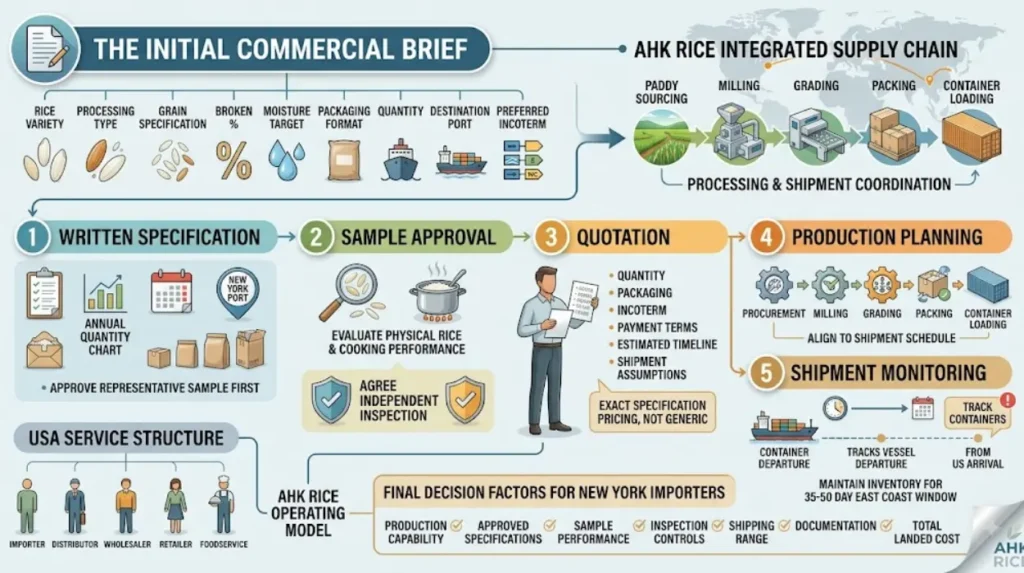
Start with a written product specification, requested annual quantity, preferred shipment schedule, destination port, packaging requirement, and commercial term. Approve a representative sample first, then finalize production, inspection, documentation, and container schedules before committing to repeat-volume procurement.
The first commercial brief should include the rice variety, processing type, required grain specification, acceptable broken percentage, moisture target, packaging format, quantity, destination port, and preferred Incoterm.
The second step is sample approval. Buyers should evaluate the physical rice and cooking performance before approving the commercial specification. If the buyer requires independent inspection, this should be agreed before production or shipment.
The third step is quotation. The exporter should provide pricing against the exact specification rather than a generic product name. The quotation should identify quantity, packaging, Incoterm, payment terms, estimated production timeline, and shipment assumptions.
The fourth step is production planning. Once commercial terms are accepted, the exporter can align procurement, milling, grading, packing, inspection, and container loading with the agreed shipment schedule.
The fifth step is shipment monitoring. New York buyers should track the container from loading through vessel departure and U.S. port arrival while maintaining sufficient inventory for the 35–50-day East Coast planning window.
AHK Rice is particularly relevant for buyers that want one export partner covering processing and shipment coordination rather than managing several intermediaries. AHK Rice’s stated operating model covers the supply chain from paddy sourcing through container loading, while its USA service is structured for importers, distributors, wholesalers, retailers, and foodservice buyers.
For a New York importer, the final decision should therefore be based on production capability, approved product specifications, sample performance, inspection controls, shipping range, documentation, and total landed cost. AHK Rice can support this decision with specification-based procurement and export coordination rather than treating high-volume Basmati rice as a one-off commodity purchase.
To begin the commercial process, submit the required product, quantity, packaging, destination, and shipping details through the AHK Rice quotation request.
Frequently Asked Questions
What Basmati rice varieties does AHK Rice supply to New York?
AHK Rice supplies Pakistani Basmati varieties including 1121 Basmati, 1121 Sella, Super Kernel, and 1509 Basmati, depending on buyer specifications and availability.
What is the minimum order quantity for Basmati rice imports to New York?
The minimum quantity depends on the product and commercial requirements. AHK Rice can discuss container-based orders, including 20-foot container shipments, with New York importers.
How long does Basmati rice shipping from Pakistan to New York take?
A typical Pakistan-to-New York shipment can require approximately 35–50 days, including inland movement, export clearance, ocean freight, and U.S. clearance. Actual transit varies by vessel schedule and port conditions.
Can New York buyers request Basmati rice samples?
Yes. AHK Rice provides samples for product evaluation. Its USA service states that samples up to 20 kg can be supplied without a rice charge, while applicable courier and phytosanitary costs are paid by the buyer.
How much does a Basmati rice sample cost?
The rice sample can be supplied without a product charge up to the stated 20 kg limit. International courier and applicable phytosanitary certificate costs are additional and depend on shipment details.
What should New York buyers check before approving a rice sample?
Buyers should evaluate grain length, broken percentage, moisture, purity, aroma, appearance, cooking expansion, texture, processing type, and overall suitability for their retail, wholesale, or foodservice requirements.
Can AHK Rice handle high-volume Basmati rice orders?
Yes. AHK Rice provides integrated procurement, processing, grading, sorting, packaging, inspection, documentation, and container-loading services designed to support commercial export orders.
What factors affect the price of Basmati rice for New York importers?
Price depends on variety, processing type, grain specification, broken percentage, quantity, packaging, seasonal paddy costs, inspection requirements, freight, insurance, Incoterm, and destination-related charges.
Does AHK Rice offer private-label Basmati rice packaging?
Yes. AHK Rice supports customized and private-label packaging for buyers that want retail packaging aligned with their own brand and market requirements.
Can New York importers arrange independent rice inspections?
Yes. Buyers can request independent pre-shipment inspection according to their commercial requirements. Inspection organizations such as SGS and Bureau Veritas may be used where agreed.
What documentation is required for importing Basmati rice into the USA?
Documentation depends on the shipment and U.S. regulatory requirements but can include commercial invoices, packing lists, certificates of origin, shipping documents, applicable phytosanitary documentation, and other food-import records required for the specific shipment.
Why is production capacity important for long-term Basmati rice contracts?
Production capacity indicates whether an exporter can consistently process and dispatch the required volume while maintaining the approved variety and quality specification. It becomes especially important for recurring container shipments.
How can a New York buyer start sourcing Basmati rice from AHK Rice?
The buyer should provide the required variety, quantity, quality specification, packaging format, destination, preferred Incoterm, and shipment schedule. AHK Rice can then provide a product recommendation, sample process, quotation, and export plan.