Which Pakistan Basmati Sample Specifications Should Indonesian Importers Compare First?
Indonesian importers should compare variety, grain length, moisture, broken percentage, purity, processing grade, and cooking performance first. Here is why: these specifications determine product positioning, quality consistency, and suitability for retail, restaurants, and wholesale distribution.
A sample comparison becomes more useful when buyers connect physical quality with commercial requirements. This approach to building quality specifications for Pakistan Basmati rice explains how Indonesian importers can compare samples before approving a supplier.
AHK Rice supplies 1121, Super Kernel, and 1509 Basmati rice from Punjab, Pakistan. Its export process covers processing, quality control, packaging, and shipment preparation. These capabilities help buyers evaluate samples against a defined commercial specification.
What are the available solutions for comparing Pakistan Basmati samples?
The main solutions are physical inspection, laboratory testing, cooking evaluation, and commercial specification comparison. Here is why: each method measures a different quality attribute, and together they establish whether a sample fits the intended Indonesian market.
Physical inspection examines the visible characteristics of rice. Buyers check grain length, colour, uniformity, broken grains, foreign matter, and surface appearance. This method provides a quick first assessment, but visual inspection alone cannot confirm moisture or cooking performance.
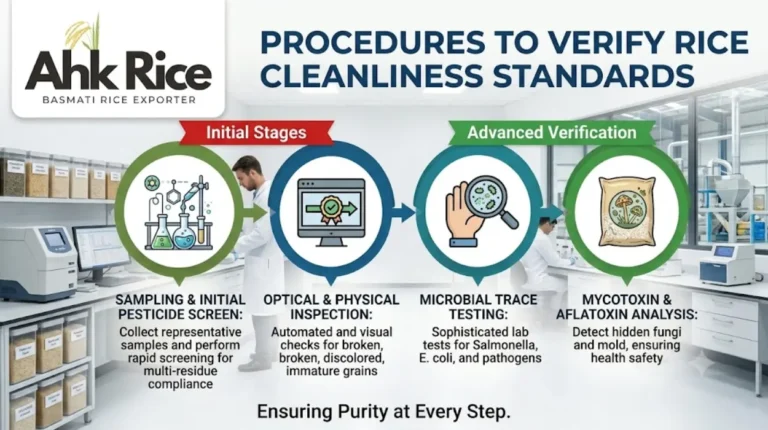
Laboratory testing measures moisture, broken percentage, foreign matter, damaged grains, and other agreed attributes. These measurements create objective evidence for supplier comparison. Indonesian rice standards also address measurable quality attributes such as moisture, broken grains, head rice, foreign matter, and milling degree. (source: Indonesian SNI rice framework, as summarized in AHK Rice’s Indonesian specification guide)
Cooking evaluation measures aroma, texture, elongation, softness, and grain separation after preparation. A sample with attractive raw grains can still perform poorly in a restaurant kitchen. Cooking tests therefore connect laboratory results with actual use.
Commercial specification comparison combines the results into one buyer-approved document. The document should identify variety, processing grade, grain length, moisture, broken percentage, purity, packaging, and inspection requirements.
The strongest approach uses all four methods. Physical inspection screens the sample, laboratory testing verifies measurable quality, cooking evaluation confirms performance, and commercial comparison supports the purchasing decision.
Which Pakistan Basmati varieties should Indonesian importers compare first?
1121, 1509, and Super Kernel provide the main comparison set for Indonesian importers. Here is why: each variety offers different grain dimensions, aroma, cooking performance, and commercial positioning.
1121 Basmati rice
1121 Basmati is a long-grain aromatic rice variety cultivated in Pakistan. It produces very long cooked grains and suits premium retail, biryani, pilaf, and restaurant applications.
Commercial references place 1121 raw grain length around 8.2–8.4 mm. AHK Rice commercial references use moisture targets around 12.5% or below and broken targets below 1–2%, depending on the contracted grade. (source: AHK Rice commercial reference)
1509 Basmati rice
1509 Basmati is a long-grain aromatic variety positioned between premium and value-focused segments. It offers long cooked grains and supports retail, foodservice, and wholesale distribution.
Commercial references place 1509 raw grain length around 8.1–8.35 mm. Moisture targets commonly fall around 12–13%, while broken percentage depends on the agreed grade. (source: AHK Rice commercial reference)
Super Kernel Basmati rice
Super Kernel Basmati is a traditional Pakistani aromatic rice variety with long, slender grains. It suits buyers seeking familiar Basmati aroma, balanced grain appearance, and specialty retail positioning.
Commercial references place Super Kernel raw grain length around 7.0–7.4 mm or above. AHK Rice commercial references use moisture targets around 12.5% or below and broken targets around 2–3% or below. (source: AHK Rice commercial reference)
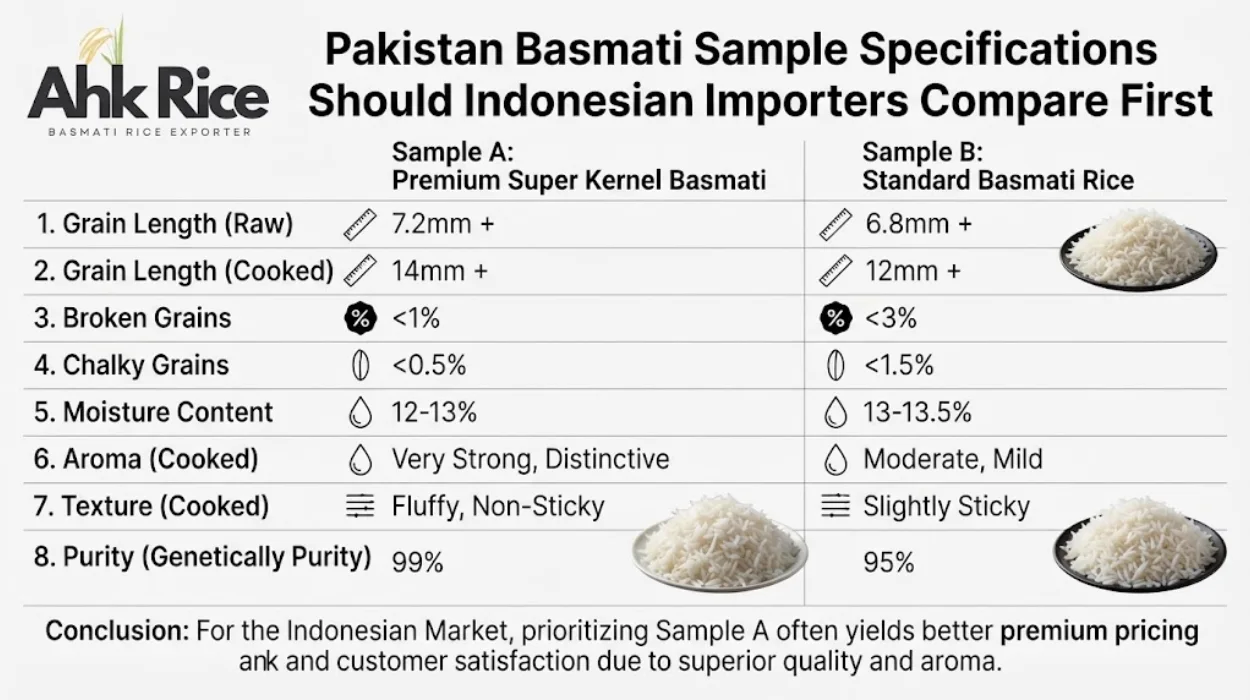
Specification comparison table
| Attribute | 1121 Basmati | 1509 Basmati | Super Kernel Basmati |
|---|---|---|---|
| Raw grain length | 8.2–8.4 mm | 8.1–8.35 mm | 7.0–7.4+ mm |
| Aroma | High | Medium-high | High |
| Cooked elongation | Very high | High | High |
| Moisture target | ≤12.5% | 12–13% | ≤12.5% |
| Broken target | <1–2% | 1–5% | ≤2–3% |
| Commercial position | Premium | Value-premium | Traditional premium |
| Main use | Retail and HORECA | Retail and HORECA | Specialty retail |
These figures are commercial reference ranges, not universal contractual specifications. Buyers should approve the final tolerance for each grade before production.
The variety comparison establishes the first decision. The next step is to compare the physical and functional attributes that determine whether the selected sample meets the intended use.
Which sample specifications matter most after variety?
Grain length, moisture, broken percentage, purity, processing grade, cooking performance, and packaging are the seven priority specifications. Here is why: these attributes connect the sample’s physical appearance with storage, preparation, retail presentation, and shipment consistency.
Grain length
Grain length measures the raw kernel from end to end. Longer kernels support premium presentation and strong cooked-grain elongation.
1121 typically offers the longest grain among the three varieties. 1509 provides a similar long-grain profile, while Super Kernel offers a shorter traditional Basmati shape. Buyers should compare measured length rather than rely on variety names alone.
Moisture
Moisture measures the water content of the rice. Lower controlled moisture supports storage stability and reduces the risk of quality deterioration during shipment.
Commercial Basmati contracts commonly use tighter moisture targets around 12–13%. Indonesian SNI rice requirements include a maximum moisture level of 14% for rice. (source: Indonesian SNI 6128:2020, as summarized in AHK Rice’s purity guide)
Broken percentage
Broken percentage measures the proportion of kernels shorter than the agreed whole-grain standard. Lower broken content supports uniform appearance and improves the proportion of intact grains in a retail pack.
Premium retail buyers commonly compare samples around 1–5% broken. Foodservice and manufacturing buyers may accept higher levels, depending on the final product and price target.
Purity
Purity measures the consistency and cleanliness of the rice shipment. It includes foreign matter, variety consistency, damaged grains, chalky grains, and broken content.
Foreign matter includes stones, husk fragments, dust, straw, weed seeds, and other unwanted materials. Colour sorting, cleaning, grading, and inspection reduce these materials before packing.
Processing grade
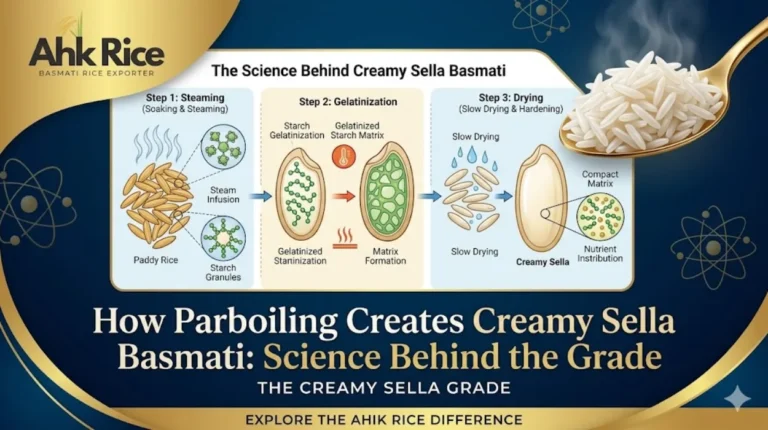
Processing grade identifies how the rice is milled, sorted, polished, parboiled, or otherwise prepared. Steam, Sella, and Golden Sella represent different processing approaches.
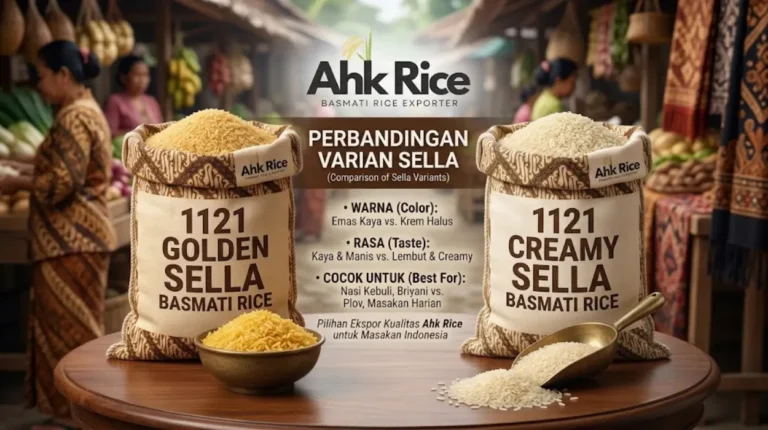
Steam rice is milled and processed without parboiling. Sella rice is parboiled and dried before milling. Golden Sella receives parboiling and drying that produce a golden appearance.
The processing grade affects grain texture, colour, cooking time, and storage behaviour. Buyers should compare the same processing grade across suppliers.
Cooking performance
Cooking performance measures how the rice behaves after preparation. Buyers should record aroma, texture, elongation, grain separation, softness, and cooking time.
A restaurant buyer may prefer long, separate grains with strong aroma. A retail buyer may prioritize appearance and consistent preparation. A wholesale buyer may focus on repeatable cooking performance across large batches.
Packaging
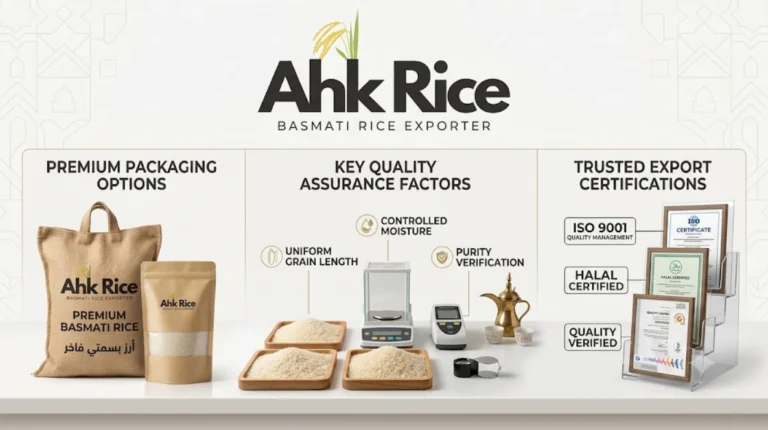
Packaging protects the rice during loading, shipping, storage, and distribution. Buyers should compare bag material, bag size, stitching, labelling, palletization, and moisture protection.
Indonesia’s rice import documentation includes product type, volume, broken percentage where required, country of origin, and importer identity. (source: Indonesian rice import regulations)
The seven specifications establish the quality baseline. The next comparison should focus on how different market regions prioritize these attributes.
How do sample requirements differ between Indonesian market regions?

Premium urban retail and foodservice buyers prioritize appearance, aroma, and cooking performance, while wholesale distributors emphasize cost, storage, and repeatable quality. Here is why: each channel has different customer expectations and inventory requirements.
Premium retail and foodservice
Premium retail buyers often compare 1121 Steam, 1121 Sella, and 1509 Steam. These grades support long-grain presentation and aromatic cooking.
Restaurant buyers focus on cooked elongation, grain separation, aroma, and consistency across large cooking batches. A sample that performs well in a household kitchen still requires testing in a commercial kitchen.
The price comparison should use the same packaging, Incoterm, shipment volume, and specification. A premium 1121 sample normally commands a higher price than a value-focused 1509 sample, while Super Kernel occupies a separate traditional-premium position.
Wholesale and regional distribution
Wholesale buyers often compare 1509 Steam, 1121 Steam, and Super Kernel. These grades provide different balances between appearance, aroma, and procurement cost.
Distributors serving price-sensitive customers prioritize landed cost and stable supply. They also compare moisture, broken percentage, packaging strength, and shelf-life expectations.
Price comparison
| Comparison | Premium retail and foodservice | Wholesale distribution |
|---|---|---|
| Preferred grades | 1121 Steam, 1121 Sella, 1509 Steam | 1509 Steam, 1121 Steam, Super Kernel |
| Main quality focus | Length, aroma, elongation, texture | Moisture, broken percentage, purity |
| Price position | Premium and value-premium | Value-premium and traditional premium |
| Packaging focus | Branded retail packs | Bulk and distributor packs |
| Buying priority | Consumer experience | Landed cost and repeat supply |
A reliable price-per-MT comparison requires current supplier quotations. The buyer should request FOB and CIF prices using identical specifications. A lower price does not represent better value when the sample has higher broken content or weaker cooking performance.
Shelf-life comparison
Shelf life depends on moisture, processing, packaging, warehouse conditions, and stock rotation. Golden Sella often suits longer storage programs because parboiling changes grain structure and supports durability.
Steam rice requires tighter moisture control and suitable storage conditions. A buyer should compare the supplier’s declared shelf life, moisture result, packaging, and storage instructions rather than apply one universal duration.
The market-region comparison shows how the same variety can serve different buyers. The next section identifies which evaluation method works best for each purchasing case.
Which sample evaluation method works best for different buyers?
A staged evaluation works best: visual screening first, laboratory testing second, cooking trials third, and commercial approval last. Here is why: each stage removes a different type of purchasing risk.
Premium retail buyer
Premium retail buyers should begin with grain length, colour, uniformity, and broken percentage. These attributes influence shelf appearance and customer expectations.
The next stage should test aroma, cooking elongation, texture, and grain separation. The final approval should confirm packaging, labelling, and retail positioning.
Restaurant group
Restaurant groups should begin with cooking trials. They should prepare the sample using the same water ratio, cooking equipment, and batch size used in their kitchens.
The next stage should compare aroma, texture, elongation, and consistency. Laboratory testing should verify moisture, broken percentage, and purity before commercial approval.
Wholesale distributor
Wholesale distributors should begin with moisture, broken percentage, purity, and price per MT. These attributes influence storage, yield, and procurement value.
The next stage should compare packaging strength and delivery terms. Cooking evaluation remains important, but the buyer should connect it to the intended customer segment.
Private-label importer
Private-label importers should compare variety, processing grade, packaging, and documentation together. The sample must match the intended brand positioning.
The buyer should also confirm the supplier’s ability to repeat the approved specification. A strong first sample has limited value when later shipments do not match it.
The staged method connects product quality with buyer requirements. The next section weighs the advantages and limitations of each approach.
What are the advantages and disadvantages of each evaluation approach?
Physical inspection is fast, laboratory testing is objective, cooking trials are practical, and commercial comparison supports final approval. Here is why: no single method measures every attribute that affects an Indonesian rice purchase.
| Method | Main advantage | Main limitation | Best use |
|---|---|---|---|
| Physical inspection | Fast visual screening | Cannot confirm all hidden defects | First sample review |
| Laboratory testing | Objective measurements | Adds time and testing cost | Contract verification |
| Cooking evaluation | Shows actual performance | Results depend on preparation | Restaurant and retail trials |
| Commercial comparison | Connects quality with cost | Requires complete supplier data | Final purchasing decision |
Physical inspection helps buyers reject visibly inconsistent samples early. Laboratory testing provides measurable evidence, but it does not replace cooking evaluation.
Cooking trials reveal performance in actual use. Commercial comparison then connects the results with packaging, price, shipment, and repeat-order requirements.
The best approach combines the four methods instead of treating them as competing choices. The final decision should use a written framework.
Which decision factors should Indonesian importers use before approving a sample?
Indonesian importers should approve samples using five factors: quality fit, cooking performance, commercial value, compliance, and repeatability. Here is why: these factors cover both the product and the supplier’s ability to deliver the same specification.
| Decision factor | Buyer question | Approval evidence |
|---|---|---|
| Quality fit | Does the sample meet the target grade? | Grain, moisture, broken, purity results |
| Cooking performance | Does the rice suit the intended use? | Standardized cooking trial |
| Commercial value | Does the cost match the quality? | Comparable FOB or CIF quotation |
| Compliance | Can the shipment meet import requirements? | Documents, labels, inspection records |
| Repeatability | Can the supplier reproduce the sample? | Batch controls and traceability |
Quality fit confirms the sample matches the written specification. Cooking performance confirms suitability for the buyer’s market. Commercial value compares the full purchasing cost rather than the sample price alone.
Compliance includes the required product and shipment documentation. Indonesia’s rice import rules address product classification, volume, broken percentage where required, origin, and importer information. (source: Indonesian rice import regulations)
Repeatability confirms the supplier can reproduce the approved quality. AHK Rice connects its end-to-end processing and export workflow with custom packaging and shipment preparation, supporting a structured sample-to-order process.
The decision framework completes the evaluation. The final step is to document the approved specification before requesting commercial production.
How should Indonesian importers document the approved sample?
The approved sample should become a written specification covering variety, grade, measurements, packaging, inspection, and shipment requirements. Here is why: written specifications reduce ambiguity between the sample, production batch, and delivered cargo.
The document should identify the exact variety and processing grade. It should state grain length, moisture, broken percentage, purity, foreign matter, and agreed tolerances.
The document should also record the sample reference, inspection method, packaging format, and approved cooking result. These details create a traceable connection between the sample and the commercial shipment.
The buyer should request the supplier’s quality report and confirm the testing method. The final contract should use the approved specification as the controlling quality reference.
A clear specification allows Indonesian importers to compare suppliers fairly. It also helps the exporter prepare the correct product, packaging, inspection, and shipping documentation.
What should Indonesian importers do next?
Indonesian importers should compare three varieties, test seven priority attributes, conduct a standardized cooking trial, and approve one written specification. Here is why: this process creates a measurable basis for supplier selection and repeat shipments.
Start with 1121, 1509, and Super Kernel. Compare the same processing grade across suppliers. Record grain length, moisture, broken percentage, purity, cooking performance, packaging, and price per MT.
Next, match the result to the target market. Premium retail and foodservice buyers often prioritize 1121. Value-focused distributors often compare 1509. Traditional-premium buyers may prefer Super Kernel.
Finally, approve the sample against a written specification. Connect the approved sample with the production batch, inspection report, packaging, and shipment documents.
AHK Rice supplies Pakistani Basmati rice from Punjab to 15+ countries. Its processing, packaging, and export workflow supports buyers evaluating different grades and commercial requirements.
For the next stage, Indonesian importers can review AHK Rice Pakistan Basmati Samples for Indonesian Importer Evaluation to understand how the approved sample connects with purchasing and shipment decisions.