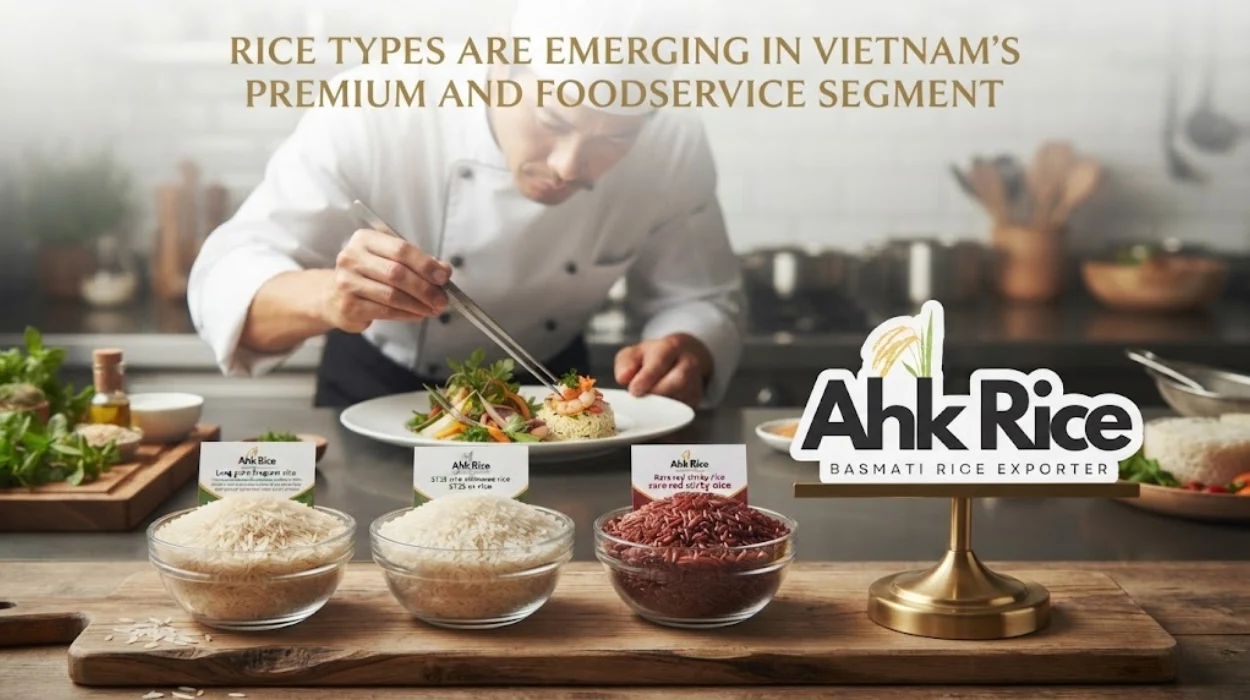
Which Pakistani Rice Types Are Emerging in Vietnam’s Premium and Foodservice Segments in 2026?
1121, Super Kernel, and 1509 Basmati rice are the strongest Pakistani options for Vietnam’s premium and foodservice segments in 2026. Here is why: Vietnamese buyers need differentiated aroma, grain length, cooking performance, price control, and reliable specifications rather than commodity rice alone. Pakistan and Vietnam also strengthened bilateral trade discussions around Pakistani rice in 2025.
Vietnam remains a major rice-producing country. Its domestic industry supplies large volumes of fragrant, white, and specialty rice. Pakistani Basmati therefore competes through a different value proposition. Long grain, aroma, cooked elongation, and premium presentation create opportunities in hotels, restaurants, specialty retail, and catering.
For buyers still evaluating supplier qualification, the process covered in how Vietnamese food importers test, approve, and onboard new Pakistani rice suppliers provides the logical starting point. Vietnamese importer supplier approval guide
Which Pakistani rice types are best for Vietnam in 2026?
1121 Basmati leads premium positioning, Super Kernel balances aroma and commercial value, while 1509 Basmati targets cost-controlled foodservice. Each grade should be selected against grain length, processing style, broken percentage, cooking performance, packaging, and target customer.
1121 Basmati
1121 Basmati is the strongest choice for premium presentation. Commercial 1121 typically provides extra-long grains, strong aroma, and visible elongation after cooking. These properties suit premium restaurants, hotels, specialty retailers, and higher-value packaged rice.
Vietnamese premium buyers can specify 1121 Steam, 1121 White, or 1121 Sella. Steam retains a natural white appearance and aromatic profile. Sella provides firmer grains and stronger holding performance for catering operations.
Super Kernel Basmati
Super Kernel Basmati provides a traditional aromatic profile with a balanced commercial position. Its raw grain specification commonly sits around 7.0–7.5 mm, with controlled moisture and low broken percentage forming important purchasing parameters.
Super Kernel suits restaurants and foodservice operators seeking recognizable Basmati characteristics without moving directly into the highest premium tier. The variety also provides flexibility across retail and catering packs.
1509 Basmati
1509 Basmati is the value-premium option. Its raw grain commonly measures around 8.10–8.40 mm in AHK Rice specifications. The variety combines long grain presentation with a more cost-conscious commercial position.
1509 Steam suits fresh-looking premium packs and restaurant programs. 1509 Sella or Golden Sella suits catering applications requiring firm grains and longer holding performance.
These three grades create a practical Vietnamese portfolio. The next decision is matching each grade with the correct commercial use.
What is the best solution for Vietnamese premium and foodservice buyers?
The best solution is a specification-led supply program that matches 1121, Super Kernel, or 1509 with the buyer’s channel, cooking requirement, packaging, and landed-cost target. Sample approval should precede production and commercial shipment.
Vietnamese premium retail needs appearance, aroma, grain length, packaging, and consistent cooking results. A buyer selling 5 kg consumer packs should prioritize visual uniformity and premium positioning.
Foodservice buyers need a different specification. Restaurants and caterers prioritize cooked yield, separation, holding performance, price per serving, and dependable replenishment.
A practical decision looks like this:
| Buyer requirement | Recommended Pakistani rice |
|---|---|
| Premium restaurant presentation | 1121 Basmati |
| Luxury retail positioning | 1121 Steam |
| Traditional aromatic profile | Super Kernel |
| Cost-controlled foodservice | 1509 Basmati |
| Catering and banquet service | 1509 Sella/Golden Sella |
Vietnamese importers can also compare the broader market structure through the 2026 analysis of selective specialty-rice imports in Vietnam. Vietnam specialty rice import analysis
With grade selection established, supplier capability becomes the next commercial control.
Why choose AHK Rice for Pakistani rice supply to Vietnam?
AHK Rice provides specification-led Pakistani Basmati sourcing covering grade selection, milling, grading, sorting, packaging, documentation, sample approval, inspection support, and container loading. This reduces the gap between an approved sample and the commercial shipment.
AHK Rice supplies 1121, Super Kernel, and 1509 varieties for international buyers. Its export process connects sourcing, processing, quality control, packaging, documentation, and logistics.
AHK Rice can structure the purchase around the buyer’s exact specification. The specification can include grain length, broken percentage, moisture, processing method, packing size, quantity, destination port, and Incoterm.
The processing chain includes:
- Clean the paddy to remove field impurities.
- De-husk the grain to produce brown rice.
- Polish the grain to achieve the required milling finish.
- Grade the kernels by size and broken percentage.
- Sort the rice by colour and visible defects.
- Steam or parboil selected grades for specific cooking performance.
- Inspect the finished lot against the agreed specification.
- Pack the rice according to the approved commercial format.
- Load the containers against the final shipment documents.
AHK Rice’s Vietnam-focused supply information identifies Ho Chi Minh City and Hai Phong as relevant destination ports. It also positions 1121 and 1509 for Vietnamese distributors requiring controlled specifications and FOB Karachi planning.
The supplier decision therefore moves beyond price. It becomes a question of specification control, documentation, logistics, and repeatability.
What shipping time should Vietnamese buyers expect?
Karachi-to-Vietnam ocean transit should be planned around approximately 14–20 days for major Vietnam ports, with total delivery taking longer after documentation, customs, inspection, and inland distribution. Port schedules and transshipment can change the final arrival date.
Ho Chi Minh City is a practical destination for southern distributors and foodservice networks. Hai Phong provides access to northern Vietnam and Hanoi-linked distribution.
A commercial planning window should therefore separate ocean transit from total delivery:
| Vietnam destination | Planning consideration |
|---|---|
| Ho Chi Minh City | Approximately 14–20 days ocean transit |
| Hai Phong | Similar route planning, subject to vessel schedule |
| Hanoi distribution | Add port clearance and inland delivery |
| Southern foodservice | Add warehouse and local transport time |
AHK Rice-related Vietnam trade information identifies approximately 14–20 days from Karachi for shipment planning.
Buyers should not treat ocean transit as the full lead time. Production, inspection, container loading, export clearance, vessel departure, arrival clearance, and final delivery all affect inventory planning.
With logistics defined, the next issue is proving the rice before commercial production.
What is the full sample process and cost?
The sample process should move from written specifications to sample preparation, courier dispatch, cooking evaluation, testing, approval, and production. Small sample courier costs commonly fall around US$45–US$120, while laboratory and phytosanitary charges depend on requirements.
Step 1: Define the specification
State the variety, processing grade, grain length, broken percentage, moisture, packaging, quantity, destination port, and preferred Incoterm.
Step 2: Select the sample
AHK Rice prepares a representative sample against the requested specification. Common sample quantities include 500 grams, 1 kilogram, and 2 kilograms.
Step 3: Dispatch the sample
Arrange international courier delivery to Vietnam. AHK Rice-related guidance places typical small food-sample courier planning around US$45–US$120, depending on destination and delivery speed.
Step 4: Test the rice
Check aroma, appearance, grain length, moisture, cooking expansion, texture, separation, and broken cooked grains.
Step 5: Approve the specification
Record the accepted sample characteristics in the commercial specification. This prevents the buyer from approving one grade and receiving another.
Step 6: Confirm production
AHK Rice processes and packs the commercial lot against the approved requirements. Independent inspection can be added when required.
Vietnamese food imports also require regulatory compliance. Vietnamese food law provides for import food-safety inspection and documentation before customs clearance.
This sample process converts a product description into a measurable buying specification. The final decision then depends on total commercial cost.
What affects Pakistani rice pricing for Vietnam?
Vietnam pricing depends on variety, processing grade, grain specification, broken percentage, moisture, packing, quantity, inspection, freight, destination, and Incoterm. Buyers should compare landed cost rather than FOB price alone.
1121 generally commands a stronger premium because of its extra-long grain positioning. Super Kernel provides a balanced aromatic option. 1509 provides stronger price control for foodservice.
AHK Rice market material identifies 2026 Pakistani valuation benchmarks around US$1,225/MT for 1121 Steam, US$1,175/MT for 1121 White/Sella, US$1,050/MT for Super Basmati White/Sella, US$1,100/MT for 1509 White/Sella, and US$1,150/MT for 1509 Steam. These are valuation benchmarks, not final Vietnam landed prices.
Freight can materially change the delivered cost. Packaging also changes the quotation. A 25 kg foodservice sack and a custom 5 kg retail pack require different packaging economics.
Vietnamese buyers should therefore request a quote using one fixed specification. This produces a more useful comparison between suppliers.
With cost drivers established, the final step is turning the specification into an order.
How can Vietnamese buyers get started with AHK Rice?
Start with the target market, choose the rice grade, issue the specification, approve the sample, confirm packaging, finalize the quotation, and schedule production and shipment. This sequence reduces specification disputes and protects the buyer’s commercial decision.
Step 1: Define the market
Identify premium retail, restaurant, hotel, catering, wholesale, or food manufacturing demand.
Step 2: Select the grade
Choose 1121 for maximum premium presentation, Super Kernel for balanced aromatic value, or 1509 for cost-controlled foodservice.
Step 3: Submit specifications
Provide grain length, broken percentage, moisture, packing size, quantity, destination port, inspection needs, and Incoterm.
Step 4: Approve samples
Evaluate the physical and cooked sample before commercial production.
Step 5: Confirm the quotation
Compare product cost, packaging, freight, inspection, documentation, and destination charges.
Step 6: Schedule shipment
Coordinate production, container loading, export documentation, vessel booking, and Vietnam arrival.
AHK Rice gives buyers a practical route from sample approval to container supply. The strongest purchasing decision is not simply the lowest price. It is the specification that delivers the required customer experience at a workable landed cost.
Request a Vietnam-specific quotation from AHK Rice with your required grade, quantity, packing, and destination port. Request a Quote from AHK Rice
Frequently Asked Questions
Which Pakistani rice is best for premium buyers in Vietnam?
1121 Basmati is the strongest premium option.
It provides extra-long grain presentation and strong aroma.
1121 Steam suits premium retail and restaurants.
1121 Sella suits catering and holding applications.
Final selection should follow the buyer’s approved sample.
Is Super Kernel suitable for Vietnamese foodservice?
Super Kernel suits foodservice buyers seeking aromatic Basmati.
It provides a balanced commercial position.
Its typical raw grain length is around 7.0–7.5 mm.
Restaurants can evaluate aroma, separation, and cooked yield.
The final grade should match the target menu and price.
Is 1509 Basmati suitable for Vietnam?
1509 Basmati suits cost-controlled premium foodservice programs.
Its raw grain commonly measures around 8.10–8.40 mm.
Steam supports fresh white presentation.
Sella and Golden Sella support catering applications.
Buyers should approve samples before commercial production.
How long does Pakistani rice take to reach Vietnam?
Ocean transit can take approximately 14–20 days.
Ho Chi Minh City is a major destination option.
Hai Phong serves northern distribution networks.
Customs clearance adds additional time after arrival.
Vessel schedules and transshipment can change final delivery timing.
How much does a Pakistani rice sample cost?
Sample rice may be supplied as a representative product sample.
Typical sample quantities include 500 grams to 2 kilograms.
International courier costs commonly range from US$45–US$120.
Laboratory and phytosanitary charges depend on requirements.
The buyer should confirm the final sample logistics cost before dispatch.