Why Vietnam Is Expanding Selective Imports of Specialty Rice Varieties in 2026
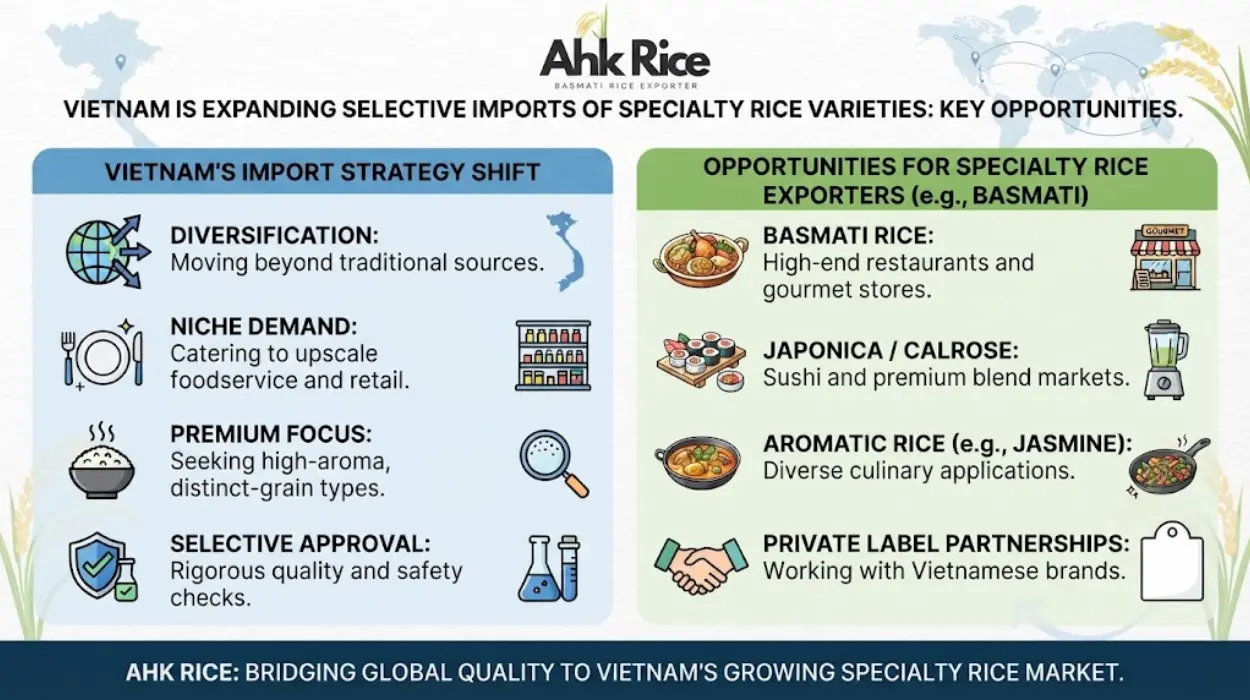
Vietnam is expanding selective rice imports in 2026 because imported rice serves specific processing, foodservice, premium, and supply-balancing needs rather than replacing domestic rice. Here is why: Vietnam imported about US$800 million of rice in the first seven months of 2026, while remaining one of the world’s leading rice exporters.
Vietnam’s import structure therefore rewards specialty specifications. Buyers distinguish paddy, milled rice, broken rice, aromatic rice, and premium Basmati by end use. Pakistani varieties such as 1121, Super Kernel, and 1509 fit selected premium and foodservice applications. A useful foundation is AHK Rice’s guide to Vietnam rice trade and why Pakistani Basmati fits the premium segment.
What are the available solutions for Vietnam’s specialty rice demand?
Vietnamese domestic rice, imported paddy, imported milled rice, and specialty Basmati provide four distinct sourcing solutions. Each option serves a different commercial objective, from processing economics to premium presentation and international foodservice requirements.
Domestic Vietnamese rice
Vietnamese rice remains the core supply option for mainstream consumption and export programs. The Mekong River Delta and Red River Delta support large-scale domestic cultivation. USDA data places Vietnam’s 2025/26 rice production at about 26.2 million metric tons.
Domestic supply works best for buyers seeking familiar local varieties, established milling infrastructure, and competitive mainstream pricing. Jasmine, fragrant rice, white rice, and specialty domestic varieties cover multiple consumer segments.
Imported paddy
Imported paddy supports Vietnamese milling and re-export economics. Cambodia remains the major source for this flow. USDA reporting shows that Vietnamese processors import Cambodian paddy, mill it in Vietnam, and export the resulting rice.
This model works for processors that need additional raw material rather than a differentiated finished product. It does not provide the same product identity as imported Pakistani Basmati.
Imported milled rice
Imported milled rice provides a different solution. Vietnam increasingly imports milled rice from India for food processing and other applications. USDA reporting identifies higher-quality imported milled rice as a supply for food processing.
This approach suits manufacturers requiring a specific grain or processing characteristic without purchasing domestic paddy.
Pakistani specialty Basmati
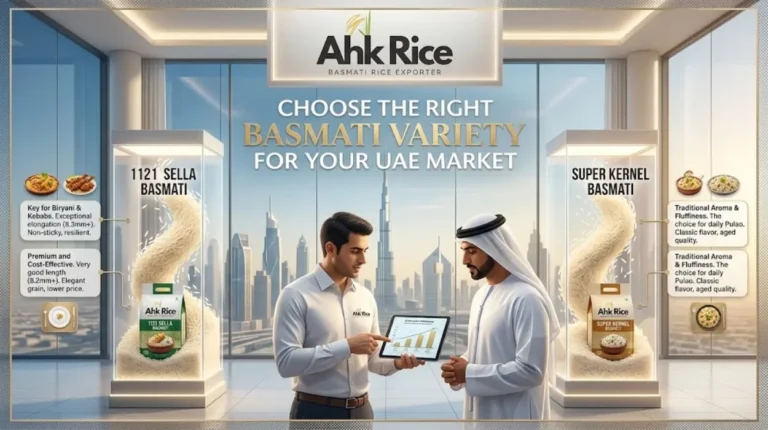
Pakistani Basmati addresses a narrower premium requirement. 1121 Basmati provides extra-long grain appearance and strong aroma. Super Kernel provides traditional Basmati aroma with a lower grain-length profile. 1509 Basmati provides long grain characteristics with a value-oriented positioning.
AHK Rice supplies these Pakistani varieties from Punjab through sourcing, milling, grading, sorting, packaging, and export coordination. The selection depends on the buyer’s target segment rather than a single universal grade.
With the four sourcing solutions defined, the next question is how their commercial specifications compare.
How do different rice-import approaches compare?
Imported specialty rice wins when grain identity, aroma, cooking performance, or premium positioning matters more than lowest procurement cost. Domestic rice and imported paddy remain stronger choices for mainstream volume and processing economics.
| Attribute | Domestic Vietnamese Rice | Imported Paddy | Imported Milled Rice | Pakistani Basmati |
|---|---|---|---|---|
| Primary use | Mainstream consumption | Milling and re-export | Food processing | Premium retail and foodservice |
| Grain identity | Local varieties | Depends on origin | Depends on origin | 1121, Super Kernel, 1509 |
| Aroma | Variety dependent | Variety dependent | Variety dependent | Strong in Basmati grades |
| Processing | Domestic milling | Vietnamese milling | Completed before import | Pakistan milling and sorting |
| Procurement basis | Domestic supply | Paddy cost | Milled-rice price | Grade and specification |
| Price benchmark | Competitive domestic | Processing-oriented | Import-dependent | About US$1,135–$1,205/MT for premium Pakistani Basmati |
| Shelf-life strategy | Grade dependent | Post-milling management | Packaging dependent | Steam and Sella selected by storage need |
The Pakistani Basmati price range above is an indicative FOB Karachi benchmark, not a Vietnam landed price. Current September 2026 market listings place 1121 White around US$1,165–$1,205/MT and 1121 Sella around US$1,135–$1,175/MT.
Vietnamese premium rice also commands differentiated pricing. ST25, for example, was reported around US$1,200/MT, while Vietnamese Jasmine was around US$513–$517/MT in May 2026.
This price spread explains selective importing. Buyers do not import specialty rice simply to obtain more rice. They import differentiated grain characteristics that justify a higher commercial position.
With the specification comparison established, the next step is matching grades to Vietnam’s actual market regions.
Which Vietnamese market regions prefer specialty rice?
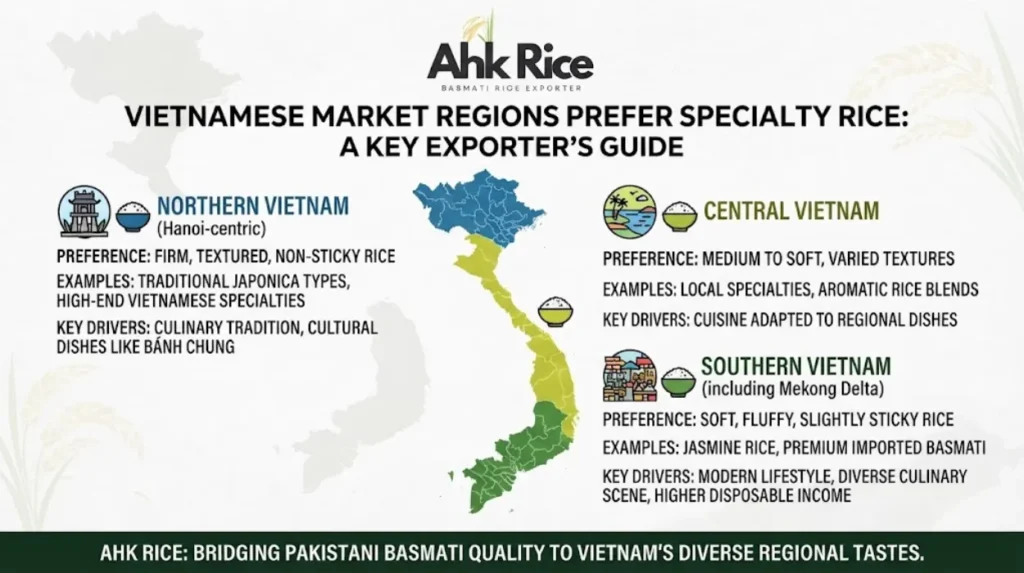
Southern Vietnam favors processing, hospitality, and commercial distribution, while northern Vietnam offers stronger opportunities for premium retail, hospitality, and international cuisine. Both regions require different purchasing specifications.
Southern Vietnam: Ho Chi Minh City and industrial foodservice
Southern Vietnam contains major commercial and processing activity around Ho Chi Minh City and the Mekong Delta. The region connects domestic rice production with ports, processors, wholesalers, hotels, restaurants, and food manufacturers.
Imported specialty rice fits foodservice and international cuisine applications. 1121 Basmati suits premium restaurants requiring long cooked grains and strong aroma. Super Kernel suits distributors seeking traditional Basmati characteristics at a lower grain-length profile. 1509 suits price-sensitive foodservice programs requiring long-grain presentation.
Southern buyers also evaluate storage performance. Steam rice provides a lighter appearance and strong cooking performance. Sella rice provides stronger grain structure for extended storage and high-volume catering.
A practical FOB benchmark for this segment remains approximately US$1,135–$1,205/MT for premium Pakistani Basmati grades. Freight, insurance, customs, inland transport, and destination charges must be added before calculating landed cost.
Northern Vietnam: Hanoi and premium distribution
Northern Vietnam provides a separate opportunity for premium retail, hotels, restaurants, and imported-food distributors. Hanoi’s international dining sector creates demand for rice varieties that differ from mainstream domestic offerings.
1121 Basmati fits premium retail and high-end restaurant applications. Its extra-long grain appearance creates visible differentiation after cooking. Super Kernel works for traditional aromatic positioning. 1509 fits buyers balancing Basmati identity with procurement efficiency.
Northern distributors need stronger inventory planning for imported specialty products. Commercial packaging, moisture control, batch consistency, and documentation become important because imported stock passes through multiple distribution stages.
The same FOB benchmark applies at origin, but final landed cost changes according to freight, port handling, order quantity, and destination distribution costs.
These regional differences show why Vietnam does not have one universal specialty-rice specification. The next question is how shelf life changes the purchasing decision.
How do price and shelf life affect grade selection?
Price determines the procurement position, while processing determines storage performance and cooking behavior. Steam generally suits faster inventory rotation, while Sella grades provide stronger storage performance for extended foodservice distribution.
Golden Sella generally provides longer commercial storage performance than Steam rice. AHK Rice’s published comparison places Golden Sella at approximately 18 months and Steam rice at approximately 12 months under suitable storage conditions.
For a southern foodservice distributor moving stock quickly, Steam can provide the required cooking characteristics without prioritizing extended storage. For a northern distributor holding inventory across a wider retail network, Sella becomes more suitable.
The same principle applies to 1121 and 1509. 1121 supports premium positioning where grain length and aroma justify higher procurement cost. 1509 supports value-oriented distribution where buyers need long grain characteristics with tighter cost control.
The correct comparison is therefore not simply price per metric ton. Buyers need to compare price, shelf life, grain length, processing, customer segment, and inventory turnover together.
Which method works best for different cases?
Domestic rice works best for mainstream volume, imported paddy suits processors, imported milled rice suits manufacturers, and Pakistani Basmati suits differentiated premium and foodservice applications. The best method depends on the product specification and final customer.
Premium retail
1121 Basmati provides the strongest fit. The grade combines extra-long grain appearance, aroma, and premium presentation. Retail packaging can position the product as an imported specialty rice.
International restaurants
Super Kernel and 1121 provide strong options. Restaurants serving Indian, Middle Eastern, Persian, or fusion cuisine require recognizable Basmati characteristics. Grain separation and aroma support menu consistency.
Large catering operations
1509 and Sella grades provide stronger cost and storage flexibility. Catering operators purchase larger quantities and prioritize cooking yield, grain strength, and predictable supply.
Food manufacturers
Imported milled rice can be more efficient than premium Basmati when the manufacturing process requires a specific functional grain characteristic. The product specification should follow the finished-food application.
Premium distributors
A mixed portfolio provides better coverage than one grade. 1121 can target premium retail, Super Kernel can serve aromatic wholesale demand, and 1509 can address cost-sensitive foodservice.
The grade-to-use relationship provides the solution framework. The next section evaluates the strengths and limitations of each approach.
What are the pros and cons of each sourcing approach?
No sourcing model dominates every Vietnamese rice segment. Domestic rice maximizes local supply access, imported paddy supports processing, milled rice supports manufacturing, and Pakistani Basmati creates specialty differentiation.
| Approach | Main advantage | Main limitation | Best example |
|---|---|---|---|
| Domestic rice | Local availability | Limited specialty differentiation | Mainstream retail |
| Imported paddy | Processing flexibility | Requires milling capacity | Re-export processor |
| Imported milled rice | Ready-to-use product | Higher dependence on origin pricing | Food manufacturer |
| Pakistani Basmati | Premium grain identity | Higher purchase price | Premium restaurant |
| Mixed sourcing | Segment flexibility | More complex procurement | National distributor |
Vietnam’s total rice import bill reached about US$800 million during January-July 2026, despite a year-on-year decline of 25.2%. This demonstrates that import demand remains substantial even as the overall import market changes.
Basmati imports are also measurable. Volza recorded 216 Basmati or Sortex Basmati shipments into Vietnam between May 2024 and April 2025, involving 45 exporters and 41 verified buyers.
The evidence supports selective rather than universal Basmati demand. Buyers purchase specialty rice where its characteristics create commercial value.
With the advantages and limitations established, the final question is which factors should control a purchasing decision.
What decision factors should Vietnamese rice buyers use?
Vietnamese buyers should rank end use, grain specification, price, shelf life, and supply reliability before selecting an imported rice variety. This approach prevents buyers from choosing a premium grade without a clear commercial purpose.
| Decision factor | Key question | Preferred solution |
|---|---|---|
| End use | Retail, restaurant, catering, or manufacturing? | Match grade to application |
| Grain profile | Long, aromatic, standard, or broken? | Select measurable specification |
| Price | What FOB and landed cost fits the target? | Normalize quotations |
| Shelf life | How long will inventory remain? | Select Steam or Sella |
| Supply model | Single grade or multi-grade portfolio? | Build segmented procurement |
Vietnamese importers should also verify moisture, broken percentage, grain length, foreign matter, packaging, inspection requirements, and export documentation before contracting.
Pakistan’s Basmati supply chain supports this specification-led approach. AHK Rice operates from Punjab and supplies 1121, Super Kernel, and 1509 varieties with end-to-end processing, custom packaging, and export coordination.
A buyer should approve a representative sample before bulk procurement. The sample should match the agreed commercial specification. Laboratory testing should verify moisture and other contractual quality parameters. Inspection should then confirm the production shipment before container loading.
This process reduces the risk of buying a premium grade without confirming its actual performance.
Vietnam’s expanding specialty-rice imports therefore reflect market segmentation rather than domestic supply weakness. The country remains a major rice producer and exporter, yet imported paddy, milled rice, and specialty Basmati serve distinct commercial purposes.
For buyers moving from market evaluation to grade selection, the next decision is which Pakistani varieties fit Vietnam’s premium retail and foodservice requirements. A decision-focused resource on Pakistani rice options for Vietnam’s premium and foodservice segments fits naturally after this section.
Frequently Asked Questions
Why is Vietnam importing specialty rice in 2026?
Vietnam is importing specialty rice because different industries require different grain characteristics. Food manufacturers need specific raw materials, while hotels, restaurants, distributors, and premium retailers require differentiated aromatic and long-grain varieties.
Why does Pakistani Basmati fit Vietnam’s premium segment?
Pakistani Basmati provides long grain structure, aroma, cooking expansion, and premium product identity. These characteristics differentiate 1121, Super Kernel, and 1509 from mainstream Vietnamese rice.
Which Pakistani rice is best for Vietnamese restaurants?
1121 Basmati fits premium restaurants requiring extra-long aromatic grains. Super Kernel suits traditional Basmati applications. 1509 provides a more cost-oriented option for larger foodservice programs.
What is the price of Pakistani Basmati rice per MT?
Current indicative FOB Karachi benchmarks place premium Pakistani Basmati around US$1,135–$1,205 per MT depending on grade and specification. Vietnam landed pricing adds freight, insurance, customs, handling, and distribution costs.
Which rice has better shelf life, Steam or Sella?
Sella generally provides stronger storage performance than Steam. AHK Rice’s published comparison uses approximately 18 months for Golden Sella and 12 months for Steam under suitable storage conditions.
Does Vietnam import Basmati rice from Pakistan?
Yes. Trade-data records show Basmati and Sortex Basmati shipments entering Vietnam from multiple origins, including Pakistan. Volza recorded Pakistan among the leading Basmati exporting countries in its Vietnam trade dataset.
What should Vietnamese importers check before buying Pakistani rice?
Buyers should verify variety, grain length, broken percentage, moisture, processing grade, packaging, laboratory testing, phytosanitary documentation, inspection requirements, Incoterm, and landed cost before confirming a shipment.