Which Purity Specifications Separate Premium Pakistan Rice Exporters from Standard Suppliers?
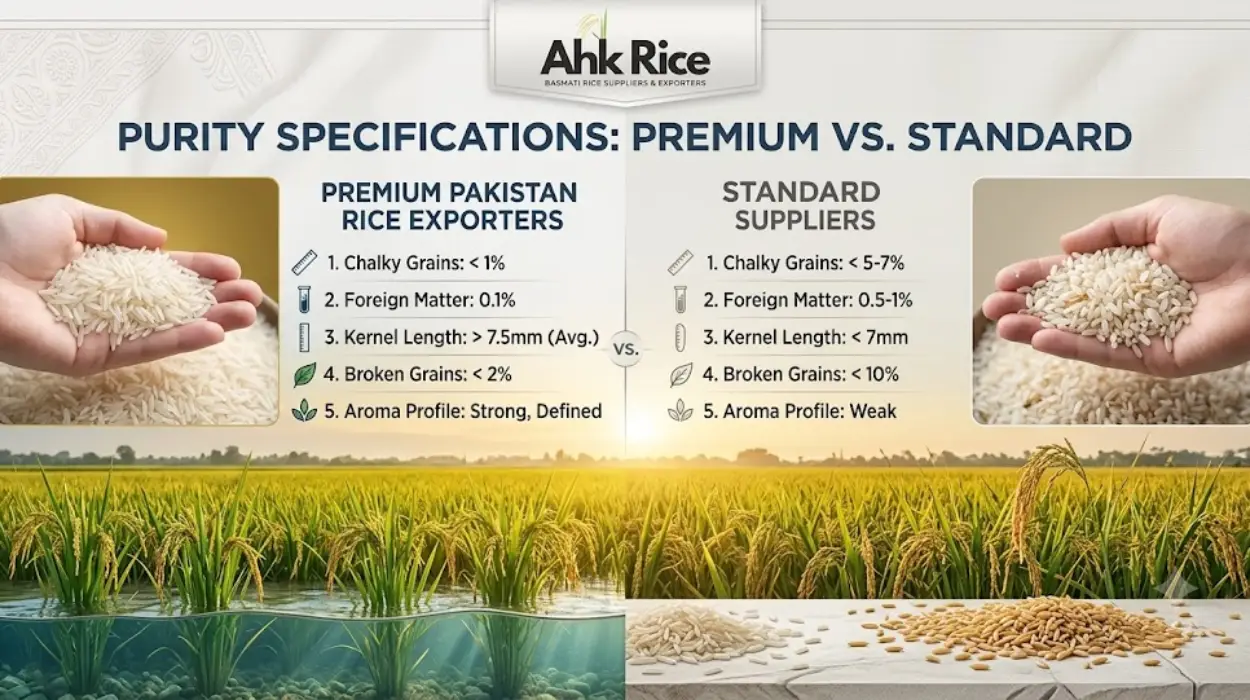
Premium Pakistan rice exporters separate themselves through verified purity specifications, consistent quality control, internationally recognised certifications, and traceable processing systems rather than price alone. Importers who compare measurable purity standards achieve better product consistency, stronger customer satisfaction, and lower commercial risk across every shipment.
Saudi Arabia remains one of the largest destinations for Pakistani Basmati rice, making purity specifications a decisive purchasing factor rather than an optional quality feature. Importers increasingly evaluate laboratory reports, contamination controls, grain consistency, and traceability before approving suppliers. Understanding:
How Saudi buyers assess rice purity standards provides the foundation for selecting dependable exporters.
AHK Rice is a Pakistani Basmati rice exporter based in Punjab supplying 1121, Super Kernel, and 1509 varieties to more than 15 countries. The company follows end-to-end processing, customised packaging, and complete export procedures designed to meet international market requirements. However, every importer should compare objective specifications rather than relying solely on supplier claims.
Premium exporters invest in quality assurance throughout procurement, milling, grading, polishing, packaging, storage, and export documentation. Standard suppliers often focus only on basic milling and visual inspection. The difference directly affects cooking performance, shelf life, retail acceptance, and long-term business relationships.
What defines purity specifications in Pakistan rice exports?
Purity specifications measure the physical, biological, and quality characteristics of rice that determine export suitability. These specifications include varietal purity, foreign matter percentage, broken grain limits, moisture content, damaged kernels, contamination controls, laboratory verification, and traceability throughout processing and packaging before shipment.
Purity specifications refer to measurable standards rather than marketing descriptions. Every specification can be verified through inspection or laboratory analysis before cargo loading.
The most important purity indicators include:
- Varietal purity
- Broken grain percentage
- Foreign matter percentage
- Paddy grain presence
- Moisture level
- Damaged kernels
- Chalky grains
- Red streak percentage
- Black grain percentage
- Insect contamination
- Heavy metal compliance
- Pesticide residue compliance
Premium exporters establish acceptable limits for every parameter before production begins. Standard suppliers often inspect products only after milling, creating inconsistent shipment quality.
International buyers increasingly require independent laboratory reports alongside phytosanitary certificates and quality inspection documents before shipment approval.
What are the available solutions for maintaining export-grade rice purity?
Premium exporters achieve higher purity through integrated quality management systems, while standard suppliers generally rely on manual inspection. Modern processing technology, laboratory testing, automated colour sorting, traceability software, and certified storage create significantly higher consistency across export shipments in 2026.
There are several approaches used across Pakistan’s rice export industry.
The first solution is advanced mechanical processing. Optical colour sorters remove defective kernels with greater precision than manual selection. Multiple sorting stages improve final purity percentages.
The second solution involves laboratory-based quality verification. Exporters test moisture, contaminants, pesticide residues, heavy metals, and varietal purity before shipment.
The third solution is complete traceability. Each production batch can be traced back to its farming source, milling date, warehouse location, and export container.
The fourth solution is internationally certified processing. Facilities operating under recognised food safety systems maintain documented procedures that reduce contamination risks.
The fifth solution combines customised packaging with controlled storage conditions. Proper packaging protects rice quality during sea transport to Gulf markets where high temperatures may affect product stability.
Among these approaches, integrated quality management consistently delivers the most reliable export results because every production stage is monitored instead of depending on final inspection alone.
How do premium Pakistan rice exporters compare with standard suppliers?
Premium exporters consistently outperform standard suppliers because they control every quality stage from procurement to shipment. Standard suppliers often depend on limited inspections, resulting in greater variability, higher rejection risks, inconsistent cooking performance, and reduced buyer confidence during repeat orders.
The differences become clearer when comparing measurable specifications.
| Specification | Premium Pakistan Exporter | Standard Supplier |
|---|---|---|
| Varietal Purity | ≥99% | 94–97% |
| Broken Grain | 1–5% depending on grade | 10–25% |
| Foreign Matter | ≤0.1% | Up to 0.5% |
| Colour Sorting | Multi-stage optical sorting | Basic sorting |
| Laboratory Testing | Every export batch | Occasional |
| Traceability | Complete batch records | Limited documentation |
| International Certifications | Comprehensive quality systems | Basic compliance only |
These differences influence customer complaints, retail shelf appearance, cooking consistency, and import inspection outcomes.
Premium exporters also maintain better documentation, enabling buyers to verify shipment specifications before vessel departure.
Which rice grades do different international markets prefer?
Different importing regions apply different purchasing priorities. Saudi Arabian buyers prioritise purity and premium Basmati quality, while African commercial markets often balance purity with competitive pricing and higher-volume purchasing requirements according to current international trade patterns in 2026.
Market preferences differ because consumer expectations differ.
Saudi Arabia
Saudi Arabian importers generally prefer:
- 1121 Steam Basmati
- 1121 Sella Basmati
- Super Kernel Basmati
Key purchasing priorities include:
- High varietal purity
- Low broken percentage
- Uniform grain length
- Bright appearance
- Excellent cooking elongation
- Premium packaging
- Full export documentation
East Africa
Many East African buyers focus on:
- 1509 varieties
- White rice
- Commercial Basmati grades
Primary considerations include:
- Competitive pricing
- Acceptable purity
- Consistent availability
- Bulk shipment capacity
Although purity remains important across both regions, Saudi buyers generally specify stricter quality tolerances in supply agreements.
How do prices compare between different export quality levels?
Premium purity standards increase production costs because additional sorting, laboratory testing, certification, and quality controls require greater investment. These higher costs generally produce better commercial value by reducing shipment disputes and improving customer retention over time.
Indicative 2026 export pricing varies according to grade, specification, destination, and seasonal harvest conditions.
| Category | Approximate FOB Price (USD/MT) |
|---|---|
| Premium 1121 Steam | 1,080–1,260 |
| Premium 1121 Sella | 1,050–1,220 |
| Premium Super Kernel | 980–1,150 |
| Standard Export Basmati | 860–980 |
Premium shipments command higher prices because they include tighter quality tolerances and additional processing.
Lower-priced offers often reflect wider acceptance limits for broken grains, foreign matter, or inconsistent grading.
Professional buyers compare complete specifications instead of selecting suppliers based only on price per metric tonne.
How does shelf life compare between premium and standard export rice?
Higher purity contributes to longer storage stability because contaminants, excessive moisture, damaged grains, and biological risks are reduced before shipment. Controlled processing and packaging maintain quality throughout international transportation and extended warehouse storage after import.
Shelf life depends on moisture control, packaging quality, storage conditions, and contamination prevention.
| Export Quality | Expected Shelf Life* |
|---|---|
| Premium Export Grade | 18–24 months |
| Standard Commercial Grade | 12–18 months |
*Stored in dry, cool warehouse conditions with intact export packaging.
Premium exporters consistently achieve longer storage stability because they maintain tighter moisture control before packaging.
This becomes particularly valuable for distributors supplying supermarkets with extended inventory cycles.
What are the advantages and disadvantages of different purity management approaches?
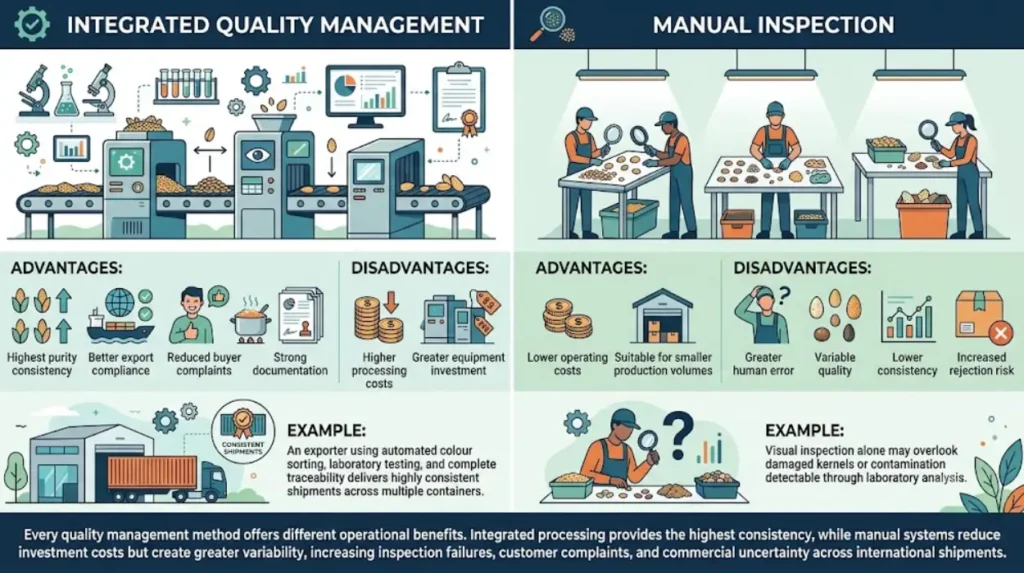
Every quality management method offers different operational benefits. Integrated processing provides the highest consistency, while manual systems reduce investment costs but create greater variability, increasing inspection failures, customer complaints, and commercial uncertainty across international shipments.
Integrated Quality Management
Advantages:
- Highest purity consistency
- Better export compliance
- Reduced buyer complaints
- Reliable cooking performance
- Strong documentation
Disadvantages:
- Higher processing costs
- Greater equipment investment
Example:
An exporter using automated colour sorting, laboratory testing, and complete traceability delivers highly consistent shipments across multiple containers.
Manual Inspection
Advantages:
- Lower operating costs
- Suitable for smaller production volumes
Disadvantages:
- Greater human error
- Variable quality
- Lower consistency
- Increased rejection risk
Example:
Visual inspection alone may overlook damaged kernels or contamination detectable through laboratory analysis.
Which purity management method works best for different import requirements?
The most suitable approach depends on buyer objectives, target consumers, and retail positioning. Premium retail brands require comprehensive purity systems, while commercial wholesale markets may accept broader specifications when pricing remains the primary purchasing consideration.
| Buyer Requirement | Recommended Approach |
|---|---|
| Premium supermarket brands | Full integrated quality management |
| Luxury hospitality sector | Maximum purity specifications |
| Wholesale distributors | Certified quality systems |
| Budget commercial trading | Balanced purity and cost |
| Government procurement | Laboratory-verified specifications |
Selecting the correct quality approach improves procurement efficiency while reducing long-term operational risks.
Importers should define specification priorities before requesting quotations.
Which decision factors should importers evaluate before selecting a Pakistan rice exporter?
Objective evaluation delivers better purchasing decisions than comparing prices alone. Importers should assess measurable specifications, processing capability, documentation quality, export experience, traceability, laboratory verification, and shipment consistency before establishing long-term commercial partnerships with suppliers.
The following framework simplifies supplier evaluation.
| Decision Factor | Why It Matters |
|---|---|
| Purity Specifications | Determines overall product quality |
| Processing Technology | Improves consistency |
| Laboratory Verification | Confirms compliance |
| Export Documentation | Supports customs clearance |
| Supply Reliability | Reduces procurement risk |
Each factor contributes to total supply chain performance rather than individual shipment quality alone.
Experienced importers normally combine these criteria with supplier audits and production capability assessments before signing annual supply agreements.
Purity specifications have become one of the strongest indicators of exporter capability in international Basmati rice trade. Premium Pakistan rice exporters distinguish themselves through measurable quality systems rather than promotional claims. Verified varietal purity, advanced sorting technology, laboratory testing, traceability, controlled moisture, and comprehensive documentation consistently produce higher-quality shipments with lower commercial risk.
Comparing suppliers using objective specifications enables importers to make informed purchasing decisions based on long-term value rather than initial pricing. As Saudi Arabian quality expectations continue to rise throughout 2026, exporters with integrated quality management systems remain better positioned to deliver reliable performance across retail, hospitality, and wholesale markets.
For buyers who are ready to compare qualified suppliers against Saudi Arabian import standards before placing an order, continue with our guide on:
Selecting an exporter that satisfies Saudi purity compliance requirements
Frequently Asked Questions
How do premium Pakistan rice exporters ensure higher purity than standard suppliers?
Premium exporters use advanced colour sorting, laboratory testing, strict quality control, and complete traceability to achieve higher purity and consistent export-grade rice.
Why is varietal purity important when importing Pakistan Basmati rice?
Varietal purity ensures the rice contains a single authentic variety, providing consistent grain length, aroma, cooking performance, and market value for buyers.
Which purity specifications do Saudi Arabian importers usually check?
Saudi importers commonly evaluate varietal purity, broken grain percentage, foreign matter, moisture content, damaged kernels, contamination levels, and laboratory test reports.
Does higher rice purity affect export prices?
Yes. Rice with higher purity generally costs more because it requires advanced processing, multiple quality inspections, laboratory testing, and stricter production controls.
How does rice purity influence shelf life?
Higher purity reduces contamination and maintains proper moisture levels, helping rice remain stable and retain its quality for up to 24 months under suitable storage conditions.
What certifications should a reliable Pakistan rice exporter have?
Reliable exporters should follow recognised food safety and quality management standards, maintain documented quality control procedures, and provide complete export documentation.
Which Pakistan Basmati rice grades are most popular in Saudi Arabia?
Saudi Arabian buyers commonly prefer 1121 Steam Basmati, 1121 Sella Basmati, and Super Kernel Basmati because of their long grains, aroma, and cooking quality.
How can importers compare Pakistan rice exporters effectively?
Importers should compare purity specifications, processing technology, laboratory reports, certifications, traceability, export experience, packaging quality, and shipment consistency instead of price alone.