Why Are Delaware Food Brands Launching Private Label Basmati Rice?
Private label Basmati rice gives Delaware food brands control over product identity, specifications, packaging, and retail positioning without owning a rice mill. The model connects a brand owner with an established rice manufacturer that sources paddy, mills, grades, packs, tests, and prepares finished rice for import or distribution. Delaware businesses are positioned for this model because the state had an estimated 1,059,952 residents in July 2025, up 7.1% from its 2020 population base, while Delaware’s 2026 industry projections include about 9,150 food-manufacturing jobs.
The opportunity is also linked to the structure of the U.S. rice market. USDA reports that more than 60% of U.S. rice imports are aromatic varieties from Asia, mainly jasmine and Basmati from Thailand, India, and Pakistan. USDA’s August 2026 outlook projects U.S. all-rice imports at a record 49.8 million hundredweight for 2026/27.
For a Delaware food brand, private label Basmati therefore becomes a product-development decision rather than a simple commodity purchase. The brand defines its target customer, grain type, cooking profile, pack size, label, and quality requirements. The manufacturer converts those requirements into a repeatable rice specification.
What is private label Basmati rice?
Private label Basmati rice is rice manufactured or packed by one company and sold under another company’s brand name, allowing food brands to control specifications, packaging, positioning, and retail presentation without owning rice-processing facilities themselves.
A private label product separates brand ownership from manufacturing ownership. The Delaware brand owns the consumer-facing identity. The rice manufacturer handles agricultural sourcing, milling, processing, quality control, packaging, and export preparation according to the approved specification.
Basmati is an aromatic long-grain rice associated with the Himalayan foothill region of the Indian subcontinent. Pakistani Basmati is grown mainly in Punjab, where climate, soil, water, and traditional cultivation support the characteristic grain and aroma associated with the product.
Pakistan supplies several commercially important Basmati formats. These include 1121 Basmati, Super Kernel Basmati, and 1509 Basmati. Each variety has different grain characteristics, cooking behavior, processing options, and market positioning.
Private label does not mean an inferior or generic rice. A private label specification can define exact grain variety, kernel length, broken percentage, moisture, foreign matter, damaged grains, milling degree, color sorting, packaging material, and cooking performance.
Why are Delaware food brands using private label Basmati rice?
Delaware food brands use private label Basmati rice to create differentiated products, control retail presentation, establish repeatable specifications, capture margin, and serve consumers seeking recognizable aromatic rice without investing in their own milling infrastructure.
The first reason is brand differentiation. A retailer or food company selling the same unbranded rice as competitors has limited control over product identity. A private label allows the business to create a distinct name, package design, positioning, and product story.
The second reason is specification control. A brand can define a 1121 Steam Basmati specification instead of purchasing whatever inventory a distributor has available. The specification can state grain length, broken percentage, moisture, purity, milling type, packaging format, and inspection requirements.
The third reason is packaging flexibility. A brand can select 2 lb, 5 lb, 10 lb, 20 lb, or foodservice-oriented formats based on its sales channel. Packaging can include the brand name, cooking instructions, country-of-origin information, nutrition information, net quantity, and required regulatory statements.
The fourth reason is channel expansion. One rice specification can support grocery retail, online sales, restaurants, meal-kit businesses, specialty food stores, and foodservice distribution. The brand can use different pack sizes while maintaining the same underlying rice specification.
The fifth reason is direct supply-chain control. Instead of buying finished rice through several distribution layers, a brand can establish a direct manufacturing specification and purchasing schedule. This creates clearer responsibility for quality, documentation, packaging, and shipment preparation.
How does the private label Basmati rice model work?
Private label Basmati rice moves through a defined chain: market research, product specification, variety selection, sample approval, paddy sourcing, milling, grading, testing, packaging, documentation, shipment, import compliance, and finished-product distribution.
The process starts with the market specification. The brand defines its customer and selling channel. A premium grocery product requires different positioning from a restaurant-oriented 20 lb bag.
Next comes variety selection. The buyer chooses between varieties such as 1121, Super Kernel, and 1509. The choice depends on grain appearance, cooking behavior, aroma, price position, and intended use.
The manufacturer then selects suitable paddy and begins processing. Paddy is cleaned to remove field debris and foreign material. It is de-husked to remove the outer husk. Brown rice then passes through milling equipment to produce milled rice.
Rice is subsequently graded. Broken kernels are separated from whole kernels. Length grading separates kernels according to the required specification. Optical color sorting removes discolored grains and selected foreign material.
Steam and parboiling processes create additional product categories. Steam Basmati receives controlled steaming before drying and milling or finishing, depending on the production method. Sella or parboiled Basmati undergoes parboiling, which changes grain structure and cooking characteristics.
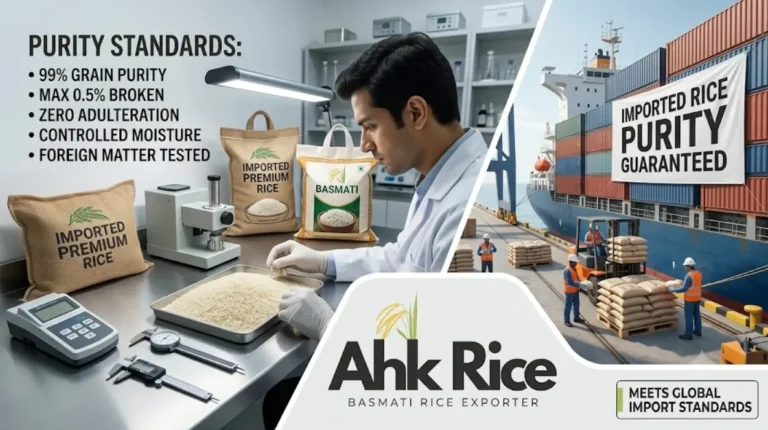
The finished rice is tested against the approved specification. Typical controls include moisture, broken percentage, grain dimensions, foreign matter, damaged kernels, purity, milling quality, and visual appearance.
The approved rice is packed into the brand’s selected packaging. Finished cases are then prepared for domestic distribution or export. For imported food entering the United States, FDA requirements apply to the food, facility, labeling, and import process. FDA states that imported foods must meet the same legal requirements as domestically produced foods.
What are the key components of a private label Basmati specification?
A private label specification combines rice variety, grain dimensions, broken percentage, moisture, purity, processing method, packaging, labeling, testing, traceability, and shipment requirements into one controlled product standard for every production batch.
The rice variety identifies the commercial product. Examples include 1121 Basmati, Super Kernel Basmati, and 1509 Basmati.
The processing type defines whether the product is White, Steam, Sella, or another approved form. This matters because processing affects appearance, texture, cooking time, and final grain separation.
The physical specification defines measurable characteristics. Examples include average grain length, broken kernels, moisture, chalky grains, damaged grains, foreign matter, and milling degree.
The quality specification establishes acceptable limits for each attribute. A buyer should avoid descriptions such as “premium quality” without measurable limits. A controlled specification converts that phrase into testable requirements.
The packaging specification defines bag material, weight, printing, inner liner, sealing, carton requirements, pallet configuration, and shipping marks.
The documentation specification identifies the records required for each shipment. Examples include commercial invoices, packing lists, certificates of analysis, certificates of origin, phytosanitary documentation where applicable, and shipping documents.
For U.S. imports, the importer also has regulatory responsibilities. FDA requires prior notice for imported food and applies Foreign Supplier Verification Program requirements to covered importers.
Which Basmati grades and varieties can private label brands use?
Private label brands can select white, steam, and parboiled Basmati products across commercial varieties such as 1121, Super Kernel, and 1509, with the final grade determined by grain quality, processing method, broken percentage, appearance, and buyer specification.
1121 Basmati is recognized for its exceptionally long grain and strong visual appeal after cooking. It is commonly positioned as a premium retail or foodservice product.
Super Kernel Basmati provides a traditional Basmati profile with long grains and aromatic characteristics. It serves brands seeking a classic Pakistani Basmati positioning.
1509 Basmati is another long-grain variety used in white, steam, and parboiled formats. It provides brands with an alternative specification for price-sensitive or differentiated product programs.
Within these varieties, manufacturers produce different processing grades. White Basmati has a conventional milled appearance. Steam Basmati uses steam treatment to improve grain integrity and cooking characteristics. Sella Basmati is parboiled and has a firmer cooked texture.
Grade selection should therefore follow the intended use. A retail brand emphasizing extra-long cooked grains needs a different specification from a foodservice brand prioritizing consistent cooking across high-volume kitchens.
Where is Pakistani Basmati rice grown and processed?
Pakistani Basmati rice is primarily associated with Punjab, where suitable agro-climatic conditions support Basmati cultivation, while commercial processing converts harvested paddy into cleaned, milled, graded, sorted, tested, and packaged export rice.
Punjab is the central production region for Pakistani Basmati. The crop moves from agricultural production into rice mills, where processing determines the final commercial specification.
The production chain starts with paddy cultivation and harvesting. Harvested paddy contains husk, impurities, moisture, and kernels that require controlled handling before retail packaging.
At the mill, cleaning removes unwanted material. De-husking separates husk from brown rice. Milling removes bran layers. Grading separates whole kernels and broken rice. Length sorting establishes the required grain profile. Optical sorting removes selected visual defects.
Modern export processing adds laboratory controls, batch identification, metal detection where applicable, packaging controls, and shipment inspection. These stages create traceability between the agricultural raw material and the finished private label product.
Pakistan’s position as a major global rice exporter also supports the availability of multiple commercial varieties and processing formats. USDA identifies Pakistan among the world’s major rice exporters.
Which markets import Pakistani Basmati rice?
Pakistani Basmati rice is imported into markets across North America, the Middle East, Europe, Africa, and other regions, with demand driven by retail consumers, restaurants, foodservice operators, wholesalers, distributors, and specialty-food businesses.
The United States is an important market because its rice imports contain a large share of aromatic Asian varieties. USDA specifically identifies Basmati from India and Pakistan among the major imported aromatic rice categories.
In the Middle East, Basmati is widely integrated into household cooking, restaurants, catering, and institutional foodservice. Saudi Arabia and the United Arab Emirates are major commercial destinations for South Asian rice.
European markets also use Basmati across ethnic retail, mainstream grocery, foodservice, and specialty food channels. African markets include both retail and institutional demand, with product specifications varying by country and customer segment.
For a Delaware brand, the relevant market is not simply “the United States.” The product can target Mid-Atlantic grocery stores, specialty retailers, restaurant suppliers, online consumers, and regional distributors.
What certifications and compliance documents apply to private label Basmati rice?
Private label Basmati rice programs require regulatory compliance first, followed by appropriate food-safety certification, supplier documentation, laboratory testing, traceability, and labeling controls based on the product, facility, destination market, and buyer requirements.
FDA facility registration is relevant to facilities that manufacture, process, pack, or hold food for U.S. commerce when registration is required. FDA also requires prior notice for imported food shipments.
FSVP applies to covered U.S. importers. The Foreign Supplier Verification Program requires importers to establish and follow procedures for verifying that foreign suppliers produce food in a manner consistent with applicable U.S. food-safety protections.
HACCP means Hazard Analysis and Critical Control Points. It is a preventive food-safety system that identifies hazards and controls critical points in production.
ISO 22000 is an international food-safety management system standard. FSSC 22000 builds on ISO 22000 with sector-specific prerequisite programs and additional scheme requirements. FSSC 22000 Version 7 was published in May 2026, making the current certification version relevant when evaluating certified suppliers.
BRCGS is another food-safety and quality standard used across international food supply chains. Buyers should verify the certificate scope, issuing certification body, site address, product category, and validity rather than relying only on a certificate logo.
Additional documentation can include certificates of analysis, certificates of origin, phytosanitary certificates where required, fumigation records where applicable, laboratory reports, packing lists, invoices, and shipment records.
What are the main benefits of private label Basmati rice?
The main benefits are stronger brand differentiation, controlled specifications, packaging ownership, flexible product positioning, clearer supplier accountability, repeatable quality, and the ability to build a recognizable rice product without establishing a rice-processing plant.
A private label program creates a direct connection between consumer positioning and product specification. The brand can define what it wants customers to experience and translate that expectation into measurable purchasing requirements.
It also creates repeatability. Once a specification is approved, future production can be compared against the same benchmark. This reduces dependence on informal descriptions such as “best quality” or “extra premium.”
Private labeling also supports portfolio design. A brand can introduce one 1121 Basmati product, then add Super Kernel, 1509, brown rice, or different processing formats as demand develops.
The model also supports pack-size segmentation. A 5 lb retail bag can target households, while a 20 lb format can target restaurants or larger families.
What problems and misconceptions affect private label Basmati rice?
The biggest problems come from treating private label rice as ordinary commodity purchasing, ignoring measurable specifications, confusing variety with grade, overlooking U.S. import compliance, and selecting certification logos without verifying their scope and validity.
One common misconception is that Basmati is one uniform product. It is not. Variety, processing, grain dimensions, broken percentage, aging, milling, and sorting affect the final product.
Another misconception is that longer grain automatically means better rice. Grain length is important for some premium specifications, but cooking performance also depends on variety, processing, moisture, aging, and preparation.
A third problem is approving a sample without creating a written specification. A sample represents one production lot. A specification establishes the requirements that future lots must meet.
A fourth problem is focusing only on FOB price. The delivered cost also includes packaging, inspection, documentation, freight, customs charges, inland transportation, warehousing, and inventory carrying costs.
A fifth problem is assuming certification replaces regulatory compliance. FDA does not pre-approve individual food labels or imported food products. U.S. importers remain responsible for applicable requirements, including labeling, facility registration, prior notice, and FSVP obligations.
What should Delaware brands understand before launching private label Basmati rice?

A successful private label Basmati program begins with a defined consumer position and ends with a controlled specification covering variety, processing, quality limits, packaging, testing, compliance, documentation, shipment requirements, and repeat-production controls.
The commercial decision should therefore begin with the intended product rather than the supplier. A Delaware brand should define its target consumer, retail channel, package size, price position, cooking profile, and expected annual volume.
The next step is converting those commercial requirements into measurable rice attributes. The buyer then evaluates manufacturers against processing capability, laboratory controls, food-safety systems, packaging capacity, documentation, and export experience.
Sample approval should establish the benchmark. Production should follow the approved specification. Inspection and laboratory testing should verify compliance before shipment. The same controls should continue across replenishment orders.
This structure explains why private label Basmati has value for Delaware food brands. It combines an established imported-food category with brand ownership and specification control. The result is a rice product designed around a defined market instead of an anonymous commodity.
For the next stage, readers evaluating supplier capability should move to the consideration topic:
How Do Importers Choose the Right Private Label Rice Manufacturer? because manufacturer selection determines how the approved product specification becomes a repeatable commercial supply program.
Frequently Asked Questions
What is private label Basmati rice?
Private label Basmati rice is manufactured or packed by a rice supplier and sold under a Delaware food brand’s own name, packaging, and specifications.
Why are Delaware food brands launching private label Basmati rice?
Delaware food brands are using private label Basmati to differentiate products, control packaging, establish consistent specifications, and build recognizable rice brands without owning rice-processing facilities.
Which Pakistani Basmati varieties are available for private label?
Common Pakistani varieties include 1121 Basmati, Super Kernel Basmati, and 1509 Basmati. Each variety offers different grain characteristics, cooking performance, processing options, and market positioning.
What is the difference between White, Steam, and Sella Basmati rice?
White Basmati is conventionally milled rice. Steam Basmati receives controlled steam treatment to improve grain integrity and cooking characteristics. Sella Basmati is parboiled and typically produces firmer cooked grains.
Where is Pakistani Basmati rice grown?
Pakistani Basmati rice is primarily grown in Punjab, where the agricultural conditions support the cultivation of aromatic, long-grain rice varieties.
How is Basmati rice processed before export?
Processing typically includes paddy cleaning, de-husking, milling, grading, length sorting, color sorting, quality testing, packaging, inspection, documentation, and container loading.