How Do Buyers Scale Rice Imports Without Supply Disruptions?
Scaling rice imports without supply disruptions requires a planned replenishment model, fixed product specifications, reserved supplier capacity, controlled shipment schedules, and inventory buffers; spot purchasing is useful for short-term gaps, while forecast-based contracts and multi-shipment programs provide stronger continuity for growing Idaho demand.
For Idaho importers, wholesalers, distributors, restaurants, and retailers, understanding demand patterns is the first step before increasing purchase volumes. The educational guide on:
Why imported Basmati rice demand is growing across Idaho provides the market context behind this expansion. The next decision is how to convert that demand into repeatable procurement without creating shortages, excess stock, quality variation, or delayed containers.
The U.S. rice market makes supply planning more important in 2026. USDA’s August 2026 Rice Outlook projects record U.S. all-rice imports of 49.8 million hundredweight for 2026/27. At the same time, projected ending stocks are 36.0 million hundredweight, 33% below the previous year. This combination shows why importers need dependable replenishment rather than relying entirely on domestic availability or last-minute international purchases.
What are the available solutions for scaling rice imports?
Rice importers can scale through spot purchasing, scheduled purchase orders, forecast-based contracts, reserved production capacity, or multi-shipment supply programs. Each model controls a different risk, so growing buyers should match the procurement structure to demand predictability, inventory requirements, cash flow, and required product consistency.
Spot purchasing means buying rice when inventory becomes low. It provides flexibility because the buyer does not need to commit to a long-term quantity. The disadvantage is that the buyer competes for available production, packaging, vessel space, and freight capacity at the same time as other importers.
Scheduled purchase orders provide more structure. A buyer establishes quantities and delivery dates in advance. The exporter can then coordinate milling, packaging, inspection, documentation, and container booking around those dates.
Forecast-based procurement goes further. The importer shares expected monthly or quarterly demand before placing every individual order. The supplier can use the forecast to plan paddy procurement, milling capacity, packaging materials, quality-control schedules, and export documentation.
Reserved production capacity is appropriate when demand is predictable and the consequences of stockouts are high. The buyer allocates a defined production window with the supplier. This reduces the risk that increasing demand will exceed available processing capacity.
A multi-shipment supply program combines these methods. Instead of importing one large annual quantity, the buyer divides demand into planned shipments. This reduces warehouse pressure while maintaining a continuous replenishment cycle.
For example, an Idaho distributor expecting 240 MT of annual Basmati demand could divide the requirement into twelve 20-MT monthly shipments. The exact schedule should reflect inventory turnover, ocean transit, port availability, inland transportation, and seasonal sales.
How do different rice procurement approaches compare?
Scheduled and forecast-based procurement provide the strongest balance between flexibility, cost control, inventory stability, and supply continuity for expanding importers. Spot purchasing remains useful for emergency replenishment, while reserved capacity becomes more valuable when demand reaches predictable commercial volumes.
| Attribute | Spot Purchasing | Scheduled Orders | Forecast-Based Program | Reserved Capacity |
|---|---|---|---|---|
| Demand visibility | Low | Medium | High | High |
| Supply continuity | Low | Medium | High | Very high |
| Price planning | Low | Medium | High | High |
| Inventory control | Reactive | Planned | Optimized | Planned |
| Specification consistency | Variable | Controlled | Strong | Strong |
| Production priority | Limited | Planned | Coordinated | Reserved |
| Best application | Emergency demand | Regular orders | Growing demand | High-volume programs |
Spot purchasing has the lowest planning requirement. It also creates the greatest exposure to changing market conditions. A buyer may secure a competitive price during one purchase and face a different price, specification, or delivery window during the next.
Scheduled orders improve predictability. They work well for wholesalers with stable monthly demand. The importer can establish product specifications such as variety, grain length, moisture, broken percentage, processing grade, packaging, and labeling before the order is produced.
Forecast-based programs create a stronger connection between sales planning and procurement. A distributor can communicate expected demand for the next three, six, or twelve months. The exporter can then plan supply around the forecast instead of waiting for a purchase order after inventory has already fallen.
Reserved capacity provides the highest supply priority when demand is established. It is especially relevant when a buyer is expanding distribution and cannot tolerate a prolonged stockout.
Which rice varieties should Idaho buyers use when scaling?
Idaho buyers should select the rice variety from end-use requirements first, then scale the approved specification rather than switching grades between shipments. Pakistani 1121 suits premium long-grain applications, Super Kernel supports aromatic Basmati programs, and 1509 provides another scalable extra-long-grain option.
AHK Rice’s USA Basmati export service covers Pakistani Basmati supply, processing, packaging, documentation, inspection, and shipment coordination for U.S. buyers.
1121 Basmati is widely positioned as an extra-long-grain variety. It is suitable for restaurants, wholesalers, retailers, and foodservice programs where grain appearance, aroma, and cooking elongation matter.
Super Kernel Basmati provides another premium long-grain option. It is useful when buyers want a strong aromatic profile and consistent cooked-grain appearance.
1509 Basmati can support buyers seeking an extra-long-grain Basmati specification with different commercial positioning. It can be supplied in processing formats such as white and parboiled grades.
Scaling should not mean changing varieties to obtain more volume. A buyer should approve a specification first and then reproduce that specification across shipments. This protects customer expectations and reduces quality disputes.
Which market regions require different rice grades and procurement strategies?
Idaho buyers should distinguish regional demand because grade preference, price positioning, inventory turnover, and logistics differ between U.S. markets and Middle Eastern markets. Idaho requires U.S.-compliant import execution, while Saudi Arabia and the UAE demonstrate stronger established demand for premium Pakistani Basmati grades.
Idaho and wider U.S. market
U.S. buyers typically evaluate rice through commercial specifications, food-import compliance, packaging, customer segment, and landed cost. Pakistani Basmati competes within a market where import demand remains structurally important.
For Idaho, 1121 Basmati and Super Kernel can serve premium restaurant, ethnic retail, wholesale, and private-label segments. 1509 provides an additional grade for buyers balancing grain performance and procurement economics.
The U.S. supply model should include production lead time, ocean transit, customs procedures, inland delivery, and safety stock. A shipment that arrives at a U.S. port is not the same as inventory available in an Idaho warehouse.
Saudi Arabia and UAE
Saudi Arabia and the UAE represent established Middle Eastern markets for Pakistani Basmati. Buyers in these markets commonly evaluate long-grain Basmati, aromatic performance, cooking behavior, processing grade, packaging, and price per metric ton.
| Market region | Typical grade preference | Planning priority | Illustrative price positioning* | Shelf-life planning |
| Idaho / U.S. | 1121 Steam, 1121 White, Super Kernel, 1509 | Compliance + landed cost | Premium Basmati generally above standard long-grain | Use FEFO/FIFO inventory control |
| Saudi Arabia / UAE | 1121, Super Kernel, 1509; White/Sella/Steam | Grade + price + replenishment | Premium grades command higher prices | Long-storage stability with controlled conditions |
*Rice prices vary by grade, origin, crop, Incoterm, packaging, freight, inspection, and shipment date. A single 2026 fixed market price does not represent all commercial offers. Historical USDA Pakistan reporting placed Basmati around $1,100/MT during the cited 2024/25 period, illustrating the premium positioning of Basmati compared with standard non-Basmati rice, but current quotations must be requested against the exact specification.
Shelf life should be treated as a storage-management issue rather than a reason to hold excessive stock. Dry rice remains commercially stable when correctly processed, packed, transported, and stored in clean, dry conditions. Importers should still define a minimum remaining shelf-life requirement at delivery and monitor warehouse conditions.
How should buyers compare rice prices when scaling volumes?
Rice importers should compare landed cost per metric ton rather than FOB price alone. The comparison should include rice specification, packaging, inspection, export charges, ocean freight, insurance where applicable, destination charges, customs costs, inland transportation, warehouse handling, and inventory financing.
A $1,100/MT FOB quotation cannot be compared directly with a $1,250/MT CIF quotation without normalizing the commercial terms.
For example, Supplier A may offer a lower FOB price but require additional packaging or inspection expenses. Supplier B may quote a higher price while including more export services. The relevant figure for the importer is the total landed cost per usable metric ton.
Scaling also changes purchasing economics. A buyer ordering one container may face different freight and production economics from a buyer placing recurring monthly orders. However, volume should not be increased simply to obtain a lower unit price.
Excess inventory carries costs. Warehouse space, insurance, financing, handling, quality monitoring, and product aging all affect the real procurement cost.
What are the pros and cons of each scaling approach?
Spot purchasing maximizes flexibility but creates the greatest supply risk; scheduled orders improve predictability; forecast-based programs improve coordination; and reserved capacity delivers the strongest continuity. The right approach depends on demand stability, working capital, warehouse capacity, and stockout consequences.
Spot purchasing works when demand is uncertain. A small Idaho restaurant distributor testing a new Basmati product may not need annual commitments. It can purchase limited quantities and measure customer response.
Its weakness appears when demand suddenly increases. The buyer must locate available stock and may face longer production or shipping schedules.
Scheduled purchasing works better for established wholesalers. A buyer can place orders according to a fixed replenishment calendar. The method reduces administrative uncertainty and supports warehouse planning.
Its weakness is reduced flexibility if the forecast changes significantly.
Forecast-based procurement works best for growing businesses. A distributor can communicate projected demand while retaining flexibility around final purchase orders.
Its main requirement is accurate forecasting. A forecast that is consistently too high can create unnecessary production and inventory exposure.
Reserved capacity is strongest for high-volume programs. The supplier can plan production around the buyer’s recurring demand.
Its disadvantage is commitment. The buyer must maintain disciplined demand planning and commercial communication.
How should buyers build supply capacity before increasing imports?
Buyers should confirm that supplier capacity covers peak demand rather than average demand. A practical planning target is capacity of at least 1.5 times planned peak shipment volume, with high-volume programs targeting approximately 2 times peak monthly demand.
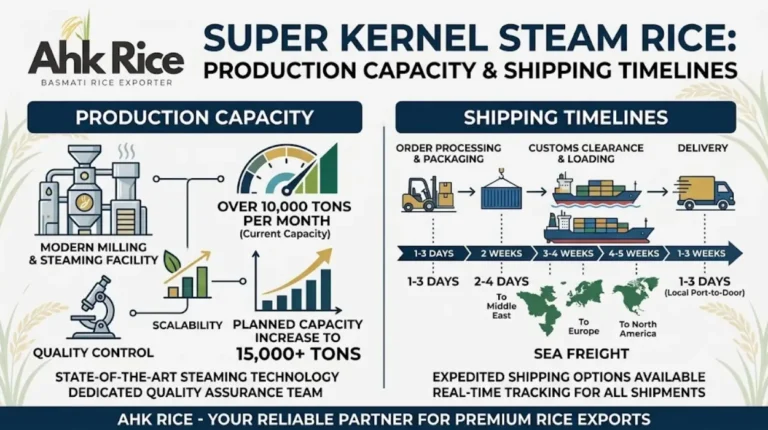
Supplier capacity is more than the amount of paddy available. It includes procurement, aging where required, milling, sorting, grading, polishing, packaging, laboratory testing, inspection, documentation, container loading, and shipment preparation.
For example, if an Idaho importer expects a peak monthly requirement of 200 MT, a supplier capacity target of 300 MT provides a 1.5-times planning buffer. A high-volume program could target approximately 400 MT of available capacity.
This does not mean the buyer must purchase 400 MT. It means the supplier should have sufficient operational capacity to absorb demand increases without disrupting existing orders.
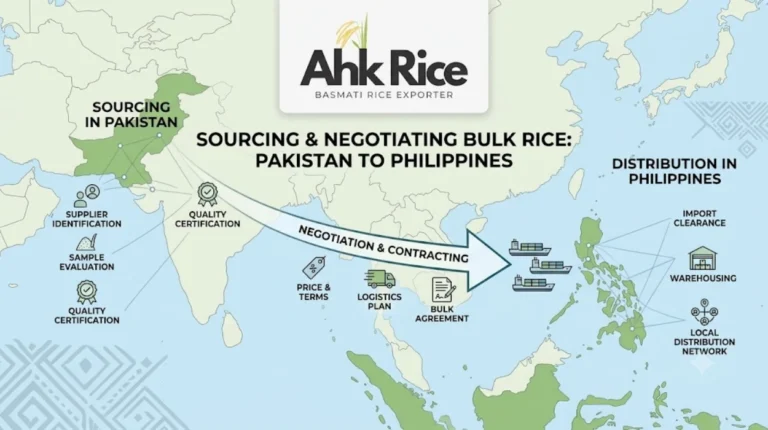
AHK Rice describes an integrated process covering sourcing, processing, grading, packaging, quality inspection, export documentation, and container loading. This type of integrated structure is relevant when buyers evaluate scalability because supply continuity depends on the entire chain rather than milling alone.
Pakistan also has a substantial export base supporting international procurement. USDA’s April 2026 Pakistan Grain and Feed Annual forecasts 2026/27 rice production at 9.8 million metric tons and exports at about 5.0 million metric tons, compared with a projected 4.7 million tons of exports for 2025/26.
What five factors should buyers use to choose a scalable supply model?
The strongest procurement decision evaluates demand predictability, approved specifications, supplier capacity, landed cost, and logistics resilience together. Price should remain important, but it should not override supply continuity, product consistency, regulatory readiness, or the buyer’s required inventory service level.
| Decision factor | What the buyer should evaluate | Strong indicator |
| Demand | Monthly and seasonal volume | Reliable 3–12 month forecast |
| Specification | Variety, grade, moisture, broken ratio, packaging | Approved master specification |
| Capacity | Production and packing capability | 1.5× peak or higher |
| Commercial cost | FOB/CIF/landed cost | Normalized cost per MT |
| Logistics | Production, vessel, port, customs, inland delivery | Planned shipment calendar |
The first factor is demand. Buyers should separate baseline demand from peak demand. A supplier should receive the peak requirement because production constraints occur during the busiest periods.
The second factor is specification control. The approved sample should become the commercial reference for future shipments. This reduces disputes over grain length, broken percentage, moisture, appearance, aroma, cooking performance, and packaging.
The third factor is capacity. Buyers should verify whether the supplier can process and pack the required volume within the requested shipment windows.
The fourth factor is total cost. A lower purchase price is valuable only when the rice arrives within specification and within the required delivery window.
The fifth factor is logistics resilience. Importers should map production, inspection, container booking, vessel departure, port arrival, customs clearance, inland transportation, and warehouse receipt.
What does a disruption-resistant Idaho rice import program look like?

A disruption-resistant Idaho program starts with a fixed product specification, forecasted demand, reserved production capacity, staggered purchase orders, adequate safety stock, documented quality controls, and shipment tracking. The system converts international rice procurement from reactive buying into scheduled replenishment.
Consider an Idaho distributor with 240 MT of annual demand. Instead of waiting until warehouse inventory reaches zero, the buyer can establish a twelve-month demand forecast, approve the rice specification, schedule monthly or bi-monthly purchase orders, and maintain a defined safety-stock threshold.
The supplier receives forward visibility. Production can be scheduled before the buyer reaches critical inventory.
The importer also gains a clearer financial picture. Purchase quantities, expected freight windows, warehouse requirements, and replenishment dates become visible before each shipment.
The system should be reviewed monthly. Actual sales should be compared with forecast demand. If sales accelerate, the next purchase order can increase. If demand slows, the buyer can reduce future orders before unnecessary inventory accumulates.
For Idaho businesses expanding their Pakistani Basmati program, the decision should therefore focus on repeatability rather than the lowest first-order price. The objective is consistent rice, predictable shipments, manageable inventory, and enough supplier capacity to absorb growth.
For buyers moving from evaluation to execution, the decision-focused guide:
Expand Idaho Basmati Rice Supply Through AHK Rice Exports can be positioned after this section as the next-stage resource.
Frequently Asked Questions
How can buyers scale rice imports without supply disruptions?
Buyers can scale imports by using demand forecasts, fixed rice specifications, reserved supplier capacity, scheduled purchase orders, safety stock, and planned shipment calendars instead of relying only on spot purchases.
What is the best procurement method for growing rice imports?
Forecast-based procurement combined with scheduled shipments provides the strongest balance of supply continuity, inventory control, price planning, and flexibility for growing rice import programs.
Why is supplier capacity important when scaling rice imports?
Supplier capacity determines whether an exporter can process, grade, pack, inspect, document, and prepare increased rice volumes without delaying existing or future shipments.
How much supplier capacity should rice importers require?
A practical planning target is supplier capacity of at least 1.5 times the buyer’s planned peak shipment volume. High-volume programs can target approximately twice peak monthly demand.
Which Pakistani Basmati varieties can buyers use for scalable supply?
Buyers can evaluate 1121 Basmati, Super Kernel Basmati, and 1509 Basmati. The appropriate variety depends on customer requirements, grain characteristics, cooking performance, packaging, and target market positioning.
How should buyers compare rice supplier prices?
Importers should compare normalized landed cost per metric ton rather than FOB price alone. The calculation should consider rice specifications, packaging, inspection, freight, destination charges, customs, inland transportation, and handling.
What is the difference between spot purchasing and scheduled rice procurement?
Spot purchasing responds to immediate inventory requirements, while scheduled procurement establishes quantities and delivery dates in advance. Scheduled purchasing provides greater supply predictability for recurring demand.
How does forecast-based rice procurement reduce shortages?
Forecasting gives exporters advance visibility of expected demand. This allows production, packaging, quality inspection, documentation, and container planning to occur before the buyer reaches a critical inventory level.
What inventory strategy helps prevent rice supply disruptions?
Importers should establish minimum inventory thresholds, safety stock, reorder points, and planned replenishment dates. Inventory should account for production time, ocean transit, customs clearance, inland delivery, and seasonal demand.