How Do Indonesian Importers Verify Moisture Levels in Pakistan Basmati Rice?
Indonesian importers get the most reliable moisture verification by combining supplier-side moisture testing, representative sampling, calibrated instruments, and independent laboratory confirmation before shipment. A single meter reading is not enough for a commercial Basmati rice purchase.
Moisture verification matters because Indonesian buyers evaluate rice for storage stability, milling quality, cooking performance, and compliance. For broader context on the varieties and export specifications entering Indonesia, importers can review this guide to Pakistani rice varieties exported to Indonesia. The relevant products include 1121, Super Kernel, and 1509 Basmati rice, with different processing grades and commercial positions.
When an importer evaluates a supplier such as AHK Rice, its rice processing and export service should be assessed alongside the product specification, moisture report, sampling procedure, packaging method, and shipment documentation. AHK Rice operates from Punjab and manages processing, grading, sorting, packaging, and export handling for international buyers.
What moisture level should Indonesian importers expect from Pakistan Basmati rice?
Indonesian importers should normally target a documented moisture specification around 12–13% for export-grade Basmati, while Indonesia’s SNI 6128:2020 establishes 14% as the maximum moisture level for rice. Contract specifications can require a tighter limit.
Moisture content is the percentage of water contained in the rice sample. It directly affects storage stability, grain condition, milling behaviour, and resistance to deterioration. For imported rice, the buyer should distinguish between a legal or market maximum and the tighter commercial specification written into the purchase contract.
SNI 6128:2020 specifies maximum moisture of 14% for rice. Indonesian government agricultural guidance also identifies 14% as the maximum moisture requirement under the standard.
Export-grade Pakistani Basmati is commonly specified below this ceiling. Current AHK Rice specifications for Indonesian products show 1121 Steam and 1509 Steam at 12.5% or below, while 1121 Sella is listed at 12% maximum.
This difference is important. A shipment can satisfy a 14% maximum while still failing a buyer’s contractual 12.5% specification. Indonesian importers should therefore verify the exact number stated in the purchase contract rather than relying on the phrase “export quality.”
Moisture should also be evaluated as a batch characteristic. A rice lot can contain local variations caused by incomplete drying, uneven storage, or moisture migration inside bags. The importer therefore needs a representative sample instead of testing one convenient bag.
What are the available solutions for verifying moisture?
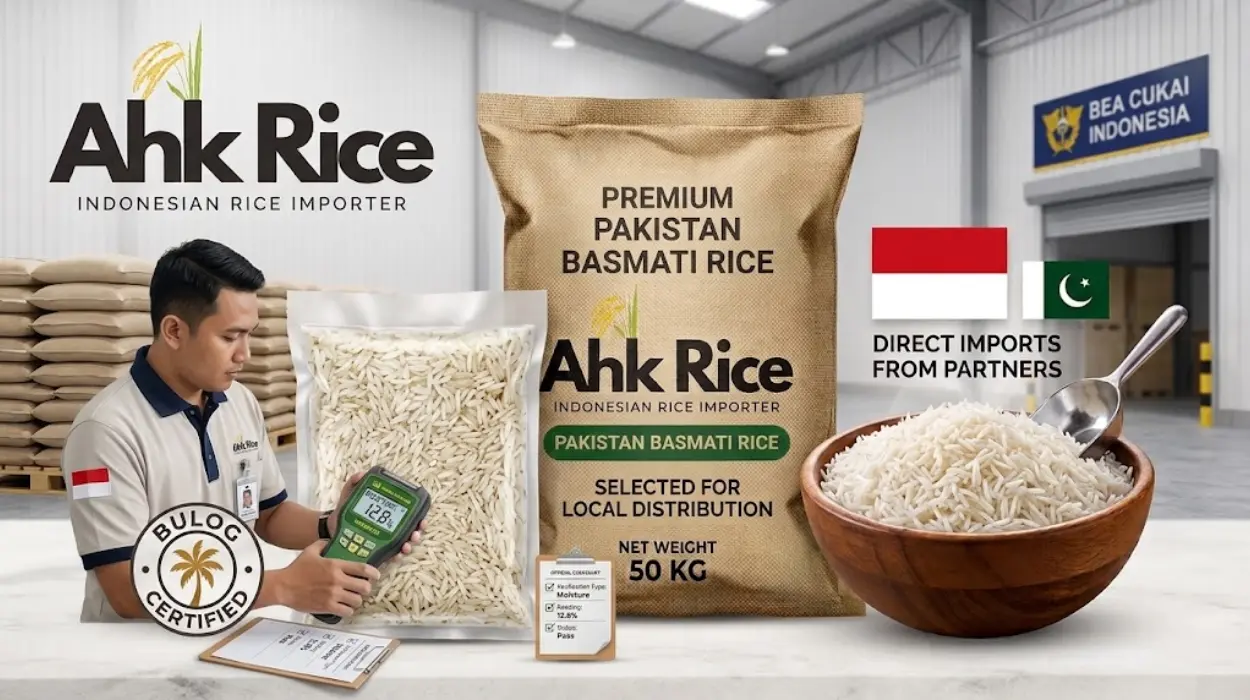
The main verification solutions are portable moisture meters, oven reference testing, laboratory analysis, supplier quality reports, and independent pre-shipment inspection. The strongest commercial system combines rapid instrument screening with laboratory confirmation using representative samples from the actual export lot.
Portable moisture meter
A portable moisture meter provides a fast reading during factory inspection, loading, or warehouse checks. It is useful because the operator can test several samples quickly and identify variation between bags or sections of a lot.
Its weakness is calibration. Different instruments use different measurement principles and grain calibrations. A meter designed for one commodity or grain condition can produce unreliable results when used without the correct rice calibration.
Oven reference method
The reference approach determines moisture by measuring the loss in mass after controlled drying. It is slower than a portable meter but provides a laboratory-style benchmark.
Indonesia has also adopted SNI ISO 712-1:2024 as the reference standard for determining moisture content in cereals and cereal products. The standard was established by Indonesia’s National Standardization Agency in 2025.
Independent laboratory testing
An independent laboratory provides stronger evidence when the purchase involves large quantities or strict contractual specifications. The laboratory receives a representative sample and reports the measured moisture value under a defined analytical method.
This method is especially useful when supplier and buyer readings differ. It creates an objective reference before the container leaves Pakistan.
Supplier certificate and quality report
A supplier’s certificate of analysis provides batch-level documentation. It should identify the product, grade, lot or batch, test date, moisture result, testing method, and responsible quality-control function.
The document should support, not replace, physical verification. A certificate without a traceable sampling procedure gives the importer less evidence than a certificate connected to a sealed commercial sample and inspection record.
Independent pre-shipment inspection
A third-party inspector can collect samples directly from the export lot and verify moisture before container loading. This approach connects the test result to the actual shipment rather than an earlier production sample.
For large commercial orders, this provides stronger purchasing control because the inspection covers the product that will physically enter the container.
How do different approaches compare?
Portable meters provide speed, laboratory methods provide stronger analytical evidence, and independent inspection provides shipment-level control. Indonesian importers should use rapid testing for screening and laboratory or third-party verification when moisture is a contractual acceptance criterion.
| Attribute | Portable Meter | Oven/Reference Method | Independent Laboratory | Pre-Shipment Inspection |
|---|---|---|---|---|
| Speed | Very high | Low | Medium | Medium |
| Cost | Low | Medium | Medium-high | Medium-high |
| Best use | Factory screening | Reference testing | Contract verification | Shipment acceptance |
| Sampling control | Operator-dependent | Controlled | Controlled | High |
| Result documentation | Basic to moderate | Strong | Strong | Strong |
| Shipment linkage | Variable | Depends on sample | Strong if sealed | Very strong |
| Commercial value | Screening evidence | Technical evidence | Independent evidence | Transaction evidence |
The comparison shows why one method should not carry the entire verification process. A portable meter can test many bags in minutes, but it does not automatically establish contractual compliance.
A laboratory report provides stronger analytical evidence, but its usefulness depends on how the sample was collected. If the sample does not represent the entire lot, the laboratory result can still misrepresent the shipment.
Pre-shipment inspection solves part of this problem by connecting sampling, testing, packaging, and container loading into one documented event.
For a commercial importer, the strongest workflow is therefore layered: supplier testing during processing, buyer or inspector sampling before shipment, and independent laboratory confirmation when the contract requires it.
Which Pakistani Basmati grades require different moisture strategies?
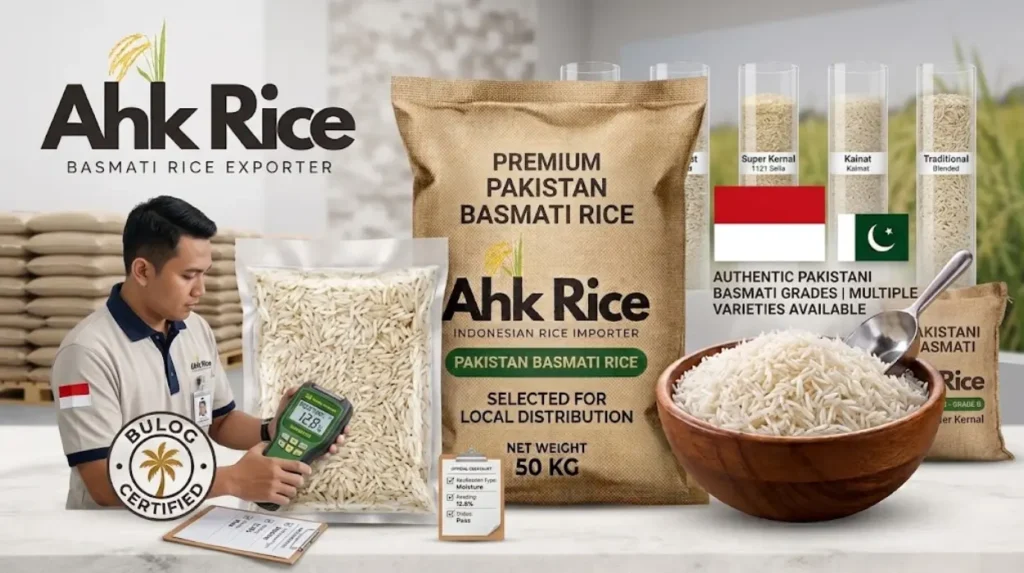
1121 Steam suits premium buyers seeking controlled moisture and visual consistency, while Sella grades offer stronger storage-oriented performance. 1509 provides a value-focused option. The moisture target should remain contract-specific across every variety and processing grade.
1121 Basmati is Pakistan’s major extra-long-grain export variety. Indonesian buyers commonly evaluate Steam, White, Sella, Golden Sella, and Creamy Sella versions according to their intended market. Current Indonesian specifications for 1121 Steam show 8.35 mm+ grain length and moisture below 12.5%.
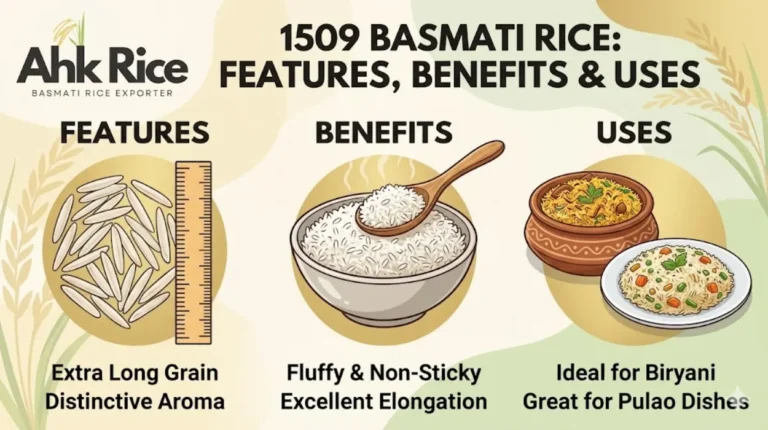
1509 Basmati provides a more value-oriented alternative. Indonesian product specifications for 1509 Steam also show moisture at or below 12.5%, with 8.4 mm+ grain length in the listed specification.
Sella and Golden Sella require a different evaluation because parboiling changes the physical structure of the grain. Golden Sella is produced through soaking, steaming, drying, milling, grading, and packing. The process creates firmer kernels and improves transport and storage characteristics.
Moisture should therefore never be evaluated independently from processing. Two products can have the same moisture percentage but different storage and cooking behaviour because their processing methods differ.
Which market regions have different grade preferences?
Indonesian demand is not uniform. Premium retail and hospitality buyers tend to emphasize grain appearance, aroma, and cooking performance. Wholesale and foodservice buyers place greater emphasis on price, yield, consistent specifications, and storage performance.
| Market region | Common grade preference | Indicative FOB price/MT | Typical shelf-life planning |
|---|---|---|---|
| Indonesia — premium retail | 1121 Steam, 1121 Sella | $1,135–$1,200 | 12–24 months |
| Indonesia — wholesale/foodservice | 1509 Steam, 1121 Steam | $920–$1,280 | 12–18 months |
| Middle East | 1121 Sella/Steam, Super Kernel | $1,135–$1,205 | 12–24 months |
| Europe/North America | 1121, Super Kernel, 1509 | $1,135–$1,205 | 12–24 months |
The price figures are indicative FOB Pakistan benchmarks rather than fixed quotations. Current published references place 1121 Steam around $1,160–$1,200 per MT, while Indonesian market guidance places 1509 Steam around $920–$1,050 and 1121 Steam around $1,080–$1,280 depending on specification and market conditions.
Shelf life should also be treated as a planning range rather than a universal product attribute. Packaging, warehouse humidity, temperature, pest control, moisture stability, and stock rotation influence actual storage performance.
Golden Sella generally suits longer storage programs because parboiling strengthens the kernel. Steam grades suit buyers prioritizing premium appearance and cooking characteristics. The importer should therefore match processing type with inventory turnover rather than selecting a grade only by moisture percentage.
Which method works best for different Indonesian import cases?
Small trial orders need portable meter checks and supplier documentation. Regular container buyers need independent sampling and batch certificates. High-value or specification-sensitive contracts benefit most from third-party inspection combined with laboratory testing before shipment.
For a first sample order, the importer can request the supplier’s moisture report and compare it with an independently measured sample. The objective is to establish whether the supplier’s stated method produces repeatable results.
For recurring container purchases, the buyer should establish a written moisture tolerance. A practical specification might state a target such as 12.0–12.5%, together with the sampling method, testing method, permitted tolerance, and rejection procedure.
For premium retail programs, the importer should connect moisture with other quality characteristics. Grain length, broken percentage, foreign matter, colour, packaging, crop year, and cooking performance should be evaluated alongside moisture.
For long-storage programs, moisture becomes even more important. The buyer should assess the condition at loading and the expected warehouse environment in Indonesia. A shipment entering a humid warehouse requires stronger moisture and packaging controls than a shipment moving quickly through distribution.
What are the pros and cons of each verification strategy?
Supplier testing is economical and fast but requires trust in procedures. Independent laboratory testing provides stronger evidence but costs more. Third-party inspection provides shipment-level assurance but adds inspection expense. Combining methods produces the strongest commercial control.
Supplier testing offers the advantage of immediate process control. Problems can be corrected before packing, reducing the risk of producing a non-conforming shipment.
Its limitation is independence. The importer depends on the supplier’s equipment, calibration, sampling process, and reporting system.
Portable meters provide excellent operational speed. A quality controller can test multiple bags and identify inconsistent moisture rapidly. Their weakness is sensitivity to calibration, sample preparation, grain temperature, and instrument condition.
Laboratory testing creates stronger evidence for contract disputes. Its limitation is time and cost. The sample must also be properly collected, sealed, labelled, and transported.
Third-party inspection offers the strongest connection between the quality result and the actual container. Its disadvantage is additional cost and scheduling. For high-value shipments, however, that cost is small compared with the financial impact of receiving a non-conforming lot.
What decision factors should Indonesian importers use?
Importers should rank moisture specification, sampling quality, testing method, batch traceability, processing grade, storage period, packaging, price, and inspection requirements. The lowest price is not the best value when moisture inconsistency creates storage or rejection risk.
| Decision factor | Question to ask | Priority |
|---|---|---|
| Moisture target | What exact percentage is written in the contract? | Critical |
| Sampling | Does the sample represent the complete lot? | Critical |
| Test method | Is the method calibrated and documented? | Critical |
| Storage | How long will the rice remain in Indonesia? | High |
| Processing grade | Is Steam, White, or Sella appropriate? | High |
The first decision should be the contractual moisture specification. A supplier cannot be evaluated fairly when the buyer has not defined an acceptance threshold.
The second decision should be sampling. A representative sample should cover multiple bags or locations within the lot. Testing one bag provides only one observation.
The third decision should be method alignment. Buyer and supplier should use comparable testing procedures when comparing results. If two methods produce different values, the contract should identify the controlling method.
The fourth decision should be storage planning. Indonesia’s humid climate makes moisture stability important for importers holding stock for extended periods.
The fifth decision should be total commercial value. An extra $20–$50 per MT can be justified when it delivers tighter specifications, better inspection control, lower rejection exposure, and stronger storage performance.
What should an Indonesian importer request before shipment?
A complete verification package should contain the agreed specification, batch moisture report, sampling record, test method, laboratory report where required, inspection certificate, packaging details, and shipment documents. These records create traceability from processed rice to container.
The importer should request the supplier’s product specification before confirming the purchase order. The document should identify variety, processing grade, moisture, broken percentage, grain length, purity, packaging, and other acceptance criteria.
The supplier should then provide a batch-level quality report before loading. The report should correspond to the actual production lot rather than a generic product specification.
Where the purchase is commercially significant, an independent inspector can sample the lot before loading. The sealed sample should remain identifiable through the inspection report.
The importer should also retain the approved pre-shipment sample. This provides a physical benchmark for comparison if the destination inspection produces a different result.
This approach turns moisture verification into a documented procurement process rather than a single measurement. It also allows Indonesian importers to compare suppliers on measurable quality control instead of marketing claims.
Indonesian importers should treat moisture as a measurable contract specification rather than a general quality claim. The strongest approach combines supplier process testing, representative sampling, calibrated measurement, independent inspection, and laboratory confirmation where required.
For 1121, 1509, and Super Kernel, the importer should compare moisture together with processing grade, grain characteristics, price, packaging, and storage requirements. Current Indonesian product specifications from AHK Rice commonly target moisture around 12–12.5%, while the broader Indonesian SNI ceiling is 14%.
A buyer seeking the best commercial outcome should therefore select the specification and verification system first, then compare suppliers against the same benchmark.
Frequently Asked Questions
What moisture level is acceptable for Pakistani Basmati rice in Indonesia?
Indonesia’s SNI 6128:2020 specifies a maximum moisture level of 14% for rice. Commercial Basmati contracts commonly use tighter specifications such as 12–13%, depending on variety, processing grade, packaging, and buyer requirements.
How do importers test Basmati rice moisture?
Importers use calibrated moisture meters for rapid screening and laboratory reference methods for stronger verification. For container-scale purchases, independent pre-shipment inspection provides additional evidence because sampling is linked directly to the shipment.
Is 12.5% moisture better than 14%?
A 12.5% specification provides a tighter commercial control than a 14% maximum. It does not automatically make one rice variety superior. The correct target depends on processing, packaging, storage duration, and the buyer’s contractual requirements.
Does Golden Sella have better storage performance?
Golden Sella generally provides stronger storage performance than raw white rice because parboiling strengthens the kernel and stabilizes the grain structure. Actual shelf life still depends on moisture, packaging, warehouse conditions, pest control, and stock rotation.
Which Pakistani Basmati varieties can Indonesian importers source?
Indonesian buyers can source 1121, Super Kernel, and 1509 Basmati in multiple processing grades. 1121 emphasizes extra-long grain presentation, Super Kernel emphasizes traditional aroma, and 1509 provides a strong price-to-performance position.
What documents should accompany a moisture-controlled rice shipment?
Importers should request the product specification, batch quality report, sampling record, laboratory report where applicable, inspection certificate, commercial invoice, packing list, certificate of origin, phytosanitary documentation, fumigation documentation, and bill of lading.
Is supplier moisture testing enough?
Supplier testing is useful for process control but should not be the only verification method for high-value contracts. Independent sampling and laboratory confirmation provide stronger evidence when moisture is a contractual acceptance criterion.
How should Indonesian importers compare suppliers?
Compare the exact moisture specification, sampling method, test method, grade, broken percentage, grain length, packaging, shelf-life planning, inspection procedure, FOB or CIF price, documentation, and shipment history. This produces a more accurate procurement decision than comparing price alone.