How Does Moisture Control Protect Rice During International Shipping?
Rice remains safe, stable, and marketable during international shipping when moisture stays between 12% and 14%. Here is why: controlled moisture prevents mould growth, insect activity, grain breakage, discoloration, and weight loss during long transit periods across oceans and different climate zones.
International rice trade depends on moisture management. Basmati rice travels thousands of kilometres from Pakistan to destinations such as the United Kingdom, Saudi Arabia, the United Arab Emirates, Canada, Australia, and Europe. Moisture control protects grain quality from the moment farmers harvest paddy until importers unload containers at destination ports. Every stage influences the final quality that buyers receive.
What Is Moisture Control in Rice Exporting?
Moisture control means maintaining grain moisture between 12% and 14% throughout harvesting, processing, storage, container loading, and international transportation.
Moisture content refers to the amount of water present inside rice kernels. Rice contains natural moisture after cultivation and harvesting. Exporters test this percentage before processing and shipping.
Rice with excessive moisture deteriorates quickly. Rice with extremely low moisture becomes brittle and breaks during milling and transportation. Export-grade Basmati therefore requires precise moisture management.
Pakistani exporters cultivate and harvest Basmati rice in Punjab’s rice-growing regions. Farmers harvest paddy, dry it, and transfer it to processing facilities where technicians test moisture levels before milling begins.
International buyers often specify moisture requirements in purchase contracts. Most markets accept moisture levels between 12% and 14% because this range balances shelf life and grain integrity.
With moisture control defined, the next question is how this protection system works during international shipping.
How Does Moisture Control Work During International Shipping?
Moisture control works through testing, drying, storage management, packaging, container preparation, and continuous quality verification before shipment.
Rice exporters follow a structured process to maintain moisture stability throughout the supply chain.
Harvest and Initial Drying
Freshly harvested paddy contains elevated moisture. Processing facilities dry the grain to export specifications before milling operations begin.
Drying reduces biological activity. Controlled drying also protects grain structure and cooking quality.
Processing and Moisture Testing
Rice mills inspect and test moisture before each processing stage.
Export facilities typically perform the following steps:
- Clean the paddy
- Dry the grain
- De-husk the kernels
- Polish the rice
- Grade by size
- Sort by colour
- Test moisture levels
- Pack the rice
- Load containers
Each step supports moisture consistency.
Container Preparation
Shipping containers require inspection before loading.
Export teams inspect container walls, floors, doors, and ventilation points. Dry containers prevent condensation formation during ocean transit.
Packaging Protection
Packaging materials reduce moisture exchange with external environments.
Common packaging options include:
- PP woven bags
- BOPP laminated bags
- Paper bags
- Vacuum packs
- Retail consumer packs
Packaging creates an additional barrier against humidity fluctuations.
With the shipping process explained, the next question concerns the components that actively control moisture.
What Components Help Control Moisture During Rice Shipping?
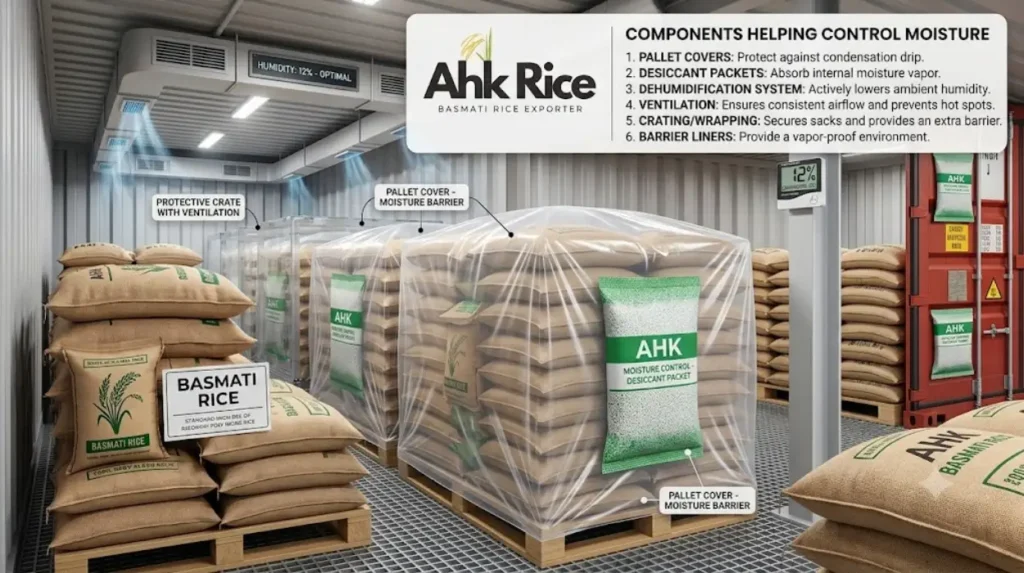
Moisture meters, drying systems, storage warehouses, packaging materials, container liners, and inspection procedures form the core moisture-control system.
Multiple components work together to protect rice quality.
Moisture Meters
Moisture meters measure water content inside rice kernels.
Technicians use these devices during receiving, processing, storage, and pre-shipment inspections. Accurate measurements prevent non-compliant shipments.
Drying Systems
Drying systems reduce moisture to export specifications.
Modern facilities use controlled drying equipment that removes excess water without damaging grain quality.
Storage Warehouses
Warehouses maintain stable environmental conditions.
Proper storage prevents rice from absorbing atmospheric moisture before shipment.
Packaging Systems
Packaging protects rice against environmental exposure.
BOPP bags, laminated bags, and retail packs help maintain stable moisture levels throughout transportation.
Quality Inspection Procedures
Inspection procedures verify compliance before dispatch.
Quality teams inspect, test, certify, and verify rice specifications before container loading.
These components work together to create measurable benefits during international trade.
What Benefits Does Moisture Control Provide During Export?
Moisture control increases shelf life, protects grain appearance, reduces breakage, prevents mould growth, and maintains export specifications.
Rice quality depends heavily on moisture stability.
Longer Shelf Life
Controlled moisture extends storage life.
Rice maintained within export specifications remains stable for extended periods. Importers benefit from longer inventory management windows.
Better Grain Appearance
Proper moisture preserves colour and surface quality.
Premium Basmati varieties retain their visual appeal during shipping and storage.
Reduced Breakage
Balanced moisture strengthens grain structure.
Rice with excessive dryness becomes fragile. Rice within specification tolerates handling more effectively.
Protection Against Mould
Fungal growth requires moisture.
Controlled moisture removes conditions that support mould development during transportation.
Compliance With Buyer Specifications
Importers frequently define moisture limits in procurement contracts.
Consistent moisture management supports compliance and reduces claim disputes.
These advantages explain why moisture control remains essential across different export markets.
Which Basmati Rice Grades Require Moisture Control?
All export grades require moisture management, including 1121 Basmati, Super Kernel Basmati, 1509 Basmati, Steam Rice, White Rice, and Golden Sella Rice.
Every rice grade responds differently to moisture conditions.
1121 Basmati Rice
1121 Basmati features extra-long grains measuring approximately 8.30 mm before cooking.
Moisture stability protects grain length and cooking expansion performance.
Super Kernel Basmati Rice
Super Kernel Basmati remains popular in Middle Eastern markets.
Controlled moisture preserves aroma and grain appearance during long-distance shipping.
1509 Basmati Rice
1509 Basmati offers high yield and strong export demand.
Stable moisture levels support milling performance and reduce broken kernels.
Steam Basmati Rice
Steam processing retains natural grain characteristics.
Moisture consistency preserves texture and cooking quality.
Golden Sella Basmati Rice
Golden Sella undergoes parboiling before milling.
Golden Sella lasts longer than Steam rice. In Gulf warehouses, Golden Sella maintains quality longer during high-temperature storage. For catering buyers in Saudi Arabia, Golden Sella often becomes the preferred specification.
Understanding the grades leads naturally to the markets that import them.
Which International Markets Focus Closely on Rice Moisture Specifications?
The United Kingdom, European Union, Gulf countries, North America, and Australia enforce strict quality and moisture requirements for imported rice.
Different markets apply different purchasing standards.
United Kingdom
UK importers prioritize food safety and product consistency.
Moisture compliance supports longer shelf life throughout retail distribution networks.
European Union
European buyers demand strict quality verification.
Inspection reports often include moisture measurements alongside purity and grading data.
Gulf Countries
Saudi Arabia, UAE, Qatar, Oman, Kuwait, and Bahrain import large quantities of Basmati rice.
High regional temperatures increase the importance of moisture stability during storage.
North America
Canadian and American importers emphasize food quality and regulatory compliance.
Consistent moisture helps maintain specification conformity throughout distribution.
Australia
Australian importers focus on grain quality and shelf-life performance.
Moisture-controlled rice performs better during extended storage cycles.
Market requirements also connect directly with certification standards.
Which Certifications Support Moisture-Controlled Rice Exports?
ISO standards, HACCP systems, phytosanitary certification, fumigation certification, and laboratory testing support moisture-controlled exports.
Certification verifies quality management practices.
ISO Certification
ISO systems establish documented quality procedures.
These procedures include testing and verification activities.
HACCP Certification
HACCP focuses on food safety controls.
Moisture monitoring supports preventive risk management.
Phytosanitary Certification
Phytosanitary certificates confirm compliance with plant health requirements.
Many importing countries require these documents.
Fumigation Certification
Fumigation certificates verify pest-control treatment.
These documents support customs clearance in many destinations.
Laboratory Testing Reports
Independent laboratories test rice specifications.
Reports often include moisture content, purity, broken percentage, and grain dimensions.
Certification supports quality assurance, but misconceptions still exist.
What Common Misconceptions Exist About Rice Moisture During Shipping?
High moisture does not improve quality, extremely dry rice does not guarantee longer shelf life, and packaging alone does not control moisture.
Several misunderstandings persist within the rice trade.
Higher moisture increases biological activity. Elevated moisture encourages mould development and quality deterioration.
Extremely dry rice increases breakage. Grain strength decreases when moisture falls below appropriate export specifications.
Packaging alone cannot solve moisture problems. Correct drying, testing, storage, and loading procedures remain essential.
Moisture control does not stop after processing. Exporters continue monitoring conditions through storage, loading, and shipment stages.
Moisture management therefore functions as a complete supply-chain system rather than a single processing step.
Moisture control protects rice during international shipping by maintaining 12%–14% moisture content, preventing mould growth, reducing grain breakage, preserving appearance, and extending shelf life. Exporters achieve this through drying, testing, grading, storage management, packaging protection, container inspection, and certification procedures. Every major Basmati variety, including 1121, Super Kernel, and 1509, depends on moisture stability to arrive at international destinations in export-grade condition.
Frequently Asked Questions
What is the ideal moisture level for export-quality rice?
The ideal moisture range is 12% to 14%. This level balances shelf life, grain strength, and food safety requirements.
Why does high moisture damage rice during shipping?
High moisture encourages mould growth, insect activity, discoloration, and quality deterioration during long transit periods.
How do exporters measure rice moisture?
Exporters use calibrated moisture meters to test rice at receiving, processing, storage, and pre-shipment stages.
Which rice varieties require moisture control?
All export varieties require moisture control, including 1121 Basmati, Super Kernel Basmati, 1509 Basmati, Steam Rice, White Rice, and Golden Sella Rice.
Does packaging alone protect rice from moisture?
No. Packaging supports moisture protection, but drying, testing, storage management, and container inspections remain essential.
Why do UK and EU importers check moisture levels?
UK and EU buyers require consistent quality, longer shelf life, and compliance with food safety standards throughout distribution networks.
What certifications support moisture-controlled rice exports?
Common certifications include ISO, HACCP, Phytosanitary Certificates, Fumigation Certificates, and independent laboratory testing reports.