AHK Rice Supports Scottish Wholesale Buyers with Export Supply Programs
AHK Rice provides Scottish wholesale buyers with specification-led Pakistani Basmati supply, export documentation, sample verification, and shipment planning. Here is why: Scottish buyers need predictable quality, clear landed-cost inputs, and controlled dispatch schedules. Pakistani Basmati is classified under UK rice heading 1006, with classification based partly on grain size and length-to-width ratio.
Scottish wholesalers can first understand the sourcing market through why Scottish wholesalers are exploring Pakistani Basmati rice sources. The commercial decision then depends on grade, processing, packaging, quality controls, shipping route, and import requirements. AHK Rice structures supply around those variables rather than treating every wholesale order as the same specification.
What is the best solution for Scottish wholesale rice sourcing?
The best solution is a specification-led export program covering grade selection, sample approval, quality verification, packaging, documentation, and scheduled shipment.
Scottish wholesalers need more than a competitive rice price. They need consistency between the approved sample and the shipped cargo. The purchase specification should therefore define variety, grain appearance, broken percentage, moisture, foreign matter, packing format, crop information, and required documentation.
AHK Rice can supply Pakistani Basmati categories including 1121, Super Kernel, and 1509 Basmati rice . Each category serves different commercial requirements. Long-grain 1121 can suit premium retail and foodservice positioning, while other grades can target broader wholesale price points.
UK classification also separates rice according to processing and grain characteristics. Milled, polished, parboiled, and broken rice can fall under different tariff classifications within heading 1006.
The practical decision is therefore specification first, price second. A lower quoted price can lose its advantage through unsuitable packaging, higher breakage, documentation problems, or delayed delivery.
How does AHK Rice structure the export supply program?
AHK Rice structures supply around product specifications, sample approval, processing control, export documentation, packaging requirements, and shipment coordination.
AHK Rice starts with the buyer’s required product profile. The buyer specifies variety, grade, packing weight, destination, estimated quantity, and intended channel. The exporter then matches the requirement with an available Pakistani Basmati specification.
AHK Rice manages the supply process from processing through export dispatch. The workflow can include cleaning, dehusking, polishing, grading, colour sorting, quality inspection, packaging, and container loading.
Which specifications should Scottish buyers confirm?
Scottish buyers should confirm variety, grain length, broken percentage, moisture, foreign matter, processing type, packing, crop year, and shipment terms before purchase.
| Specification | Buyer decision | Commercial purpose |
|---|---|---|
| Variety | 1121, Super Kernel, or 1509 | Defines product positioning |
| Processing | White, Steam, Sella, or Brown | Determines cooking and market use |
| Broken percentage | Contract specification | Controls visual and yield expectations |
| Moisture | Agreed contract limit | Supports storage stability |
| Foreign matter | Agreed quality limit | Supports food safety and appearance |
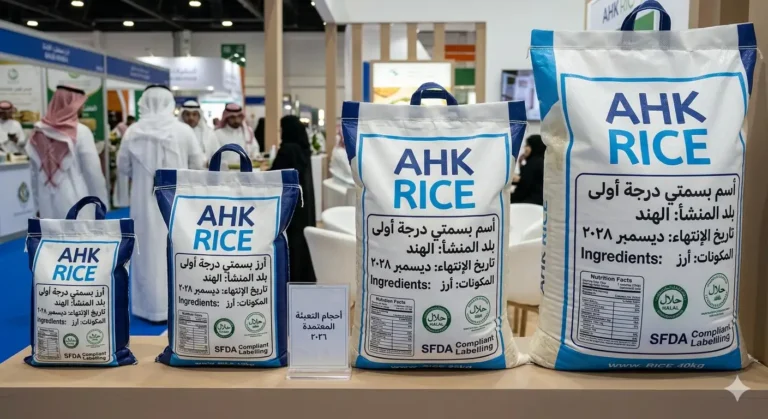
| Packaging | Retail or wholesale format | Matches distribution channel |
| Incoterm | FOB or CIF | Defines cost responsibility |
UK guidance confirms that Basmati is a slender, aromatic, non-glutinous long-grain rice. Approved Basmati varieties include Kernel and other recognised varieties.
Scottish buyers should also confirm the exact customs classification before shipment. HMRC states that rice classification can depend on processing, grain size, and length-to-width ratio.
The specification establishes what is being purchased; the next decision is whether the supplier can execute it consistently.
Why choose AHK Rice for Scottish wholesale supply?
AHK Rice offers Scottish buyers a direct Pakistani sourcing route with controlled specifications, sample approval, processing oversight, packaging options, and export coordination.
AHK Rice is positioned as a supplier for buyers that require repeatable export specifications. The value is not simply the availability of Pakistani rice. The value comes from coordinating product selection with processing and shipment requirements.
Quality control begins before loading. Rice can be inspected and tested against the agreed specification. Packaging can then be prepared according to the buyer’s required commercial format.
AHK Rice can also support buyers that need different grades for different customer segments. A Scottish wholesaler serving restaurants may require one specification, while a distributor supplying ethnic retail stores may require another.
The same supply program can therefore separate product specifications rather than forcing every customer into one generic grade.
What proof should a buyer request before approving an order?
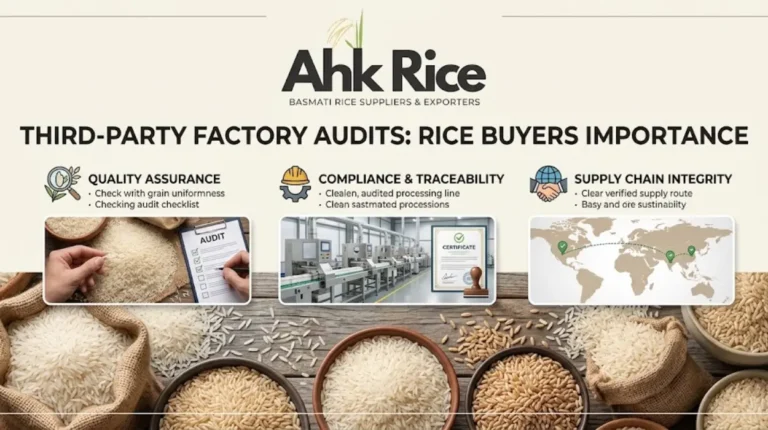
Buyers should approve a physical sample, confirm laboratory or inspection requirements, review export documents, and match the final shipment against the agreed specification.
A sample is the commercial reference point. The approved sample should represent the grade, appearance, cooking characteristics, packaging, and quality requirements expected in the shipment.
The buyer should also confirm documentation before dispatch. UK imports can involve licensing and quota considerations for rice. Current Rural Payments Agency notices show active rice import quota arrangements for 2026.
Pakistan-origin milled rice also appears in UK quota documentation under CN code 1006 30. Current guidance identifies Pakistan as an eligible country under specified quota arrangements.
Documentation accuracy therefore matters alongside physical quality. Certificate of origin, commercial invoice, packing information, transport documents, and any required inspection or compliance documentation should align with the shipment.
Scottish buyers should also monitor current food controls. UK government guidance updated in July 2026 identifies controls affecting certain foods from specific countries, while separate legislation identifies Pakistan-origin rice among products subject to specified contaminant controls.
The proof stage protects the buyer from approving a product that cannot satisfy the import process.
What results can Scottish wholesale buyers expect?
A well-defined export program can improve specification consistency, reduce purchasing uncertainty, support planned stock replenishment, and make landed-cost decisions clearer.
The first result is specification consistency. The buyer has a defined reference before production and shipment. This reduces ambiguity over what “premium Basmati” means commercially.
The second result is better shipment planning. Pakistani rice can move through an international container supply chain before final inland delivery into Scotland. Actual transit depends on port, carrier, sailing schedule, congestion, customs, and inland transport.
How many shipping days should Scottish buyers plan?
Scottish buyers should plan roughly 30–45 days for a Pakistan-to-Scotland sea-freight program, with customs and inland delivery adding further time.
| Market destination | Planning window | Main variables |
|---|---|---|
| Scotland | 30–45 days | Sea route, port, customs, inland haulage |
| England | 25–40 days | Port congestion and inland delivery |
| Wales | 25–40 days | Port selection and final haulage |
| Northern Ireland | 30–45+ days | Route, customs, and onward transport |
These are planning ranges, not guaranteed transit times. AHK Rice should confirm the live sailing schedule and destination routing for each order before committing a delivery date.
Scottish buyers can reduce operational risk by ordering against forecast demand rather than waiting for inventory to reach a critical level. A scheduled replenishment program can also separate production lead time from transport lead time.
The commercial outcome is greater visibility. Buyers know what specification they are buying, what documents are required, and what shipping window should be planned.
How much does Pakistani Basmati rice export supply cost?
Export cost depends on rice grade, processing, packaging, order quantity, Incoterm, freight, insurance, documentation, testing, and applicable UK import charges.
A fixed price without a specification is not commercially useful. 1121 Steam, 1121 White, and 1121 Golden Sella can have different production and market values. Packaging can also materially change the delivered cost.
FOB pricing generally focuses on the export-side cargo value and agreed loading responsibilities. CIF pricing adds freight and insurance to the destination port. Scottish buyers should therefore compare like-for-like quotations.
What costs should be included in the buying calculation?
Buyers should calculate product cost, packaging, inspection, documentation, freight, insurance, customs charges, inland delivery, and applicable duty or quota costs.
| Cost factor | Why it matters |
|---|---|
| Rice grade | Changes product value |
| Processing | Adds production cost |
| Packaging | Changes material and labour cost |
| Quantity | Influences production economics |
| Inspection | Supports specification verification |
| Freight | Changes landed cost |
| Insurance | Protects cargo during transit |
| Customs | Depends on classification and applicable arrangements |
| Inland haulage | Moves cargo from arrival port to Scotland |
UK rice imports can be subject to licensing and quota arrangements. Current government notices demonstrate that import conditions and quota application windows can change, so buyers should verify the applicable arrangement before each shipment.
Sample pricing should also be separated from commercial container pricing. A small courier sample cannot represent the per-tonne economics of a full container.
How does the full rice sample process work?
The sample process should move from specification confirmation to sample preparation, dispatch, evaluation, approval, commercial quotation, and production authorization.
1. Define the specification.
State variety, processing type, broken percentage, moisture requirement, packaging, quantity, and destination.
2. Prepare the sample.
AHK Rice prepares a representative sample against the requested specification.
3. Dispatch the sample.
The buyer receives the sample for physical and cooking evaluation.
4. Test the sample.
Check appearance, grain length, aroma, cleanliness, cooking behaviour, and agreed quality characteristics.
5. Approve the specification.
Confirm the exact product reference before commercial production.
6. Confirm the quotation.
Review product value, packaging, Incoterm, freight, and shipment assumptions.
7. Authorize production.
Release the confirmed specification for processing and export preparation.
What can sample approval cost?
Sample costs vary by quantity, courier destination, testing requirements, and requested documentation; the final amount should be confirmed before dispatch.
A small product sample can carry courier and handling charges that do not represent container economics. Laboratory analysis can also create additional costs when specific contaminant or quality testing is requested.
Scottish buyers should therefore request a written sample-cost breakdown. A practical breakdown can separate rice sample value, packaging, courier, laboratory testing, and documentation.
This approach makes the sample commercially transparent. It also prevents buyers from confusing a sample shipment cost with the final bulk cargo price.
Which Pakistani Basmati grade should a Scottish wholesaler choose?
1121 is often the strongest starting point for premium long-grain positioning, while Super Kernel and 1509 can support different price and channel requirements.
When should buyers choose 1121?
Choose 1121 when long grain appearance, premium presentation, and broad Basmati positioning are central to the wholesale offer.
1121 can support retail packs, restaurant supply, catering, and ethnic wholesale distribution. The exact grade should still be selected according to broken percentage, processing, packaging, and buyer specification.
When should buyers consider Super Kernel?
Choose Super Kernel when the buyer needs a Pakistani Basmati category with a strong balance between grain presentation and commercial positioning.
Super Kernel can be evaluated as a separate product rather than treated as an interchangeable alternative to 1121. Sample comparison should determine the final decision.
When can 1509 be commercially useful?
Choose 1509 when the target specification and price position make its processing and grain characteristics suitable for the intended wholesale channel.
The correct decision depends on the customer’s required cooking performance, visual presentation, price band, and packaging format. Buyers should compare approved samples before committing to volume.
For a structured comparison approach, Scottish buyers can review how wholesale buyers select reliable rice categories before requesting a commercial specification.
The grade decision establishes the product; the final step is converting that specification into an executable order.
How can Scottish wholesalers get started with AHK Rice?
Start with the required grade, quantity, packaging, destination, and delivery window, then approve the sample before confirming the commercial shipment.
1. Submit the specification.
Provide the required variety, processing type, broken percentage, packaging, quantity, and destination.
2. Review the sample.
Evaluate the physical grain, cooking result, appearance, and agreed quality characteristics.
3. Confirm the quotation.
Compare the product price with freight, insurance, documentation, and applicable import costs.
4. Approve the order.
Confirm the final specification, quantity, packaging, Incoterm, and shipment schedule.
5. Monitor dispatch.
Coordinate loading, export documentation, shipping, customs clearance, and inland delivery.
AHK Rice gives Scottish wholesale buyers a practical route from specification to shipment. The strongest purchasing decision is not simply the lowest quotation. It is the quotation that matches the approved product, required documentation, shipping plan, and intended wholesale margin.
Contact AHK Rice today and submit your requirements through the quotation request form to receive a tailored export proposal.
Frequently Asked Questions
Is AHK Rice suitable for Scottish wholesale buyers?
AHK Rice can support Scottish wholesale sourcing through Pakistani Basmati supply programs.
The process begins with a defined product specification.
Samples can be reviewed before bulk production.
Packaging and export documentation can be aligned with the order.
The final shipment should follow the approved commercial specification.
How long does Pakistan-to-Scotland rice shipping take?
A practical planning range is around 30–45 days for sea freight.
Actual timing depends on the selected port and carrier schedule.
Customs clearance can add additional time.
Inland haulage also affects the final Scottish delivery date.
Buyers should confirm the live schedule before placing time-sensitive orders.
Which Basmati grade should Scottish wholesalers choose?
1121 is a strong starting point for premium long-grain wholesale positioning.
Super Kernel can provide another Pakistani Basmati comparison point.
1509 can suit specific price and channel requirements.
Processing type also changes the commercial specification.
Buyers should approve samples before selecting the final grade.
What documents are important for UK rice imports?
Buyers should verify the required customs, origin, commercial, transport, and quality documentation.
Rice imports can involve licensing and quota arrangements.
Country of origin can affect the applicable import treatment.
Current UK requirements should be checked before every shipment.
Documentation should match the physical cargo and commercial invoice.
How much does a rice sample cost?
Sample cost depends on quantity, courier destination, testing, and documentation requirements.
A courier sample does not represent full-container freight economics.
Laboratory testing can create additional charges.
Packaging can also affect the sample cost.
AHK Rice should confirm the exact sample cost before dispatch.
Can AHK Rice provide different packaging formats?
AHK Rice can structure packaging around the buyer’s agreed wholesale requirement.
Packaging weight should be confirmed before quotation.
Retail and foodservice channels can require different formats.
The packaging specification should match the product specification.
Final packing details should appear in the commercial order.