Why Does Grain Purity Matter for Extra Long Grain Pakistan Basmati Rice in Saudi Arabia?
Extra Long Grain Pakistan Basmati Rice stands among the most valued aromatic rice varieties in international trade because of its grain length, fragrance, cooking performance, and appearance. Grain purity determines whether a shipment contains the intended Basmati variety without unwanted grains, broken kernels, or foreign material. In Saudi Arabia, where premium Basmati rice is widely consumed in homes, restaurants, catering companies, and food manufacturers, grain purity directly influences product consistency, consumer satisfaction, and import quality compliance.
Understanding grain purity begins with knowing how authentic Pakistan Basmati rice is cultivated, processed, graded, and inspected before export. Every stage, from seed selection to container loading, contributes to the final purity level.
What Does Grain Purity Mean in Extra Long Grain Pakistan Basmati Rice?
Grain purity refers to the percentage of genuine Extra Long Grain Pakistan Basmati kernels present in a rice lot without mixing with other rice varieties, damaged grains, weed seeds, stones, husks, or foreign materials. Higher purity produces consistent cooking performance, appearance, aroma, and commercial value throughout the supply chain.
Grain purity is a measurable quality parameter rather than a visual opinion. Rice exporters and inspection laboratories determine purity through physical examination, variety identification, and grading procedures.
In Extra Long Grain Pakistan Basmati Rice, purity primarily evaluates whether every grain belongs to the declared variety. For example, an authentic lot of Pakistan 1121 Basmati contains only 1121 grains instead of a mixture with IRRI rice, broken kernels, or shorter local varieties.
Saudi Arabian buyers examine grain purity because imported rice reaches multiple market segments, including supermarkets, wholesale distributors, hotels, restaurants, and institutional kitchens. Uniform grains simplify packaging and produce predictable cooking characteristics.
Grain purity differs from moisture content, grain length, chalkiness, and broken percentage. Each quality parameter measures a different characteristic, although all contribute to overall rice quality.
How Is Extra Long Grain Pakistan Basmati Rice Produced With High Grain Purity?
High grain purity results from controlled farming, certified seed selection, careful harvesting, mechanical cleaning, grading, color sorting, laboratory inspection, and hygienic packaging. Every processing stage removes unwanted materials and preserves the identity of the original Basmati variety before export.
Production begins in Pakistan’s Punjab region, where most export-quality Basmati rice is cultivated. Farmers plant certified Basmati seeds to reduce varietal mixing from the beginning of cultivation.
Crop management includes controlled irrigation, weed management, and timely harvesting. Harvesting at proper maturity minimizes immature grains and damaged kernels.
After harvesting, paddy rice undergoes drying until it reaches suitable processing moisture levels. Stable moisture improves milling efficiency while reducing kernel breakage.
The rice then passes through several processing stages.
Cleaning
Cleaning equipment removes dust, straw, stones, weed seeds, metal particles, and field debris.
Husking
Machines remove the outer husk while protecting the inner rice kernel.
Whitening or Steam Processing
Depending on the product specification, rice becomes White Rice, Steam Rice, or Sella Rice through controlled industrial processing.
Polishing
Polishing smooths the grain surface while improving appearance.
Length Grading
Length graders separate extra-long grains from shorter kernels to maintain uniformity.
Thickness Grading
Thickness graders remove immature and undersized grains.
Color Sorting
Optical color sorters identify discolored kernels, damaged grains, chalky rice, black tips, and defective pieces.
Final Inspection
Quality inspectors verify grain purity before packaging through sampling and laboratory examination.
Each processing step removes a different category of impurities. Together, they produce export-grade Basmati rice suitable for demanding international markets.
What Components Determine Grain Purity in Pakistan Basmati Rice?
Grain purity depends on varietal identity, broken percentage, foreign matter, damaged kernels, immature grains, chalky kernels, discoloration, weed seeds, stones, and uniform grain dimensions. Each component represents a measurable quality factor evaluated before international shipment and commercial acceptance.
Several measurable components influence purity.
Varietal Purity
This measures how many grains belong to the declared Basmati variety.
Foreign Matter
Foreign matter includes stones, husks, dust, sand, straw, plastic fragments, and metal particles.
Broken Rice
Broken kernels reduce visual consistency even though they remain edible.
Damaged Grains
Damaged grains include insect-damaged kernels, cracked rice, mold-damaged grains, and heat-damaged kernels.
Chalky Grains
Chalkiness appears as opaque white areas inside kernels. Premium export specifications generally require lower chalkiness percentages.
Immature Grains
Immature kernels remain thinner and cook differently from fully developed grains.
Grain Length Uniformity
Extra Long Grain Pakistan Basmati is recognized by consistent kernel length before cooking and substantial elongation after cooking.
Laboratories evaluate these characteristics through standardized inspection methods before issuing quality reports.
Why Does Grain Purity Matter for Saudi Arabian Rice Imports?
Saudi Arabian rice buyers require consistent grain purity because uniform rice improves cooking quality, packaging consistency, shelf presentation, inventory classification, and customer satisfaction across retail, hospitality, catering, and food manufacturing sectors that consume significant volumes of imported Pakistan Basmati Rice annually.
Saudi Arabia imports substantial quantities of premium rice every year because domestic rice production remains limited by climate and water availability.
Consumers expect premium Basmati rice to display long grains, pleasant aroma, and consistent texture after cooking.
Restaurants serving dishes such as Kabsa, Mandi, Bukhari Rice, and traditional family meals benefit from uniform grain expansion during cooking.
Retail brands also depend on consistent grain appearance because consumers often judge rice quality before purchasing.
Importers classify products into different quality grades. Higher grain purity helps maintain product consistency across repeated shipments.
Quality consistency also simplifies warehouse management because identical specifications reduce sorting and reclassification requirements.
Readers interested in how different purity percentages influence pricing and commercial grading can explore the detailed discussion in the related article on:
How rice purity standards influence commercial value in the Saudi market.
What Benefits Does High Grain Purity Provide?
High grain purity improves cooking consistency, visual appearance, aroma preservation, consumer confidence, grading accuracy, processing efficiency, export compliance, and storage stability. These benefits increase product reliability throughout transportation, distribution, retail sales, food service operations, and household consumption.
Uniform grains absorb water at similar rates.
Cooking becomes more predictable because grains finish cooking at nearly the same time.
Long grain appearance remains consistent after cooking.
Packaging machines perform more efficiently when grain dimensions remain uniform.
Food manufacturers benefit from standardized raw materials during production.
Retail consumers experience similar product quality with repeated purchases.
Import inspection becomes easier because laboratory samples closely represent the entire shipment.
Warehouse inventory also remains easier to classify according to export specifications.
Where Is Extra Long Grain Pakistan Basmati Rice Commonly Used?
Extra Long Grain Pakistan Basmati Rice serves households, restaurants, hotels, catering companies, institutional kitchens, packaged food manufacturers, and retail brands because its long kernels, aroma, and cooking performance meet premium quality expectations across multiple commercial applications in Saudi Arabia and international markets.
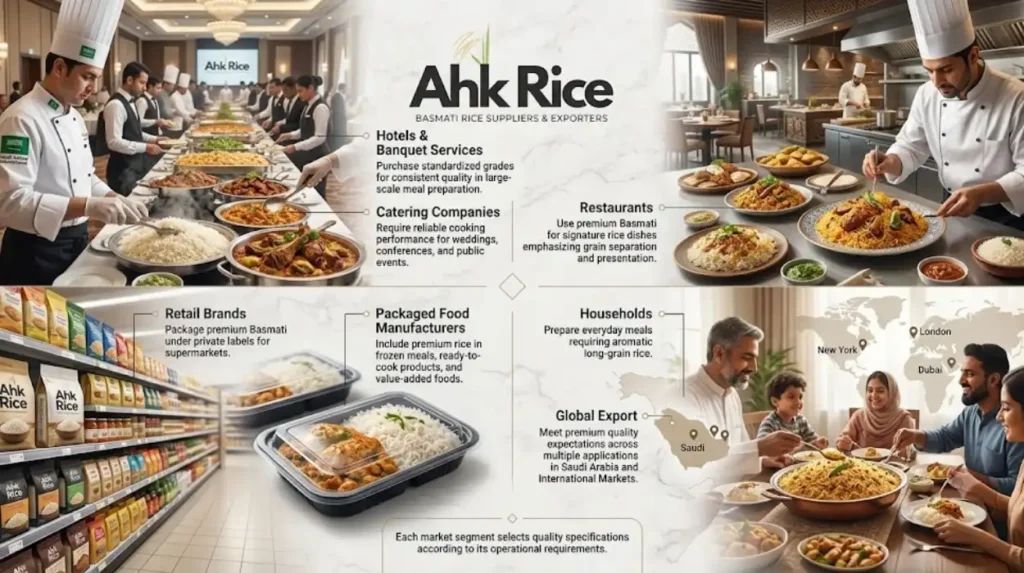
Households prepare everyday meals requiring aromatic long-grain rice.
Restaurants use premium Basmati for signature rice dishes that emphasize grain separation and presentation.
Hotels purchase standardized grades for banquet services where consistent quality supports large-scale meal preparation.
Catering companies require reliable cooking performance for weddings, conferences, and public events.
Retail brands package premium Basmati under private labels for supermarkets.
Food manufacturers include premium rice in frozen meals, ready-to-cook products, and value-added packaged foods.
Each market segment selects quality specifications according to its operational requirements.
What Misconceptions Exist About Grain Purity?
Several misconceptions confuse grain purity with grain size, aroma, polishing, or color. Grain purity specifically measures the authenticity and cleanliness of the rice lot instead of describing only its appearance or cooking characteristics.
One common misconception assumes longer grains automatically indicate higher purity.
Grain length and grain purity represent different quality measurements.
Another misconception suggests polished rice always contains higher purity.
Polishing improves surface appearance but does not identify mixed varieties.
Some buyers believe aroma alone confirms authentic Basmati.
Aromatic characteristics support variety identification but laboratory inspection remains necessary for purity verification.
Another misunderstanding assumes broken rice indicates contamination.
Broken rice represents physical kernel breakage rather than foreign material.
Some people also believe every white grain belongs to the same rice variety.
Different rice varieties share similar appearance while possessing different cooking properties and grain structures.
Understanding these differences improves purchasing decisions and quality evaluation.
Which Quality Standards and Certifications Support Grain Purity Verification?
Grain purity verification relies on standardized quality inspection, documented grading procedures, laboratory analysis, traceability systems, food safety management, phytosanitary compliance, and internationally recognized certifications that confirm product quality throughout the export supply chain in 2026.
Export-quality Pakistan Basmati Rice typically undergoes inspection before shipment.
Quality laboratories evaluate physical characteristics through representative sampling methods.
Export documentation often includes quality specifications covering purity, broken percentage, moisture level, damaged grains, and foreign matter.
Food safety systems strengthen production consistency through documented operational controls.
Common certifications associated with export-oriented rice processing include:
ISO 22000
ISO 22000 establishes food safety management requirements throughout processing operations.
HACCP
Hazard Analysis and Critical Control Points identifies and controls food safety risks during production.
Phytosanitary Certification
Phytosanitary certificates confirm compliance with plant health requirements established by importing countries.
Certificate of Origin
The Certificate of Origin verifies that exported rice originates from Pakistan.
These documents support transparency throughout international rice trade while helping importers evaluate shipment quality according to agreed specifications.
Grain purity defines the authenticity and physical cleanliness of Extra Long Grain Pakistan Basmati Rice. It measures whether a shipment contains genuine Basmati kernels with minimal broken grains, foreign matter, damaged rice, and unwanted varieties. High grain purity begins with certified seed selection and continues through controlled cultivation, cleaning, grading, color sorting, laboratory inspection, and export packaging. For Saudi Arabia, where premium Basmati rice serves households, restaurants, hotels, retailers, and food manufacturers, grain purity supports consistent cooking performance, attractive presentation, reliable quality classification, and standardized commercial trade. Understanding this quality parameter helps buyers, distributors, and consumers interpret rice specifications with greater accuracy in the evolving international rice market of 2026.
Frequently Asked Questions
What does grain purity mean in extra long grain Pakistan Basmati rice?
Grain purity refers to the proportion of correctly identified, clean, sound, and uniform rice kernels in a lot. It considers whole kernels, broken grains, foreign matter, damaged grains, discoloration, moisture, insects, and other quality factors.
Why is grain purity important for Saudi Arabian rice importers?
Grain purity helps Saudi importers maintain consistent product quality, appearance, cooking performance, and compliance with applicable Saudi food regulations and standards. It also reduces quality disputes between buyers and suppliers.
Does extra long grain automatically mean higher rice purity?
No. Extra-long grain describes kernel length, not overall purity. A rice lot can contain very long kernels while still having excessive broken grains, foreign matter, damaged kernels, mixed varieties, or other defects.
How is grain purity controlled during rice processing?
Purity is controlled through multiple stages, including paddy cleaning, destoning, dehusking, milling, grading, length separation, optical sorting, laboratory testing, and final inspection before packaging.
What defects reduce the purity of Pakistan Basmati rice?
Common defects include broken kernels, foreign seeds, stones, husk, damaged grains, discolored kernels, insects, abnormal odor, excessive moisture, and unwanted varietal mixtures.
How does moisture affect Pakistan Basmati rice purity?
Moisture affects storage stability and grain condition. Excessive moisture increases the risk of deterioration during storage and transportation, making moisture testing an important part of rice quality control.
Which Pakistan Basmati varieties are relevant to Saudi Arabia?
Pakistan supplies several commercial Basmati varieties to international markets, including 1121, Super Kernel, and 1509. These varieties are available in different processing forms such as white and parboiled rice.
What is the difference between grain purity and grain length?
Grain length measures the physical size of rice kernels. Grain purity evaluates whether the rice conforms to its specified identity and quality requirements, including cleanliness, defects, broken kernels, and foreign matter.
What certifications apply to Pakistan Basmati rice imported into Saudi Arabia?
Depending on the product and shipment, Saudi imports can require documents such as a certificate of origin, halal certification where applicable, food-product registration, conformity information, and laboratory or quality documentation.
How does grain purity affect the market value of 1121 rice?
Purity influences how closely 1121 rice matches the buyer’s specification. Whole-kernel percentage, broken grains, foreign matter, moisture, appearance, varietal identity, processing form, and documented compliance all influence commercial evaluation.
What should Saudi buyers check before importing extra long grain Basmati rice?
Buyers should verify variety, grain length, whole-kernel percentage, broken percentage, foreign matter, moisture, damaged grains, processing type, packaging, laboratory reports, certificates, and compliance with applicable Saudi and GCC requirements.