AHK Rice Pakistan Super Kernel Brown Rice Supply for Indonesian Specialty Retailers
For Indonesian specialty retailers, the strongest procurement solution is a specification-controlled Pakistan Super Kernel Brown Rice program that combines representative sampling, defined quality tolerances, suitable retail packing, export documentation, and scheduled sea freight. The commercial decision depends on landed cost, sample performance, compliance, and repeat-order consistency.
Indonesian specialty retailers operate in a different purchasing environment from conventional rice distributors. The product must have a clear premium proposition, consistent physical quality, suitable packaging, and dependable replenishment. Super Kernel Brown Rice addresses this requirement through its long, slender grain profile and retained bran layer.
Before selecting a supplier, buyers need to understand why the product fits the category. The earlier guide:
Why Pakistan Super Kernel Brown Rice is relevant to Indonesian specialty markets, explains its product positioning, nutritional characteristics, and market relevance. This BOFU specification focuses on the next decision: supplier selection, sampling, pricing, shipping, documentation, and commercial ordering.
What is the best solution for Indonesian specialty retailers seeking Super Kernel Brown Rice?
The best solution is a direct Pakistani supply program built around one approved product specification, representative samples, controlled milling, documented inspection, retail-ready packing, and a shipment plan linked to the Indonesian destination port and importer requirements.
AHK Rice supplies Super Kernel Brown Rice from Punjab, Pakistan, with the bran layer retained through brown-rice processing. Its published specification lists an average grain length of 7.0–7.4 mm, moisture of up to 12.5%, broken grains of approximately 2–3%, and no polishing.
These parameters give a specialty retailer measurable procurement criteria. Grain length supports premium shelf presentation. Moisture affects storage and cooking performance. Broken percentage affects visual quality and retail positioning. Brown processing preserves the bran layer rather than producing a conventional polished white-rice product.
The appropriate supply model is therefore specification-first rather than price-first. A buyer defines the target grade, moisture limit, broken percentage, packing, quantity, destination, inspection scope, and Incoterm before accepting a commercial quotation.
AHK Rice’s Indonesia export program also provides Super Kernel Brown Rice in multiple packing formats, including 1 kg, 2 kg, 5 kg, 10 kg, 20 kg, and 40 kg formats across PP, non-woven, jute, and cloth options.
For specialty retail, smaller consumer packs create a direct route to shelf placement. Larger bags suit foodservice, wholesalers, or retailers that operate their own repacking facilities. The packaging decision belongs in the initial specification because it affects production, labelling, handling, and landed cost.
Why choose Indonesia as the service route for this product?
Indonesia requires a market-specific export workflow because rice imports operate under agricultural and import-control rules, while specialty retail supply requires coordinated documentation, product specifications, shipping, and destination clearance before commercial distribution.
The Indonesian Ministry of Trade has updated its import framework during 2026. Regulation No. 11 of 2026, issued in April 2026, amended agricultural import controls, while Regulation No. 18 of 2026, issued in June 2026, further amended Indonesia’s broader import policy framework. Both are listed as in force by the Ministry of Trade’s legal database.
Rice import requirements depend on the purpose, importer status, product classification, and applicable authorization. Indonesian Ministry of Trade guidance distinguishes rice for general use from rice for other purposes and identifies requirements involving Import Approval, commodity-balance arrangements, importer status, and distribution restrictions.
This distinction matters for specialty retailers. The importer should establish the correct Indonesian import route before the supplier books the commercial shipment. The supplier then aligns the product specification and export documentation with that route.
The Indonesia export service is structured around this market-specific workflow. AHK Rice states that it can coordinate production, packaging, documentation, inland transport, port handling, and shipment to Indonesian ports.
A suitable commercial specification includes:
| Procurement attribute | Retail decision |
|---|---|
| Variety | Super Kernel Brown Rice |
| Grain profile | Long, slender, 7.0–7.4 mm stated range |
| Processing | Brown, unpolished |
| Moisture | Up to 12.5% stated specification |
| Broken grains | Approximately 2–3% stated specification |
| Packing | Retail or bulk format |
| Origin | Punjab, Pakistan |
| Inspection | Supplier QC and optional third-party inspection |
| Destination | Indonesian port agreed in contract |
| Commercial term | FOB, CFR/CNF, or CIF according to quotation |
The buyer should place the final specification directly into the purchase contract. This prevents a common procurement problem: approving one sample and receiving a different bulk specification.
How does the AHK Rice sample process work?
The sample process begins with specification confirmation, continues through physical and cooking evaluation, and ends with formal approval of the exact commercial grade; the sample itself can be supplied without a rice charge, while courier and applicable phytosanitary costs remain buyer responsibilities.
AHK Rice states that up to 20 kg of Super Kernel Brown Rice can be provided as a free rice sample, with the buyer covering sample shipping and the applicable phytosanitary certificate cost.
A practical sample workflow contains seven checkpoints.
1. Confirm the specification
The retailer provides the required grain type, moisture target, broken percentage, packaging format, sample quantity, destination, and intended retail positioning.
2. Prepare the representative sample
AHK Rice prepares the sample against the proposed commercial specification. The sample must represent the product intended for bulk production.
3. Dispatch to Indonesia
The buyer can use its own courier account. AHK Rice’s Indonesia information states that samples from its Punjab mills can reach Indonesia in approximately 7–10 days.
4. Inspect the dry grain
The retailer checks grain uniformity, colour, broken grains, foreign matter, grain length, and general appearance.
5. Conduct the cooking test
The product is cooked using the retailer’s normal preparation method. The evaluation covers texture, firmness, aroma, expansion, separation, and cooked appearance.
6. Approve the commercial specification
The buyer confirms the exact quality parameters before production. Any changes in moisture, broken percentage, packing, or processing must be reflected in the commercial quotation.
7. Convert approval into the purchase order
The approved sample becomes the physical quality reference for production and inspection.
A practical sample budget is therefore not a fixed product price. AHK Rice states that the rice itself can be free up to the stated sample quantity, while the buyer pays shipping and phytosanitary charges. A separate laboratory test adds another cost when the buyer requests independent verification.
For budgeting purposes, a recent AHK Rice sample guide gives an indicative $40–$90 courier range for 1–2 kg samples and an additional $25–$60 laboratory-testing range when testing is requested. These are estimates, not fixed Indonesian charges.
The sample cost becomes economically insignificant when compared with the value of a rejected commercial container. The important decision is therefore to validate the specification before bulk production.
How long does Pakistan Super Kernel Brown Rice take to reach Indonesia?
Indonesian buyers should plan approximately 14–21 days for some Karachi-to-Indonesia sea routes, while broader planning ranges of 18–28 days apply to specific destination and routing conditions; total procurement lead time also includes production, documentation, port handling, and clearance.
AHK Rice publishes 14–21 days for some direct Pakistan-to-Indonesia sea routes. Its broader Indonesia logistics information also gives approximately 18–28 days depending on destination and routing.
For procurement planning, destination-specific ranges are more useful:
| Indonesian market | Planning sea-transit range | Procurement use |
|---|---|---|
| Jakarta / Tanjung Priok | 18–24 days | Java and national distribution |
| Surabaya | 20–26 days | East Java distribution |
| Medan / Belawan | 22–28 days | Northern Sumatra distribution |
These are planning ranges rather than guaranteed arrival dates. Vessel schedules, transshipment, port congestion, customs processing, inspection, and inland delivery affect final arrival.
A complete order cycle is longer than ocean transit. AHK Rice’s published workflow indicates production can take approximately 7–10 days, with inland movement from the Punjab facility to Karachi adding around 2–3 days before export handling and vessel departure.
A retailer opening a seasonal promotion should therefore work from the confirmed vessel booking and estimated arrival date. The shortest sailing estimate is not an inventory plan.
What does Super Kernel Brown Rice cost for Indonesian specialty retail?
The correct commercial comparison is landed cost per metric ton, not the lowest FOB quotation; final pricing depends on rice specification, order volume, packaging, inspection, freight, insurance, destination charges, currency, and the agreed Incoterm.
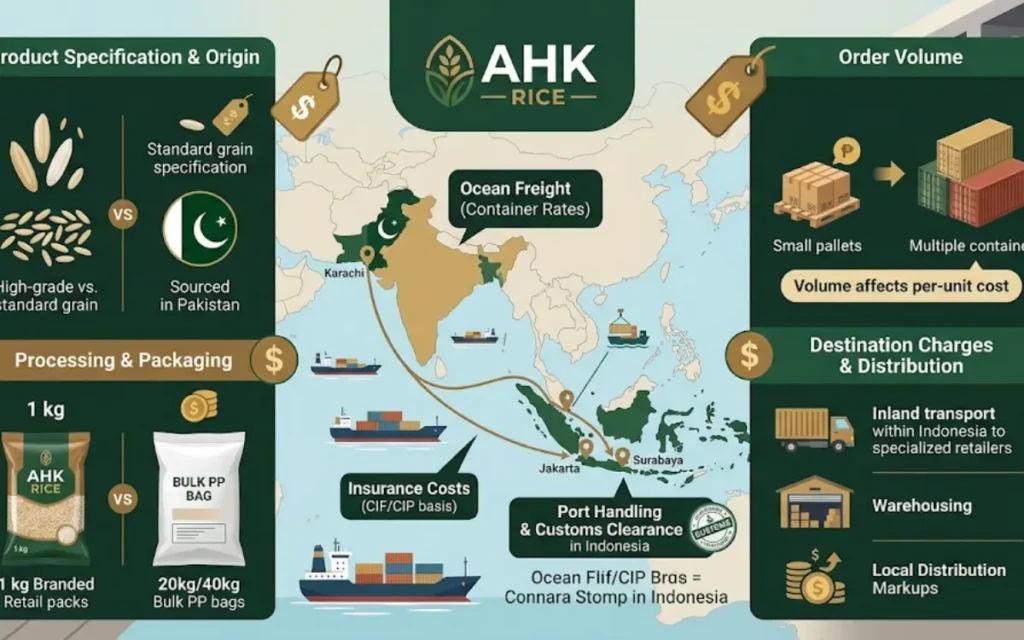
AHK Rice lists the Super Kernel Brown Rice Indonesia product with a quotation-based price rather than a fixed public dollar-per-ton rate.
This approach is appropriate for a specialty export product because brown rice pricing varies with specification and packaging. A buyer requesting 1 kg branded retail packs has a different production cost from a buyer ordering 20 kg or 40 kg bulk PP bags.
The cost structure should be evaluated as:
Product price + packaging + inspection + export documentation + inland transport + ocean freight + insurance where applicable + Indonesian destination costs + applicable duties/taxes = landed procurement cost.
The quotation should also state whether the price is FOB Karachi, CFR/CNF, or CIF. An FOB quotation excludes ocean freight and several destination-side costs. Comparing it directly with a CIF quotation produces a false price advantage.
Current Pakistan rice market data shows how widely export prices can vary by variety and grade. August 2026 indicative FOB Karachi prices for Pakistani rice range from lower-priced non-Basmati products to more than $1,100/MT for premium Basmati varieties. Super Kernel Brown Rice requires its own specification-based quotation rather than an assumption based on white Super Kernel or another Basmati grade.
For a retailer, the better purchasing model is a landed-cost sheet containing:
| Cost factor | What to confirm |
|---|---|
| Rice | Exact Super Kernel Brown specification |
| Quantity | MT and container loading plan |
| Packing | Retail or bulk format |
| Freight | Karachi to selected Indonesian port |
| Inspection | Supplier QC or third-party inspection |
| Documents | Invoice, packing list, origin and phytosanitary documents as applicable |
| Insurance | Included or separately arranged |
| Destination | Port, customs and inland delivery |
| Payment | T/T, L/C or agreed commercial terms |
| Validity | Quotation expiry date |
This structure gives the retailer a usable margin calculation. It also prevents freight or packaging from being hidden inside an apparently low product price.
What results can Indonesian specialty retailers expect?
A properly controlled supply program gives retailers measurable quality checkpoints, predictable procurement stages, retail-specific packaging options, and a repeat-order reference based on the approved sample rather than subjective descriptions of premium rice.
The first result is specification consistency. The retailer knows the grain profile, moisture target, broken percentage, processing method, and packaging before commercial production.
The second result is better shelf positioning. Super Kernel Brown Rice provides a visibly different product from polished white rice because the bran layer remains intact. This creates a clear basis for a health-oriented or premium specialty SKU.
The third result is procurement control. Sample approval happens before the container order. Inspection happens before shipment. Documentation is assembled before export. These checkpoints reduce avoidable specification disputes.
The fourth result is more accurate inventory planning. Indonesia route information provides an operational framework for estimating sea transit and full order lead time.
The fifth result is repeatability. Once the retailer approves a defined specification, the same specification can become the reference for subsequent purchase orders.
The supplier decision should therefore be based on five measurable criteria:
| Decision criterion | Pass condition |
|---|---|
| Product | Sample matches contracted specification |
| Cooking | Texture and performance meet retail positioning |
| Quality | Moisture and broken percentage meet tolerance |
| Logistics | Confirmed route supports inventory requirement |
| Commercial | Landed cost supports target retail margin |
This is also where the comparison stage becomes useful. Buyers evaluating grades, specifications, and supplier options can use the:
How Do Indonesian Buyers Compare Pakistan Super Kernel Brown Rice Options? before approving the final Super Kernel Brown Rice specification.
What should Indonesian retailers verify before placing the order?
Retailers should verify importer eligibility, current Indonesian rice-import requirements, HS classification, destination-port requirements, product specification, packaging and labelling, inspection scope, export documents, payment terms, and the exact Incoterm before issuing a binding purchase order.
The regulatory point requires particular attention in 2026. Indonesia’s import framework has changed during the year, and agricultural commodities remain subject to specific controls. The Ministry of Trade lists Regulation No. 11 of 2026 as an active amendment covering agricultural import policy, while Regulation No. 18 of 2026 is an active amendment to the broader import-policy framework.
The Indonesian importer should therefore confirm the current authorization route before shipment. Supplier documentation does not replace the importer’s Indonesian regulatory responsibilities.
The commercial file should normally contain the agreed invoice, packing list, Bill of Lading, Certificate of Origin, phytosanitary documentation where required, inspection documentation where contracted, and any additional certificates applicable to the shipment. AHK Rice identifies commercial invoice, packing list, Certificate of Origin, and phytosanitary documentation within its Indonesia export workflow.
The buyer should also make the approved sample part of the procurement record. This creates a direct reference between the product tested in Indonesia and the rice loaded for export.
How can an Indonesian specialty retailer get started?
Start by submitting one precise commercial specification, then approve the sample, confirm the landed-cost quotation, validate Indonesian import requirements, approve packaging, sign the contract, and book production against the same specification used during sampling.
A practical onboarding sequence is:
- Submit requirements: variety, grade, moisture, broken percentage, quantity, packing, destination port, and Incoterm.
- Receive specification and quotation: confirm product price, logistics assumptions, validity, and payment terms.
- Request the sample: test the dry grain and cooking performance.
- Approve the specification: record the exact accepted parameters.
- Confirm regulatory route: Indonesian importer verifies current import authorization and destination requirements.
- Approve packaging: select retail or bulk format and provide artwork where required.
- Issue the purchase order: match the PO to the approved sample.
- Production and inspection: produce, pack, inspect, and document the commercial batch.
- Book shipment: confirm Karachi departure and Indonesian destination.
- Track delivery: coordinate arrival, customs clearance, and final inland distribution.
AHK Rice’s published Super Kernel Brown Rice workflow follows this same commercial sequence from order confirmation through production, inspection, packaging, documentation, container loading, and shipping.
For a specialty retailer, the decision is straightforward: select Super Kernel Brown Rice when the target customer values a premium long-grain brown-rice format, then control the purchase through a written specification and representative sample. AHK Rice provides the product, sampling, packaging, and Indonesia-oriented export workflow required to move from evaluation to container supply.
AHK Rice should be evaluated on the complete commercial package rather than a single FOB number: specification accuracy, sample performance, packaging, inspection, shipping schedule, documentation, and landed cost. That approach gives Indonesian specialty retailers a defensible supplier decision and a repeatable procurement standard.
To confirm the current specification, sample arrangements, shipping plan, and landed quotation, submit the order requirements through request-a-quote.
Frequently Asked Questions
What is AHK Rice Super Kernel Brown Rice?
AHK Rice Super Kernel Brown Rice is a long-grain Pakistani brown rice with the bran layer retained. It is supplied for specialty retail, wholesale, and foodservice applications in Indonesia.
What specifications are available for Super Kernel Brown Rice?
The stated specification includes a grain length of approximately 7.0–7.4 mm, moisture up to 12.5%, broken grains around 2–3%, and an unpolished brown-rice finish.
Can Indonesian retailers request a sample before ordering?
Yes. AHK Rice provides samples for evaluation. The buyer can assess grain appearance, cooking performance, texture, aroma, and overall suitability before approving a commercial order.
How much does the Super Kernel Brown Rice sample cost?
The rice sample can be supplied free within the stated sample quantity. The buyer is responsible for courier charges and applicable phytosanitary costs. Laboratory testing is an additional cost when independently requested.
How long does shipping from Pakistan to Indonesia take?
Sea transit generally requires around 14–28 days depending on the Indonesian destination, vessel routing, and port conditions. Production, export documentation, and destination clearance add to the total procurement lead time.
Which Indonesian ports can receive Super Kernel Brown Rice?
The appropriate destination depends on the importer’s distribution network and shipping schedule. Jakarta/Tanjung Priok, Surabaya, and Belawan are relevant commercial port options, subject to the confirmed shipping route and importer requirements.