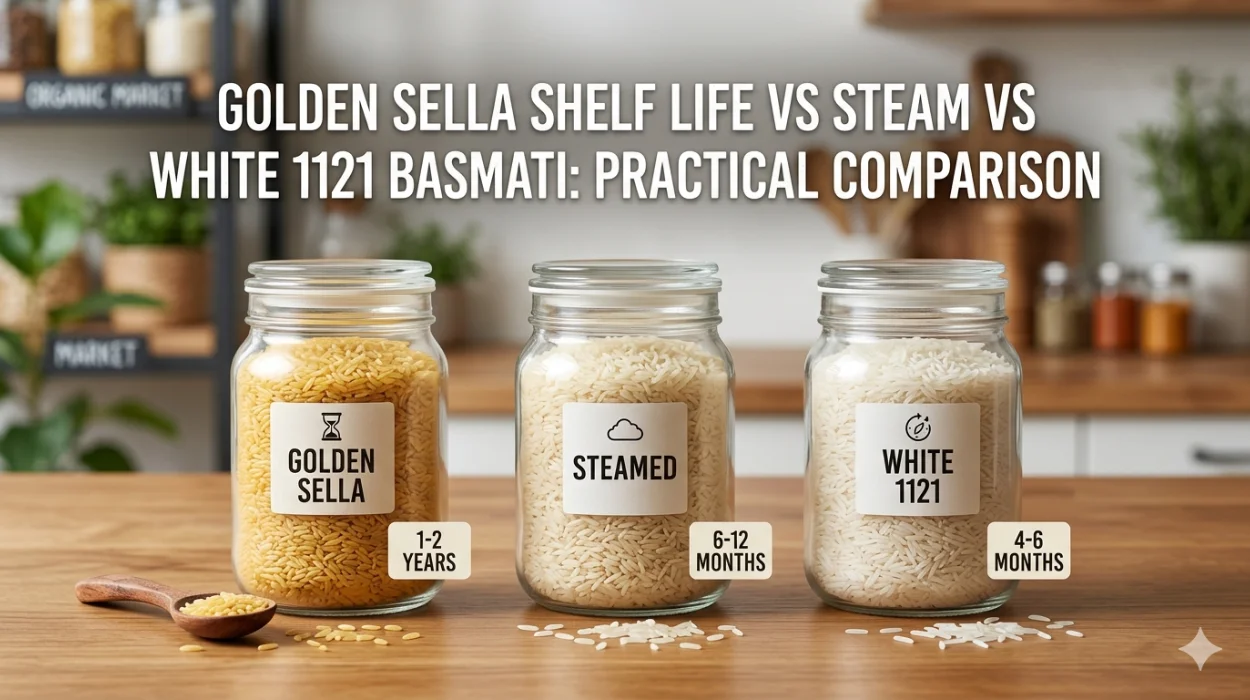
Golden Sella Shelf Life vs Steam vs White 1121 Basmati: Practical Comparison
Golden Sella Basmati lasts longer and is more storage‑stable than both steam‑treated and raw white 1121 Basmati, but each of these rice types serves different market and operational needs. Golden Sella offers the best balance of shelf life, transport durability, and consistent cooking performance, while steam‑treated 1121 gives a middle‑ground option, and raw white 1121 remains the premium choice for maximum aroma and flavour.
What are the available solutions when comparing 1121 Basmati shelf life?
The three main available solutions are Golden Sella 1121, steam‑treated 1121, and raw white 1121 Basmati, each with distinct shelf life, structural stability, and market positioning.
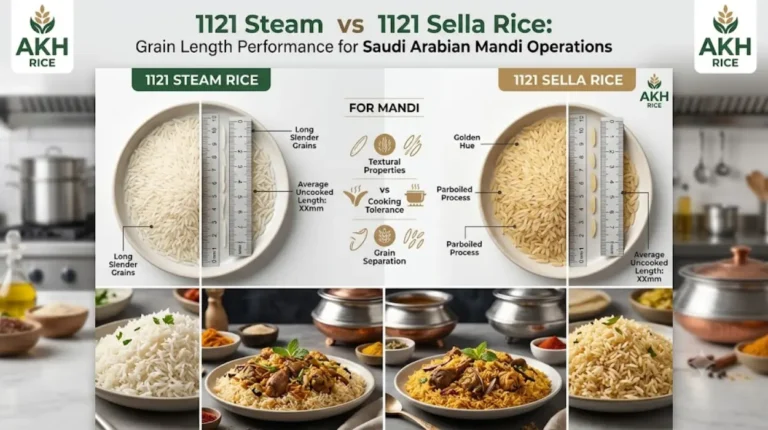
Golden Sella 1121 is a parboiled, partially precooked Basmati graded for long‑haul export. It undergoes full parboiling, drying, milling, and grading, which sets its starch and strengthens the grain. This structure allows for longer storage and better resistance to moisture migration and insect infestation compared with raw white Basmati.
Steam‑treated 1121 Basmati is a hybrid approach. The paddy or milled rice goes through a light steaming phase after milling but before packing, which partially sets the starch without producing the full golden colour of Golden Sella. This treatment improves texture stability and extends shelf life versus raw white 1121 but does not match the durability of fully parboiled Golden Sella.
Raw white 1121 Basmati is the least processed option. It is milled directly from husked paddy with minimal moisture alteration, preserving the highest level of aroma and fragrance. However, the absence of parboiling or steaming makes it more susceptible to ageing, flavour loss, and breakage over time, especially under non‑ideal storage conditions.
For buyers managing large‑volume import and long‑term inventory, these three types represent the core Basmati‑shelf‑life strategies. Each one can be framed as a solution: Golden Sella for maximising shelf life and reducing logistics risk, steam‑treated 1121 for balancing stability and premium perception, and raw white 1121 for prioritising aroma and culinary quality.
A good starting point to understand how Golden Sella fits into the broader Basmati export landscape is the exported parboiled Basmati grade from Pakistan, which covers production, grades, and key technical advantages.
How do Golden Sella, steam‑treated, and white 1121 Basmati compare technically?
Golden Sella 1121 has the longest shelf life, lowest breakage, and highest transport durability, while steam‑treated 1121 sits in the middle, and raw white 1121 excels in aroma but has the shortest storage window.
To compare these options systematically, seven technical attributes are useful:
- Processing type (parboiled, steam‑treated, or raw)
- Typical shelf life (months)
- Resistance to breakage
- Cooking consistency
- Aroma retention
- Moisture‑stability under long‑term storage
- Suitability for long‑haul export
A practical comparison table can make these differences clear:
| Feature | Golden Sella 1121 (Parboiled) | Steam‑treated 1121 | Raw White 1121 |
|---|---|---|---|
| Processing type | Fully parboiled, precooked | Milled, then steamed | Raw milled Basmati |
| Typical shelf life | 14–18 months under controlled conditions | 10–14 months | 8–12 months |
| Resistance to breakage | Very high | Moderate | Low |
| Cooking consistency | Very stable, low mushiness | Fairly stable | Variable, depends on cooking mastery |
| Aroma retention | Moderate‑high, slightly muted | High | Highest (least altered) |
| Moisture‑stability in storage | Excellent | Good | Poor |
| Suitability for long‑haul export | Ideal | Suitable | Risky |
This table shows why Golden Sella 1121 dominates long‑term export contracts. The fully parboiled grain structure minimises grain fracture, maintains form across long sea‑transit times, and offers predictable cooking performance even after months in storage. Steam‑treated 1121 offers a compromise, preserving more aroma than Golden Sella while still gaining some moisture‑stability benefits. Raw white 1121 remains the top‑choice for premium restaurant and gourmet‑pack buyers who prioritise aroma and freshness over long‑term stock‑management.
How do Golden Sella and 1121 Basmati perform in key market regions?
In the Gulf Cooperation Council (GCC) and South Asia, buyers prioritise long shelf life, stable cooking, and logistics durability, which makes Golden Sella 1121 the dominant choice, while in Europe and luxury retail markets, raw white 1121 Basmati is preferred for superior aroma and texture.
In the GCC region, demand centres around 11–25‑kg consumer packs used in households, catering, and food‑service chains. Golden Sella 1121 accounts for a high share of Basmati imports into Saudi Arabia, UAE, Kuwait, and Qatar, where distributors require rice that can sit in warehouses for 12–18 months without quality loss. These markets accept a slight reduction in aroma in exchange for consistent elongation, low breakage, and minimal clumping.
Price per metric tonne reflects this demand. In a standard 2025–2026 export cycle, Golden Sella 1121 typically trades at USD 780–850/MT, steam‑treated 1121 around USD 820–880/MT, and raw white 1121 Basmati at USD 900–980/MT depending on harvest quality and market season. The higher value of raw 1121 comes from its status as the least altered, premium option, but it also carries higher storage and handling risk.
In Europe, the preference shifts. Supermarkets, private‑label chains, and high‑end restaurants often choose raw white 1121 or steam‑treated 1121, because Italian, German, and UK‑based buyers place more emphasis on aroma and cooking finesse. In this context, Golden Sella is used more in bulk‑service segments, such as catering‑line rice and ready‑to‑cook meals, where stability and yield matter more than subtle fragrance.
For buyers who balance GCC‑style stability with European‑style quality, steam‑treated 1121 can be the pragmatic choice. It retains more aroma than Golden Sella, while still offering longer shelf life than raw white 1121. This middle‑grade solution suits importers who supply both retail supermarkets and institutional kitchens, needing one SKU that can perform across multiple channels.
Which method works best for different operational cases?
Golden Sella 1121 works best for large‑volume importers, long‑haul shipping, and multi‑year inventory plans, while steam‑treated 1121 suits mid‑sized buyers who want some shelf life without sacrificing aroma, and raw white 1121 is optimal for short‑turnover, high‑touch markets.
Large‑scale GCC or African distributors benefit most from Golden Sella 1121, because their trade model depends on steady 6–18‑month stock rotations. These buyers need rice that arrives in good condition after 4–6 weeks at sea, then remains stable in warehouse conditions with fluctuating temperatures. In this scenario, Golden Sella’s 14–18‑month usable shelf life and low breakage provide measurable savings in waste and re‑inspection.
Steam‑treated 1121 fits best for importers supplying European grocery chains and Middle‑Eastern hotels that want to maintain brand differentiation. For example, a Turkish‑based distributor supplying both Istanbul supermarkets and Dubai hotel kitchens may use Golden Sella 1121 for bulk catering and steam‑treated 1121 for branded 1–2‑kg bags that carry a “premium Basmati” label. The steam‑treated option offers a perceptible aroma edge over Golden Sella without exposing the buyer to the high‑risk storage profile of raw white 1121.
Raw white 1121 excels in short‑rotation settings where rice turns over in 3–6 months. Fine‑dining restaurants, specialty rice shops, and private‑label brands that rotate stock frequently minimise the impact of ageing and loss of aromatic compounds. In these cases, the higher price per metric tonne is justified by customer expectations around fresh, delicate flavour. Buyers who cannot guarantee tight stock control should avoid raw white 1121, because the premium quickly erodes if the rice sits unused for 9–12 months.
What are the pros and cons of each 1121 Basmati type?
Golden Sella 1121 offers the strongest logistical and shelf‑life advantages but with slightly muted aroma, steam‑treated 1121 improves aroma and texture at the cost of lower shelf life, and raw white 1121 provides the best sensory profile with the highest operational risk.
Advantages of Golden Sella 1121 include:
- Shelf life of 14–18 months under controlled conditions, compared with 8–12 months for raw 1121.
- Very low breakage during milling, transport, and repackaging, which improves yield and reduces rejections at destination.
- High moisture stability that reduces the risk of insect infestation, chalkiness, and oxidation in hot‑season container storage.
Disadvantages of Golden Sella 1121 include:
- Aroma that is perceptibly lower than raw white 1121, especially when processed too intensely.
- A golden colour and texture that some gourmand customers prefer less than the whiter, softer look of raw 1121.
Steam‑treated 1121’s pros are:
- Aroma that is closer to raw 1121, making it suitable for premium‑positioned brands.
- Improved cooking consistency versus raw 1121, because the light steaming sets the starch to some degree.
Its cons include:
- Shelf life that is better than raw 1121 but not equal to Golden Sella, so it is less ideal for very long‑term inventory.
- Processing complexity that can vary by factory, leading to inconsistency if not tightly controlled.
Raw white 1121’s strengths are:
- Maximum aromatic intensity and the most “authentic” Basmati experience.
- Simple processing that preserves grain structure with minimal intervention.
Its weaknesses are:
- Sensitivity to humidity and temperature, which can cause flavour loss, yellowing, and breakage within 8–12 months.
- Higher rejection risk in long‑haul exports if the shipper does not manage storage and moisture properly.
What decision‑framework should buyers use when choosing 1121 types?
Buyers should use a decision framework that weighs shelf life, market preference, price per metric tonne, logistics profile, and brand positioning before selecting between Golden Sella, steam‑treated, or raw white 1121 Basmati.
A five‑row decision‑framework table can guide this choice:
| Decision factor | Recommendation for Golden Sella 1121 | Recommendation for Steam‑treated 1121 | Recommendation for Raw White 1121 |
|---|---|---|---|
| Stock‑holding time required | 12–18 months | 6–12 months | ≤ 6 months |
| Target market aroma sensitivity | Low–medium (GCC, bulk) | Medium–high (mid‑premium) | Very high (gourmet, restaurant) |
| Price tolerance per metric tonne | Lower to mid‑range | Mid‑range | Highest |
| Logistics risk (shipping duration, humidity) | Very low transportation sensitivity | Low–medium | High sensitivity |
| Brand image (premium vs. value) | Value / reliability branding | Balanced premium branding | High‑premium branding |
In practice, this framework means that if a distributor in the UAE aims to import 1,000 MT of 1121 Basmati that must last 15 months in a warehouse with frequent power‑outage‑driven temperature swings, Golden Sella 1121 is the logical choice. If a UK‑based specialty food company wants to differentiate its Basmati by emphasising aroma and is willing to manage tight stock rotations, it should prioritise raw white 1121. Steam‑treated 1121 sits between these extremes, giving importers a way to align modest price‑premiums with improved shelf life and more consistent cooking.
For buyers who need granular export‑pricing guidance, including FOB, CNF, and CIF components for full‑container‑load shipments, the AHK Rice 1121 golden sella FOB CNF CIF container pricing provides a structured breakdown of how each cost layer affects total landed value per metric tonne.