Pakistan Vietnam Rice Trade Dynamics and Emerging Opportunities in 2026
Pakistan can expand its Vietnam rice trade through specialty Basmati, specification-led sourcing, and reliable export documentation. Here is why: Vietnam has expressed interest in increasing Pakistani rice imports, while 2026 shipment data confirms an active Pakistan-to-Vietnam trade lane.
Vietnam remains a major rice producer, so Pakistani suppliers should not compete only on commodity volume. The stronger opportunity sits in differentiated rice varieties, premium foodservice, specialty distribution, and buyers seeking non-domestic grain profiles.
For Vietnamese importers evaluating Pakistani supply, the guide to sourcing non-domestic rice varieties from Pakistan establishes the sourcing process. The commercial decision then depends on variety, specifications, compliance, landed cost, and shipment reliability.
What is the best solution for sourcing Pakistani rice in Vietnam?
The best solution is specification-led sourcing of 1121, Super Kernel, and 1509 with pre-shipment testing, compliant documents, buyer-approved samples, and scheduled container logistics from Pakistan to Vietnam. This model reduces quality uncertainty and gives importers a measurable basis for supplier selection.
Vietnamese buyers should begin with the intended application. Premium Basmati fits specialty retail, restaurants, hotels, and foodservice. 1509 fits buyers seeking long grain performance with stronger cost control. Super Kernel provides aromatic Pakistani Basmati positioning for premium applications.
AHK Rice supplies Pakistani Basmati varieties through a controlled sourcing and processing workflow. The commercial specification should state grain length, broken percentage, moisture, processing type, packing format, quantity, destination port, and Incoterm before quotation.
The comparison of Pakistani rice grades gaining trial adoption in Vietnam helps buyers narrow the specification before requesting samples.
Vietnamese import demand for Basmati remains comparatively specialized. Volza recorded 189 Basmati Rice shipments into Vietnam during July 2024 to June 2025, with Pakistan among the leading exporting countries.
Pakistan’s government also identified Vietnam as a market with potential for increased Pakistani rice imports during bilateral trade discussions in 2025. Both countries subsequently launched negotiations for a Preferential Trade Agreement.
This makes specification-led trial orders more practical than attempting immediate commodity-scale competition.
Why choose AHK Rice for Vietnam rice sourcing?

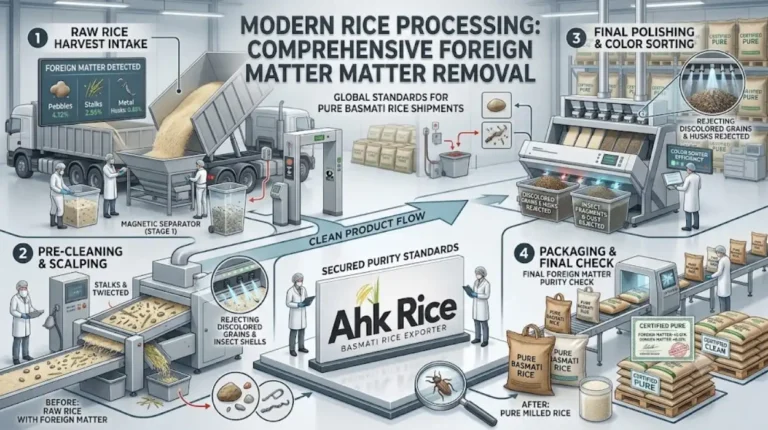
AHK Rice combines Pakistani Basmati sourcing, milling, grading, sorting, packaging, quality verification, and export coordination into one supplier workflow for Vietnamese importers. The benefit is one commercial specification from sample approval through container loading.
AHK Rice is a Pakistani Basmati rice exporter based in Punjab. AHK Rice supplies 1121, Super Kernel, and 1509 varieties for international buyers. The service covers sourcing, processing, grading, inspection, packaging, and export coordination.
The first product decision should identify the appropriate grain. 1121 targets premium long-grain positioning. Super Kernel targets aromatic Basmati demand. 1509 targets cost-conscious volume applications.
AHK Rice can prepare specifications around:
- Grain length: 1121, Super Kernel, or 1509 according to buyer requirement.
- Moisture control: Commercial limits agreed before production.
- Broken percentage: Grade-specific tolerance confirmed before shipment.
- Colour sorting: Optical sorting for cleaner visual presentation.
- Packaging: Retail, foodservice, bulk, or private-label formats.
- Documentation: Export and quality documents prepared for the shipment.
Vietnam’s regulatory framework makes documentation important. Vietnam’s Trade Portal identifies food-safety inspection, labeling, traceability, and imported-food controls under Decree 15/2018/ND-CP.
Plant products also fall within Vietnam’s regulated plant-quarantine framework. Rice and other grains are listed among plant-quarantine articles, making phytosanitary compliance part of import planning.
AHK Rice therefore treats the commercial specification and compliance file as one sourcing package rather than separate activities.
With supplier capability established, the next decision is the measurable result a Vietnamese buyer can expect.
What results can Vietnamese importers expect?
Vietnamese importers can expect a controlled sample-to-container process, clearer quality specifications, predictable logistics planning, and lower procurement uncertainty through approved samples and shipment documentation. Results depend on the selected grade, order quantity, destination port, inspection requirements, and agreed Incoterm.
AHK Rice starts with the buyer specification. The buyer selects the rice variety, processing type, packaging, quantity, and destination. A commercial quotation then reflects the selected specification rather than a generic rice price.
The sample stage provides the main quality checkpoint. A buyer can assess appearance, aroma, grain uniformity, cooking performance, broken percentage, and packaging before committing to commercial volume.
A practical sample workflow is:
- Share the specification — Provide variety, grade, packing, quantity, destination, and intended application.
- Select the sample — Choose the proposed grade and processing type.
- Prepare the sample — AHK Rice prepares the requested rice sample for buyer evaluation.
- Arrange courier delivery — The buyer pays actual international courier charges and applicable phytosanitary costs.
- Test the sample — Assess grain appearance, aroma, cooking performance, and agreed quality parameters.
- Approve the specification — Confirm the final commercial specification before production.
- Confirm the order — Agree quantity, price, Incoterm, packing, and shipment schedule.
- Inspect the cargo — Verify the finished shipment against the approved specification.
- Load the container — Dispatch the approved cargo through the agreed export route.
For sampling, AHK Rice can offer up to 20 kg of Super Kernel Basmati for sampling, while the buyer covers courier delivery and applicable phytosanitary charges.
Shipping planning should separate ocean transit from customs clearance. Commercial shipping references for Karachi-to-Vietnam routes indicate approximately 14–20 days to Ho Chi Minh City or Hai Phong, depending on routing and carrier schedules.
For southern Vietnam, Ho Chi Minh City is the relevant planning point. For northern distribution, Hai Phong provides the alternative gateway. Buyers should add customs, inspection, port handling, and inland delivery time to the ocean transit estimate.
With the expected outcome defined, pricing becomes the next commercial decision.
What affects Pakistani rice pricing for Vietnam?
Vietnam rice pricing depends on rice variety, grain length, broken percentage, moisture, processing, packaging, order volume, inspection, destination port, freight, and Incoterm rather than one fixed market price. A precise quotation therefore requires the complete buyer specification.
AHK Rice prices each order against the commercial specification. A 1121 premium specification carries a different cost structure from a volume-oriented 1509 specification. Super Kernel pricing also changes with grade, processing, packaging, and quantity.
Freight creates another major variable. FOB Karachi separates the rice price from international freight. CFR or CIF moves more logistics responsibility into the supplier quotation. Vietnamese buyers should compare quotations using the same Incoterm.
A practical cost structure includes:
| Cost factor | Buyer decision |
|---|---|
| Rice variety | 1121, Super Kernel, or 1509 |
| Processing | White, Steam, Sella, or agreed specification |
| Quality | Grain length, moisture, broken percentage |
| Packing | Bulk, retail, or private label |
| Quantity | Trial, partial container, or full container |
| Inspection | Buyer, third-party, or agreed inspection |
| Freight | FOB, CFR, or CIF |
| Destination | Ho Chi Minh City or Hai Phong |
Vietnamese buyers should also budget for import-side inspection and clearance. Vietnam’s normal imported-food inspection procedure can require documentation before or upon arrival, with authorities reviewing the submitted file and issuing an import compliance result.
The commercial objective is not simply the lowest FOB price. The better decision is the lowest landed cost that meets the approved specification and regulatory requirements.
AHK Rice gives buyers a structured basis for comparing those variables before committing to a container.
How can Vietnamese buyers get started with AHK Rice?
Vietnamese buyers should start with a written rice specification, request a matching sample, approve quality parameters, compare the landed quotation, and then confirm the commercial order and shipment schedule. This sequence turns an exploratory inquiry into a controlled procurement decision.
The first step is specification. State the preferred variety, processing type, grain length, broken percentage, moisture target, packaging, quantity, destination port, and Incoterm.
The second step is sampling. AHK Rice prepares the agreed sample so the importer can evaluate the physical and cooking characteristics before commercial production.
The third step is verification. Confirm the final COA requirements, inspection arrangements, phytosanitary documentation, packaging artwork, and shipping documents before dispatch.
The fourth step is shipment planning. Karachi-to-Vietnam ocean transit commonly requires around 14–20 days, while customs and port procedures require additional planning.
The fifth step is commercial approval. Confirm the final price, payment terms, quantity, packing, destination, and shipment window in the purchase documentation.
AHK Rice provides a single export workflow from sourcing through loading. AHK Rice can therefore support buyers that need a trial order before expanding to recurring container volumes.
The opportunity is strongest for importers that have a defined specialty-rice application. Vietnamese buyers can use Pakistani Basmati to add differentiated grain characteristics without treating the product as a direct replacement for Vietnam’s domestic rice supply.
Pakistan’s broader export position also supports the opportunity. Pakistan exported 489,000 tonnes of rice in December 2025, compared with Vietnam’s 387,000 tonnes that month, according to trade data reported by Dawn.
For Vietnamese buyers, the decision should therefore focus on product fit, documented quality, landed economics, and supplier execution rather than origin alone.
For a Vietnam-specific quotation and sample specification, request a commercial rice quotation from AHK Rice.
Frequently Asked Questions
Does Vietnam import rice from Pakistan?
Yes, Vietnam imports Pakistani rice, including Basmati varieties.
Recent shipment data confirms an active Pakistan-to-Vietnam trade lane.
Pakistan was among the leading Basmati exporting countries recorded for Vietnam.
Vietnam has also expressed interest in increasing Pakistani rice imports.
The opportunity remains focused on differentiated and specialty rice segments.
Which Pakistani rice varieties suit Vietnam?
1121 Basmati suits premium retail, restaurants, and foodservice applications.
Super Kernel suits buyers seeking aromatic Pakistani Basmati.
1509 suits cost-conscious buyers seeking long-grain performance.
The final grade should match the buyer’s application and target price.
AHK Rice can prepare samples against the selected commercial specification.
How long does Pakistani rice take to reach Vietnam?
Ocean transit from Karachi to Vietnam commonly takes around 14–20 days.
Ho Chi Minh City and Hai Phong are key destination gateways.
Actual transit depends on carrier, routing, and port conditions.
Customs, inspection, and inland delivery require additional time.
Buyers should therefore plan total landed delivery beyond ocean transit.
What documents are important for Vietnamese rice imports?
Commercial documents include the invoice, packing list, and bill of lading.
Quality documentation can include a certificate of analysis and inspection report.
Phytosanitary documentation supports plant-quarantine compliance.
Vietnam also applies imported-food safety and inspection procedures.
The final document set should match the confirmed shipment requirements.
How does the AHK Rice sample process work?
The buyer first submits the required rice specification.
AHK Rice then prepares the selected grade for evaluation.
The buyer pays applicable courier and phytosanitary sampling costs.
The buyer tests the sample before approving commercial production.
AHK Rice then proceeds toward quotation, order confirmation, inspection, and shipment.