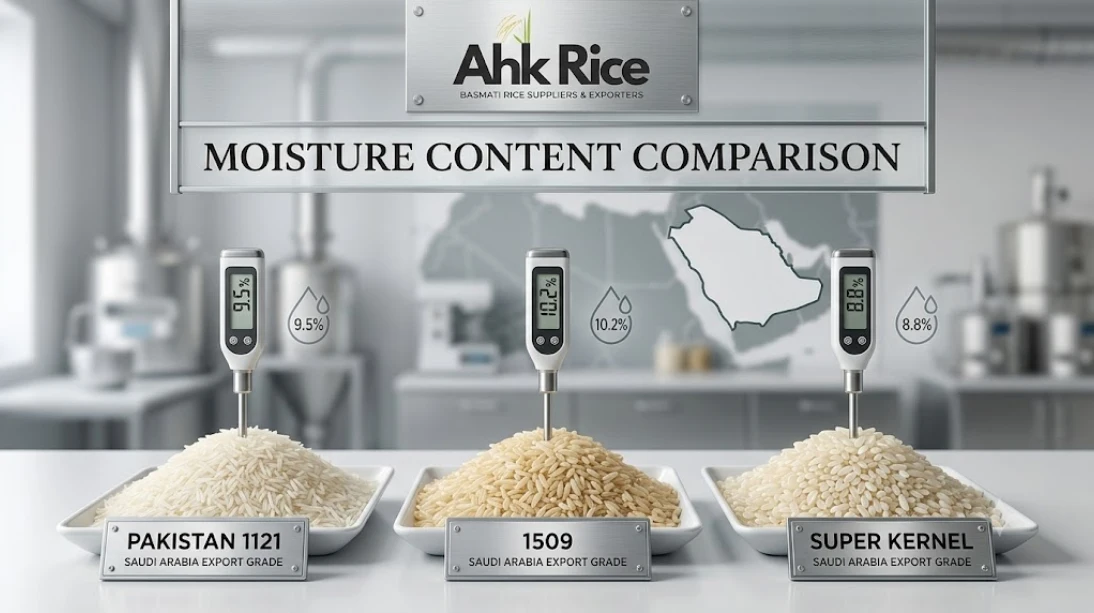
Moisture Content Comparison Across Pakistan 1121, 1509, and Super Kernel Rice for Saudi Arabia
Pakistan 1121 Basmati, 1509 Basmati, and Super Kernel Basmati all meet Saudi Arabian import requirements, but 1121 with controlled moisture offers the strongest balance of storage stability, grain elongation, cooking performance, and long-distance shipment reliability, while 1509 and Super Kernel serve different commercial objectives depending on buyer priorities.
Saudi Arabian rice importers evaluate much more than grain appearance. Moisture percentage directly influences storage life, aroma retention, cooking consistency, breakage during transportation, and compliance with buyer specifications. Before comparing rice varieties, it helps to understand how lower and controlled moisture improves export quality, as explained in our guide about:
Why premium Saudi importers prioritize properly dried Pakistani Basmati rice.
Saudi Arabia remains one of Pakistan’s largest premium Basmati destinations in 2026. Importers purchase rice for supermarkets, wholesalers, food service distributors, luxury hospitality groups, and private-label brands. Each segment prefers different grain characteristics, but all require moisture levels that preserve quality throughout ocean transportation and warehouse storage.
The three primary Pakistani varieties exported to Saudi Arabia are:
- 1121 Basmati Rice
- 1509 Basmati Rice
- Super Kernel Basmati Rice
Each variety is milled, graded, polished, tested, and packed according to export specifications before shipment.
What moisture level is considered suitable for Pakistan Basmati rice exported to Saudi Arabia?
Moisture content between approximately 12% and 13% delivers the most reliable export performance for Saudi Arabia because it minimizes fungal growth, protects aroma, improves storage stability, reduces grain stress during transport, and maintains consistent cooking quality throughout long international supply chains from Pakistan.
Moisture content represents the percentage of water naturally remaining inside the rice kernel after harvesting, drying, milling, and final conditioning.
Export moisture differs from field moisture.
Freshly harvested paddy normally contains over 20% moisture. Modern drying systems gradually reduce this level before milling begins. The drying process protects internal grain structure instead of simply removing water quickly.
Saudi importers generally request moisture specifications that support:
- Long warehouse storage
- Stable cooking quality
- Reduced insect activity
- Lower microbial risks
- Better packaging performance
If moisture becomes too high, several problems appear.
Rice absorbs humidity inside containers during long sea voyages.
Condensation increases.
Grains soften.
Shelf life decreases.
Broken kernels increase during handling.
Conversely, excessively low moisture also creates problems.
Very dry rice becomes brittle during polishing, grading, transportation, and loading.
Therefore, exporters target controlled moisture instead of simply achieving the lowest possible percentage.
How do Pakistan 1121, 1509, and Super Kernel compare in moisture-related performance?
Although all three varieties can meet Saudi import standards, 1121 generally provides the strongest moisture stability and grain integrity, 1509 delivers efficient commercial performance with faster production cycles, while Super Kernel balances aroma, appearance, and traditional premium market expectations across multiple buyer segments.
Each variety possesses different grain dimensions, starch composition, kernel strength, and aging behavior.
These characteristics influence moisture management throughout processing.
Moisture Specification Comparison
| Specification | 1121 Basmati | 1509 Basmati | Super Kernel |
|---|---|---|---|
| Typical Export Moisture | 12–13% | 12–13% | 12–13% |
| Grain Length | Extra Long | Long Extra Fine | Long Slender |
| Cooking Elongation | Highest | High | High |
| Aroma Retention | Excellent | Good | Excellent |
| Storage Stability | Excellent | Very Good | Very Good |
| Breakage Resistance | Excellent | Very Good | Good |
| Saudi Premium Market Preference | Highest | Growing | Established |
The moisture percentage alone does not determine export quality.
The rice variety determines how the grain reacts to moisture during:
- Milling
- Polishing
- Storage
- Container transportation
- Cooking
For example, 1121 maintains exceptionally long grain expansion after cooking when moisture remains properly controlled.
1509 performs well in commercial distribution where buyers prioritize value alongside quality.
Super Kernel remains highly preferred among consumers seeking traditional aromatic Basmati characteristics.
Which moisture management solutions are available during rice processing?
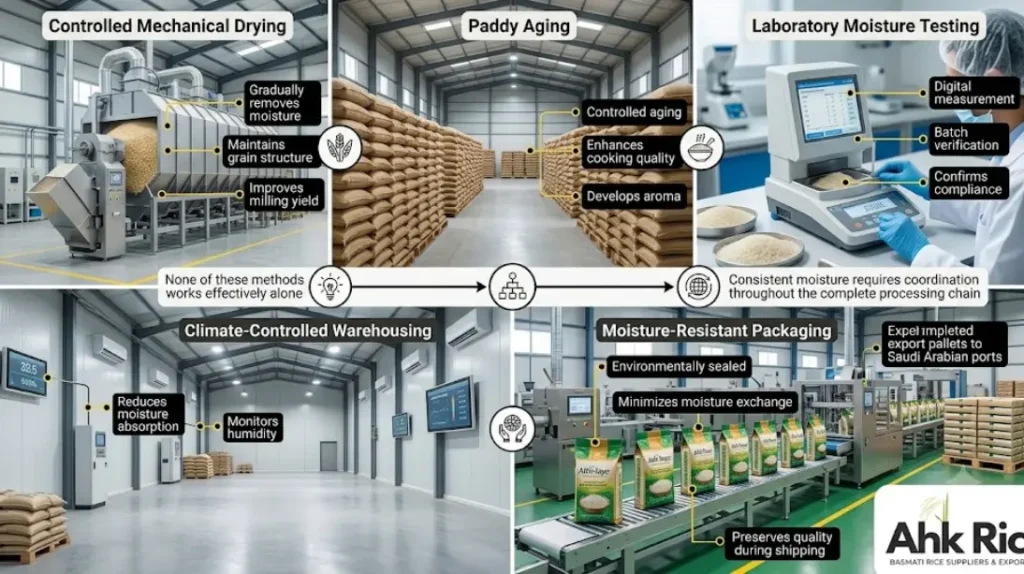
Modern Pakistani exporters combine scientific drying, controlled storage, laboratory testing, warehouse humidity management, and moisture-resistant packaging to achieve consistent export specifications instead of depending on a single processing stage or isolated quality inspection before shipment.
Moisture control begins immediately after harvesting.
Several integrated solutions work together.
Controlled Mechanical Drying
Mechanical drying gradually removes moisture without damaging grain structure.
Uniform drying prevents internal stress.
This improves milling yield.
Paddy Aging
Many premium Basmati lots undergo controlled aging.
Proper aging improves:
- Cooking quality
- Aroma development
- Moisture balance
- Grain hardness
Laboratory Moisture Testing
Every production batch can be tested using calibrated digital moisture analyzers.
Laboratory testing confirms compliance before packing.
Climate-Controlled Warehousing
Warehouses reduce unnecessary moisture absorption.
Humidity monitoring protects grain consistency before container loading.
Moisture-Resistant Packaging
Export packaging minimizes environmental moisture exchange.
Proper sealing helps preserve quality during shipping to Saudi Arabian ports.
None of these methods works effectively alone.
Consistent moisture requires coordination throughout the complete processing chain.
How do different moisture control approaches compare?
Integrated moisture management consistently outperforms isolated drying because combining controlled drying, laboratory verification, humidity-controlled storage, and export-grade packaging delivers more stable grain quality than relying on any individual processing method by itself across international supply chains.
Different processing strategies produce different outcomes.
| Approach | Accuracy | Cost Efficiency | Storage Performance | Export Reliability | Suitable For |
|---|---|---|---|---|---|
| Natural Sun Drying | Moderate | High | Moderate | Moderate | Local markets |
| Mechanical Drying Only | Good | Good | Good | Good | Standard exports |
| Drying + Laboratory Testing | Very Good | Very Good | Very Good | Very Good | Regular importers |
| Full Moisture Management System | Excellent | Excellent Long-Term | Excellent | Excellent | Premium Saudi buyers |
| Continuous Monitoring Throughout Processing | Highest | Highest Value | Highest | Highest | Premium branded products |
The most reliable exporters combine all processing stages.
Each stage validates the previous one.
Quality becomes predictable instead of variable.
Which Pakistani rice variety suits different Saudi market segments?
No single variety serves every Saudi importer equally because supermarkets, hospitality businesses, wholesalers, food manufacturers, and premium retail brands prioritize different balances of grain length, aroma, cooking expansion, moisture stability, pricing, and consumer expectations.
Saudi Arabia contains multiple rice distribution channels.
Each values different product characteristics.
Premium Retail Brands
Preferred Grade:
- 1121 Extra Long Grain
Reason:
Exceptional grain length.
Strong presentation.
Excellent cooking expansion.
Hospitality Industry
Preferred Grade:
- 1121 Steam
- Super Kernel
Reason:
Consistent cooking.
Reliable serving appearance.
Lower cooking losses.
Wholesale Distribution
Preferred Grade:
- 1509 Steam
- Super Kernel
Reason:
Competitive pricing.
Stable availability.
Commercial cooking performance.
Food Manufacturing
Preferred Grade:
- 1509
Reason:
Efficient processing.
Consistent grain size.
Reliable production planning.
Traditional Premium Stores
Preferred Grade:
- Super Kernel
Reason:
Recognized aroma.
Traditional consumer preference.
Balanced pricing.
How do Saudi market preferences differ across rice grades?
Saudi buyers select rice grades according to customer expectations, retail positioning, cooking applications, and pricing strategies rather than choosing solely on grain length, making market segmentation an essential purchasing consideration for importers in 2026.
The Saudi market has become increasingly segmented.
Premium retailers increasingly favor extra-long grains.
Hotels focus on cooking consistency.
Wholesalers evaluate inventory turnover.
Food service companies prioritize dependable batch performance.
Regional Preference Comparison
| Market Region | Preferred Variety | Main Purchase Priority | Estimated Price (USD/MT 2026)* | Typical Shelf Life |
|---|---|---|---|---|
| Central Saudi Arabia | 1121 | Premium retail quality | 1,250–1,550 | Up to 24 months |
| Western Saudi Arabia | Super Kernel | Hospitality & retail | 1,100–1,400 | Up to 24 months |
| Eastern Saudi Arabia | 1509 | Commercial distribution | 950–1,250 | Up to 24 months |
*Prices vary according to grade, processing type, certification, packaging, freight, and international market conditions.
Proper moisture control supports the full shelf life when storage conditions remain suitable.
What are the advantages and disadvantages of each variety?
Every rice variety offers measurable strengths and trade-offs because premium grain quality, pricing, cooking characteristics, export consistency, and target market suitability differ according to production objectives rather than one universal quality standard.
1121 Basmati
Advantages
- Exceptional grain length
- Excellent elongation
- Strong export reputation
- Superior moisture stability
- High premium value
Limitations
- Higher purchase price
- Premium market focus
1509 Basmati
Advantages
- Competitive pricing
- Reliable production
- Good cooking performance
- Efficient commercial distribution
Limitations
- Less elongation than 1121
- Lower premium positioning
Super Kernel
Advantages
- Traditional aroma
- Attractive appearance
- Balanced pricing
- Strong consumer familiarity
Limitations
- Slightly lower grain length than 1121
- Market positioning varies by buyer segment
For example, a luxury supermarket brand launching premium packaged rice often selects 1121 because visual presentation strongly influences purchasing decisions. A regional food distributor serving restaurants may instead prioritize 1509 due to its balance between quality and commercial efficiency. Traditional grocery retailers frequently continue choosing Super Kernel because long-established consumers recognize its aroma and cooking characteristics.
What decision factors should Saudi importers evaluate before selecting a rice variety?
Successful purchasing decisions depend on matching moisture-controlled rice specifications with commercial objectives, distribution channels, consumer expectations, inventory turnover, and long-term supply consistency instead of evaluating price or grain appearance independently.
The following framework simplifies variety selection.
Decision Framework
| Decision Factor | 1121 | 1509 | Super Kernel |
|---|---|---|---|
| Premium Branding | Excellent | Good | Very Good |
| Budget Efficiency | Good | Excellent | Very Good |
| Cooking Presentation | Excellent | Very Good | Very Good |
| Long-Term Storage | Excellent | Very Good | Very Good |
| Retail Consumer Appeal | Excellent | Good | Excellent |
Importers should also evaluate:
- Required moisture specification
- Grain aging period
- Packaging format
- Laboratory reports
- Container loading practices
- Export certifications
- Destination climate
- Inventory turnover speed
These factors influence overall product performance after arrival in Saudi Arabia.
Selecting between Pakistan 1121, 1509, and Super Kernel rice depends on commercial objectives rather than a single quality indicator. Controlled moisture between approximately 12% and 13%, supported by scientific drying, laboratory verification, proper storage, and suitable packaging, enables all three varieties to perform reliably during export to Saudi Arabia. Among them, 1121 remains the preferred choice for premium retail brands, 1509 offers excellent commercial value, and Super Kernel continues to satisfy buyers seeking traditional aromatic Basmati characteristics. Buyers evaluating long-term suppliers should also understand how exporters maintain these moisture specifications throughout production and shipment by reviewing our guide on:
Consistent moisture standards for premium Pakistan Basmati rice supply.
Frequently Asked Questions
What is the ideal moisture content for Pakistan Basmati rice exported to Saudi Arabia?
The ideal export moisture content is typically 12%–13%, providing the best balance between storage stability, cooking quality, and transportation safety.
Does lower moisture always mean better rice quality?
No. Moisture that is too low can make rice brittle and increase grain breakage during milling and transport.
How is moisture content measured before export?
Exporters use calibrated digital moisture meters and laboratory testing to verify each batch meets buyer specifications.
Which rice variety has the best moisture stability during export?
Pakistan 1121 Basmati Rice generally offers the highest moisture stability due to its grain structure and aging characteristics.
Is 1509 Basmati suitable for long-distance shipping to Saudi Arabia?
Yes. When processed and stored correctly, 1509 Basmati performs reliably during sea shipment and long-term storage.
Why is Super Kernel still popular among Saudi buyers?
Super Kernel combines traditional Basmati aroma, attractive appearance, and dependable cooking performance at a competitive price.
What moisture control methods are used during rice processing?
Modern exporters use controlled drying, laboratory testing, humidity-controlled storage, and moisture-resistant packaging.
Why is laboratory moisture testing important?
It confirms every production batch complies with customer specifications before packaging and shipment.
Can packaging affect rice moisture levels?
Yes. High-quality export packaging helps protect rice from external humidity during transportation and storage.