1121 Sella vs Non-Sella Basmati: Shelf Life and Storage Comparison
1121 Sella Basmati lasts longer and stores more reliably than non-sella basmati. Here is why: parboiling hardens the kernel, reduces breakage, and stabilizes moisture for extended storage across climates.
In bulk export decisions, storage durability directly affects cost, waste, and delivery performance. For foundational learning on grades and processing, read our educational guide: AHK Rice 1121 sella basmati bulk pricing minimum order.
Contact AHK Rice to source 1121 Sella Basmati with full export documentation and controlled processing through our service page: AHK Rice export services.
What are the available solutions?
Available solutions are 1121 Sella Basmati, 1121 Steam Basmati, and 1121 Raw Basmati.
1121 Sella Basmati undergoes parboiling, which gelatinizes starch and strengthens the grain. This process increases shelf life and transport tolerance.
1121 Steam Basmati applies light steaming without full parboiling. This method preserves aroma but reduces storage durability.
1121 Raw Basmati remains unprocessed after milling. This option offers maximum fragrance but the shortest storage window.
1121 Sella Basmati (Parboiled Grade)
Sella Basmati delivers consistent grain hardness and moisture stability. It performs reliably in long transit cycles and high-temperature warehouses.
1121 Steam Basmati (Light Processed Grade)
Steam Basmati balances aroma and moderate durability. It suits markets with faster turnover and controlled storage.
1121 Raw Basmati (Unprocessed Grade)
Raw Basmati offers peak fragrance but requires rapid consumption and strict moisture control.
How do different approaches compare?
1121 Sella Basmati stores up to 18–24 months, while non-sella options typically store 6–12 months.
Parboiling in Sella reduces internal moisture variance. This stabilizes the kernel and prevents fissures during storage.
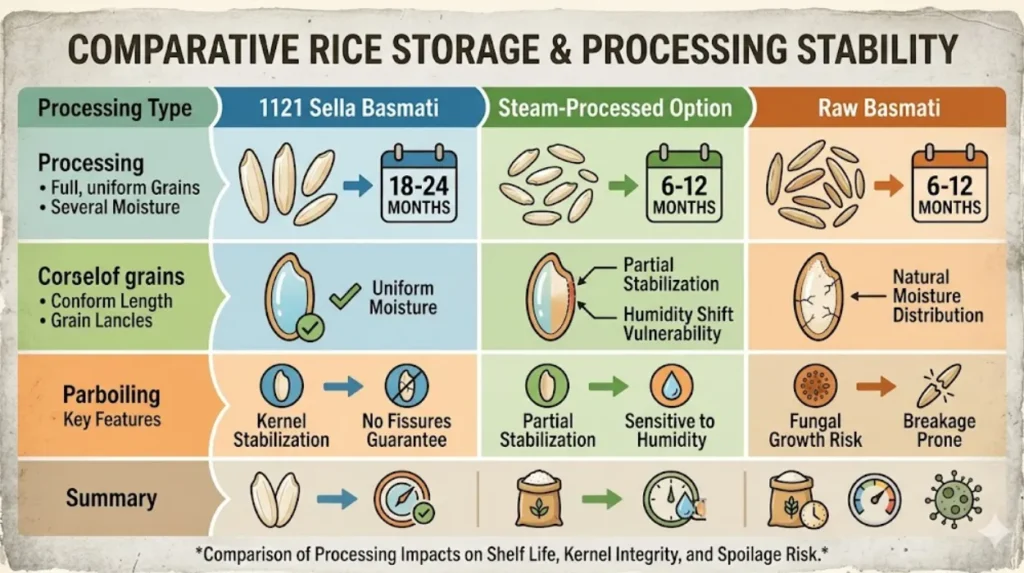
Steam processing offers partial stabilization but leaves the grain more sensitive to humidity shifts.
Raw basmati retains natural moisture distribution. This increases susceptibility to fungal growth and breakage over time.
Specification Comparison Table
1121 Sella vs Non-Sella Basmati (7 Attributes)
| Attribute | 1121 Sella Basmati | 1121 Steam Basmati | 1121 Raw Basmati |
|---|---|---|---|
| Shelf Life | 18–24 months | 9–12 months | 6–9 months |
| Moisture Stability | High | Medium | Low |
| Breakage Rate | <1% | 2–4% | 4–7% |
| Storage Tolerance | High heat, variable humidity | Moderate | Low |
| Aroma Retention | Moderate | High | Highest |
| Cooking Expansion | 2.5–3x | 2–2.5x | 2–2.2x |
| Transport Durability | Excellent | Good | Moderate |
Sella Basmati maintains integrity across extended shipping cycles. Steam and Raw require tighter storage control to avoid degradation.
With the comparison established, the next step is identifying the best method for specific market conditions.
Which method works best for different cases?
Sella works best for long storage and export; Steam suits mid-term use; Raw fits premium short-term consumption.
In Gulf markets, buyers store rice in 40–45°C warehouses. Sella Basmati maintains quality for 18–24 months under these conditions.
In European markets, climate-controlled storage supports Steam Basmati for 9–12 months without quality loss.
In local Pakistani or Indian retail, Raw Basmati is consumed quickly. Shelf life beyond 6–9 months is rarely required.
Market Preferences
Middle East (UAE, Saudi Arabia, Qatar)
Buyers prioritize durability and cooking consistency. Sella Basmati dominates due to heat-resistant storage performance.
Europe (UK, Germany, Netherlands)
Retailers focus on aroma and appearance. Steam Basmati is preferred due to balanced fragrance and moderate durability.
South Asia (Pakistan, India)
Consumers prioritize aroma and freshness. Raw Basmati is widely used for immediate consumption.
With regional preferences clarified, the next step is analyzing pros and cons in practical use.
Pros and cons (with examples)
Sella offers durability and low waste; non-sella offers aroma but higher storage risk.
Sella Basmati Pros
Sella Basmati reduces breakage during shipping. This minimizes loss in containerized export.
Sella Basmati tolerates humidity fluctuations. This prevents mold formation in non-controlled storage.
Sella Basmati maintains consistent cooking results. This suits catering and bulk buyers.
Sella Basmati Cons
Sella Basmati has reduced aroma compared to Raw. This may impact premium retail perception.
Sella Basmati requires longer cooking time. This may affect quick-service operations.
Non-Sella Basmati Pros
Steam and Raw retain strong aroma. This enhances consumer appeal in premium markets.
Steam Basmati offers faster cooking time. This benefits household and restaurant use.
Non-Sella Basmati Cons
Non-sella grains break more easily during transport. This increases wastage rates.
Non-sella requires strict storage conditions. This increases operational costs.
With strengths and weaknesses outlined, the next section focuses on decision-making factors.
Decision factors
Choose Sella for durability, choose Steam for balance, choose Raw for aroma.
Decision Framework Table
5 Key Decision Factors
| Factor | Best Choice | Reason |
|---|---|---|
| Long-Term Storage | Sella | Stable moisture and hardened grain |
| High-Temperature Storage | Sella | Heat-resistant structure |
| Aroma Priority | Raw | Maximum fragrance retention |
| Balanced Use | Steam | Moderate durability and aroma |
| Transport Distance | Sella | Low breakage during shipping |
If your priority is export efficiency, choose Sella. This reduces loss and improves delivery reliability.
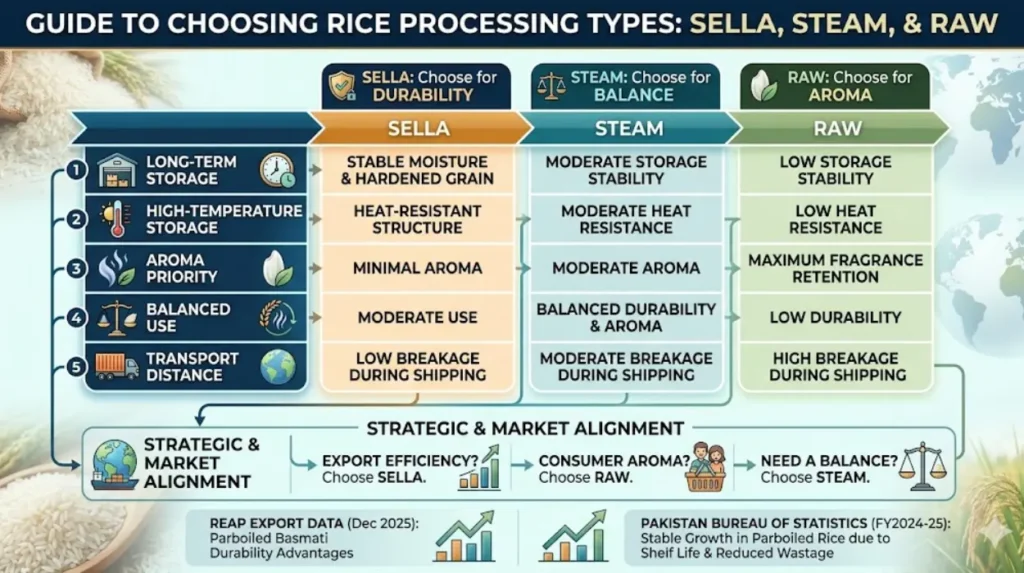
If your priority is consumer aroma, choose Raw. This enhances sensory appeal in retail markets.
If you need a balance, choose Steam. This supports moderate storage and flavor retention.
According to REAP export data, parboiled basmati accounts for a significant share of Pakistan’s exports due to durability advantages (source: REAP export data, December 2025).
Pakistan Bureau of Statistics reports stable export growth in parboiled rice categories due to extended shelf life and reduced wastage (source: Pakistan Bureau of Statistics, FY2024-25).
With decision factors established, you can align product choice with operational goals and market conditions.
Conclusion
1121 Sella Basmati is the most reliable choice for shelf life and storage stability.
Sella Basmati delivers extended durability, reduced wastage, and consistent performance across export conditions. Non-sella options provide aroma advantages but require tighter storage control.
For bulk buyers and exporters, Sella remains the optimal solution for cost efficiency and product reliability.
Frequently Asked Questions
What is the shelf life of 1121 Sella Basmati rice?
1121 Sella Basmati lasts 18–24 months under proper storage conditions. Parboiling strengthens the grain structure and stabilizes moisture. Store in dry, ventilated warehouses below 25°C to maintain quality and prevent discoloration or odor absorption.
How long does non-sella basmati rice last?
Non-sella basmati lasts 6–12 months depending on processing type. Raw basmati lasts 6–9 months, while Steam basmati extends to 9–12 months. Maintain low humidity and sealed packaging to avoid spoilage and insect activity.
Why does Sella Basmati have a longer shelf life?
Sella Basmati lasts longer because parboiling gelatinizes starch and hardens the kernel. This process reduces internal cracks and moisture variation. The grain resists breakage, mold, and environmental stress during storage and transport.
Which basmati type is better for export storage?
1121 Sella Basmati is the best choice for export storage. It tolerates long shipping cycles and high temperatures. In Gulf conditions, Sella maintains quality for up to 24 months without requiring climate-controlled storage.
How should basmati rice be stored for maximum shelf life?
Store basmati rice in cool, dry, and airtight conditions to extend shelf life. Use moisture-proof bags, maintain humidity below 60%, and avoid direct sunlight. Stack pallets properly to allow airflow and prevent condensation buildup.