Rice Import Regulations in China Every Exporter Must Know in 2026
China enforces mandatory GACC registration, phytosanitary certification, residue compliance, and customs inspection for all rice imports. Here is why: these controls protect food safety, traceability, and domestic supply stability under a centralized import approval system.
What are rice import regulations in China in 2026?
Rice import regulations in China in 2026 are a structured system of registration, inspection, quarantine, and customs clearance requirements enforced by GACC.
Rice import regulations define how exporters register facilities, certify shipments, and clear goods at Chinese ports. China uses a centralized authority called the General Administration of Customs of China (GACC). GACC registers foreign exporters and inspects incoming consignments.
China requires exporters to submit documents before shipment. China requires importers to declare cargo at customs. China requires both parties to maintain traceability records. Rice imports must comply with residue limits, pest control rules, and labeling standards.
Rice import regulations apply to all rice types, including white rice, parboiled rice, and broken rice. Examples include 1121 Basmati, IRRI-6 long grain, and Japonica rice. Each type follows the same regulatory structure with product-specific testing thresholds.
With the definition established, the next question is how this regulatory system works step by step.
How do rice import regulations China 2026 work?
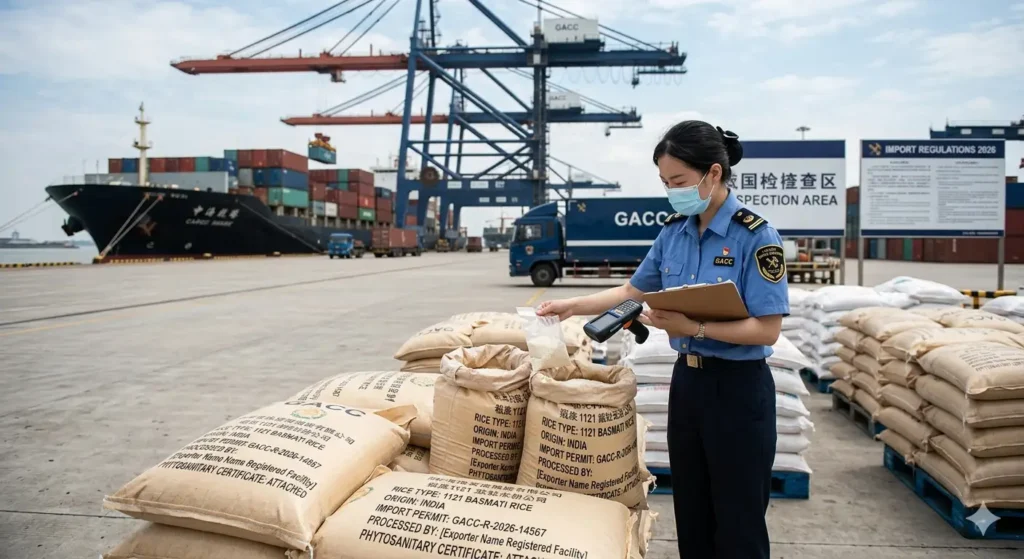
Rice import regulations work through five steps: GACC registration, contract approval, pre-shipment inspection, customs declaration, and port quarantine clearance.
China controls imports through a process sequence. Each step requires verified documentation and physical checks. Exporters must complete the process in order to avoid shipment rejection.
Step-by-step workflow
- Register the exporting facility with GACC
- Sign a contract with a licensed Chinese importer
- Inspect and test the rice before shipment
- Submit customs declaration documents electronically
- Clear quarantine inspection at the Chinese port
GACC registration assigns a unique code to each exporter. This code links shipments to certified facilities. Without this code, customs rejects the cargo immediately.
Pre-shipment inspection includes pesticide residue testing, moisture testing, and pest verification. Laboratories issue reports that confirm compliance with Chinese standards.
Customs declaration includes invoice, packing list, bill of lading, and certificate of origin. Importers submit these documents through China’s customs system.
Port quarantine inspection includes sampling and laboratory testing. Authorities check for contaminants, insects, and compliance with labeling rules.
This process flow explains execution. The next section breaks down the key components inside the system.
What are the key components of rice customs China?
The key components are GACC registration, phytosanitary certificate, residue limits, labeling compliance, and customs documentation.
Each component plays a defined role in controlling rice imports. Missing one component leads to shipment delays or rejection.
GACC registration rice
GACC registration certifies exporters and processing units. Authorities inspect facilities before approval. Facilities must meet hygiene, traceability, and quality standards.
Registered exporters receive a code. Exporters print this code on packaging. Customs verifies this code during clearance.
China phytosanitary certificate
Phytosanitary certification confirms the rice is free from pests and diseases. Government plant protection agencies issue this certificate.
Inspectors check for insects, fungi, and contamination. The certificate must match shipment details exactly.
Residue and contaminant limits
China defines maximum residue levels (MRLs) for pesticides. Laboratories test rice samples before shipment.
Examples include chlorpyrifos limits, aflatoxin limits, and heavy metal thresholds. Shipments exceeding limits face rejection.
Labeling and packaging compliance
China requires labels in Chinese language. Labels must include product name, origin, weight, and GACC code.
Packaging must protect rice during transit. Common formats include 25 kg PP bags, 50 kg woven bags, and vacuum packs.
Customs documentation
Customs requires a complete document set. Missing documents cause delays.
Required documents include:
- Commercial invoice
- Packing list
- Bill of lading
- Certificate of origin
- Phytosanitary certificate
These components form the regulatory backbone. The next section explains the benefits of following these rules.
What are the benefits of complying with China rice import regulations?
Compliance delivers faster clearance, reduced rejection risk, higher buyer trust, and stable long-term trade access.
Compliance improves shipment predictability. Customs clears compliant shipments faster. Non-compliant shipments face inspections, delays, or destruction.
Compliance reduces financial loss. Rejected shipments incur freight loss, demurrage charges, and re-export costs.
Compliance builds importer trust. Chinese buyers prefer exporters with a strong compliance record. This preference leads to repeat contracts.
Compliance enables market access. China restricts imports to approved exporters. Registered exporters gain continuous access to the market.
Compliance also improves internal quality systems. Exporters adopt testing, traceability, and documentation processes. These improvements strengthen overall export operations.
With benefits clarified, the next question is where these regulations apply in real trade scenarios.
What are the use cases of Pakistan rice export China?
Use cases include bulk commodity trade, premium retail imports, and government-approved supply contracts.
Pakistan exports multiple rice categories to China. Each category follows the same regulatory system but serves different buyers.
Bulk commodity exports
Bulk shipments supply wholesalers and food processors. These shipments include IRRI-6, IRRI-9, and broken rice.
Bulk buyers prioritize price and volume. Compliance ensures uninterrupted supply chains.
Premium retail imports
Premium imports include 1121 Basmati and Super Kernel Basmati. These products target retail consumers.
Retail buyers demand strict quality control. Compliance ensures branding, labeling, and safety standards.
Contract-based imports
Government and large enterprises import rice through contracts. Contracts define volume, quality, and delivery schedules.
Compliance ensures contract execution without penalties. Non-compliance triggers legal and financial consequences.
These use cases show application. The next section addresses common problems exporters face.
What are common problems and misconceptions in rice import regulations China?
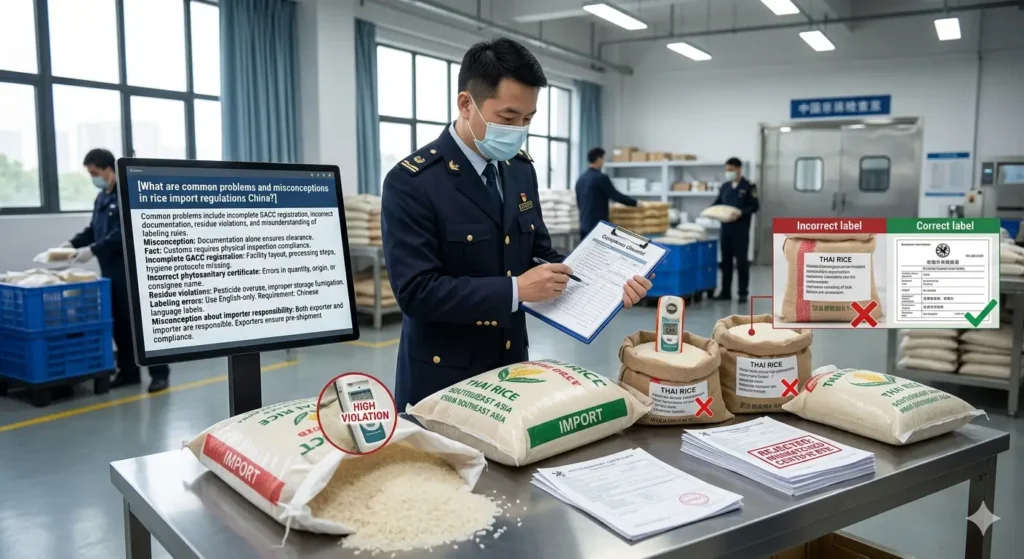
Common problems include incomplete GACC registration, incorrect documentation, residue violations, and misunderstanding of labeling rules.
Exporters often assume documentation alone ensures clearance. Customs requires both documents and physical inspection compliance.
Incomplete GACC registration
Exporters submit partial information. Authorities reject applications due to missing facility details.
Complete registration requires facility layout, processing steps, and hygiene protocols.
Incorrect phytosanitary certificate
Certificates often mismatch shipment details. Errors include wrong quantity, origin, or consignee name.
Authorities reject shipments with mismatched certificates.
Residue violations
Exporters fail to control pesticide use. Laboratory tests detect excess residues.
Examples include pesticide overuse during cultivation and improper storage fumigation.
Labeling errors
Exporters use English-only labels. China requires Chinese language labels.
Incorrect labels lead to re-labeling requirements or shipment delays.
Misconception about importer responsibility
Exporters assume importers handle compliance. Regulations assign responsibility to both exporter and importer.
Exporters must ensure pre-shipment compliance. Importers handle customs declaration.
These problems highlight risk areas. The final section connects all components into a structured understanding.
How does the full regulatory system connect from farm to port?
The system connects cultivation control, processing inspection, certification, and customs clearance into a single traceable chain.
Rice cultivation must follow pesticide control guidelines. Farmers apply approved chemicals within defined limits.
Rice processing must maintain hygiene and traceability. Mills clean, dehusk, polish, grade, and pack rice under controlled conditions.
Quality teams inspect and test rice before shipment. Laboratories verify moisture, purity, and residue levels.
Exporters compile documents and dispatch shipments. Importers submit declarations and clear customs.
Chinese authorities inspect shipments at ports. Approved shipments enter the domestic market.
This chain ensures food safety and traceability. Every step links to the next through documentation and inspection.
With the full system explained, exporters can align operations with China’s regulatory framework and avoid disruption.