Choosing Between 1121 Golden Sella and White Basmati for European Retail
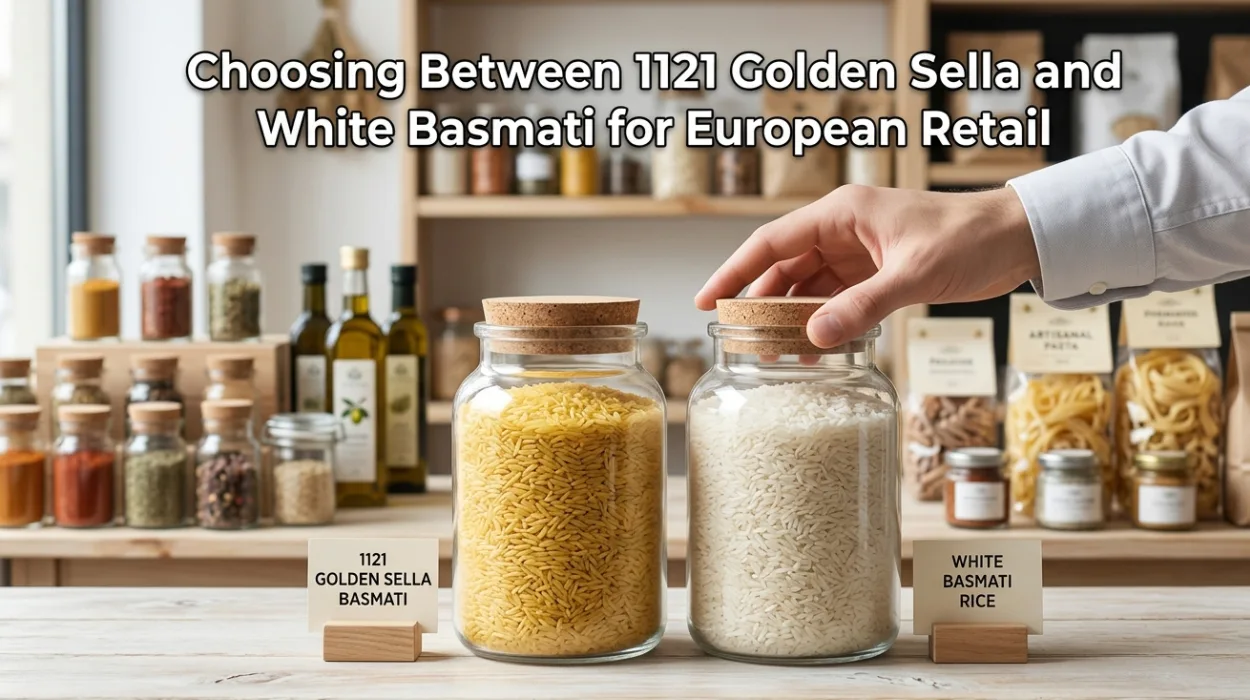
1121 Golden Sella fits European retail when the buyer prioritises shelf life, transport stability, and consistent cooking, while white Basmati fits when the buyer prioritises fragrance, premium whiteness, and a lighter consumer perception. The right choice depends on whether the retail position is value-stability or aroma-premium.
What are the available solutions for European retail buyers?
European retail buyers usually choose between 1121 Golden Sella, white Basmati, or a blended range strategy, and each option serves a different retail position, shelf-life target, and price point.

1121 Golden Sella is the parboiled version of 1121 Basmati. It is processed through soaking, steaming, drying, and milling before packing. This creates a harder grain, a golden tint, and a longer storage profile. White Basmati is milled without the parboiling cycle, which keeps the grain whiter and the aroma more pronounced.
For European retail, the decision is not only about rice quality. It is about category fit. Supermarkets, ethnic retailers, and premium food brands all treat rice differently in their planograms and margin structures. A rice that handles long shelf cycles and mixed distribution routes performs differently from a rice that competes on aroma and visual premium cues.
The third solution is a mixed portfolio. Some importers use Golden Sella for bulk and white Basmati for premium retail. That approach reduces concentration risk and lets the buyer match the product to the channel. AHK Rice, based in Punjab, supplies 1121, Super Kernel, and 1509 grades through full export processing, so both routes sit inside the same supply framework.
A useful starting point is the parboiled Basmati grade from Pakistan. That background helps European buyers understand why the product has become such a strong export category before they compare it with white rice at retail level.
How do 1121 Golden Sella and white Basmati compare in the EU market?
1121 Golden Sella and white Basmati differ most in shelf life, grain appearance, transport resilience, and consumer positioning, which makes the white versus sella EU market comparison primarily a retail strategy question rather than a raw quality question.
| Attribute | 1121 Golden Sella | White Basmati |
|---|---|---|
| Processing | Parboiled, dried, milled | Milled without parboiling |
| Grain colour | Golden to light amber | Bright white |
| Aroma retention | Moderate-high | High |
| Shelf life | 14–18 months | 8–12 months |
| Breakage resistance | High | Medium |
| Cooking consistency | Very stable, separate grains | Fluffier, more aromatic |
| Retail positioning | Value-stability, bulk premium, long cycle | Premium aroma, gourmet, fresh-look retail |
The table shows why the two products win in different parts of the market. Golden Sella wins on structure and stability. White Basmati wins on sensory appeal and perceived freshness. In Europe, where supply chains are long and retail calendars are strict, that difference changes margin planning, warehouse turnover, and complaint risk.
1121 Golden Sella behaves better under transit stress. It tolerates moisture fluctuation, repeated handling, and longer time in distribution centres. White Basmati carries more sensory prestige, but it needs tighter stock rotation and more careful storage. That makes Golden Sella stronger in mixed-channel or private-label supply, while white rice remains stronger in high-premium or aroma-led formats.
A retail buyer also evaluates the product at shelf level. Golden Sella presents as a firmer, more durable rice. White Basmati presents as the more aromatic and visually bright rice. That visual difference matters when the category is judged by first impression, especially in European supermarkets where shelf decisions often happen quickly.
Which method works best for different European retail cases?
1121 Golden Sella works best where the buyer needs supply stability, lower breakage, and longer shelf life, while white Basmati works best where the retailer sells on fragrance, premium perception, and clean white appearance.
For private-label supermarket chains, Golden Sella often performs better. Those buyers usually run larger inventory cycles and need a product that remains stable through warehousing, shelf display, and customer storage. Golden Sella’s 14–18 month shelf life reduces markdown pressure and product-age risk. It also handles international transport more reliably, which lowers the chance of quality complaints after arrival.
For premium ethnic retailers, white Basmati often delivers the stronger shelf story. Customers in this channel often seek fragrance first and visual whiteness second. A product with a strong aroma profile can command a more attractive price point and support premium pack design. In that context, the shorter shelf-life window is acceptable because turnover is faster and the brand promise is sensory quality.
For food-service distribution, Golden Sella usually has the advantage. The grain stays separate during cooking and maintains shape under volume cooking. That makes it attractive for catering buyers, institutions, and commercial kitchens. White Basmati works here too, but only where aroma-led dish presentation is central and stock rotation is disciplined.
For importers building an EU-wide portfolio, the best method is often channel segmentation. Golden Sella can support value and high-volume listings. White Basmati can support premium and gift-box formats. AHK Rice can supply both from a common Basmati origin in Punjab, which keeps sourcing aligned even when the retail strategy changes by market.
What are the pros and cons of each option in European retail?
1121 Golden Sella offers stronger logistics, longer shelf life, and lower breakage, while white Basmati offers higher aroma, brighter appearance, and stronger premium appeal, which means each product has clear strengths and trade-offs in European retail.
Advantages of 1121 Golden Sella
- Maintain stock stability for 14–18 months, which supports slower retail turnover and fewer write-offs.
- Reduce breakage during sea freight, container handling, and warehouse movement, which protects fill quality.
- Deliver consistent cooking behaviour, which is useful for private label and food-service buyers.
- Fit value-premium positioning, where the retailer wants a strong product without the top-end fragrance profile.
Limitations of 1121 Golden Sella
- Present a golden tone that some retail buyers see as less premium than bright white rice.
- Offer slightly lower fragrance intensity than white Basmati.
- Require stronger education at shelf, because some consumers still confuse parboiled rice with lower-grade rice.
Advantages of white Basmati
- Deliver a more aromatic cooking result, which strengthens premium consumer perception.
- Present a white, elegant grain look that performs well in premium retail packaging.
- Support a classic Basmati identity that appeals to buyers who focus on aroma and tradition.
Limitations of white Basmati
- Carry a shorter shelf-life range, often 8–12 months under standard retail storage conditions.
- Break more easily under stress from transport and repeated handling.
- Require tighter warehouse rotation and more precise stock planning to avoid ageing loss.
The practical difference becomes visible in retail economics. A product with stronger shelf life reduces shrink and returns. A product with stronger aroma supports margin but requires better inventory control. European buyers decide between these outcomes based on channel, category, and the retailer’s brand promise.
What price and shelf-life patterns matter most for European retail?
1121 Golden Sella usually supports lower risk per pallet and stronger shelf-life economics, while white Basmati usually supports a higher premium per kilogram but a narrower operational window in the European retail chain.
In most European retail models, Golden Sella has the stronger logistics case. It absorbs longer shipping times, port delays, and slower shelf rotation without losing as much functional quality. That matters when containers travel from Pakistan to ports in the UK, Germany, the Netherlands, or Southern Europe and then move through regional distribution networks.
White Basmati usually commands a higher shelf price because the product carries a more premium consumer profile. That premium supports smaller pack sizes, speciality retail, and gift or gourmet positioning. The trade-off is that the buyer must manage turnover carefully, because older stock loses aroma and consumer appeal faster than Golden Sella.
For many buyers, shelf life creates the bigger financial difference than spot price. A cheaper rice that expires on the shelf creates more cost than a slightly more expensive rice that holds condition longer. That is why many importers compare landed cost together with stock-age risk rather than price alone.
If the buyer wants a deeper container-level comparison, the BOFU analysis on AHK Rice 1121 Golden Sella minimum 24 MT container pricing gives the pricing structure at shipment level and helps connect shelf-life choice with landed-cost planning.
Which decision factors should buyers use before choosing?
The best decision factors are shelf rotation speed, target consumer profile, shipping distance, packaging format, and the retailer’s premium versus value strategy.
Decision framework
| Factor | Choose 1121 Golden Sella when | Choose white Basmati when |
|---|---|---|
| Shelf rotation | Stock moves slowly or unevenly | Stock turns quickly |
| Consumer profile | Value-conscious or mixed-channel buyer | Aroma-led premium buyer |
| Shipping route | Longer sea transit and handling | Shorter, tightly managed routes |
| Packaging | Bulk, private label, food service | Premium retail, smaller packs |
| Margin strategy | Stability and lower shrink matter more | Premium perception supports the price |
Shelf rotation is the first factor. A product that sits in a warehouse for months needs better durability. Golden Sella suits that model. White Basmati suits a faster-turn market where fragrance sells first and storage time stays short.
Consumer profile is the second factor. If the end buyer knows Basmati by aroma, white rice has an edge. If the buyer values consistency, cookability, and shelf discipline, Golden Sella is stronger. Retailers that operate across both profiles often split the assortment rather than forcing one rice type to do everything.
Shipping route matters as well. Longer routes create more handling points and more risk of quality drift. Golden Sella manages that better. White Basmati can still travel well, but it needs more controlled movement and faster stock turnover once it lands.
Packaging also influences the decision. Smaller premium packs benefit white Basmati’s visual profile. Larger retail and food-service packs benefit Golden Sella’s stability. AHK Rice supports both through custom packaging and export-ready handling, which keeps the commercial model aligned with the channel.
How should European buyers structure their sourcing strategy?
European buyers should structure sourcing as a channel-specific rice strategy, with 1121 Golden Sella used for stability-led listings and white Basmati used for premium aroma-led listings.

That approach reduces channel conflict. It stops the buyer from asking one product to satisfy two different consumer jobs. A supermarket private-label range can use Golden Sella for its dependable performance and long shelf life. A premium ethnic or gourmet range can use white Basmati for its fragrance and brighter appearance.
It also improves forecasting. Buyers can assign stock weeks to each SKU based on actual turnover. Golden Sella can carry slower-moving lines. White Basmati can sit in faster-moving premium lines. That division lowers waste and improves replenishment accuracy.
AHK Rice fits this model because it supplies 1121, Super Kernel, and 1509 from Punjab through end-to-end processing and export control. That gives European buyers a single sourcing base with two retail outcomes. It also keeps quality conversations technical rather than promotional, which is what serious buyers need when comparing golden sella Europe retail options against white rice.
A final point matters for risk. Retailers do not lose margin only through purchase price. They lose margin through shrink, complaints, expired stock, and weak shelf performance. Golden Sella lowers those risks. White Basmati increases premium appeal. The right choice depends on which loss the buyer wants to minimise and which signal the retailer wants to maximise.
What is the clearest buying conclusion?
The clearest buying conclusion is that 1121 Golden Sella is the safer commercial choice for European retail chains, while white Basmati is the stronger sensory choice for premium retail and aroma-led channels.
If the priority is shelf life, transport resilience, and lower shrink, Golden Sella wins. If the priority is fragrance, consumer prestige, and a white grain presentation, white Basmati wins. The best buyers do not treat them as interchangeable. They treat them as separate solutions for separate market jobs.
For European retail, that means the decision should start with channel design, not with grain type alone. A chain that wants stable inventory and predictable quality should lean toward Golden Sella. A retailer that sells on aroma and premium positioning should lean toward white Basmati. A mixed portfolio produces the most control when both channels are active.