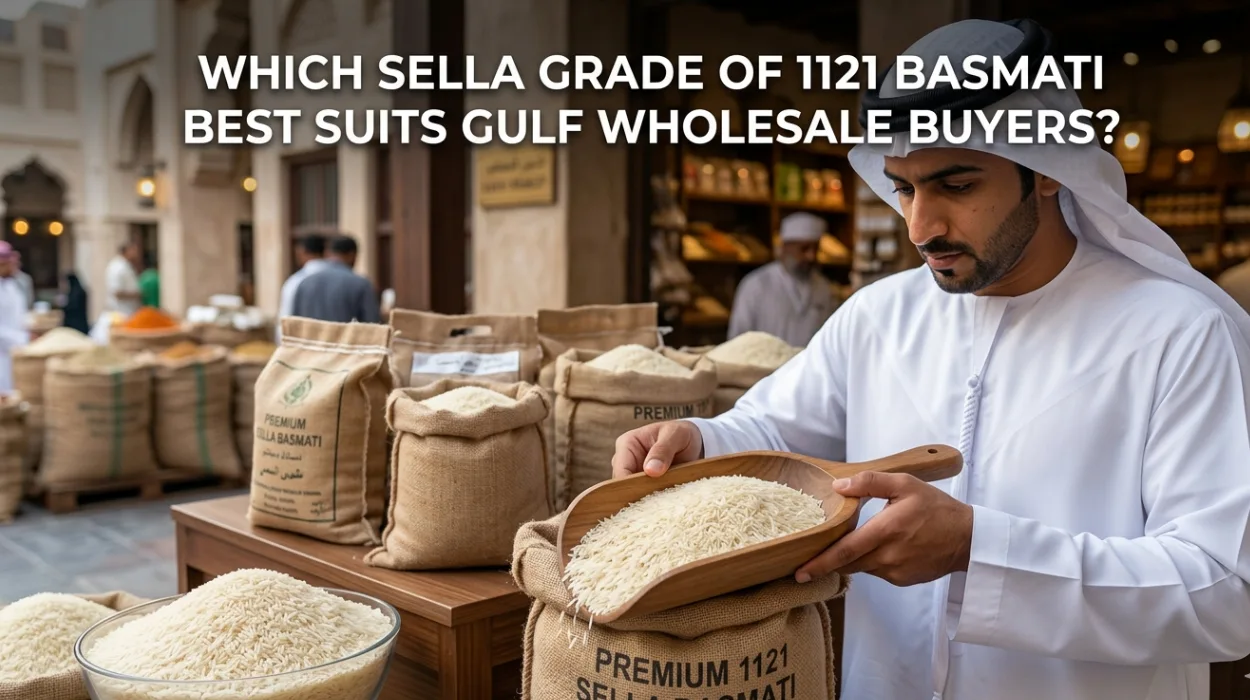
Which Sella Grade of 1121 Basmati Best Suits Gulf Wholesale Buyers?
Among the 1121 Sella grades available, the Golden Sella format usually suits Gulf wholesale buyers best because it offers the strongest visual premium and export‑grade stability for high‑turnover channels. The choice between 1121 Sella, Golden Sella, and Creamy Sella depends on the buyer’s balance of price, appearance, and storage expectations. To understand the underlying processing, the 1121 Sella Basmati shelf life explains why parboiled 1121 holds better in long‑route trade.
What are the available sella grade solutions for 1121 Basmati?
The three main 1121 Sella solutions are 1121 Sella, Golden Sella, and Creamy Sella, each with its own colour intensity, head‑rice performance, and export‑grade positioning. These are not different rice species. They are the same 1121 basmati processed under slightly different parboiling, steam‑treatment, and grading conditions. The result is three distinct specification bands that Gulf wholesale buyers can map to their channels.
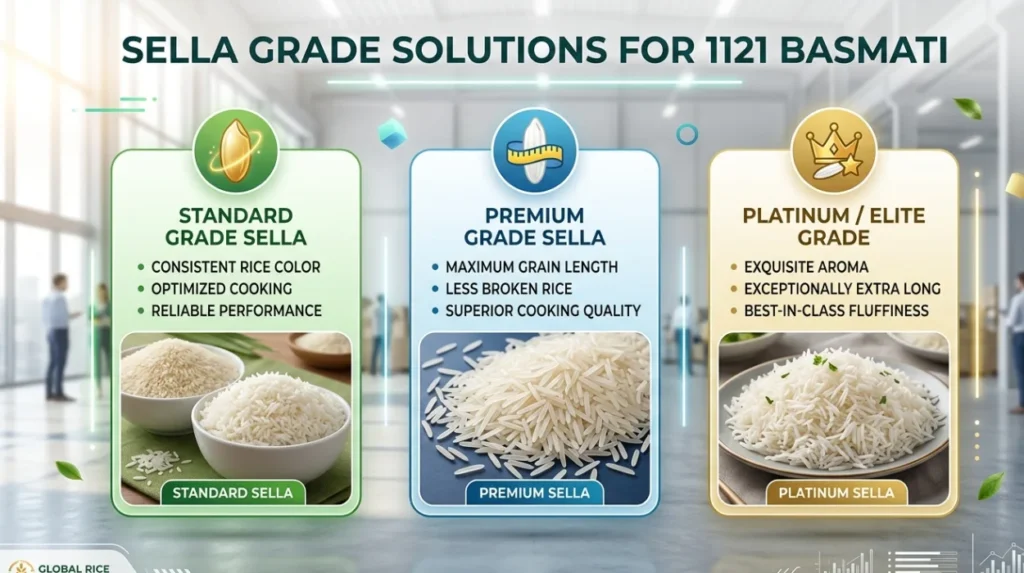
1121 Sella sits in the middle, with a golden‑amber finish, stable grain length, and moderate‑premium pricing. Golden Sella emphasizes a deeper, more uniform golden colour, which is positioned as a higher‑end parboiled format. Creamy Sella uses a lighter, cream‑coloured finish targeted at value‑driven and foodservice channels that still want parboiled benefits.
For Gulf buyers, the key is to match each grade to the destination channel. Golden Sella usually fits national‑brand supermarkets and premium‑retail. 1121 Sella suits mixed‑retail and wholesale hubs. Creamy Sella fits budget‑and‑foodservice buyers who prioritise function over visual premium. The choice is not about which is “better” in general, but which fits the buyer’s margin, appearance, and volume strategy.
How do 1121 Sella, Golden Sella, and Creamy Sella compare in Gulf‑wholesale terms?
1121 Sella, Golden Sella, and Creamy Sella compare on grain appearance, price per MT, shelf‑life stability, and the visual signal each creates in the Gulf wholesale channel. The same 1121 parboiled base is shaped by processing intensity and grading, which creates different trade‑outcomes. The table below gives a 7‑attribute comparison relevant to the Gulf wholesale buyer.
| Attribute | 1121 Sella | Golden Sella | Creamy Sella |
|---|---|---|---|
| Variety base | 1121 basmati | 1121 basmati | 1121 basmati |
| Parboiling level | Standard | High‑intensity | Medium‑low |
| Colour intensity | Golden‑amber | Deep golden | Light cream |
| Head‑rice recovery | High | Very high | High |
| Grain separation after cooking | Strong | Strong | Strong |
| Typical price per MT | Medium | High | Medium‑low |
| Gulf‑wholesale best‑fit | Mixed‑channel | Premium‑retail | Value‑and‑foodservice |
In the Gulf, wholesalers who sell into both branded retail and cash‑and‑carry markets often choose 1121 Sella. The golden‑amber finish is clearly parboiled and export‑grade, but the price is lower than Golden Sella. Gulf buyers who supply supermarkets that demand a strong “golden rice” identity choose Golden Sella, because the colour supports higher‑end pricing. Budget‑oriented wholesalers and foodservice buyers often prefer Creamy Sella, which keeps the landed cost lower while still delivering parboiled texture.
Price‑per‑MT is the first clear differentiator. Golden Sella usually trades at a 10–15% premium over 1121 Sella, and Creamy Sella can sit 5–10% below depending on the mill and season. Shelf‑life is less divergent, because all three grades share the same parboiled advantages, but the Gulf‑wholesale buyer must still control moisture and packaging to preserve that advantage.
Which 1121 Sella grade works best for different Gulf‑wholesale cases?
Golden Sella works best for premium‑retail‑heavy Gulf portfolios, 1121 Sella for mixed‑channel buyers, and Creamy Sella for value‑and‑foodservice‑focused wholesalers. The deciding factor is not just the rice itself. It is how the grain looks on the shelf, how it tastes in bulk kitchens, and what the buyer can charge for “golden‑premium” versus “value‑premium.”
For example, a Riyadh‑based distributor supplying major supermarket chains prefers Golden Sella because the deep‑golden colour reads as more premium at shelf and aligns with private‑label marketing. The price premium is absorbed through higher‑retail‑pricing. The grain’s strong head‑rice recovery supports clean bag appearance and repeat‑sales. In this case, the buyer values appearance and margin more than the lowest possible MT price.
A Sharjah‑based wholesaler serving mixed‑retail and large‑foodservice clients prefers 1121 Sella. The product is still clearly parboiled, but the price is lower than Golden Sella. The grain remains firm and long after cooking, which suits cafeterias and restaurants. The buyer can split volumes between retail‑sacks and bulk‑sacks, giving outlets a consistent look without overpaying for a deep‑golden finish.
A Muscat‑focused, budget‑driven wholesaler whose main customers are small‑cafés and local‑markets prefers Creamy Sella. The lighter colour reduces the visual premium, which allows the buyer to keep the landed price lower. The grain still separates and resists mushiness, which is enough for basic foodservice use. The loss of visual premium is acceptable because the margin structure depends on volume rather than image.
What are the pros and cons of each Sella grade for Gulf buyers?
The pros and cons of each 1121 Sella grade depend on how the Gulf buyer balances appearance, price, and channel expectations.
1121 Sella pros and cons
- Gain a clear golden‑amber finish that signals parboiled rice without the highest Golden Sella price.
- Keep price per MT under Golden Sella levels, which supports margin in mixed‑channel portfolios.
- Support both retail and foodservice because the grain separation and texture fit multiple use‑cases.
- Accept weaker visual premium than Golden Sella in markets that strongly associate “golden” with status.
- Face tighter colour‑sorting pressure if the buyer expects Golden Sella‑level uniformity from a mid‑grade product.
Golden Sella pros and cons
- Strengthen shelf impact with a deeper, more uniform golden colour, which suits premium‑retail and private‑label lines.
- Align with higher‑end labelling and pricing, because the product naturally supports a “premium‑golden” identity.
- Gain stronger brand differentiation in markets where Golden Sella is already recognised as a top‑tier parboiled format.
- Pay a higher price per MT because processing intensity and colour standards create an export‑grade premium.
- Limit value‑efficiency when the buyer serves price‑sensitive channels that do not reward the visual shift.
Creamy Sella pros and cons
- Lower per‑MT acquisition cost by selecting a less colour‑intense finish that still delivers parboiled texture.
- Maintain grain separation and firmness, suitable for foodservice and bulk‑serving environments.
- Fit value‑conscious buyers who prioritise function over strong visual premium.
- Reduce shelf‑differentiation compared with Golden Sella, which may limit resale value in premium retail.
- Weaken brand‑premium perception if the buyer enters markets that expect a clear golden‑finish parboiled rice.
These pros and cons show that the best choice for Gulf wholesale buyers is not a universal answer. The decision depends on the channel mix, margin model, and how the buyer wants the rice to look on the shelf.
What decision factors should Gulf wholesale buyers consider?

Gulf wholesale buyers should consider five decision factors: target channel, landed price per MT, shelf‑life and storage capability, packaging and branding needs, and container‑level consistency. Evaluating these factors helps buyers choose the right 1121 Sella grade without over‑investing in visual premium or under‑paying for grain stability.
| Decision factor | 1121 Sella | Golden Sella | Creamy Sella |
|---|---|---|---|
| Target channel | Mixed retail and foodservice | Premium‑retail | Value‑and‑foodservice |
| Landed price per MT | Medium | High | Medium‑low |
| Shelf‑life expectation | Strong | Strong | Strong |
| Visual branding | Golden‑amber, export‑grade | Deep golden, high‑premium | Light‑cream, functional |
| Margin‑and‑segment fit | Balanced for mixed channels | Best for premium‑retail markup | Best for volume‑based margin |
The first factor is the target channel. If the buyer’s network is skewed toward supermarkets and branded retail, Golden Sella is usually the best fit. If the buyer serves mixed‑retail and wholesale, 1121 Sella creates a strong balance. If the buyer leans toward value‑and‑foodservice, Creamy Sella fits better.
The second factor is landed price per MT. Gulf buyers must compare the ex‑mill rate, freight, and port‑fees across all three grades. Golden Sella is usually at the top of the band, Creamy Sella at the bottom, and 1121 Sella in the middle. The exact spread varies with season and origin‑availability, but the relative hierarchy is stable.
The third factor is shelf‑life and storage. All three grades benefit from parboiled advantages, so the choice is more about packaging and warehouse capability than the grade itself. The buyer must still maintain controlled moisture and cool storage to preserve the parboiled shelf life advantage.
Fourth is packaging and branding. Golden Sella usually suits shiny‑retail‑sacks and private‑label designs. Creamy Sella fits more basic‑packs and bulk‑sacks. 1121 Sella sits between them, which makes it a flexible option for wholesalers who re‑pack under multiple labels.
Fifth is container‑level consistency. The buyer must ensure that the chosen grade arrives with consistent colour, length, and head‑rice percentage from one shipment to the next. That is where the AHK Rice 1121 Sella service, listed on the 1121 Basmati Sella Rice product page, becomes relevant for decision‑check later. The grade‑stability effect is stronger when the supplier controls end‑to‑end processing, custom packaging, and container‑handling.
How do shelf life and price per MT compare across the Gulf?
Across the Gulf, shelf life is similar across the three grades, but price per MT differs significantly, with Golden Sella at the top, Creamy Sella at the bottom, and 1121 Sella in the middle. The deep‑golden finish of Golden Sella commands a premium because it supports higher‑retail‑pricing and stronger visual branding. The lighter‑cream finish of Creamy Sella allows a lower acquisition cost. 1121 Sella occupies the middle ground.
For example, in a typical Gulf import cycle, Golden Sella can trade 10–15% above 1121 Sella, and Creamy Sella can sit 5–10% below. The exact spread depends on the season, freight‑costs, and demand‑cycles. The grain length and head‑rice recovery are usually comparable, so the price gap is driven by finish and perception.
Shelf life is less variable because the parboiling step shapes the grain structure for all three formats. Proper storage, controlled moisture, and stable packaging protect the parboiled shelf life advantage in each case. The buyer’s choice is not about grain‑durability. It is about whether the visual‑premium justifies the extra cost.