Brown Basmati Rice Cooking Guide: Water Ratio Time and Soaking Instructions
Brown basmati rice cooking guide water ratio time soaking explains how wholegrain basmati rice absorbs water, requires controlled soaking, and cooks over extended time to achieve soft texture, intact grains, and optimal nutrient retention using precise ratios and timing.
Brown basmati rice is a wholegrain form of basmati rice where only the outer husk is removed. The bran layer remains intact. This layer contains fiber, vitamins, and oils. It also changes how the rice behaves during cooking.
A cooking guide defines three core variables: water ratio, soaking duration, and cooking time. These variables directly control hydration and heat penetration. Unlike white basmati rice, brown basmati absorbs water slowly due to its dense bran layer.
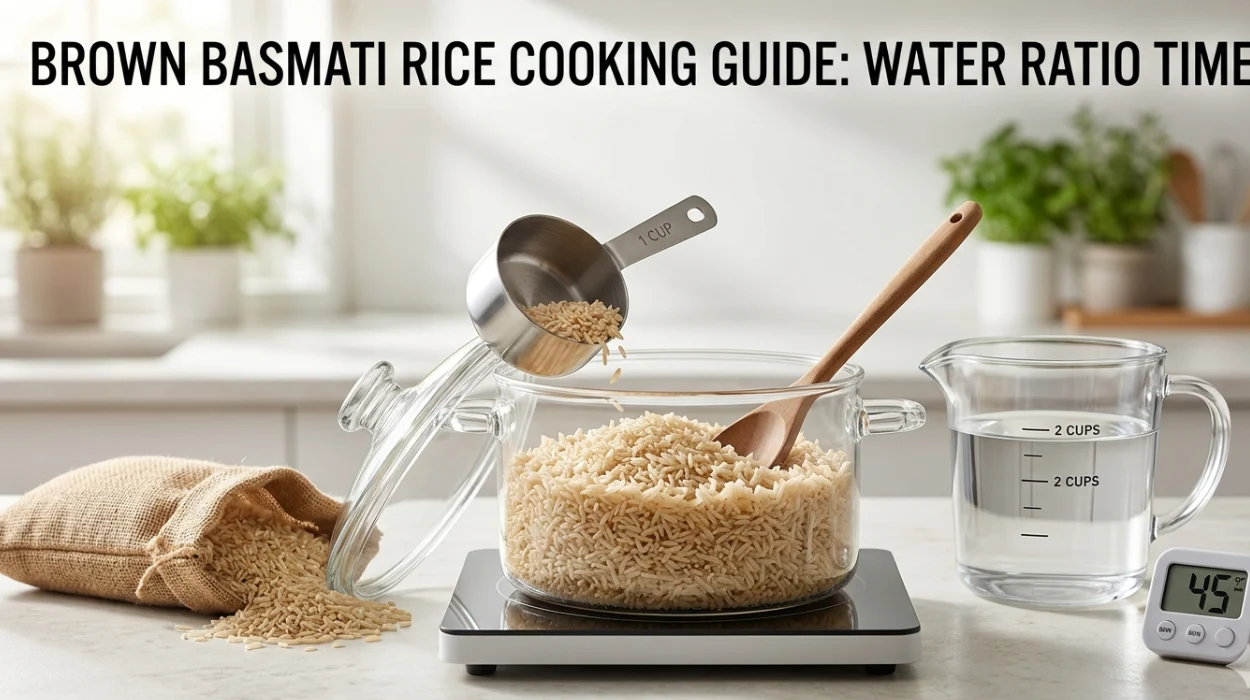
Water ratio refers to the proportion of water to rice, for example 2.5:1 or 3:1. Soaking refers to pre-cooking hydration, typically between 30 and 60 minutes. Cooking time defines the heat exposure needed to soften the grain, usually 30–45 minutes depending on method.
This guide standardizes outcomes. Without precise ratios and timing, brown basmati becomes undercooked or overly sticky. Consistency depends on understanding these elements as a system.
How does brown basmati rice cooking work?
Brown basmati rice cooking works by gradual water absorption through bran layers, followed by starch gelatinization under heat, requiring higher water volume, longer cooking time, and optional soaking to ensure even hydration and prevent hard centers or broken grains.
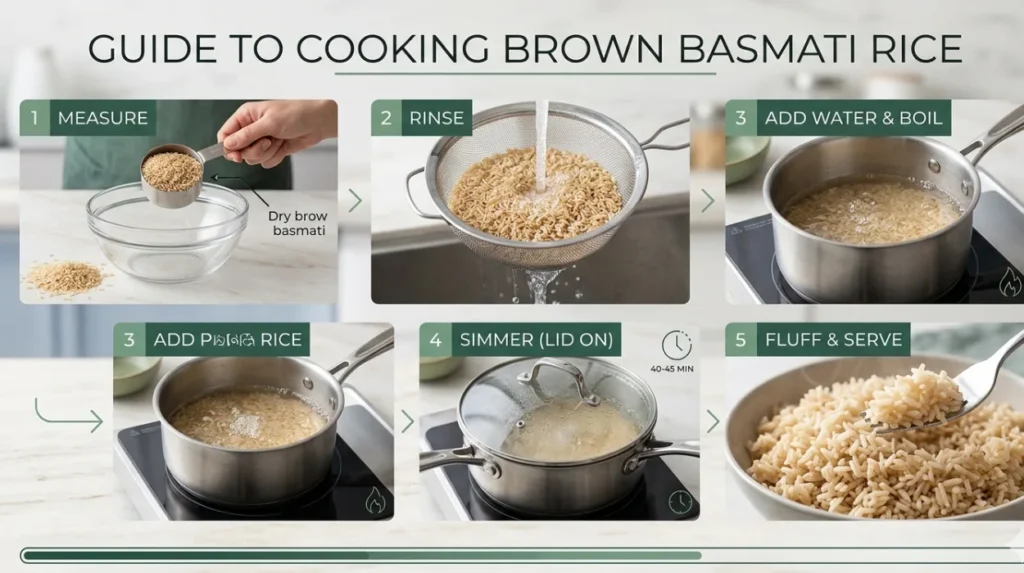
Cooking begins with water absorption. The bran layer slows water entry into the grain. This delay requires either soaking or extended cooking time. Without pre-soaking, outer layers soften while the core remains firm.
Heat triggers starch gelatinization. This process occurs when starch granules absorb water and swell. In brown basmati, this happens at a higher threshold due to the intact grain structure.
Evaporation and absorption must balance. Too little water leads to incomplete cooking. Too much water causes mushiness. Controlled simmering ensures gradual absorption rather than rapid boiling.
Cooking methods influence results. Examples include stovetop absorption method, rice cooker method, and pressure cooking. Each method alters time and water slightly, but the hydration principle remains constant.
What is the ideal water ratio for brown basmati rice?
The ideal water ratio for brown basmati rice ranges from 2.5:1 to 3:1 depending on soaking, cooking method, and grain age, ensuring full hydration of bran layers while preventing excess moisture that leads to sticky or overcooked texture.
Unsoaked rice requires more water. A 3:1 ratio works best for stovetop cooking without soaking. Soaked rice absorbs part of the water beforehand. This reduces required cooking water to around 2.25:1 or 2.5:1.
Rice age affects absorption. Older grains lose internal moisture. They require slightly more water. Newly harvested grains require less.
Cooking method changes ratios. Rice cookers retain steam, so they use slightly less water. Pressure cookers reduce evaporation further, lowering the ratio to around 2:1.
Examples of ratios:
- Unsoaked stovetop: 3 cups water per 1 cup rice
- Soaked stovetop: 2.5 cups water per 1 cup rice
- Rice cooker soaked: 2.25 cups water per 1 cup rice
Precision matters. Measuring inconsistently leads to unpredictable texture.
How long should brown basmati rice be soaked?
Brown basmati rice should be soaked for 30 to 60 minutes to soften bran layers, reduce cooking time, improve grain elongation, and ensure even water penetration before heat application begins during the cooking process.
Soaking hydrates the outer bran. This allows water to move toward the center before cooking begins. As a result, cooking becomes more uniform.
A 30-minute soak reduces cooking time by about 20%. A 60-minute soak reduces it further and improves texture. Longer soaking does not provide additional benefits and weakens grain structure.
Soaking also improves grain separation. The grains elongate more during cooking. This characteristic is important for basmati varieties such as 1121 and Super Kernel.
Skipping soaking is possible. However, it requires increased water and longer cooking time. This approach increases the risk of uneven texture.
After soaking, rice must be drained. Excess soaking water contains released starch. Removing it prevents stickiness.
What is the cooking time for wholegrain basmati rice?
Wholegrain basmati rice cooking time ranges from 30 to 45 minutes depending on soaking status, heat control, and cooking method, ensuring complete starch gelatinization and soft texture without compromising grain integrity or causing excessive moisture loss.
Unsoaked rice typically takes 40–45 minutes on a stovetop. Soaked rice cooks faster, usually within 30–35 minutes. Heat must remain consistent at a low simmer after initial boiling.
Rice cookers automate timing. They adjust heat based on moisture levels. Cooking time in a rice cooker ranges from 35 to 50 minutes depending on model.
Pressure cooking reduces time significantly. Brown basmati cooks in 20–25 minutes under pressure with natural release.
Cooking time includes resting. After heat is turned off, rice must rest for 10 minutes. This allows moisture redistribution within grains.
Skipping rest time leads to uneven texture. The outer layer dries while the center remains moist.
What are the key components in brown basmati cooking?
The key components in brown basmati cooking include water ratio, soaking duration, heat control, cooking vessel, grain quality, and resting period, all interacting to determine final texture, flavor, and structural integrity of the cooked rice.
Water ratio determines hydration level. Soaking affects initial moisture distribution. Heat control influences cooking speed and uniformity.
Cooking vessels affect evaporation. Examples include stainless steel pots, electric rice cookers, and pressure cookers. Each controls moisture differently.
Grain quality plays a major role. Long-grain varieties such as 1121 brown basmati produce more elongation. Shorter grains produce denser texture.
Resting period stabilizes the structure. Without resting, steam escapes too quickly. This disrupts internal moisture balance.
Each component interacts with others. Adjusting one variable requires recalibration of others.
What are the benefits of following a proper cooking guide?
Following a proper brown basmati cooking guide ensures consistent texture, improved nutrient retention, better digestibility, reduced cooking errors, and optimized grain separation, resulting in high-quality outcomes suitable for both home cooking and professional culinary applications.
Consistent texture means grains remain separate and tender. This is essential for dishes such as pilaf, biryani, and grain bowls.
Nutrient retention improves when cooking is controlled. Overcooking breaks down vitamins present in the bran layer.
Digestibility improves with soaking and proper cooking. Hydrated grains are easier to process in the digestive system.
Error reduction saves time and resources. Incorrect ratios lead to wasted batches.
Professional kitchens rely on repeatability. Standardized cooking methods ensure consistent product quality.
What are common use cases for brown basmati rice?
Brown basmati rice is used in health-focused meals, traditional dishes, meal preparation systems, and global cuisines where wholegrain texture, nutty flavor, and extended satiety are required, supporting dietary goals and diverse culinary applications across regions.
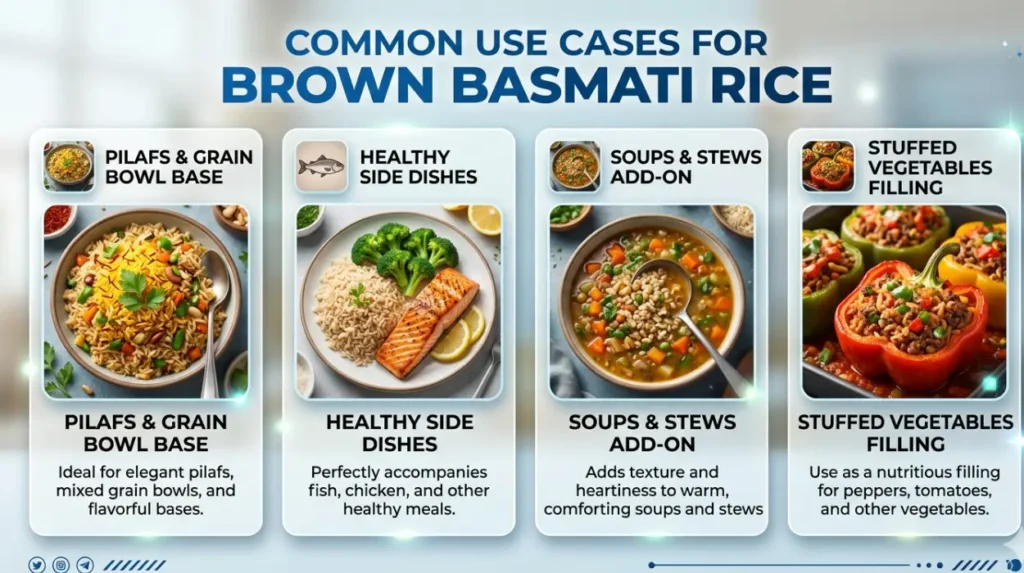
Health-focused meals use brown basmati for fiber content. Examples include weight management diets and diabetic meal plans.
Traditional dishes adapt brown basmati for modern preferences. Examples include brown rice biryani and pilaf variations.
Meal preparation systems rely on its storage stability. Cooked brown basmati maintains structure for several days under refrigeration.
Global cuisines integrate it into diverse dishes. Examples include Mediterranean bowls, Middle Eastern rice dishes, and Western grain salads.
Different varieties perform differently in these use cases. For example, European wholegrain markets long-grain 1121 brown basmati produces lighter dishes, while denser grains suit hearty meals.
What are common problems and misconceptions?
Common problems include incorrect water ratios, skipping soaking, uneven cooking, and misunderstanding grain behavior, while misconceptions involve treating brown basmati like white rice, leading to hard texture, excess moisture, or inconsistent cooking results.
One common mistake is using white rice ratios. Brown basmati requires more water and longer cooking time. Using a 2:1 ratio leads to undercooked grains.
Skipping soaking creates uneven texture. The outer layer softens while the core remains firm.
High heat causes rapid evaporation. This prevents full hydration. Controlled simmering is essential.
Another misconception is that longer cooking fixes all issues. Overcooking leads to broken grains and mushy texture.
Grain variability also causes confusion. Different basmati types absorb water differently. Examples include aged rice requiring more water and newly harvested rice requiring less. Understanding these differences eliminates inconsistency. Cooking becomes predictable when variables are controlled.