Malaysia Rice Import Policy 2026: What Pakistani Exporters Need to Know
Malaysia Rice Import Policy 2026 is a state-controlled import framework regulating licensing, quotas, quality standards, and certification for all rice entering Malaysia under single-desk import authority. Here is why: Malaysia centralises rice imports through government-linked agencies, enforces strict halal compliance, and prioritises controlled distribution to stabilise domestic supply and consumer pricing.
Malaysia rice imports operate under a single-desk procurement structure. The system restricts direct private import competition. It ensures controlled entry of foreign rice into domestic distribution channels.
Malaysia classifies rice as a strategic food staple. Government agencies regulate volumes to maintain price stability. Import approvals depend on national food security calculations.
Pakistani exporters targeting Malaysia must align with regulated supply channels. These channels require pre-approved licensing before shipment initiation. Without licensing, cargo clearance is rejected at port entry.
The policy directly affects exporters from Pakistan who supply basmati and non-basmati varieties. Compliance determines whether shipments enter retail or institutional supply chains.
With the policy structure defined, the next focus is how the import system operates in practice across licensing and distribution layers.
How does Malaysia rice import system work?
Malaysia rice import system works through a single government-controlled importer, mandatory licensing approval, quota allocation, and port inspection clearance before distribution into mills, wholesalers, and institutional buyers. Here is why: every stage is structured to control supply flow, stabilise prices, and ensure national food security consistency across consumption channels.
Malaysia imports rice through a centralised approval mechanism. The government assigns import rights to designated agencies. These agencies consolidate foreign rice procurement.
Import licenses determine shipment eligibility. Each license specifies quantity, origin, and rice classification. Cargo without matching documentation is rejected during customs inspection.
Port authorities inspect moisture content, grain length, and contamination levels. Inspection ensures compliance with Malaysian food safety thresholds before release into warehouses.
Distribution follows controlled allocation. Approved rice is released to wholesalers and institutional buyers. Retail pricing remains stabilised through managed supply chains.
With system operations clarified, the next section explains the regulatory components governing import eligibility and trade approval.
What are key components of Malaysia rice import rules?
Malaysia rice import rules consist of licensing control, quota management, halal certification enforcement, phytosanitary inspection, and quality grading standards applied at customs clearance. Here is why: these components ensure controlled supply, religious compliance, and consistent grain quality across imported rice entering Malaysian consumer and institutional markets.
Licensing control defines importer eligibility. Only authorised entities can apply for rice import quotas. Applications require government validation before approval.
Quota management limits annual import volumes. This ensures domestic rice producers remain protected while balancing consumer demand.
Halal certification ensures compliance with Islamic dietary requirements. All imported rice must carry recognised halal documentation verified by approved certification bodies.
Phytosanitary inspection verifies absence of pests, fungal contamination, and chemical residue. Inspection occurs at origin and entry ports.
Quality grading standards classify rice based on length, whiteness, and broken percentage. Grades determine pricing tiers and distribution priority.
With regulatory components established, the next section examines certification requirements for Pakistani exporters entering Malaysia.
Which certifications are required for Pakistan rice exports to Malaysia?
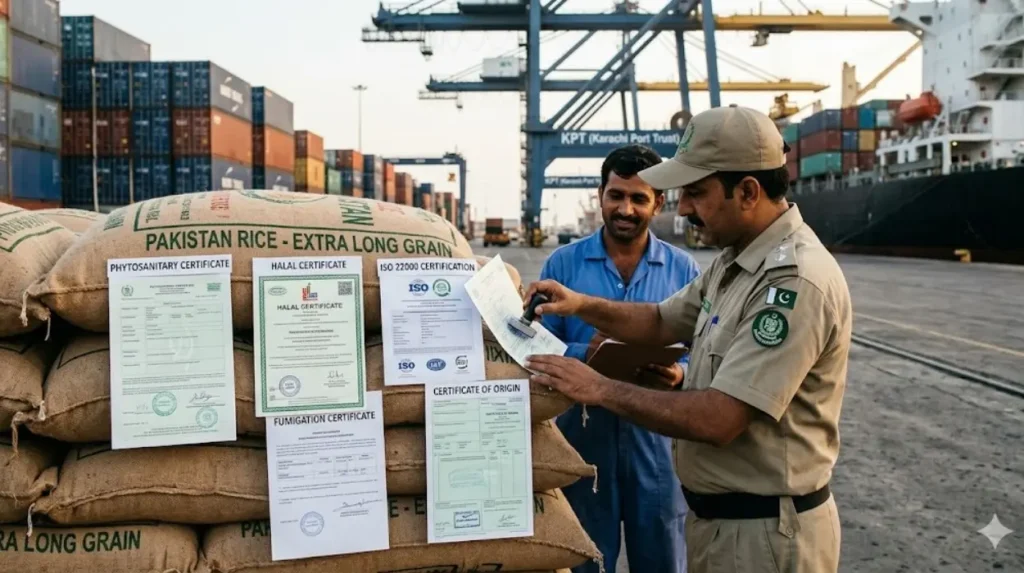
Malaysia requires halal certification, phytosanitary certificates, ISO quality management compliance, and export registration documents for rice imported from Pakistan. Here is why: certification ensures religious compliance, food safety validation, and traceable supply chain verification from origin milling facilities to Malaysian distribution authorities.
Halal certification confirms compliance with Islamic dietary laws. Certification must be issued by recognised authorities accepted in Malaysia’s import system.
Phytosanitary certificates verify pest-free status. These documents confirm rice has undergone inspection during export clearance procedures.
ISO certification validates processing facility standards. Mills must demonstrate controlled production systems for grading and hygiene.
Export registration documents establish exporter identity. Authorities verify shipment origin and production traceability before issuing import clearance.
Halal certified rice Pakistan Malaysia import matters becomes relevant here because halal compliance directly determines import approval speed and market access eligibility.
With certification requirements established, the next section explains the benefits exporters gain through compliance with Malaysia’s import system.
What benefits does compliance bring?
Compliance with Malaysia rice import policy ensures faster customs clearance, stable buyer contracts, reduced rejection risk, and access to institutional procurement channels. Here is why: compliant exporters secure predictable demand pipelines, improved pricing stability, and long-term trade relationships with regulated Malaysian import authorities and distributors.
Faster customs clearance reduces port delays. Certified shipments pass inspection without extended quarantine holds.
Stable buyer contracts emerge through approved supplier status. Importers prefer consistent, regulation-compliant exporters.
Reduced rejection risk protects exporters from financial losses. Non-compliant shipments face immediate re-export or disposal.
Institutional procurement access includes hotels, catering companies, and government food programs. These channels require verified compliance documentation.
With benefits explained, the next section examines practical use cases of Pakistani basmati rice in Malaysian markets.
What are use cases of Pakistani rice in Malaysia market?
Pakistani rice is used in Malaysia for hospitality catering, retail supermarket supply, institutional dining programs, and ethnic cuisine restaurants. Here is why: long-grain basmati varieties offer fragrance, elongation, and texture stability required for high-volume cooking and premium food service applications across diverse Malaysian consumer segments.
Hospitality catering uses basmati rice for banquet and hotel buffets. Consistent grain length ensures uniform presentation.
Retail supermarkets distribute packaged rice to household consumers. Packaging sizes range across 1 kg to 40 kg formats.
Institutional dining programs include schools and corporate cafeterias. Bulk supply ensures cost-efficient meal preparation.
Ethnic cuisine restaurants rely on aromatic rice for South Asian dishes. Texture retention supports biryani and pilaf applications.
1121, Super Kernel, and 1509 varieties serve different segments. 1121 targets premium export demand. 1509 supports cost-sensitive institutional supply chains.
With use cases established, the next section addresses common misconceptions in Malaysia rice import policy interpretation.
What are common problems or misconceptions about Malaysia rice import policy?
Common misconceptions include assumption of free import access, misunderstanding halal enforcement, underestimating quota restrictions, and ignoring documentation precision requirements. Here is why: Malaysia enforces strict import centralisation, and even minor documentation errors result in shipment delays or outright rejection at customs clearance points.
Free import assumption misleads exporters. Malaysia does not allow unrestricted rice imports without licensing.
Halal misunderstanding causes shipment delays. Certification must align with Malaysian recognised bodies only.
Quota underestimation leads to oversupply planning errors. Exporters often miscalculate available import volumes.
Documentation errors include mismatched batch numbers, incorrect origin statements, or missing inspection certificates.
Malaysia rice import system prioritises control over volume flexibility. Exporters must align operational planning with regulatory timelines.
With misconceptions clarified, the policy framework becomes more predictable for structured export planning and long-term trade alignment.
FAQ: Malaysia Rice Import Policy 2026
What controls rice imports in Malaysia?
Malaysia rice imports are controlled by a single-desk government agency that regulates licensing, quotas, and approved suppliers. All rice shipments enter only after official import approval and customs verification under national food security regulations.
Do Pakistani exporters need halal certification for Malaysia?
Pakistani exporters must provide halal certification approved by Malaysian authorities for rice shipments. This requirement ensures compliance with Islamic dietary laws and determines whether products are cleared for retail and institutional distribution in Malaysia.
What rice grades are accepted in Malaysia?
Malaysia accepts multiple rice grades including long-grain basmati, parboiled rice, and broken rice categories. Quality approval depends on grain length, moisture level, purity, and compliance with inspection standards at origin and entry ports.
How does Malaysia handle rice import quotas?
Malaysia manages rice import quotas through government allocation based on domestic supply needs. Approved importers receive fixed annual volumes, and all shipments must remain within assigned quota limits to maintain market stability.
Why are import documents important for Malaysia rice trade?
Import documents are critical because Malaysia requires complete traceability of rice origin, certification, and quality testing. Missing or incorrect documents result in shipment delays, rejection, or re-export orders at the port of entry.