West Africa Rice Market 2026: How Ivory Coast Became a Key Pakistan Buyer
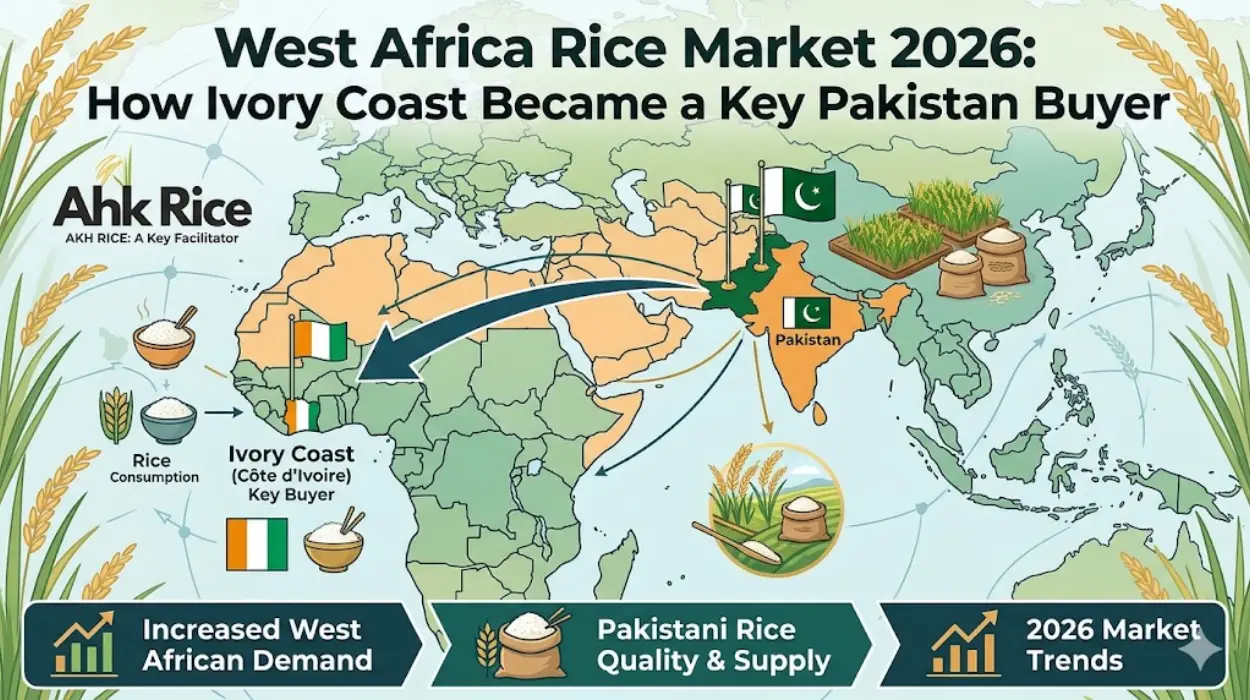
Ivory Coast became one of Pakistan’s most important rice buyers because the country imports large volumes of rice to meet domestic demand, while Pakistan supplies multiple rice categories that match West African consumption patterns. Here is why: rising urban populations, expanding food distribution networks, and demand for both aromatic and non-aromatic rice increased imports across West Africa, with Ivory Coast emerging as a major destination for Pakistani shipments (source: Pakistan Bureau of Statistics, FY2024-25).
What Is Driving Ivory Coast’s Position In The West Africa Rice Market?
Ivory Coast imports millions of tonnes of rice annually, making it one of West Africa’s largest rice-consuming and rice-importing countries.
Ivory Coast, officially known as Côte d’Ivoire, is a West African nation with a population exceeding 30 million people. Rice serves as a staple food across urban and rural regions. Domestic production covers only part of national demand, creating a continuous requirement for imported rice.
West Africa rice market 2026 trends show that Ivory Coast remains one of the region’s largest rice import hubs. Importers source rice from Pakistan, India, Thailand, Vietnam, and other exporting countries to maintain stable supply chains (source: FAOSTAT Rice Trade Database, 2025).
Pakistani rice exporters supply several categories that align with consumer preferences in Ivory Coast. These categories include long-grain white rice, parboiled rice, basmati rice, and broken rice grades used in retail and food service sectors.
Urbanization strengthens rice demand. Cities such as Abidjan consume significant rice volumes through supermarkets, wholesalers, restaurants, and institutional buyers. This consumption pattern increases the importance of reliable international suppliers.
With Ivory Coast’s market position established, the next question is how Pakistan became a significant supplier to West African buyers.
How Did Pakistan Become A Major Rice Supplier To Ivory Coast?
Pakistan supplies multiple rice varieties, competitive pricing structures, and large export volumes that fit West African procurement requirements.
Pakistan ranks among the world’s leading rice exporters. Punjab and Sindh produce the majority of export-oriented rice through irrigated agriculture systems supported by the Indus River network (source: Pakistan Economic Survey 2025).
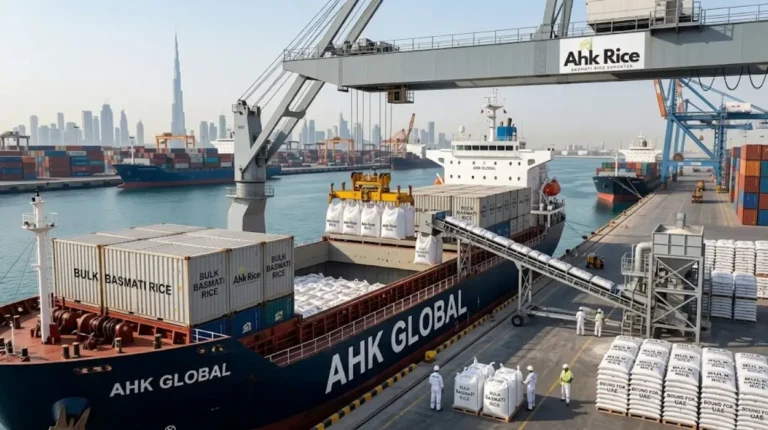
Pakistani rice reaches West Africa through established maritime routes. Exporters load containers at Karachi Port and Port Qasim before dispatching shipments toward West African ports. Ivory Coast receives cargo primarily through the Port of Abidjan.
Several Pakistani rice varieties fit West African demand patterns.
1509 Basmati Rice
1509 Basmati offers long grain length and competitive pricing. Importers use it in retail distribution and food service applications.
1121 Basmati Rice
1121 Basmati delivers extra-long grain appearance and strong visual appeal. Premium retailers and specialty distributors frequently source this variety.
Super Kernel Basmati Rice
Super Kernel Basmati provides traditional aroma and cooking performance. Importers targeting premium consumers often select this specification.
Non-Basmati Rice
Non-Basmati rice supports large-scale consumption requirements. Institutional buyers, wholesalers, and government procurement programs frequently source these grades.
Pakistan’s variety portfolio explains part of its success. The next factor involves the production and processing systems behind exported rice.
How Is Pakistani Rice Produced And Processed For West African Markets?
Rice moves through 9 processing stages before export: cleaning, dehusking, drying, polishing, grading, sorting, testing, packaging, and shipping.
Rice cultivation begins in Punjab and Sindh. Farmers cultivate paddy fields using irrigation systems designed for consistent crop development.
Harvested paddy enters processing facilities after moisture inspection.
Rice Processing Steps
- Clean the paddy to remove dust and foreign materials.
- Dehusk the grain to separate the outer husk.
- Dry the rice to achieve export moisture standards.
- Polish the kernels to improve appearance.
- Grade the rice according to size specifications.
- Sort the grains using optical sorting systems.
- Test the rice for moisture and purity.
- Package the rice according to buyer requirements.
- Ship the cargo after export clearance.
Processing consistency supports international trade requirements. Buyers in Ivory Coast expect uniform grain size, stable moisture levels, and verified quality documentation.
Parboiled grades follow additional processing procedures. Processors soak, steam, and dry paddy before milling. This treatment strengthens grain structure and changes kernel colour.
Processing standards lead directly to the question of which rice grades Ivory Coast importers purchase most frequently.
Which Rice Grades Are Most Popular In Ivory Coast?
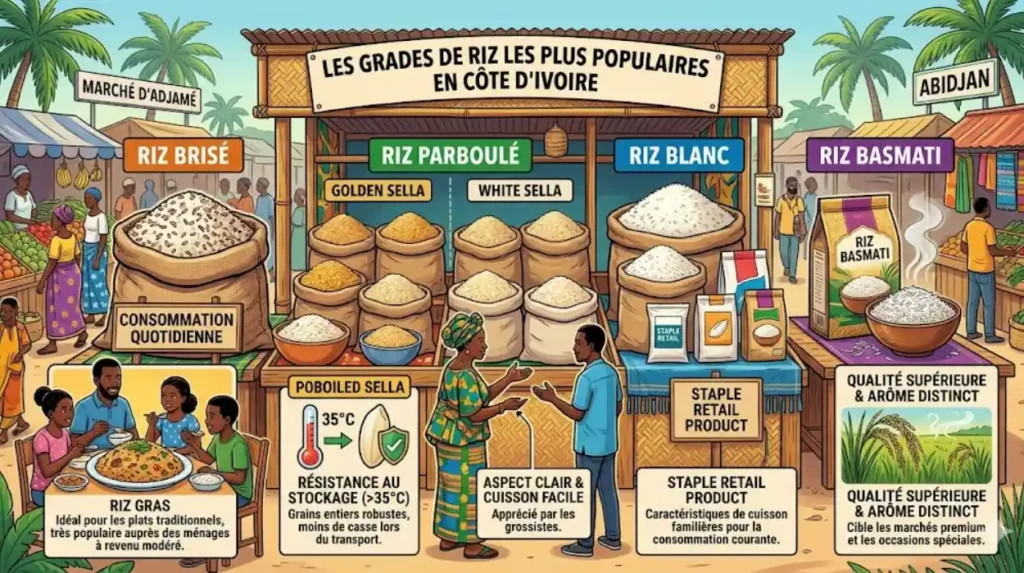
Parboiled rice, white rice, basmati rice, and broken rice represent the main imported categories entering Ivory Coast.
Consumer preferences differ across income groups, distribution channels, and regions.
White Rice
White rice remains a major retail product. Consumers purchase white rice for daily household consumption because of its familiar cooking characteristics.
Golden Sella Rice
Golden Sella rice undergoes parboiling before milling. The process creates a golden appearance and stronger grain structure.
Golden Sella lasts longer than standard white rice. In tropical storage environments exceeding 35°C, Golden Sella maintains grain integrity for extended periods. Retail distributors benefit from reduced breakage during transportation.
White Sella Rice
White Sella combines parboiling benefits with a lighter appearance. Many wholesalers source this category for markets preferring lighter-coloured rice.
Basmati Rice
Basmati rice serves premium retail channels. Long grain length and aroma differentiate basmati from conventional rice categories.
Importers evaluating parboiled specifications often compare processing styles and performance characteristics. Readers interested in grain appearance, storage performance, and importer preferences can explore a detailed comparison of different parboiled specifications in our guide to selecting the right rice type for West African distribution networks.
Grade preferences explain buyer behaviour. Certifications provide the next layer of purchasing confidence.
What Certifications Matter For Rice Imports Into Ivory Coast?
Food safety certificates, phytosanitary certificates, quality inspections, and origin documents support rice imports into West Africa.
Importers require documentation that verifies product quality and regulatory compliance.
Quality Documents
- Certificate of Origin
- Phytosanitary Certificate
- Fumigation Certificate
- Packing List
- Commercial Invoice
Inspection Documents
- Quality Inspection Report
- Moisture Analysis Report
- Purity Verification Report
Export Documents
- Bill of Lading
- Export Declaration
- Insurance Documentation
Government authorities inspect documentation before cargo clearance. These procedures support food safety standards and trade compliance requirements.
Documentation facilitates trade, but market growth depends on broader economic advantages.
What Benefits Does Pakistan Offer To West African Rice Buyers?
Consistent supply, multiple rice categories, scalable export volumes, and established shipping routes support long-term trade relationships.
Pakistan harvests large rice volumes annually. Exporters maintain supply continuity throughout the year using modern storage infrastructure (source: REAP Export Statistics, December 2025).
Variety availability provides another advantage. Importers can source premium aromatic rice, value-focused white rice, parboiled rice, and broken rice from the same exporting country.
Shipping connectivity strengthens commercial relationships. Regular vessel schedules between South Asia and West Africa support predictable procurement planning.
Price segmentation also benefits buyers. Importers can select specifications that match retail, wholesale, institutional, or food service requirements.
These advantages explain trade growth. Misconceptions about West African rice demand often create confusion, which deserves clarification.
What Misconceptions Exist About The West Africa Rice Market?
West Africa imports more than premium basmati rice, and Ivory Coast purchases multiple rice categories across different price segments.
One common misconception suggests that West African buyers only purchase low-cost rice.
West African importers purchase diverse categories. Premium basmati rice serves specialty retailers. Parboiled rice serves mass-market distribution. White rice supports daily household consumption.
Another misconception assumes local production eliminates import demand.
Domestic production remains important. However, consumption levels exceed local output in several countries, including Ivory Coast. Imports continue filling supply gaps (source: FAO Food Outlook Report, 2025).
A third misconception suggests all rice buyers require identical specifications.
Buyer requirements vary significantly. Retail distributors prioritize appearance. Institutional buyers prioritize volume consistency. Food service operators prioritize cooking performance.
Understanding these realities helps explain future market developments.
How Will The West Africa Rice Market Evolve In 2026?
Population growth, urban expansion, and food security planning will continue increasing rice demand across Ivory Coast and West Africa.
West Africa remains one of the fastest-growing food consumption regions globally. Expanding urban populations increase demand for convenient staple foods, including rice (source: World Bank Population Outlook, 2025).
Ivory Coast continues investing in logistics infrastructure, port development, and food distribution networks. These investments support larger import volumes and improved supply chain efficiency.
Rice consumption remains deeply integrated into regional food habits. Household demand, restaurant demand, and institutional demand create multiple channels for imported rice.
Pakistani rice exporters remain relevant participants in this trade ecosystem because they supply several rice categories required by West African buyers.
West Africa rice market 2026 projections indicate that Ivory Coast will remain one of the region’s key rice import destinations, while Pakistan will continue serving as a major supplier through established agricultural production, processing, certification, and export systems.
Frequently Asked Questions
Why does Ivory Coast import rice from Pakistan?
Ivory Coast imports rice from Pakistan because domestic rice production does not meet total consumer demand. Pakistani exporters supply white rice, parboiled rice, basmati rice, and broken rice grades that match different market segments across the country.
Which Pakistani rice varieties are most popular in Ivory Coast?
1509 Basmati, 1121 Basmati, Super Kernel Basmati, White Sella Rice, Golden Sella Rice, and long-grain white rice are among the most imported Pakistani rice varieties in Ivory Coast. Importers select different grades based on retail, wholesale, and food service requirements.
What is the difference between white rice and Golden Sella rice?
White rice is milled directly after harvesting and drying. Golden Sella rice undergoes a parboiling process before milling. Golden Sella has a golden color, stronger grain structure, and better resistance to breakage during storage and transportation.
What documents are required to export rice to Ivory Coast?
Rice exports to Ivory Coast typically require a Certificate of Origin, Phytosanitary Certificate, Fumigation Certificate, Commercial Invoice, Packing List, Bill of Lading, and quality inspection reports. These documents help ensure regulatory compliance and smooth customs clearance.
Will rice demand continue growing in West Africa after 2026?
Rice demand in West Africa is expected to increase because of population growth, urbanization, and rising food consumption. Countries such as Ivory Coast continue importing significant rice volumes to support household consumption and national food security requirements.