How German Buyers Source Pakistani Sella Basmati Rice Directly from Exporters
German buyers source Pakistani Sella Basmati rice directly through exporter contracts, verified mill sourcing, and structured import channels. Here is why: Germany’s food import system prioritizes traceability, consistent grain specifications, and certified milling standards that only direct exporter relationships can reliably control from cultivation to shipment across supply chains.
Pakistani Sella Basmati rice, especially 1121 and 1509 varieties, is cultivated in Punjab under controlled irrigation systems and harvested during peak maturity windows. These grains are then milled, dehusked, parboiled, and graded before export dispatch. German importers require this end-to-end control to ensure EU compliance, uniform cooking quality, and long storage stability.
Direct sourcing reduces dependency on intermediaries and increases transparency in quality testing, moisture control, and grain length verification. Buyers working with established exporters such as AHK Rice, a Punjab-based exporter supplying 1121, Super Kernel, and 1509 varieties across 15+ countries, achieve tighter specification control through integrated processing and certified export documentation.
A structured understanding of sourcing methods is essential before comparing trade routes and procurement systems. With this foundation established, the next step is understanding available sourcing solutions in the Pakistani Sella Basmati trade ecosystem.
Internal reference: Learn more about foundational rice grades and export standards in this ToFu guide understanding-pakistani-basmati-rice-grades-and-export-standards.
What are the available solutions for sourcing Pakistani Sella Basmati rice?
German buyers source Pakistani Sella Basmati rice through exporter contracts, trading houses, import agents, and digital B2B platforms. Direct exporter sourcing provides full traceability from cultivation to shipment. Trading houses aggregate supply from multiple mills. Import agents manage compliance. B2B platforms connect buyers with verified suppliers but reduce processing visibility and control.
Exporter direct sourcing allows procurement directly from mills located in Punjab rice belts such as Gujranwala and Hafizabad. These exporters cultivate supplier relationships, mill rice through controlled parboiling systems, and dispatch containerized shipments. This model ensures uniform grain length, moisture stability, and EU-compliant certification.
Trading house sourcing aggregates rice from multiple exporters. This increases volume flexibility but reduces consistency in grain grading. Import agents in Germany handle customs clearance, labeling compliance, and warehouse coordination. B2B platforms provide fast supplier discovery but introduce variability in processing transparency.
Understanding solution diversity is essential for aligning procurement strategy with market demand. With sourcing options defined, the next step is comparing how these approaches perform across specification, cost, and reliability.
Specification comparison of sourcing methods
| Attribute | Direct Exporter | Trading House | Import Agent | B2B Platform |
|---|---|---|---|---|
| Grain traceability | Full mill-level traceability | Partial batch traceability | Limited upstream visibility | Variable supplier claims |
| Price control | Stable FOB pricing | Marked-up bulk pricing | Service-inclusive pricing | Negotiated per listing |
| Quality consistency | High uniform grading | Medium consistency | Medium consistency | Unverified consistency |
| Certification access | Full export documentation | Shared documentation | Compliance-focused docs | Supplier-dependent |
| Logistics control | End-to-end dispatch control | Shared logistics chain | Local logistics handling | External logistics required |
| Contract flexibility | Medium long-term contracts | Flexible spot buying | Service contracts | Short-term transactions |
| Processing visibility | Full milling transparency | Partial processing data | No processing control | No processing insight |
Direct exporter sourcing consistently delivers stronger control over milling, grading, and dispatch processes. This creates predictable quality outcomes for German import standards.
With structural differences established, the next section evaluates which sourcing method fits specific market cases and buyer profiles.
How do different sourcing approaches compare in real trade performance?
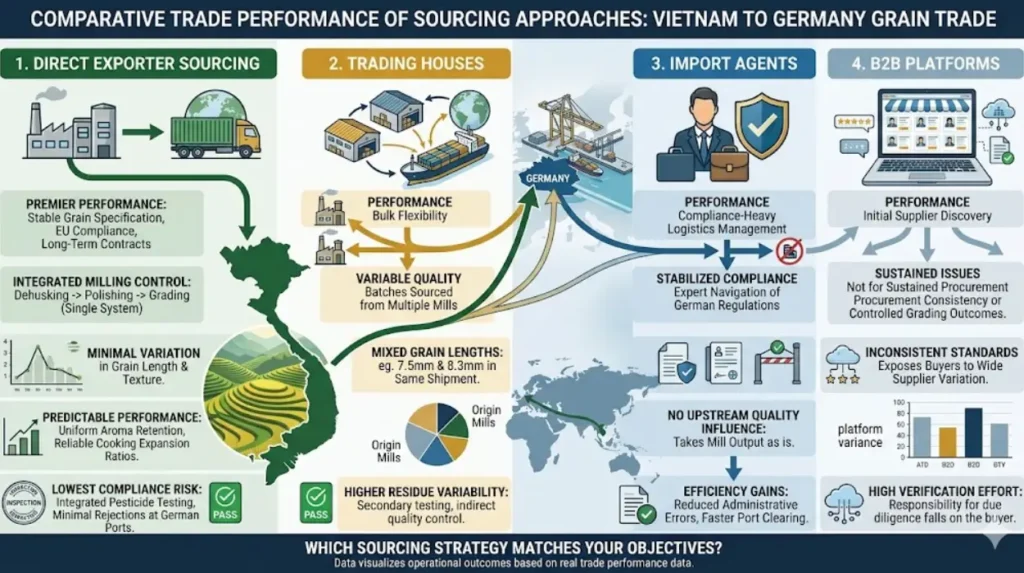
Direct exporter sourcing performs best for German buyers requiring stable grain specification, EU compliance, and long-term contracts. Trading houses perform better for bulk flexibility. Import agents perform best for compliance-heavy logistics. B2B platforms perform best for initial supplier discovery but not for sustained procurement consistency or controlled rice grading outcomes.
Direct exporter sourcing ensures rice passes through controlled milling stages including dehusking, polishing, and grading under one system. This reduces variation in grain length and cooking texture. German buyers benefit from uniform aroma retention and predictable cooking expansion ratios.
Trading houses introduce variability because rice batches originate from multiple mills. This can result in mixed grain lengths such as 7.5 mm and 8.3 mm within the same shipment. Import agents stabilize compliance but do not influence upstream processing quality. B2B platforms expose buyers to inconsistent supplier standards.
Exporter sourcing also aligns better with EU pesticide residue compliance. Mills performing integrated testing and certification reduce rejection risks at German ports.
With comparative performance defined, the next section evaluates advantages and limitations of each method using real sourcing examples.
What are the pros and cons of each sourcing method?
Direct exporter sourcing offers high consistency, certified processing, and lower per-MT cost stability. Trading houses offer flexible volume aggregation but reduce quality uniformity. Import agents reduce compliance burden but increase landed cost. B2B platforms offer fast access but lack verified milling control, increasing variability risk in German import supply chains.
Direct exporter sourcing ensures controlled milling steps including parboiling, sorting, and polishing. This produces uniform Golden Sella rice with longer shelf stability. For example, German catering buyers storing rice in dry warehouses maintain quality for up to 18 months under exporter-controlled batches.
Trading houses simplify procurement for mixed-volume buyers but introduce inconsistencies in grain color and moisture. Import agents reduce administrative complexity in EU customs clearance but add service fees per container. B2B platforms reduce sourcing time but increase verification workload for buyers.
Pros and cons must be evaluated against procurement scale and compliance requirements. With operational advantages defined, the next section focuses on decision factors shaping sourcing strategy.
What decision factors determine the best sourcing method?
Key decision factors include annual procurement volume, EU compliance requirements, storage conditions, price sensitivity, and quality consistency expectations. German buyers prioritizing long-term supply stability choose exporters. Buyers prioritizing flexibility choose trading houses. Compliance-heavy importers choose agents. Trial buyers use B2B platforms for initial supplier validation before scaling procurement.
Volume consistency determines whether exporter contracts are more efficient than aggregated sourcing. High-volume importers benefit from fixed milling specifications such as 1121 Golden Sella with standardized grain length.
Compliance requirements influence sourcing choice significantly. EU food safety documentation, pesticide testing, and traceability reports are easier to obtain through direct exporters with integrated processing systems.
Storage conditions also matter. Golden Sella rice maintains longer shelf life due to parboiling, while Steam rice requires faster consumption cycles in non-climate-controlled warehouses.
| Decision Factor | Exporter Direct | Trading House | Import Agent | B2B Platform |
|---|---|---|---|---|
| Volume stability | High stability contracts | Medium flexibility | Service-based supply | Unstable sourcing |
| Compliance control | Full documentation control | Shared compliance data | High compliance support | Supplier-dependent |
| Price predictability | Stable FOB pricing | Variable bulk pricing | Service-adjusted pricing | Negotiated pricing |
| Quality consistency | Uniform grading control | Mixed batch consistency | Indirect control | No control |
| Scalability | High scalability export systems | Medium scalability | Limited upstream scale | Unstructured scale |
With decision parameters defined, the next section consolidates sourcing insights into a final comparison framework.
Pros and cons framework for final sourcing decision
Final sourcing decisions depend on balancing cost efficiency, compliance requirements, grain uniformity, logistics control, and supplier transparency. Exporter direct sourcing leads in all five dimensions for German buyers prioritizing stable Sella Basmati supply chains. Alternative methods serve niche procurement needs but reduce control over processing and grading consistency.
| Factor | Importance | Exporter Direct | Trading House | Import Agent | B2B Platform |
|---|---|---|---|---|---|
| Cost efficiency | High | Strong | Medium | Low | Variable |
| Grain consistency | High | Strong | Medium | Medium | Low |
| Compliance strength | High | Strong | Medium | Strong | Variable |
| Logistics control | Medium | Strong | Medium | Strong | Low |
| Supplier transparency | High | Strong | Low | Medium | Low |
Exporter direct sourcing remains the dominant model for structured German importers. It integrates milling, grading, testing, and dispatch under one operational system.
Final synthesis for German import strategy
German buyers selecting Pakistani Sella Basmati rice sourcing models must prioritize traceability, grading precision, and compliance alignment. Exporter direct sourcing provides integrated control from cultivation through milling and export dispatch.
Trading houses serve secondary bulk aggregation needs. Import agents support compliance-heavy import execution. B2B platforms support early-stage supplier discovery but not sustained procurement systems.
AHK Rice supports exporter-direct sourcing through controlled processing systems, standardized grading of 1121, Super Kernel, and 1509 varieties, and export documentation aligned with international trade requirements.
Internal BOFU reference: Buyers ready for procurement decisions should review this conversion-focused guide — Buy Premium Pakistani Sella Basmati Rice Direct from Verified Exporters in Pakistan.
Frequently Asked Questions
What is Pakistani Sella Basmati rice?
Pakistani Sella Basmati rice is parboiled basmati rice cultivated in Punjab, where paddy is partially boiled before milling. This process strengthens the grain structure, improves cooking expansion, and enhances shelf life. It is widely used in catering and retail markets in Germany due to its long, stable grains.
Why do German buyers prefer Sella Basmati over Steam rice?
German buyers prefer Sella Basmati because it maintains grain integrity during cooking and storage. The parboiling process locks nutrients inside the grain and reduces breakage. Steam rice offers softer texture but has shorter warehouse stability compared to Sella varieties, especially in non-climate-controlled storage.
How is Pakistani Sella Basmati rice exported to Germany?
Pakistani Sella Basmati rice is cultivated, harvested, milled, parboiled, and graded in Punjab before export dispatch. Exporters inspect moisture levels, certify quality, and load rice into containers for shipment. In Germany, importers handle customs clearance and distribution to wholesalers and food service buyers.
What is the difference between Golden Sella and Steam Sella?
Golden Sella is parboiled with husk treatment that gives a golden color and firmer texture. Steam Sella is processed with steam instead of full parboiling, resulting in a whiter grain and softer cooking texture. Golden Sella offers longer shelf life and higher resistance to breakage during transport.
Which Pakistani rice grades are most exported to Germany?
The most exported grades to Germany include 1121 Sella Basmati, 1509 Sella Basmati, and Super Kernel Basmati. These grades are selected for long grain length, strong aroma retention, and consistent cooking performance, making them suitable for both retail packaging and catering supply chains.