The Role of Pakistani Sella Basmati Rice in Qatar’s Food Supply Chain
Pakistani Sella Basmati Rice plays a critical role in Qatar’s food supply chain because it offers long shelf life, consistent cooking performance, and reliable import availability. Here is why: Qatar imports a large percentage of its food requirements, and Sella Basmati Rice provides the quality, storage stability, and volume needed for retail, hospitality, and catering sectors.
Qatar depends on imported food products due to limited agricultural land and water resources. Rice remains one of the most consumed staple foods across households, restaurants, hotels, and catering companies. Pakistani Sella Basmati Rice occupies an important position within this supply chain because it combines premium grain quality with export-ready specifications.
Pakistani Basmati cultivation occurs primarily in Punjab. The region produces long-grain aromatic rice varieties that meet the requirements of Gulf markets. Sella Basmati undergoes a specialized parboiling process before milling, which improves grain strength and storage performance.
Understanding the role of Sella Basmati Rice requires examining its production, processing, logistics, market demand, and food service applications within Qatar.
What Is Pakistani Sella Basmati Rice?
Pakistani Sella Basmati Rice is a parboiled aromatic long-grain rice processed through soaking, steaming, drying, and milling to improve grain strength, shelf life, and cooking performance.
Pakistani Sella Basmati Rice originates from Basmati-growing regions in Punjab, Pakistan. Farmers cultivate Basmati varieties using irrigation systems fed by the Indus River basin. The grain develops its characteristic aroma, slender shape, and elongation properties during cultivation.
Sella refers to the parboiling process applied before milling. The process transfers nutrients from the outer layers into the grain. The treatment strengthens the kernel and reduces breakage during handling and transportation.
Qatari buyers often source Sella Basmati because large-scale food operations require consistent cooking results. Hotels, catering businesses, and institutional kitchens value grain stability during bulk preparation.
Which Sella Basmati Grades Reach Qatar?
Several Basmati grades enter the Qatari market.
1121 Sella Basmati Rice
1121 Sella Basmati features extra-long grains measuring approximately 8.30 mm to 8.40 mm before cooking. The grain elongates significantly after cooking and remains separate.
Super Kernel Sella Basmati Rice
Super Kernel Sella Basmati offers a traditional Basmati aroma and strong acceptance among Gulf consumers. The grain provides balanced cooking performance and premium presentation.
1509 Sella Basmati Rice
1509 Sella Basmati delivers high yield and efficient production cycles. The grade supports cost-conscious commercial food operations.
With the definition of Sella Basmati established, the next question is how this specialized processing system works.
How Does Pakistani Sella Basmati Rice Move Through the Food Supply Chain?
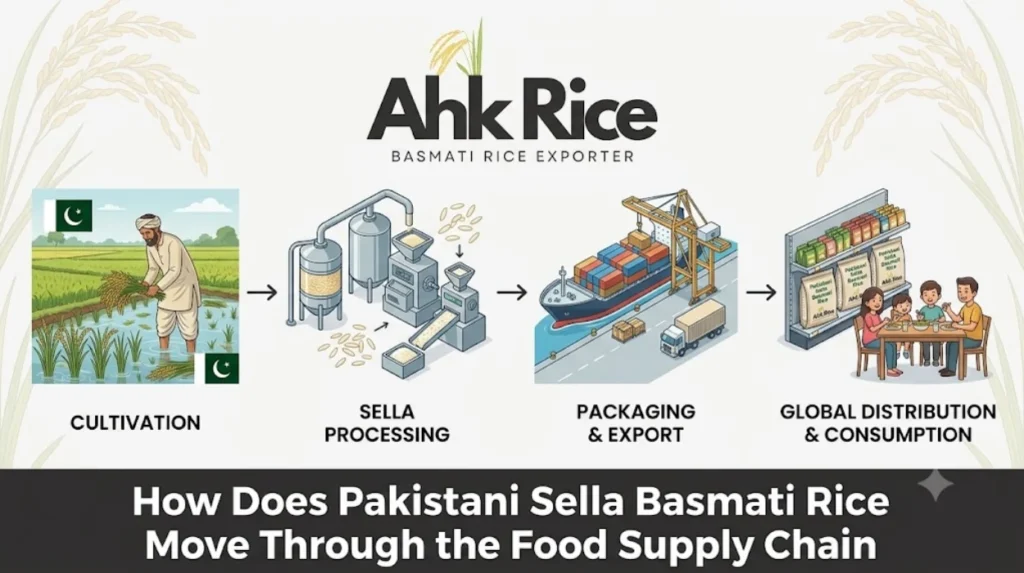
Pakistani Sella Basmati Rice moves through cultivation, harvesting, parboiling, milling, grading, certification, export logistics, import clearance, distribution, and food service channels.
The food supply chain begins in Punjab’s rice-growing districts. Farmers cultivate Basmati rice during the Kharif season. Harvesting takes place after grain maturity.
Processing facilities receive harvested paddy. Each stage contributes to quality preservation and export readiness.
What Are the Main Processing Steps?
The processing chain includes 9 essential stages:
- Clean the harvested paddy.
- Soak the paddy in controlled water tanks.
- Steam the soaked grain.
- Dry the parboiled paddy.
- De-husk the grain.
- Mill the kernels.
- Grade by size and quality.
- Sort through color sorting systems.
- Pack for export shipment.
Each step affects grain quality. Parboiling improves kernel hardness. Color sorting removes defective grains. Grading creates uniform specifications for importers.
How Does Rice Reach Qatar?
Export logistics involve several documented stages.
- Quality Inspection Certificates
- Phytosanitary Certificates
- Certificate of Origin
- Packing Lists
- Commercial Invoices
- Bill of Lading
- Health Certificates
Exporters load containers at Pakistani ports. Shipping lines transport rice to Gulf ports. Importers clear customs and distribute products through wholesalers, retailers, and food service suppliers.
With the supply chain process explained, the next question concerns the specific components that make Sella Basmati suitable for Qatar.
What Key Components Make Pakistani Sella Basmati Important for Qatar?
Long grain length, parboiling technology, aroma retention, storage stability, cooking consistency, and export infrastructure make Pakistani Sella Basmati important within Qatar’s food ecosystem.
Food supply chains depend on predictable product performance. Sella Basmati satisfies this requirement through several measurable characteristics.
Grain Length
Basmati grains maintain premium appearance. Long grains improve presentation in traditional Gulf dishes.
Parboiling Technology
Parboiling strengthens kernels before milling. Stronger grains reduce breakage during transportation and storage.
Aroma Profile
Basmati contains natural aromatic compounds. These compounds contribute to the distinctive fragrance associated with premium rice dishes.
Storage Performance
Sella Basmati maintains quality during long-distance shipping. The grain remains stable under commercial storage conditions.
Quality Control Systems
Modern rice processing facilities use:
- Moisture control
- Laboratory testing
- Colour sorting
- Metal detection
- Grain grading
- Fumigation management
These systems help maintain export standards demanded by international buyers.
With the components identified, the next section explains the benefits created by these characteristics.
What Benefits Does Pakistani Sella Basmati Rice Provide to Qatar’s Food Supply Chain?
Reliable availability, lower breakage rates, longer storage life, consistent cooking quality, and suitability for bulk food preparation strengthen Qatar’s food supply chain.
Food security depends on stable imports. Sella Basmati supports this objective through dependable supply volumes from Pakistan.
Reduced Grain Breakage
Parboiled kernels withstand handling better than untreated rice. Lower breakage improves commercial value and customer satisfaction.
For example, Golden Sella maintains structural integrity during container transport. White Rice experiences higher breakage under identical handling conditions.
Longer Shelf Life
Sella Basmati stores efficiently within retail and wholesale inventory systems.
Golden Sella lasts longer than Steam Rice. In a 40°C warehouse environment common in Gulf logistics networks, Golden Sella maintains quality for approximately 18 months. Steam Rice performs best within 12 months.
For large catering suppliers serving thousands of meals daily, longer storage stability improves inventory management.
Consistent Cooking Performance
Restaurants require predictable cooking outcomes. Sella Basmati provides uniform grain expansion and separation.
Bulk kitchens benefit from repeatable preparation standards because food quality remains consistent across large production volumes.
With the benefits understood, the next question examines where the rice is actually used within Qatar.
Where Is Pakistani Sella Basmati Rice Used in Qatar?
Pakistani Sella Basmati Rice serves households, hotels, restaurants, catering companies, institutional kitchens, and food distribution networks throughout Qatar.
Different sectors require different rice specifications.
Hospitality Industry
Hotels prepare large quantities of rice-based dishes daily. Sella Basmati supports buffet operations due to grain stability.
Restaurant Sector
Restaurants use premium Basmati for biryani, mandi, kabsa, and grilled meat accompaniments.
Catering Operations
Large catering companies prioritize rice that performs consistently during batch cooking. Sella Basmati fulfills this requirement.
Retail Markets
Retail consumers purchase packaged Basmati through supermarkets and specialty stores.
Institutional Food Services
Schools, labor accommodations, healthcare facilities, and corporate dining operations depend on stable rice supplies throughout the year.
The widespread applications explain demand, but several misconceptions still surround Sella Basmati Rice.
What Common Misconceptions Exist About Pakistani Sella Basmati Rice?
The most common misconceptions involve nutrition, quality, aroma, cooking characteristics, and grade differences between White, Steam, and Sella Basmati Rice.
Market confusion often occurs because multiple Basmati categories exist.
Misconception 1: Sella Rice Is Lower Quality
Sella Rice undergoes additional processing. The parboiling stage strengthens the grain rather than reducing quality.
Many commercial buyers specifically choose Sella because of its durability.
Misconception 2: All Basmati Grades Are Identical
Different grades have different characteristics.
1121 Sella offers exceptional grain length. Super Kernel provides traditional aroma. 1509 supports high-volume commercial applications.
Misconception 3: White Rice and Sella Rice Cook the Same Way
Cooking performance differs significantly.
Golden Sella absorbs water differently than White Basmati. Grain texture remains firmer after cooking.
For catering operations serving hundreds of guests, Sella reduces the risk of overcooking.
Misconception 4: Aroma Determines Quality Alone
Quality evaluation involves multiple factors:
- Grain length
- Moisture content
- Purity percentage
- Broken percentage
- Cooking elongation
- Certification compliance
Professional importers assess all specifications before procurement decisions.
With misconceptions clarified, the final question concerns future demand patterns.
Why Does Pakistani Sella Basmati Continue to Matter in Qatar’s Food Supply Chain?
Growing food demand, expanding hospitality sectors, strong trade relationships, and consistent product performance ensure continued importance for Pakistani Sella Basmati Rice.
Qatar’s population growth supports sustained food demand. The hospitality industry continues expanding through tourism, business travel, and event-driven consumption.
Pakistani exporters maintain established trade routes with Gulf markets. Efficient shipping networks support continuous supply availability.
Sella Basmati remains relevant because it combines agricultural quality, processing technology, and logistics efficiency within a single product category.
Rice importers require predictable specifications. Food service companies require reliable cooking results. Consumers require premium eating experiences. Pakistani Sella Basmati Rice fulfills these requirements through a structured supply chain that begins in Punjab’s fields and ends on dining tables across Qatar.
A deeper understanding of processing differences helps buyers evaluate specifications more effectively. Readers interested in grain characteristics should continue with the article discussing the distinctions between white, steam, and parboiled rice types.
Frequently Asked Questions
Why is Sella Basmati Rice popular in Qatar?
Sella Basmati Rice offers long shelf life, strong grain structure, and consistent cooking performance. These characteristics support retail distribution, food service operations, and large-scale catering requirements across Qatar.
What makes Pakistani Sella Basmati different from White Basmati Rice?
Pakistani Sella Basmati undergoes soaking, steaming, and drying before milling. This process strengthens the grain and improves storage performance compared with traditional White Basmati Rice.
Which Pakistani Basmati varieties are commonly exported to Qatar?
The most common varieties include 1121 Sella Basmati, Super Kernel Sella Basmati, and 1509 Sella Basmati. Each variety serves different retail and commercial market requirements.
How long does Sella Basmati Rice remain suitable for storage?
Properly stored Sella Basmati Rice maintains quality for extended periods because the parboiling process improves kernel stability. Commercial inventories often prefer Sella grades for long-term storage management.
Why do catering companies prefer Sella Basmati Rice?
Catering companies value Sella Basmati because the grains remain separate after cooking, tolerate bulk preparation, and deliver consistent results across large meal volumes.