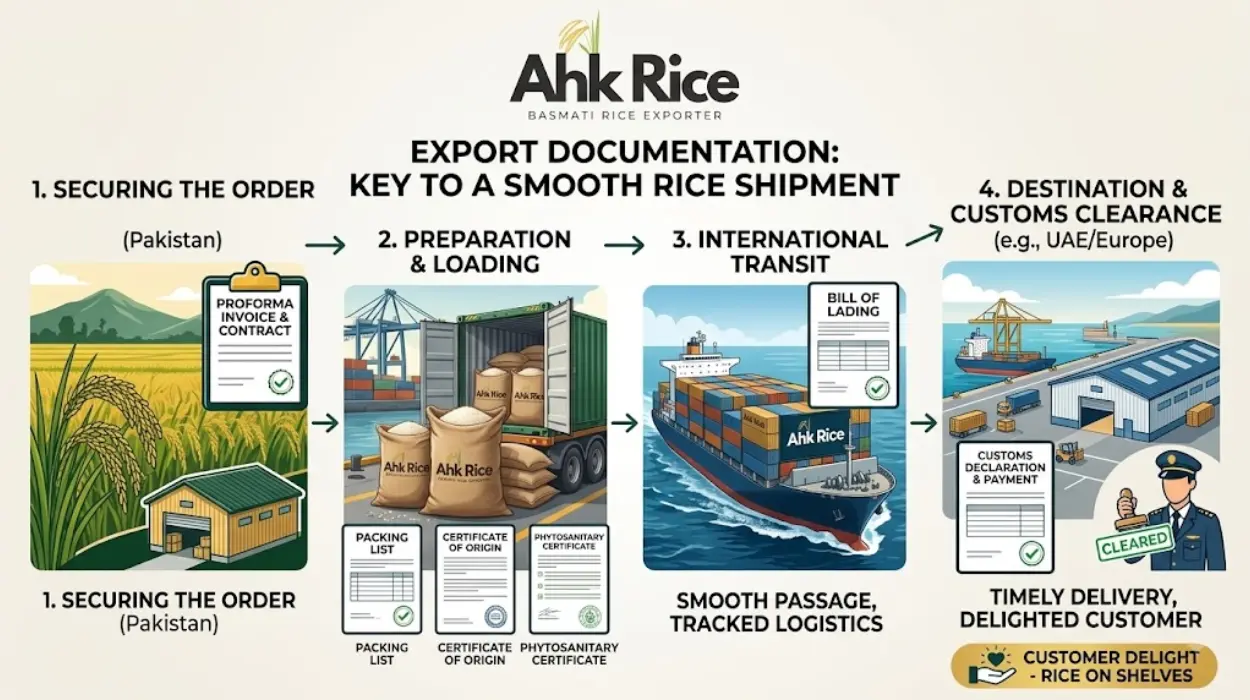
How Do Export Documents Support Smooth Rice Shipment Clearance?
Complete export documentation supports smooth rice clearance by matching product identity, quantity, value, origin, treatment, and transport data across every shipment record. Here is why: customs authorities use these records to verify cargo, assess compliance, and release shipments.
Rice export documentation connects the physical shipment with its legal and commercial identity. Pakistan’s web-based export procedure lists the commercial invoice, packing list, Form-E, and phytosanitary certificate among required documents. Rice shipments also use the Pakistan Single Window process for export declarations and phytosanitary certification. (source: Trade Information Portal of Pakistan; Pakistan Single Window)
For buyers learning the complete documentation requirements before comparing suppliers, this guide on Pakistan rice export documentation for UAE importers provides the foundational document and compliance context.
What are the available solutions for rice export documentation?
Rice exporters can use exporter-managed documentation, clearing-agent coordination, buyer-managed compliance, or an integrated documentation workflow. Integrated management provides the strongest control because product, certification, customs, and shipping records stay synchronized.
Export documentation means the records used to identify, value, certify, inspect, transport, and clear exported rice. The core documents normally include a commercial invoice, packing list, bill of lading, certificate of origin, phytosanitary certificate, and customs declaration. Additional certificates depend on the destination and buyer requirements. (source: Trade Information Portal of Pakistan)
Which documents form the core rice export set?
Commercial invoices establish the seller, buyer, product description, quantity, value, HS classification, and trade terms. Customs authorities use these details to assess the shipment and compare declared information with other records.
Packing lists identify packages, weights, quantities, marks, and container details. Customs officers and freight operators use this information during cargo examination and handling. Pakistan’s export guidance specifically identifies packing lists and invoices as core documents for export clearance. (source: Trade Information Portal of Pakistan)
Certificates of origin establish where the rice originates. Phytosanitary certificates confirm plant-health compliance. Fumigation certificates document treatment where required. Inspection reports verify agreed quality parameters. Bills of lading establish the transport record after cargo loading.
How does Pakistan’s electronic export system support clearance?
Pakistan’s Single Declaration system allows exporters and clearing agents to submit export information electronically through the Pakistan Single Window. Rice was specifically moved into the PSW workflow for electronic phytosanitary certification and customs clearance. (source: Pakistan Single Window)
This electronic workflow reduces dependence on disconnected paperwork. The exporter enters shipment information once and connects supporting documentation to the declaration. Data accuracy therefore becomes as important as document availability.
With the documentation options defined, the next issue is comparing how each approach controls clearance risk.
How do different documentation approaches compare?
Exporter-managed documentation offers the strongest product knowledge, while clearing agents add customs expertise. Buyer-managed documentation provides control but increases coordination demands. Integrated workflows provide the best balance for recurring commercial rice shipments.
Rice exporters generally use four documentation approaches. Each approach distributes responsibility differently between the exporter, buyer, bank, freight forwarder, and customs representative.
| Attribute | Exporter Managed | Clearing Agent Managed | Buyer Managed | Integrated Workflow |
|---|---|---|---|---|
| Product data control | High | Medium | Medium | High |
| Customs expertise | Medium | High | Medium | High |
| Certificate coordination | High | High | Medium | High |
| Error detection | High | High | Medium | High |
| Buyer visibility | High | Medium | High | High |
| Processing efficiency | High | High | Medium | Very high |
| Best use | Regular exports | Complex clearance | Experienced buyers | Repeat shipments |
Exporter-managed documentation works well when the supplier understands rice specifications and destination requirements. The exporter prepares the commercial and technical records before dispatch.
Clearing-agent management works well when customs procedures require specialized local knowledge. The agent submits declarations, coordinates inspections, and communicates with customs authorities.
Buyer-managed documentation gives importers greater control over destination compliance. This model requires strong knowledge of local food, customs, labeling, and import rules.
Integrated documentation combines exporter preparation, quality verification, electronic customs submission, freight coordination, and buyer document sharing. This approach reduces the number of disconnected handoffs.
The comparison shows that documentation quality depends on coordination rather than the number of certificates alone.
How do Gulf and European markets differ in rice documentation requirements?
Gulf markets prioritize phytosanitary, fumigation, origin, and food-control records, while UK and EU markets place stronger emphasis on traceability, pesticide compliance, and destination-specific food regulations. Document preparation must match each market.
Regional documentation requirements differ because customs authorities and food regulators apply different compliance frameworks. UAE importers commonly request commercial invoices, packing lists, bills of lading, certificates of origin, phytosanitary certificates, fumigation certificates, import permits, and laboratory reports.
UK and EU buyers also evaluate phytosanitary compliance, certificates of origin, commercial invoices, packing lists, and laboratory evidence. EU importers place particular importance on maximum residue limits and traceability. Current market guidance identifies EU MRL compliance and RASFF monitoring as important controls for Pakistani rice entering Europe.
Which grades do these regions commonly prefer?
Gulf importers commonly select 1121 Golden Sella, 1121 Steam, Super Kernel, and 1509 according to retail, catering, and wholesale requirements. Golden Sella suits bulk foodservice applications because parboiling strengthens grain structure and supports longer storage.
UK and European buyers commonly select 1121 White, 1121 Steam, Super Kernel, and selected Sella grades. Retail buyers place stronger emphasis on appearance, aroma, packaging, traceability, and laboratory compliance.
How do indicative prices compare?
Current indicative FOB Karachi pricing places 1121 Golden Sella around US$1,145–1,185 per MT. 1121 White ranges around US$1,165–1,205 per MT. These benchmarks apply before destination freight and local import charges. (source: Pakistan Rice market pricing, July 2026)
For UAE and UK buyers, the product FOB range can therefore overlap substantially. The delivered price differs because freight, insurance, port charges, customs costs, and Incoterms change the final landed cost.
UAE shipments also have shorter sailing times. Current market guidance places Karachi–Jebel Ali sailing around 4–10 days, while Karachi–Felixstowe is around 24–40 days.
How does shelf life affect the documentation decision?
Golden Sella commonly carries a 18–24 month commercial shelf-life range under appropriate storage. White and Steam Basmati commonly fall around 12–18 months. Storage conditions, moisture, packaging, crop age, and warehouse management affect actual product stability.
For Gulf distributors holding larger inventory cycles, Golden Sella provides a stronger storage-oriented specification. For UK retail buyers emphasizing white appearance and aroma, Steam or White can provide a better product-market fit.
Regional differences therefore affect both product selection and documentation preparation.
Which documentation method works best for different shipment cases?
Integrated exporter documentation works best for recurring container shipments, while clearing-agent support suits complex customs cases. Buyer-led compliance fits experienced importers with established regulatory systems and destination-specific document controls.
Different buyers require different levels of documentation support.
Which method suits a first-time importer?
Exporter-managed documentation provides the simplest structure for first-time importers. The exporter prepares core documents and explains the shipment record before dispatch.
A first-time buyer should verify the invoice, packing list, certificate of origin, phytosanitary certificate, fumigation certificate, inspection certificate, and bill of lading before vessel arrival.
Which method suits recurring wholesale orders?
Integrated documentation works best for recurring wholesale orders. The exporter can standardize product descriptions, packaging information, HS codes, certificate formats, and shipment data across repeat orders.
Standardization reduces repeated corrections. It also creates a consistent documentary history for the importer.
Which method suits regulated markets?
Buyer-exporter coordination works best for regulated markets. The exporter prepares origin and product documentation. The buyer confirms destination-specific permits, food registrations, laboratory requirements, and labeling rules.
The importer remains responsible for destination compliance because import rules belong to the destination jurisdiction.
What are the pros and cons of each documentation approach?
Exporter control improves product accuracy and reduces communication gaps, while agent support strengthens customs handling. Buyer-led systems increase destination control but require expertise. Integrated workflows provide efficiency but require disciplined coordination.
Exporter-managed documentation
Advantages
- Product data remains close to the processing source.
- Certificate preparation follows shipment specifications.
- Corrections can occur before container dispatch.
- Buyers receive one coordinated document package.
Disadvantages
- Destination-specific rules require additional buyer input.
- Complex customs cases may require specialist agents.
A rice exporter that prepares a packing list directly from the final container plan can reduce quantity mismatches during customs review.
Clearing-agent documentation
Advantages
- Customs procedures receive specialist handling.
- Electronic declarations receive professional review.
- Inspection communication becomes centralized.
Disadvantages
- Product specifications may pass through another communication layer.
- Incorrect instructions can create discrepancies between commercial and customs records.
Buyer-managed documentation
Advantages
- Destination compliance remains directly controlled.
- Import permits can be coordinated with local authorities.
- Retail registration requirements can be checked before arrival.
Disadvantages
- The importer carries more administrative responsibility.
- Communication between exporter and buyer becomes more important.
Integrated documentation
Advantages
- Product, quality, origin, treatment, and transport records remain connected.
- Repeat shipments use standardized data.
- Errors can be identified before customs submission.
Disadvantages
- The system requires clear responsibility at every stage.
- Destination requirements still require importer verification.
The advantages and limitations show why documentation should be evaluated as a workflow rather than a document checklist.
What decision factors should buyers use before choosing a rice exporter?
Buyers should evaluate document completeness, data consistency, certification capability, destination knowledge, and pre-shipment verification. These five factors reveal whether an exporter can support clearance beyond simply supplying individual certificates.
| Decision Factor | What Buyers Should Check | Why It Matters |
| Document completeness | Core certificates and transport records | Prevents missing-document holds |
| Data consistency | Product, quantity, weight, and container numbers | Prevents discrepancies |
| Certification capability | Phytosanitary and origin documentation | Supports regulatory clearance |
| Destination knowledge | Market-specific requirements | Reduces compliance gaps |
| Pre-shipment verification | Inspection and laboratory records | Confirms shipment specifications |
Document completeness comes first because missing certificates can stop the clearance process. Pakistan’s official export procedure identifies core records that must accompany applicable shipments.
Data consistency comes next because customs officers compare shipment information across records. The commercial invoice, packing list, customs declaration, certificate, and bill of lading should describe the same shipment.
Certification capability matters for food commodities because rice falls within plant and food-related regulatory controls. Pakistan’s system specifically connects rice exports with electronic phytosanitary certification.
Destination knowledge matters because import requirements differ between UAE, Saudi Arabia, UK, EU, China, and other markets. A document package must therefore reflect the actual destination.
Pre-shipment verification provides the final control. Laboratory reports and inspection certificates establish measurable evidence before cargo leaves Pakistan.
How can exporters prepare documents for smoother rice shipment clearance?
Exporters should verify shipment specifications, prepare commercial records, obtain required certificates, reconcile transport details, and share the completed document set before arrival. Early verification prevents avoidable customs corrections and destination delays.
What should exporters verify first?
- Verify the product name and rice grade.
- Verify the HS classification.
- Verify the net and gross weights.
- Verify the package count and packaging format.
- Verify the buyer and consignee details.
- Verify the origin statement.
- Verify the destination port.
- Verify the container and seal numbers.
- Verify treatment and inspection certificates.
- Verify the bill of lading after loading.
The commercial invoice should match the packing list. The packing list should match the physical cargo. The bill of lading should match the loaded container details.
The phytosanitary certificate should correspond with the exported commodity and shipment information. Pakistan’s current PSW workflow specifically connects rice exports with electronic phytosanitary certification.
AHK Rice manages export documentation as part of its integrated processing and logistics workflow. Its documented export process includes commercial invoices, packing lists, phytosanitary certificates, certificates of origin, fumigation certificates, and bills of lading.
For buyers moving from evaluation to supplier selection, the next logical resource is the decision-stage article,Receive Complete Rice Export Documentation from AHK Rice.
Why does documentation accuracy matter more than document quantity?
Accurate documentation creates one consistent shipment identity across customs, logistics, food safety, banking, and buyer records. Ten inconsistent documents create more clearance risk than a smaller set of complete and correctly matched documents.
Documentation accuracy affects customs valuation, cargo identification, regulatory compliance, and transport release. A mismatch in weight, consignee, product description, or container number can trigger manual review.
Pakistan’s export guidance confirms that customs clearance uses documents such as invoices and packing lists alongside electronic declarations.
The practical objective is therefore not to produce the largest document package. The objective is to produce the correct package with matching data.
For a shipment containing 1121 Golden Sella Basmati, the grade, quantity, packaging, origin, treatment, inspection records, and transport details should remain consistent across the documentary chain.
That consistency connects rice processing with customs clearance and turns documentation into an operational control rather than an administrative afterthought.
Frequently Asked Questions
What documents are required for rice export from Pakistan?
The core documents include a commercial invoice, packing list, export declaration, certificate of origin, phytosanitary certificate, and bill of lading. Fumigation, inspection, health, laboratory, or destination-specific documents apply according to the shipment and importing market.
Why is the phytosanitary certificate important for rice exports?
The phytosanitary certificate provides plant-health certification for agricultural cargo. Pakistan’s export system connects rice shipments with electronic phytosanitary certification through the Pakistan Single Window.
Why must the commercial invoice and packing list match?
The invoice establishes commercial value and product information. The packing list establishes package and weight information. Matching records allow customs and logistics teams to verify the same physical shipment across documents.
Does every rice shipment require a fumigation certificate?
Fumigation requirements depend on destination regulations, treatment requirements, and buyer specifications. Exporters should confirm the destination’s applicable agricultural and food-import rules before container loading.
How does documentation reduce customs delays?
Complete documentation gives customs authorities the information needed to identify, value, inspect, and regulate the shipment. Accurate records also reduce manual corrections caused by inconsistent product, weight, origin, or container information.
Which rice grades are suitable for longer storage?
Golden Sella commonly provides an 18–24 month commercial shelf-life range under suitable storage conditions. White and Steam Basmati commonly provide around 12–18 months. Actual stability depends on moisture, packaging, warehouse conditions, and crop characteristics.
How much does Pakistani Basmati rice cost per MT?
Current indicative FOB Karachi prices place 1121 Golden Sella around US$1,145–1,185 per MT, while 1121 White ranges around US$1,165–1,205 per MT. Freight, insurance, destination charges, and Incoterms change the final landed price.
What should buyers check before selecting a rice exporter?
Buyers should check document completeness, data consistency, certification capability, destination-market knowledge, and pre-shipment inspection. These five factors provide a stronger supplier assessment than price alone.