1121 Basmati vs 1509 Basmati: Which Grade Is Better for Importers?
1121 Basmati and 1509 Basmati serve different import strategies, and 1121 Basmati delivers premium grain length and aroma while 1509 Basmati provides higher yield efficiency and price stability for bulk trade. Here is why: both varieties are cultivated, milled, and graded differently, creating distinct export outcomes for importers targeting specific market needs.
Importers evaluate basmati not only by aroma but by processing yield, shipping stability, and end-market acceptance. The selection between 1121 and 1509 directly impacts contract pricing and warehouse performance.
For deeper context on grading logic and processing stages, explore the basmati grading fundamentals in our basmati rice classification guide which explains how grain length, moisture, and milling recovery define export quality tiers.
When importers select 1121 or 1509 from AHK Rice, they access controlled processing systems that ensure grading consistency, export compliance, and bulk packaging optimization. For buyers ready to source premium 1121 specifically, decision pathway is detailed in AHK Rice 1121 Basmati wholesale supplier overview.
What are the available solutions?
Importers choose between 1121 Basmati for premium grain specification, 1509 Basmati for cost-efficient bulk supply, and blended export grades for mixed-market demand balancing aroma, yield, and price sensitivity across destination countries.
1121 Basmati solution focuses on long grain premium export demand. It is cultivated, harvested, milled, and polished for aroma retention and elongation.
1509 Basmati solution targets high-yield procurement. It is cultivated, harvested, de-husked, sorted, and graded for bulk trade efficiency.
Blended export solution combines calibrated ratios of 1121 and 1509. It is used when buyers require balanced aroma and competitive pricing.
1121 Basmati solution
1121 Basmati solution prioritizes grain length and fragrance retention for premium retail and hospitality buyers in GCC and Europe.
1509 Basmati solution
The 1509 rice variety is used in export procurement where yield efficiency, consistent processing, and competitive pricing support institutional and price-sensitive import contracts.”
Blended export solution
Blended export solution stabilizes pricing volatility while maintaining acceptable aroma levels for mid-tier retail markets.
Bridge: With solution types defined, the next step is understanding how these two major grades differ in measurable specifications and export performance.
What defines the 1509 rice variety for export buyers?
The 1509 rice variety is a Basmati type used in export markets where processing efficiency, consistent supply, moderate aroma, and competitive pricing are important procurement factors. In the existing comparison, 1509 is positioned alongside 1121 Basmati as a distinct variety with different commercial attributes rather than as a lower version of the same grade.
Its raw grain length is shorter than 1121, while its milling recovery is presented as higher. These characteristics influence how buyers use the variety. Bulk distributors, institutional food-service operators, and price-sensitive retail channels focus on the relationship between grain specification, usable output, and purchase cost.
Processing also shapes its export profile. The article describes 1509 as being de-husked, sorted, graded, and, in parboiled production, dried before export. This creates a procurement profile centred on throughput and storage performance rather than maximum grain elongation.
How do different approaches compare?
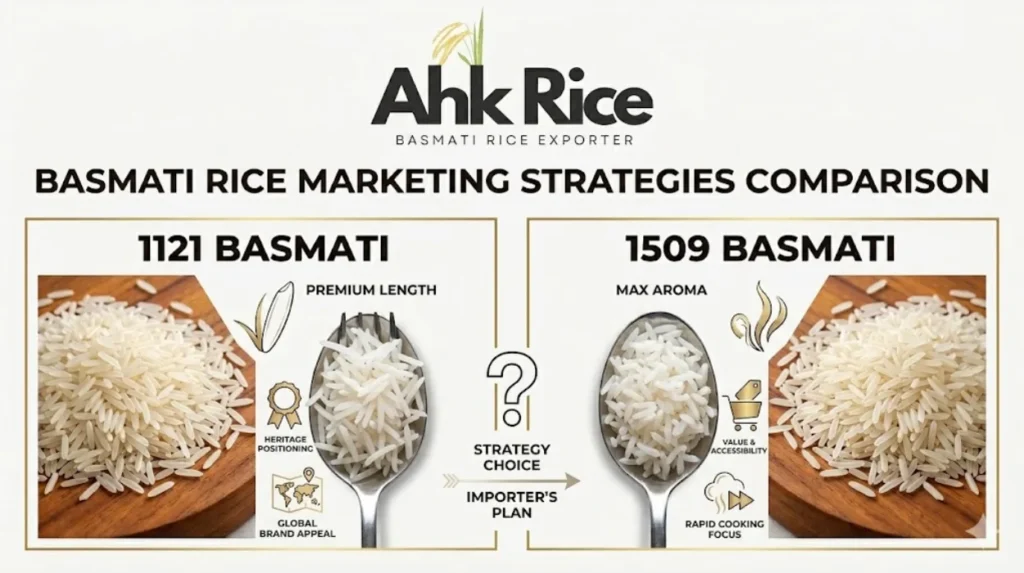
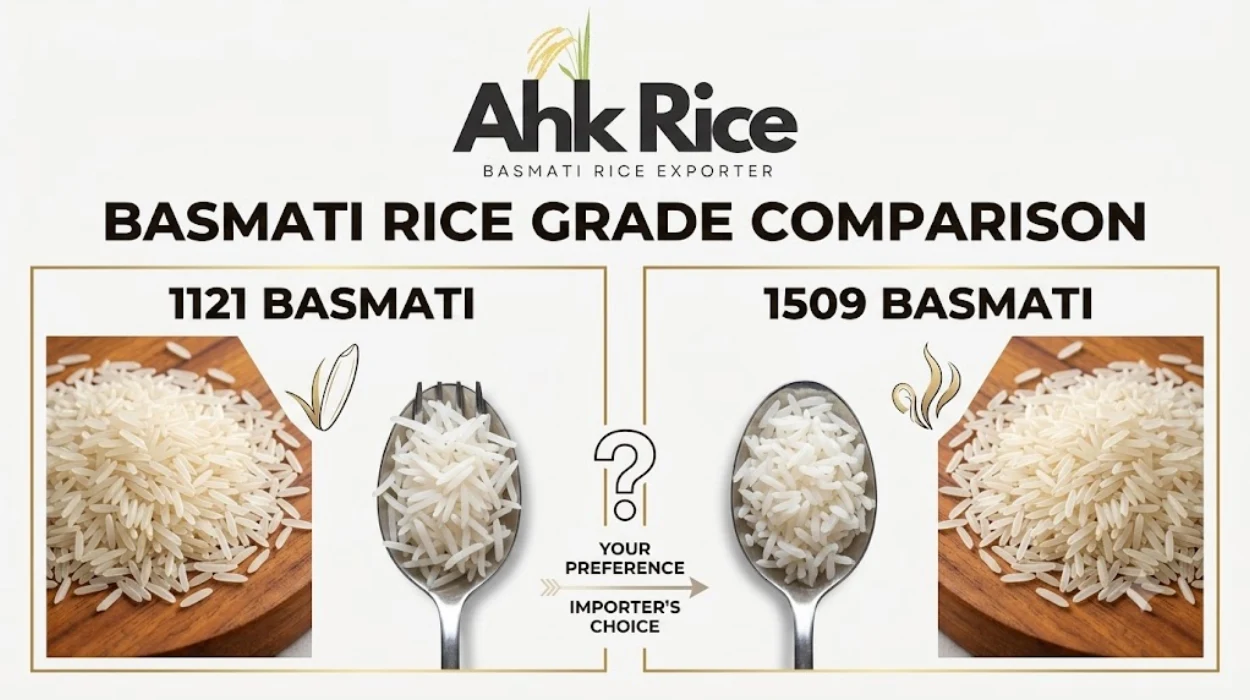
1121 Basmati delivers superior grain elongation at 8.3–8.5 mm after cooking, while 1509 Basmati provides stronger yield recovery at 67–70% milling efficiency, making 1121 premium and 1509 commercially scalable.
Specification comparison table (7 attributes)
| Attribute | 1121 Basmati | 1509 Basmati |
|---|---|---|
| Grain length (raw) | 8.30–8.40 mm | 7.10–7.30 mm |
| Aroma intensity | High natural fragrance | Moderate aroma profile |
| Milling recovery | 62–65% | 67–70% |
| Cooking elongation | High elongation (2x+) | Medium elongation (1.5x–1.8x) |
| Market positioning | Premium retail & hospitality | Bulk institutional trade |
| Price stability | Moderate volatility | High stability |
| Export demand | EU, GCC premium stores | Africa, GCC bulk supply chains |
Processing difference
1121 processing involves fine polishing and strict grading. It is milled, sorted, and length-calibrated.
1509 processing emphasizes throughput efficiency. It is parboiled, dried, and bulk sorted for export readiness.
Quality perception difference
1121 is perceived as luxury basmati in retail shelves. 1509 is perceived as functional procurement rice for volume buyers.
With technical comparison established, the next step is mapping how each grade performs across major importing regions.
Which method works best for different cases?
1121 Basmati performs best in premium retail, fine dining, and branded packaging markets, while 1509 Basmati performs best in bulk procurement, food service contracts, and price-sensitive institutional supply chains.
GCC & Middle East market preference
GCC importers prioritize aroma consistency and visual grain uniformity.
1121 dominates premium retail shelves in UAE and Saudi Arabia due to fragrance intensity and elongation stability.
1509 dominates catering contracts in UAE labor camps and institutional kitchens due to cost efficiency.
Europe & UK market preference
European importers prioritize packaging compliance and premium branding.
1121 leads organic and specialty retail segments in UK and Germany.
1509 is used in ethnic wholesale channels and price-driven supermarket private labels.
Price per MT comparison
| Region | 1121 Basmati (USD/MT) | 1509 Basmati (USD/MT) |
|---|---|---|
| GCC | 1,150–1,350 | 850–1,000 |
| Europe | 1,300–1,600 | 900–1,100 |
Shelf life comparison
| Storage condition | 1121 Basmati | 1509 Basmati |
|---|---|---|
| 30–35°C warehouse | 12–15 months | 14–18 months |
| Climate-controlled storage | 18–24 months | 20–24 months |
1121 lasts longer in controlled environments due to polishing stability. 1509 maintains structure longer in bulk storage due to parboiling resilience.
Bridge: With regional performance defined, the next step is evaluating practical pros and cons for procurement planning.
Pros and cons
1121 Basmati provides superior aroma, longer grain elongation, and premium retail positioning, while 1509 Basmati provides higher yield recovery, lower procurement cost, and stronger bulk storage performance.
1121 Basmati advantages
Aroma retention enhances premium brand value in retail packaging. Grain elongation improves plating presentation in restaurants. Market demand increases resale value in GCC and EU retail chains.
1121 Basmati limitations
Price volatility increases procurement risk in large contracts. Lower milling recovery reduces export volume per ton. Sensitive grading requires stricter inspection and certification.
1509 Basmati advantages
High milling recovery improves export profitability per container. Stable pricing reduces procurement fluctuations for buyers. Parboiled structure improves warehouse durability in hot climates.
1509 Basmati limitations
Moderate aroma reduces premium retail positioning. Shorter grain elongation limits fine dining appeal. Lower branding value in luxury supermarket segments.
Decision factors
Import decisions depend on end-market positioning, storage environment, budget allocation, contract duration, and target customer segmentation across retail or institutional channels.
Market positioning factor
Premium retail requires 1121 for aroma-driven branding.
Bulk procurement requires 1509 for cost optimization.
Storage environment factor
Hot warehouse environments favor parboiled 1509 stability.
Controlled environments support 1121 premium preservation.
Budget allocation factor
High-budget procurement supports 1121 branding strategies.
Low-margin procurement requires 1509 efficiency scaling.
Contract duration factor
Long-term contracts favor 1509 price stability.
Short-term seasonal contracts often use 1121 premium cycles.
Customer segmentation factor
Retail consumers demand 1121 sensory experience. Institutional buyers prioritize 1509 functional yield.
Decision framework for importers
| Factor | 1121 Basmati | 1509 Basmati | Recommendation |
|---|---|---|---|
| End-use market | Premium retail | Institutional bulk | Match to buyer type |
| Price sensitivity | Medium | High | Choose 1509 if cost-driven |
| Aroma requirement | High | Medium | Choose 1121 if branding-led |
| Storage condition | Controlled | Non-controlled | Choose 1509 for hot regions |
| Export strategy | Luxury positioning | Volume trade | Align with contract scale |
Connection map: grading to export outcome
1121 Basmati connects to aroma intensity, elongation index, and retail branding value.
1509 Basmati connects to yield recovery, parboiling stability, and bulk logistics efficiency.
Both grades connect to milling processes, grading systems, and export compliance frameworks.
AHK Rice integrates these variables through standardized sorting, polishing, and export dispatch systems.
1121 Basmati defines premium positioning and sensory-driven demand. 1509 Basmati defines cost-efficient volume supply and operational stability.Importers choose based on market type, not superiority. Each grade serves a distinct export logic.
Frequently Asked Questions
Which is better for export, 1121 or 1509?
1121 Basmati is better for premium retail export. 1509 Basmati is better for bulk institutional export.
Why is 1121 Basmati more expensive?
1121 Basmati has lower yield recovery, higher aroma retention, and stronger retail demand.
Does 1509 Basmati have good aroma?
1509 Basmati has moderate aroma due to parboiling, but it is not as strong as 1121.
Which rice lasts longer in storage?
1509 Basmati lasts longer in hot storage due to parboiling structure stability.
Which grade is used in hotels?
Hotels use 1121 for premium dining and 1509 for large-scale catering operations.