Why European Buyers Prefer Super Kernel Basmati Rice
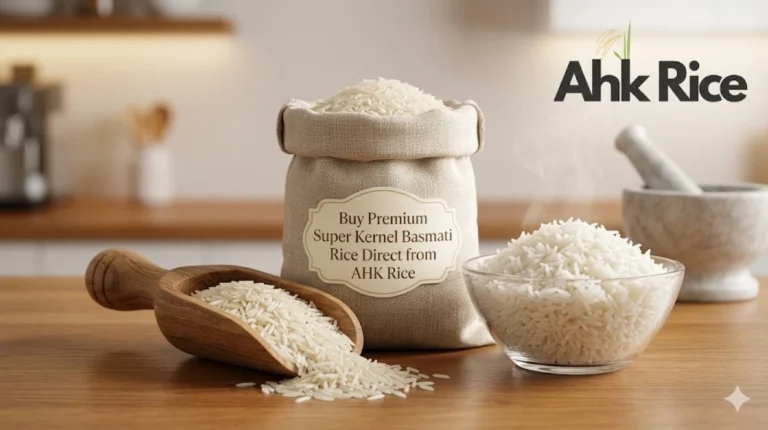
Super Kernel Basmati Rice is preferred by European buyers because it delivers consistent grain length, low stickiness, and export-grade aroma stability. Here is why: European import standards prioritize uniform kernel elongation, controlled moisture levels, and non-sticky cooking performance, all of which Super Kernel Basmati consistently delivers through advanced milling, grading, and polishing systems.
European buyers select Super Kernel Basmati Rice because procurement decisions depend on repeatable cooking quality across retail, foodservice, and private-label supply chains. Buyers reduce risk by choosing varieties with stable specification tolerance.
Understanding this preference requires production knowledge. Read the full cultivation and processing system in the TOFU guide How Super Kernel Basmati Rice Is Produced in Pakistan, which explains field-to-export transformation in detail.
Super Kernel Basmati sits in the premium aromatic rice category supplied by AHK Rice, a Pakistani exporter based in Punjab supplying 1121, Super Kernel, and 1509 varieties to 15+ countries. This category competes directly in Europe against Indian 1121 Basmati and Thai Jasmine substitutes in retail and catering segments.
What are the available solutions?
European buyers evaluate Super Kernel Basmati Rice through three main procurement solutions: origin sourcing, grade selection, and processing type selection. These solutions define grain performance, price stability, and shipment reliability, where Super Kernel Basmati becomes the balanced option between premium aroma and export consistency.
European procurement systems do not rely on a single product type. They combine multiple sourcing and grading strategies depending on end-use.
Origin sourcing determines aroma intensity and grain behavior. Pakistani Super Kernel Basmati delivers longer grain elongation compared to short-grain alternatives. Indian basmati alternatives compete in similar aromatic categories but vary in moisture stability.
Grade selection defines broken percentage and purity level. Lower broken ratios improve visual presentation in retail packaging.
Processing type defines cooking behavior. Parboiled (Sella) rice maintains structure under high heat, while steam-processed rice preserves softer texture for household consumption.
Core solution categories
- Origin sourcing selection
- Grade purity selection
- Processing method selection
- Packaging specification selection
- Contract supply structure selection
AHK Rice supplies all three processing types under export specifications, ensuring flexibility across European import requirements.
Bridge: With solution types defined, the next step is understanding how these approaches perform when directly compared in export markets.
How do different approaches compare?
Super Kernel Basmati performs differently across processing methods, grades, and origin sources, with parboiled variants delivering highest export stability, steam variants delivering softer cooking texture, and raw variants delivering fastest cooking but lower shelf stability for European distribution systems.
European buyers compare rice using measurable specifications rather than branding. This creates structured evaluation frameworks.
Specification comparison table (7 attributes)
| Attribute | Super Kernel Steam | Super Kernel Sella | Super Kernel Raw |
|---|---|---|---|
| Grain length after cooking | High elongation | Very high elongation | Moderate elongation |
| Stickiness level | Low | Very low | Medium |
| Shelf stability | 12–14 months | 18–24 months | 10–12 months |
| Aroma retention | High | High + stable | Medium |
| Broken ratio | 2–5% | 1–3% | 3–6% |
| Export handling | Standard containers | High-heat resistant logistics | Fast turnover required |
| Market preference | Retail households | Foodservice + retail hybrid | Local quick markets |
Parboiled Sella dominates export logistics because heat treatment stabilizes starch structure.
Steam rice dominates premium retail shelves because it maintains softer texture.
Raw rice remains limited to price-sensitive buyers due to shorter shelf life.
European buyers prioritize stability under mixed storage conditions, especially during summer shipping cycles exceeding 30°C container temperatures.
AHK Rice processes Super Kernel batches using graded milling, dehusking, polishing, and color sorting systems to maintain uniform export specs.
Bridge: With comparison established, the next question is which method works best in specific market scenarios.
Which method works best for different cases?
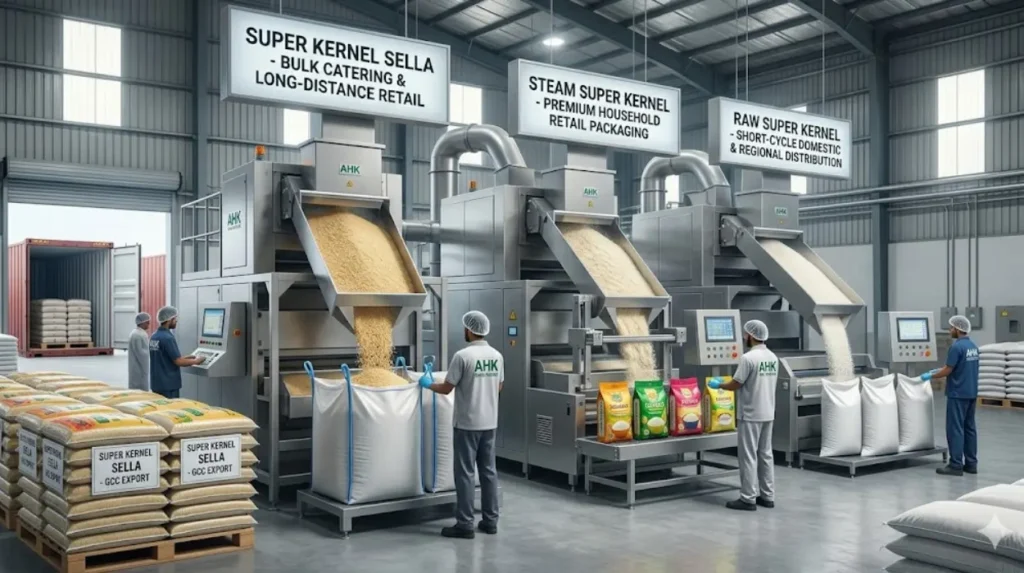
Super Kernel Sella works best for European catering and long-distance retail supply chains, Steam works best for premium household retail packaging, and Raw works best for short-cycle domestic or regional distribution where storage duration remains under 12 months.
European importers operate multiple channels. Each channel requires different rice behavior.
Super Kernel Sella supports bulk catering because it retains structure during boiling cycles above 100°C. It performs consistently in hotel kitchens and institutional foodservice.
Steam Super Kernel supports retail branding because it delivers softer texture preferred in household cooking environments. It performs well in small-pack supermarket SKUs.
Raw Super Kernel supports price-sensitive contracts because it avoids parboiling costs. It performs best in fast-turnover wholesale markets.
Market region preference breakdown
Europe
- Preferred grade: Steam + Sella hybrid supply
- Average price per MT: $980–$1,250
- Shelf life expectation: 12–18 months
- Main drivers: Retail consistency, branding, EU labeling compliance
Middle East (GCC)
- Preferred grade: Sella dominant supply
- Average price per MT: $850–$1,100
- Shelf life expectation: 18–24 months
- Main drivers: Catering demand, high-temperature storage resilience
GCC buyers prioritize heat resistance due to non-climate-controlled warehouses.
European buyers prioritize cooking uniformity due to packaged retail competition.
AHK Rice aligns both markets through graded export segmentation and container-specific loading protocols.
Bridge: With market-specific applications defined, the next step is evaluating strengths and weaknesses of each method.
Pros and cons (with examples)
Super Kernel Basmati strengths include high grain elongation, export stability, and aroma retention, while limitations include higher processing cost for Sella and lower texture flexibility in Raw variants under long cooking cycles.
Every rice processing method creates trade-offs in export performance.
Super Kernel Sella
Pros
- Structural stability under heat cooking conditions
- Extended shelf life in humid climates
- Low breakage during transport handling
Cons
- Higher processing cost due to parboiling stages
- Slightly firmer texture compared to Steam variants
Example: In UAE catering kitchens operating at 40°C storage conditions, Sella maintains quality for 18 months, while Steam requires 12-month turnover cycles.
Super Kernel Steam
Pros
- Soft texture preferred in European households
- Strong aroma retention in sealed packaging
- Premium shelf presentation in retail stores
Cons
- Lower stability in high-heat logistics
- Shorter shelf life in non-climate storage
Example: In German retail supermarkets, Steam Super Kernel maintains strong branding appeal but requires faster stock rotation.
Super Kernel Raw
Pros
- Lowest processing cost
- Faster cooking cycles
- Competitive wholesale pricing
Cons
- Reduced shelf life stability
- Higher variation in grain expansion
Example: In local Balkan wholesale markets, Raw Super Kernel is used for price-driven distribution but not premium branding.
AHK Rice reduces variation through multi-stage grading and polishing systems before export dispatch.
Bridge: With advantages and limitations understood, the final step is identifying decision factors that guide buyer selection.
Decision factors
European buyers select Super Kernel Basmati based on five decision factors: storage environment, end-use channel, budget per MT, packaging format, and required shelf life, where Sella dominates logistics-heavy contracts and Steam dominates branding-heavy retail contracts.
Procurement decisions rely on measurable operational constraints rather than taste alone.
Decision framework table (5 rows)
| Factor | Sella Choice | Steam Choice | Raw Choice | Impact |
|---|---|---|---|---|
| Storage temperature | High tolerance | Medium tolerance | Low tolerance | Shelf stability |
| End-use channel | Catering systems | Retail branding | Wholesale trade | Market fit |
| Budget level | Mid-range | Premium | Low-cost | Profit margin |
| Packaging size | 10–50 kg bags | 1–5 kg retail packs | Bulk sacks | Distribution model |
| Supply cycle | Long cycle (12–18 months) | Medium cycle (8–12 months) | Short cycle (<10 months) | Inventory turnover |
European importers reduce risk by aligning all five factors before contract finalization.
Super Kernel Sella becomes dominant when logistics uncertainty increases.
Steam becomes dominant when brand differentiation is the goal.
Raw becomes dominant when pricing pressure is extreme.
AHK Rice structures export contracts using these decision parameters to match buyer specifications across 15+ countries.
Conclusion and content placement guidance
Super Kernel Basmati Rice preference in Europe is driven by measurable stability, grading precision, and processing selection aligned with supply chain risk control. Sella dominates logistics-heavy systems, Steam dominates retail branding systems, and Raw dominates cost-sensitive systems.
Frequently Asked Questions
Why do European buyers prefer Super Kernel Basmati Rice?
European buyers prefer Super Kernel Basmati Rice because it offers consistent grain length, low stickiness, and stable aroma after cooking. These qualities ensure reliable performance across retail and foodservice supply chains.
What makes Super Kernel Basmati suitable for export markets?
Its controlled moisture content, uniform grain grading, and strong elongation after cooking make it suitable for long-distance export. These factors reduce quality variation during shipping and storage.
Which processing type of Super Kernel Basmati is most used in Europe?
Sella (parboiled) is widely used for catering and bulk supply due to its heat resistance, while Steam is preferred for retail packaging because of its softer texture and strong aroma retention.
How does Super Kernel Basmati maintain consistent quality?
Consistency is maintained through advanced milling, polishing, grading, and color sorting systems. These processes ensure low broken percentage and uniform grain appearance.
Is Super Kernel Basmati better than other basmati varieties for Europe?
It is often preferred for its balance of price, cooking stability, and export reliability. While other basmati varieties compete in aroma, Super Kernel stands out for consistency in large-scale supply chains.