Global Rice Supply Changes Impact International Trade
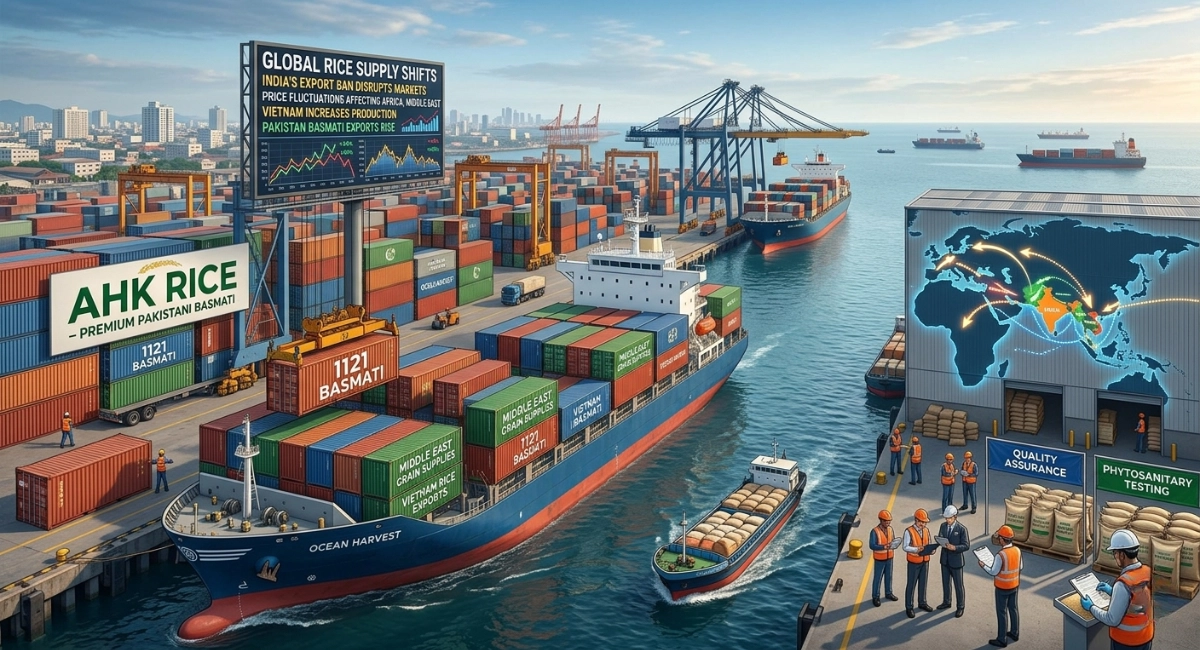
Global rice supply changes impact international trade by altering grain distribution metrics, changing baseline cross-border pricing, and shifting import volumes across sovereign nations. Rice is a primary agricultural commodity and a staple food source for greater than 3,500,000,000 people across multiple continents, including Asia, Africa, and Europe. When major producing nations modify production volumes, the global logistics network, commercial supply chains, and food security frameworks adjust immediately.
What is the Global Rice Supply Chain?
The global rice supply chain is an international network of agricultural producers, processing facilities, export companies, shipping vectors, and sovereign import markets that collective move milled grains across borders. This interconnected trade system converts raw paddy fields into standardized commercial food products for global consumers.
The system relies entirely on specific geographic production hubs that generate export surpluses. Pakistan, India, Thailand, Vietnam, and the United States serve as the primary nodes for global grain distribution. When weather patterns fluctuate, or national trade policies change, the total volume of rice available for maritime transit shifts. This affects the food reserves of purchasing nations.
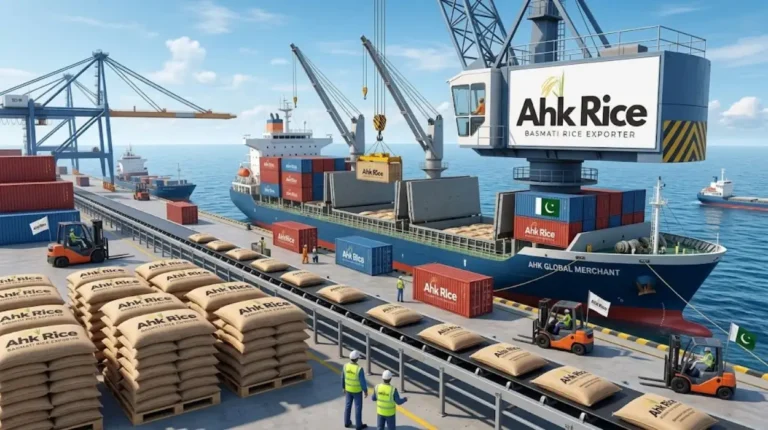
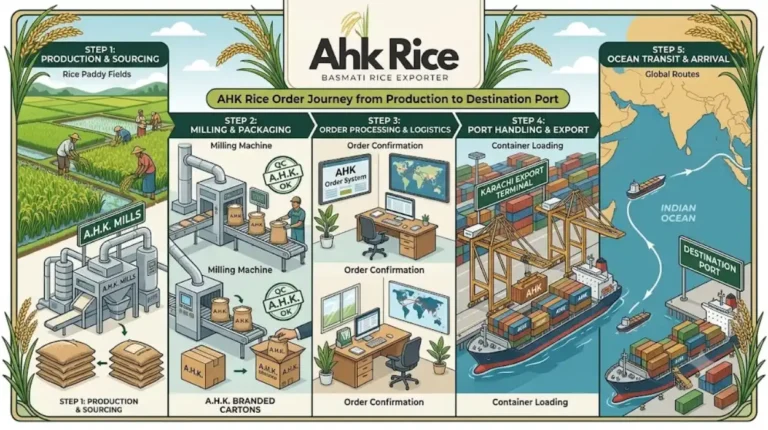
Sovereign purchasing nations use specific transaction mechanisms to secure shipments. These mechanisms include government-to-government contracts, open private tenders, and long-term business-to-business supply agreements. The physical supply chain contains distinct milestones, including cultivation, regional aggregation, milling, sorting, packaging, and containerized ocean shipping.
How Does International Rice Processing Work?
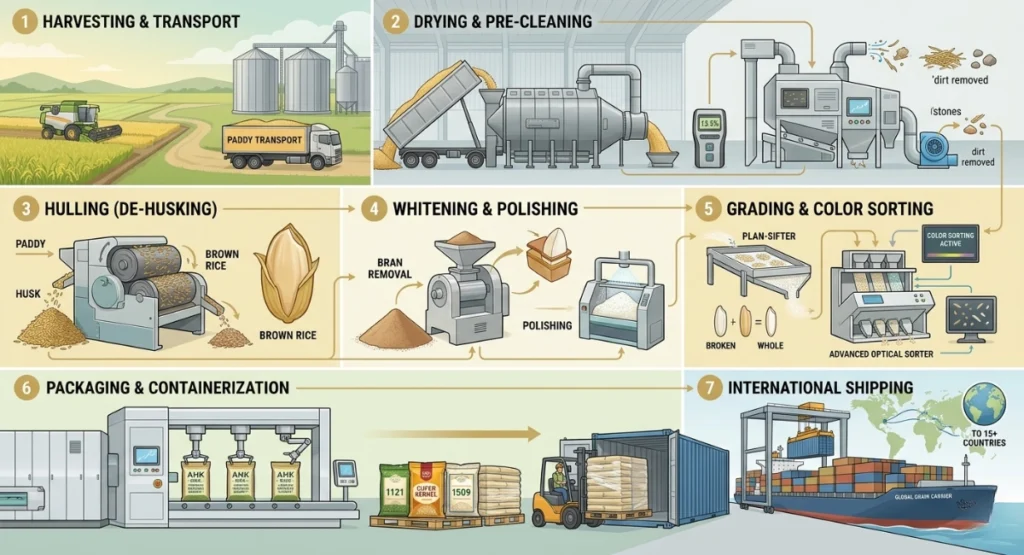
International rice processing functions through a series of sequential mechanical stages that transform raw, moisture-heavy paddy grains into shelf-stable, polished, and standardized white or parboiled rice. The entire industrial procedure uses specialized machinery to eliminate impurities and standardize quality.
1. Pre-Cleaning and De-Husking
Raw paddy arrives from agricultural fields with a moisture content of approximately 20% to 24%. Industrial mechanical dryers lower this moisture content to a stable level of 12% to 14% to prevent microbial spoilage. After drying, multi-stage pre-cleaners use aspiration networks and vibratory sieves to remove external objects, such as soil particles, stones, and straw elements. The clean paddy then enters a rubber-roll hulling machine. This specific apparatus applies shear force to remove the protective outer husk, yielding unpolished brown rice.
2. Whitening and Polishing
The brown rice passes into abrasive whitening machines. These units use structured emery rollers to remove the nutrient-rich bran layer through precise friction. This process exposes the starch endosperm. Next, friction-based polishing machines use fine water mists to buff the exterior of the grain. This step eliminates remaining dust particles and creates a smooth surface. This smooth surface prevents fatty acid oxidation during long maritime shipping transits.
3. Grading and Color Sorting
The polished rice moves to plan-sifters, which separate whole grains from broken pieces based on length criteria. The grains then pass through digital monochrome or trichromatic optical color sorters. These advanced sorting systems use high-speed charge-coupled device cameras to scan individual grains. The machines use compressed air valves to eject discolored items, peck grains, and chalky kernels. This automated step ensures structural and visual consistency across the entire batch.
4. Packaging and Containerization
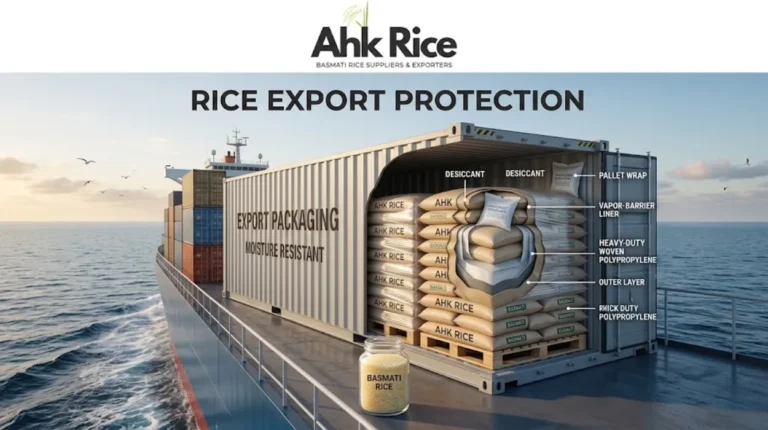
The fully sorted grains flow into automated bagging stations equipped with digital load cells. Workers package the product into specified materials, such as polypropylene bags, jute sacks, or multi-layer laminate pouches. Every single package receives a tracking code detailing the batch number, processing date, and mill origin. Automated systems load the completed bags onto wooden pallets, wrap them in protective stretch film, and secure them inside standard 20-foot shipping containers.
What are the Key Components of the Rice Export Industry?
The key components of the rice export industry include distinct grain varieties, specific processing configurations, standardized milling grades, and defined quality classifications. These variables determine the economic value of agricultural shipments in international markets.
Cultivar Varieties
The market recognizes several main long-grain aromatic and non-aromatic varieties. These include 1121 Basmati, Super Kernel Basmati, 1509 Basmati, and coarse varieties like IRRI-6. Each cultivar possesses distinct structural dimensions, elongation ratios, and natural aroma profiles.
Processing Configurations
Exporters process grains into three main formats:
- White Rice: Husk, bran, and germ are completely removed during mechanical milling.
- Brown Rice: Only the outer husk is stripped, leaving the nutrient-dense bran layer intact.
- Parboiled Rice: Raw paddy is soaked, steamed, and vacuum-dried before milling, which gelatinizes the starch and locks nutrients inside the core.
Standardized Milling Grades
Wholesale markets classify shipments using exact percentages of broken grains. Standard trade classifications include 5% broken white rice, 10% broken white rice, 25% broken white rice, and 100% broken broken fragments (foster grains). Lower broken percentages yield higher market prices.
What are the Benefits of Standardized Rice Exports?
The benefits of standardized rice exports include absolute predictability in culinary performance, reduced product loss during transit, and verified safety alignment with destination food laws. Standardization ensures that bulk shipments remain uniform across separate production years.
Predictable Culinary Behavior
Standardized milling variables ensure that grains respond uniformly to heat and water during industrial cooking. For example, high-grade 1121 Basmati consistently elongates to greater than 19 millimeters when cooked. This structural predictability allows commercial kitchens, packaging companies, and restaurants to maintain consistent dish quality.
Protection Against Spoilage
Strict moisture management prevents the growth of hazardous molds, such as Aspergillus flavus, which produces dangerous aflatoxins. Keeping grain moisture levels below 14% prevents internal heat generation and grain clumping inside shipping containers during long ocean transits.
Streamlined Customs Clearances
Pre-shipment testing and standard grade declarations allow border agents to process imports quickly. Clear paperwork reduces cargo inspection times at major international entry ports. This protects exporters from expensive port storage fees and demurrage charges.
What are the Main Use Cases for Imported Rice?
The main use cases for imported rice include direct retail distribution, industrial food manufacturing, state-sponsored food security reserves, and hospitality operations. Each distinct destination sector requires specific grain characteristics and packaging types.
Direct Retail Distribution
Supermarket chains and grocery stores buy pre-packaged rice under private labels or exporter brands for household consumption. Consumers purchase specific formats, such as 1-kilogram pouches or 5-kilogram handle bags, based on regional preferences.
Industrial Food Manufacturing
Processing companies use specific grades of rice to create secondary products. Examples include baby food formulas, rice flour, puffed snacks, and ready-to-eat microwave meals. These applications require strict chemical purity and consistent starch properties.
State-Sponsored Food Reserves
National grain boards purchase large bulk shipments to maintain statutory food reserves. Governments release these stocks during internal market shortfalls or high inflation periods to stabilize domestic food prices.
What are the Common Misconceptions About the Rice Trade?
The common misconceptions about the rice trade include the belief that all long-grain rice is Basmati, that broken grains represent a useless waste product, and that plastic rice exists in commercial supply chains. These factual errors confuse market analysis and distort product valuation.
Misconception 1: All Long-Grain Grains are Basmati
Many consumers mistake any long-grain white rice for authentic Basmati. True Basmati is a specific geographic entity restricted to the fertile Punjab region of Pakistan and India. It requires specific soil profiles and cold Himalayan meltwater to develop its unique aroma and elongation traits. Non-Basmati long grains lack these specific genetic properties.
Misconception 2: Broken Grains are Waste Products
Traders do not throw away broken grains from the milling process. Broken rice is a valuable commodity used in starch manufacturing, pet food production, and brewing industries. Countries in certain regions, such as West Africa, deliberately import 100% broken rice for traditional regional dishes.
Misconception 3: Commercial Supplies Contain Plastic Rice
The rumor that factories manufacture plastic rice and mix it into real grain shipments is physically impossible. Plastic melts under direct heat and behaves differently than natural grain starch. Rice has a low profit margin per kilogram, making the chemical synthesis, molding, and texturing of fake plastic grains economically unviable.
Which International Markets Import Rice?
The international markets that import rice include geographic regions with structural water deficits, high population densities, or specific culinary traditions. Global trade statistics track these shifting volumes across distinct economic zones.
Sovereign import nations enforce detailed health and phytosanitary rules. For example, European Union ports require chemical analysis certificates showing that tricyclazole and pesticide residues fall below established maximum residue limits (MRLs).
What Certifications Control the International Rice Trade?
The certifications controlling the international rice trade are mandatory quality management systems, food safety protocols, and phytosanitary verifications issued by authorized third-party groups. These credentials prove that an export shipment complies with international laws.
- ISO 22000: Verifies that a mill runs a complete food safety management system across its entire processing line.
- HACCP: Identifies and controls potential biological, chemical, and physical hazards during milling and packaging.
- Phytosanitary Certificate: Issued by national quarantine departments to certify that the grain is free from live insects and dangerous plant diseases.
- Halal Certification: Confirms that processing steps, facility cleaning materials, and packaging components comply with Islamic dietary laws.